Have you ever stopped while writing a sentence and wondered, “Should I use who’s or whose?” You are not alone. These two words sound almost identical, but they have completely different grammatical jobs.
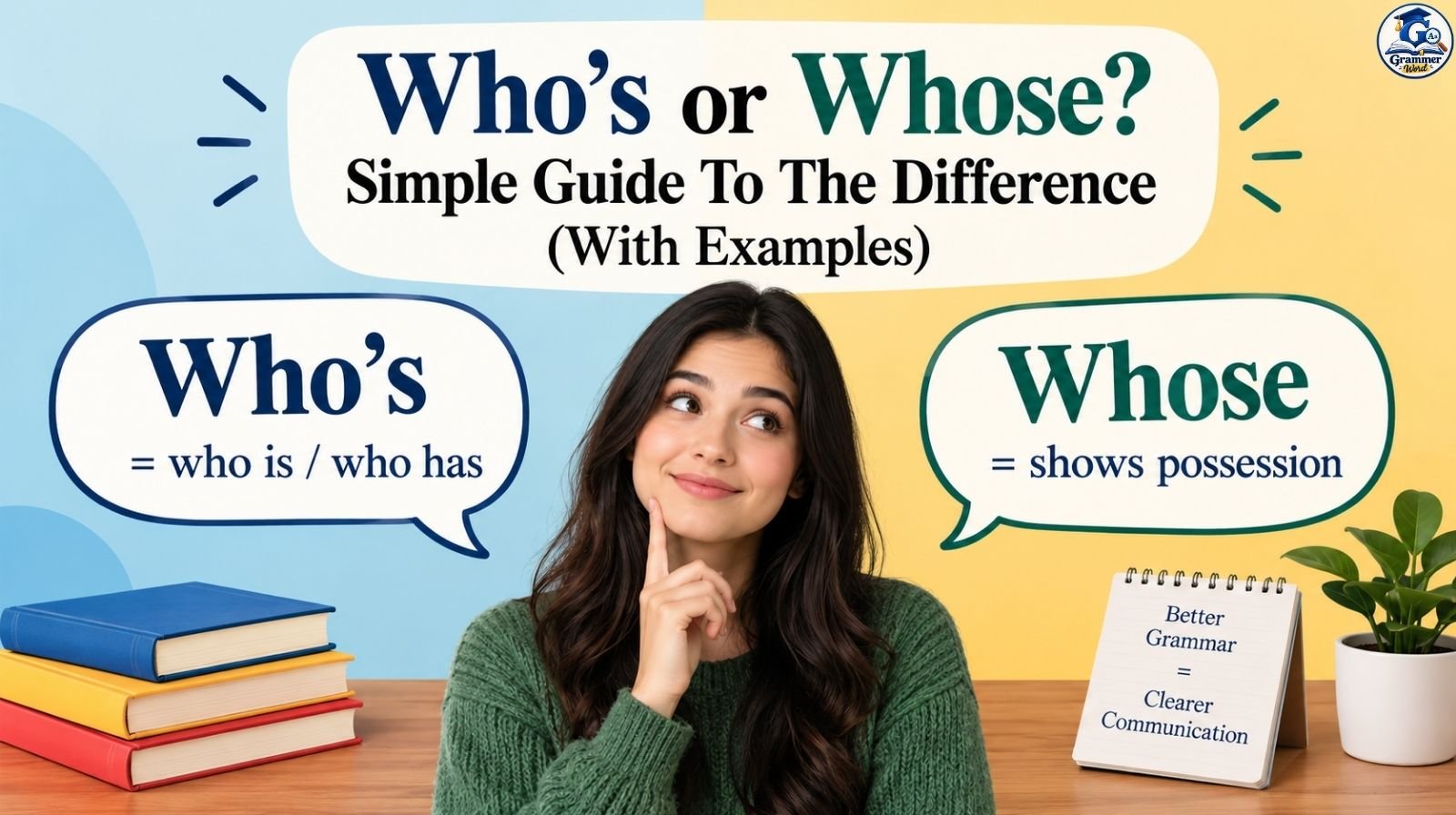
The basic rule is simple: who’s is a contraction of “who is” or “who has,” while whose is used to show possession or ask who something belongs to. Cambridge Dictionary confirms these distinct uses, including who’s as a short form of “who is” or “who has” and whose for possession.
For example:
- Who’s coming to the party? → Who is coming?
- Whose jacket is this? → Who does this jacket belong to?
Once you learn one quick substitution test, choosing between who’s or whose becomes much easier.
What Is the Difference Between Who’s and Whose?
The main difference is that who’s contains an apostrophe because it is a contraction, whereas whose is a possessive word and does not contain an apostrophe.
Who’s Means “Who Is” or “Who Has”
Who’s is a shortened form of either:
- who is
- who has
For example:
Who’s at the door?
= Who is at the door?
Or:
Who’s finished the assignment?
= Who has finished the assignment?
Cambridge Dictionary lists both “who is” and “who has” as meanings of who’s.
Whose Shows Possession
Whose is used when you are talking about ownership, possession, connection, or responsibility.
Examples:
- Whose phone is ringing?
- Whose bag is on the chair?
- Whose idea was this?
- Whose car are we taking?
In each case, whose essentially asks, “Who does this belong to?” Cambridge Dictionary describes whose as a word used to ask who something belongs to or who someone or something is connected with.
Who’s or Whose: The Easiest Rule to Remember
If you only remember one trick from this article, remember this:
Read More: Theater or Theatre: Which Spelling Is Correct?
Replace Who’s With “Who Is” or “Who Has”
When you see who’s, expand it.
If the sentence still makes sense with who is or who has, then who’s is correct.
Example:
Who’s your teacher?
Replace it:
Who is your teacher?
That works, so who’s is correct.
Another example:
Who’s taken my pen?
Replace it:
Who has taken my pen?
Again, it works.
Use Whose When Something Belongs to Someone
If the sentence asks about ownership or possession, use whose.
Whose pen is this?
You are asking:
Who does this pen belong to?
Therefore, whose is correct.
This distinction also appears in Purdue OWL’s treatment of pronoun case: whose is identified as a possessive form, while apostrophes can indicate contractions such as who’s = who is.
Who’s or Whose Examples You Can Use in Everyday English
Seeing the words in realistic sentences makes the difference much easier to remember.
Examples of Who’s
Here are several examples where who’s means who is:
- Who’s waiting outside?
- Who’s your new manager?
- Do you know who’s coming tonight?
- Who’s responsible for this project?
- Who’s ready to leave?
- I wonder who’s calling me.
Try expanding the contraction:
Who’s ready to leave?
Who is ready to leave?
The sentence works perfectly.
Who’s can also mean who has:
Who’s already finished the work?
= Who has already finished the work?
Read More: Laid Off or Layed Off: Which One Is Correct?
Examples of Whose
Use whose when talking about possession:
- Whose book is this?
- Whose keys are on the table?
- Do you know whose car that is?
- Whose responsibility is it?
- Whose idea was it?
- I don’t know whose phone this is.
Cambridge gives examples such as “Whose is this bag?” and “Whose bag is this?”, both of which ask about ownership.
Who’s vs. Whose Comparison Table
| Word | Meaning | Main Use | Example |
|---|---|---|---|
| Who’s | Who is | Contraction | Who’s coming with us? |
| Who’s | Who has | Contraction | Who’s finished the task? |
| Whose | Belonging to whom | Possession | Whose jacket is this? |
| Whose | Connected with whom | Relationship/connection | The student whose laptop broke went home. |
A Quick Test for Who’s or Whose
Use this three-step method:
Step 1: Look at who’s.
Step 2: Replace it with who is or who has.
Step 3: If the sentence makes sense, use who’s. If it does not, ask whether you are showing possession. If you are, use whose.
For example:
Who’s phone is this?
Replace who’s with who is:
Who is phone is this?
That does not work.
The sentence is asking about ownership, so the correct version is:
Whose phone is this?
Read More: Discrete vs Discreet: Which One Should You Use?
How to Use Whose in Questions and Relative Clauses
One reason whose can be confusing is that it does more than simply ask questions about ownership.
Whose in Questions
The most familiar use is asking who owns something.
Examples:
Whose laptop is this?
Whose shoes are by the door?
Whose turn is it?
Whose idea was this?
Here, whose comes before a noun in many common constructions.
You can also use it by itself:
Whose is this?
The meaning is essentially “Who does this belong to?”
Cambridge Dictionary explains that whose can function as a question word and can also introduce relative clauses.
Whose in Relative Clauses
Whose can also connect additional information to a person, animal, or, in appropriate contexts, a thing.
For example:
I met a woman whose son is a doctor.
Here, whose son means the woman’s son.
Another example:
We visited a house whose roof was damaged.
Here, whose roof means the roof of the house.
Purdue OWL notes that whose is the possessive relative pronoun and can refer to people and things. Cambridge likewise explains that whose can introduce relative clauses indicating possession.
Read More: Anyway or Anyways: Which One Is Correct?
Common Who’s and Whose Mistakes
Because who’s and whose sound alike, writers sometimes substitute one for the other.
Mistake: “Who’s Book Is This?”
❌ Who’s book is this?
This is incorrect because who’s cannot mean “belonging to whom.”
The correct sentence is:
✅ Whose book is this?
You can remember it by asking:
Who does the book belong to?
The answer requires whose.
Purdue OWL specifically gives “Who’s dog is this?” as incorrect and “Whose dog is this?” as correct.
Mistake: “Whose Coming With Us?”
❌ Whose coming with us?
Here, there is no idea of possession. You mean:
Who is coming with us?
Therefore:
✅ Who’s coming with us?
Mistake: “I Know Whose Responsible”
❌ I know whose responsible.
If you mean “I know who is responsible,” then:
✅ I know who’s responsible.
However, whose would be correct if a noun followed it in a possessive construction:
I know whose responsibility this is.
The difference becomes much clearer when you stop relying on pronunciation and check the grammatical meaning.
Who’s or Whose in Professional and Academic Writing
Choosing the correct form matters in emails, reports, essays, websites, applications, and other forms of written communication.
Read More: Skillset or Skill Set: Which Term Is Correct In Modern English?
Why Small Grammar Errors Matter
A single incorrect word can change the meaning of a sentence or make the reader pause to interpret what you intended.
This is especially relevant because written communication remains a major part of professional work. Grammarly’s 2025 Productivity Shift report surveyed thousands of workers and business leaders and analyzed tens of thousands of communication data points.
It describes communication overload and reports that businesses lose an estimated $9,284 per worker annually due to poor communication.
That figure is not specifically about who’s/whose errors, so it should not be interpreted as evidence that these two words independently cause such losses. Instead, it illustrates the broader importance of clear written communication.
Case Study: Indeed and Clearer Workplace Writing
A useful real-world example comes from Indeed, which Grammarly profiled in a January 2025 case study. Indeed has almost 11,000 employees and operates across multiple regions, creating communication challenges for a large and diverse workforce.
The case study reports that some employees, particularly non-native English speakers, experienced lower writing confidence and spent substantial time revising their communications.
After Grammarly was integrated into the workflow, the case study reports that 72% of written communications were improved through Grammarly suggestions, while users saved an average of 43 minutes per person.
The reported result was not simply about correcting spelling; the system was used to improve clarity, tone, and consistency as well.
This example shows why seemingly small language choices can matter in real communication. A sentence such as “Who’s responsible for the report?” asks who has responsibility, while “Whose report is this?” asks who owns or is associated with the report.
Read More: Dreamt or Dreamed: Which One Is Correct?
The two sentences may look similar, but they request different information. In professional writing, making that distinction correctly helps readers understand the intended question immediately.
Read Grammarly’s 2025 workplace communication research
A Simple Step-by-Step Method to Choose Who’s or Whose
When you are unsure, use this quick checklist.
Step 1: Look for an Apostrophe
If the word is who’s, remember that the apostrophe indicates missing letters because it is a contraction.
Who’s = who is / who has
Step 2: Expand the Word
Try:
- who is
- who has
Example:
Who’s coming?
→ Who is coming?
Correct.
Step 3: Check for Possession
If “who is” or “who has” does not work, ask whether the sentence is about ownership, connection, or responsibility.
Example:
Whose coat is this?
→ Who does this coat belong to?
Correct: whose
Step 4: Check the Noun
Whose is frequently followed by a noun:
- whose car
- whose phone
- whose house
- whose idea
- whose book
- whose responsibility
For example:
Whose phone is ringing?
Read More: Fiancé or Fiancée: Understanding The Difference And Correct Usage
Step 5: Read the Complete Sentence
Finally, read the sentence aloud not just for pronunciation, but for meaning.
If you are asking who is doing something, you probably need who’s.
If you are asking who owns or is connected to something, you probably need whose.
Who’s vs. Whose: More Examples
Here are some pairs that make the difference especially clear.
Example Pair 1
❌ Who’s bag is on the desk?
✅ Whose bag is on the desk?
Why? The sentence asks who owns the bag.
Example Pair 2
❌ Whose going to answer the question?
✅ Who’s going to answer the question?
Why? Who’s = who is.
Example Pair 3
❌ I don’t know who’s phone this is.
✅ I don’t know whose phone this is.
Why? The sentence asks about ownership.
Example Pair 4
❌ Do you know whose coming to dinner?
✅ Do you know who’s coming to dinner?
Why? Who’s = who is.
Example Pair 5
The teacher whose class we attended was helpful.
Here, whose introduces a possessive relationship: the class belongs to or is associated with the teacher.
Example Pair 6
She’s the person who’s organizing the event.
Here, who’s = who is:
She’s the person who is organizing the event.
Read More: Freshman or Freshmen: Which One Is Correct?
Data and Writing in 2025–2026: Why Accuracy Still Matters
There is no reliable 2025–2026 statistic showing that a specific percentage of English writers confuse who’s and whose. It would be misleading to invent one.
However, current workplace communication research shows why clarity and correctness remain relevant. Grammarly’s 2025 research describes communication overload as a major workplace issue and reports that nearly 60% of leaders and 54% of workers struggle to keep up with notifications across multiple communication platforms.
The broader lesson is straightforward: when readers already process large amounts of written information, precise wording can reduce unnecessary ambiguity. Correctly choosing who’s or whose is one small but useful part of writing clearly.
For authoritative grammar guidance, resources such as Cambridge Dictionary and Purdue OWL provide established explanations of pronouns, contractions, and relative clauses.
Who’s or Whose? Mini Quiz
Test yourself with these 15 quick and easy questions. Pick the answer first, then check the answer underneath each one.
1. ___ coming to the party tonight?
A) Who’s
B) Whose
Answer: Who’s It means “Who is coming?”
2. ___ jacket is this?
A) Who’s
B) Whose
Answer: Whose It asks who the jacket belongs to.
3. Which sentence is correct?
A) Who’s phone is ringing?
B) Whose phone is ringing?
Answer: Whose phone is ringing? Whose shows possession.
4. “Who’s” can mean:
A) Who is
B) Who has
C) Both A and B
Answer: Both A and B Who’s can mean “who is” or “who has.”
5. ___ your new teacher?
A) Who’s
B) Whose
Answer: Who’s Who’s = Who is.
6. ___ keys are on the table?
A) Who’s
B) Whose
Answer: Whose The question asks who the keys belong to.
7. Choose the correct sentence.
A) I wonder whose coming with us.
B) I wonder who’s coming with us.
Answer: I wonder who’s coming with us. Who’s = who is.
8. “Whose” is mainly used to show:
A) Possession
B) Time
C) Action
Answer: Possession Whose tells us who something belongs to.
Read More: Any Time or Anytime: Which One Is Correct?
9. ___ already finished the assignment?
A) Who’s
B) Whose
Answer: Who’s Here, who’s = who has.
10. Which one is correct?
A) Whose car is that?
B) Who’s car is that?
Answer: Whose car is that? You are asking who owns the car.
11. Quick substitution: “Who’s ready?”
What can replace who’s?
A) Who is
B) Whose is
C) Who was
Answer: Who is “Who is ready?” makes sense.
12. ___ idea was it?
A) Who’s
B) Whose
Answer: Whose The sentence asks who the idea belongs to.
13. Which sentence uses “who’s” correctly?
A) Who’s bag is this?
B) Who’s waiting outside?
C) Whose waiting outside?
Answer: Who’s waiting outside? Who’s = who is.
14. Complete the sentence: “The student ___ laptop broke went home.”
A) who’s
B) whose
Answer: Whose Whose laptop shows possession.
15. Final challenge: Which sentence is completely correct?
A) Who’s book is on the desk?
B) Whose book is on the desk?
C) Whose coming to class?
D) Who’s shoes are these?
Answer: Whose book is on the desk? Whose is used because the question asks who the book belongs to.
Read More: Whoever or Whomever: A Complete Guide To Correct Usage
FAQs
Q1. Is “who’s” the same as “whose”?
No. Who’s is a contraction of who is or who has. Whose indicates possession or asks who something belongs to.
Q2. Is “whose” possessive?
Yes. Whose is used to express possession or a relationship to someone or something.
Whose book is this?
It means:
Who does this book belong to?
Q3. How do I know when to use who’s?
Replace who’s with who is or who has. If the sentence still makes sense, who’s is usually correct.
Who’s coming?
Who is coming? ✓
Q4. How do I know when to use whose?
Use whose when asking about ownership, possession, responsibility, or connection.
Whose car is that?
Q5. Can whose refer to things?
Yes. Although whose is commonly associated with people and animals, established grammar references also recognize its use with things, particularly in formal writing.
The company whose website we visited has expanded.
Cambridge and Purdue both document this use.
Q6. Can who’s mean “who has”?
Yes. Who’s can mean who has when used as a contraction.
Who’s finished the project?
Who has finished the project?
Conclusion:
The difference between who’s or whose is much easier once you focus on meaning instead of pronunciation.
Remember these two rules:
- Who’s = who is / who has
- Whose = possession or connection
So:
Who’s coming to the meeting?
= Who is coming?
But:
Whose laptop is on the desk?
= Who does the laptop belong to?
Whenever you are unsure, expand who’s to who is or who has. If that substitution does not work and the sentence is about ownership or connection, whose is the correct choice.
Master this simple test, and you will be able to use who’s and whose confidently in everyday conversations, academic writing, emails, and professional content. For more practical English grammar and commonly confused-word guides, keep exploring and practicing one rule at a time.
Discover More Article
- Flyer or Flier: Which One Is Correct? A Clear Guide For Writers
- Led or Lead: What’s The Difference?
- Jist or Gist: Which Spelling Is Correct And How To Use It Properly?
- Cancelation or Cancellation: Which Spelling Is Correct?
Keep learning with more easy grammar lessons on Grammer Word.com

Hi, I’m Noor Fatima, the person behind this website. I created this site to make English grammar and confusing words easier to understand. I love breaking down tricky words, meanings, spellings, and grammar rules into simple explanations. My goal is to help you learn English naturally, avoid common mistakes, and feel more confident every time you write or speak.