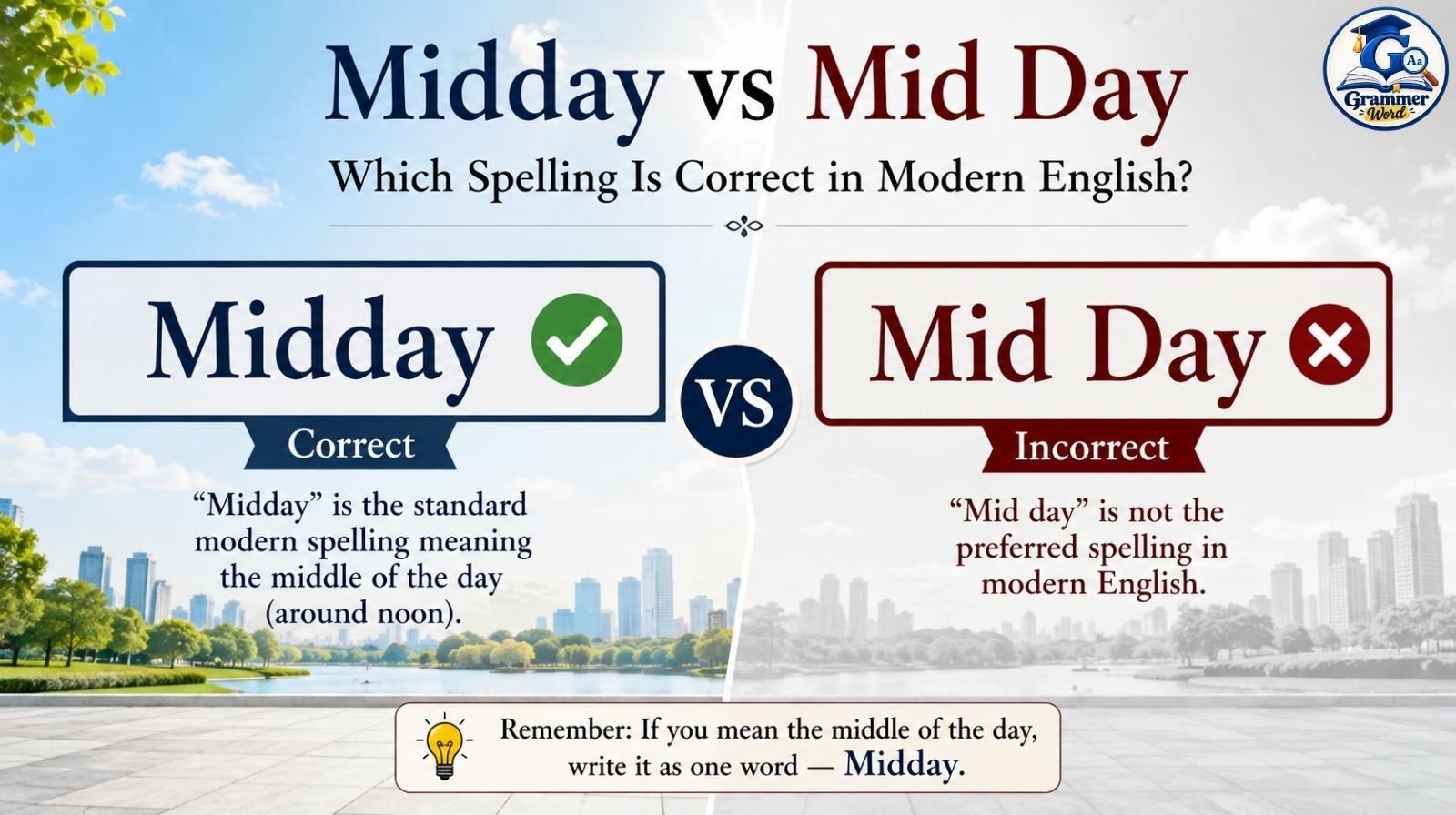
If you’ve ever stopped while writing and wondered whether it should be “midday” or “mid day,” you’re not alone. The good news is that the answer is straightforward: midday is the standard modern spelling when you mean the middle of the day or approximately noon.
Major English dictionaries such as Merriam-Webster and Cambridge list midday as the standard headword.
So, should you write “The meeting starts at mid day” or “The meeting starts at midday”? In normal modern English, choose midday.
This guide explains why, when to use it, whether mid-day is acceptable, and how to avoid the most common mistakes.
Midday vs Mid Day: What Is the Correct Spelling?
The short answer is simple: “midday” is correct in standard modern English.
Why “midday” is one word
Midday is an established compound word formed from mid + day. It refers to the middle of the day, particularly the period around noon.
For example:
- We arrived at midday.
- The temperature was highest around midday.
- She usually takes a break at midday.
- The midday sun can be extremely strong.
Merriam-Webster defines midday as “the middle of the day” and lists it as a noun that can also function attributively. Its entry records the word’s first known use as before the 12th century.
Is “mid day” ever correct?
As a normal spelling of the time of day, mid day is generally not the form you should choose.
You may occasionally encounter the two-word version in historical writing, informal material, or contexts where mid and day are functioning independently. However, that does not make it the preferred modern spelling of the noun midday.
For everyday writing, use:
midday
not:
mid day
What about “mid-day”?
You may also see mid-day, especially in older texts or particular editorial styles. It has existed as an alternative form, but modern dictionaries overwhelmingly present midday as the main spelling. Wiktionary, for example, records mid-day as an alternative form while listing midday as the primary form.
Therefore, if you’re writing a modern article, email, report, essay, or website, midday is the safest and most natural choice.
What Does Midday Mean?
Midday means the middle of the day, usually around 12 o’clock noon.
Cambridge Dictionary defines midday as twelve o’clock in the middle of the day and gives noon as a synonym.
Midday vs noon
Although midday and noon are closely related, they aren’t always perfectly interchangeable.
Noon usually points specifically to 12:00 p.m., whereas midday can refer more broadly to the period around the middle of the day.
Compare:
- The train leaves at noon.
- We expect the temperature to peak around midday.
- She called me at 12 noon.
- The streets become busy around midday.
This distinction matters because midday can describe a general time period rather than one exact minute.
Midday as a noun and modifier
Midday can be used as a noun:
We arrived at midday.
It can also modify another noun:
The midday heat was intense.
I skipped my midday meal.
The midday news was already on.
Dictionary.com likewise lists midday as both a noun and an adjective/modifier.
How to Use Midday Correctly in a Sentence
Once you know the spelling, using midday is easy.
Common examples of midday
Here are natural examples:
| Incorrect or less preferred | Standard modern English |
|---|---|
| We arrived at mid day. | We arrived at midday. |
| The mid-day heat was intense. | The midday heat was intense. |
| I’ll call you around mid day. | I’ll call you around midday. |
| They scheduled a mid day meeting. | They scheduled a midday meeting. |
| The shop closes at mid day. | The shop closes at midday. |
“At midday” vs “around midday”
Both expressions are correct, but they communicate slightly different ideas.
At midday suggests a time at or very close to the middle of the day:
The ceremony begins at midday.
Around midday suggests an approximate period:
I’ll probably arrive around midday.
This distinction is useful when you’re describing schedules, appointments, travel, weather, or daily routines.
Midday, midday meal, and midday sun
Some of the most common combinations are:
- midday sun
- midday heat
- midday meal
- midday break
- midday traffic
- midday temperature
- midday appointment
Merriam-Webster’s current examples include combinations such as midday meal and midday trading, illustrating how naturally the compound works in contemporary English.
Why Do People Write “Mid Day” or “Mid-Day”?
The confusion comes partly from the way English compounds have developed over time.
English compound words change over time
English frequently combines two words into a single compound. Some compounds remain open:
high school
Others become hyphenated:
well-known
And some become closed compounds:
bedroom
lunchtime
midday
There isn’t always a simple rule that tells you when a compound will change from two words to a hyphenated or closed form. Usage, history, dictionaries, and editorial conventions all play a role.
In the case of midday, the closed form is now firmly established.
The historical form explains some variation
Midday is not a new construction. Dictionary.com traces the word back to Old English middæg, showing that the concept and the compound itself has a very long history in English.
That history helps explain why modern English treats midday as a single lexical item rather than simply putting mid in front of day every time.
A practical rule for modern writers
If you’re unsure, use this rule:
When you mean “the middle of the day,” write “midday.”
That’s the form readers will recognize immediately, and it’s the form supported by major contemporary dictionaries.
A Real-World Usage Case Study: How “Midday” Appears in Modern English
A useful way to understand spelling isn’t simply to memorize a dictionary definition; it’s to look at how the word actually functions in contemporary writing.
Consider recent examples collected by Merriam-Webster. Its 2025–2026 example sentences use midday in several different contexts: weather reports describe conditions improving by midday, financial reporting refers to midday trading, lottery coverage uses the phrase midday draw, and lifestyle writing discusses midday snacks.
Notice what these examples have in common. They aren’t limited to formal grammar books or traditional literature. Midday works naturally across journalism, weather reporting, finance, food writing, and everyday descriptions.
This is important for writers because it demonstrates that the word isn’t merely technically correct it is an active part of contemporary English usage. A weather reporter can write that fog will lift by midday. A financial journalist can describe midday trading. A lifestyle writer can discuss a midday meal or snack. The same closed spelling works in each case.
In practical editorial terms, this consistency makes midday the clear default for modern websites, newsletters, academic writing, business communication, and general-purpose content.
2025–2026 Evidence: What Current Dictionaries Show
When a spelling question concerns modern English, current dictionary evidence is more useful than relying solely on old grammar advice.
A current dictionary snapshot
A simple 2025–2026 comparison provides a useful evidence-based picture:
| Reference | Current treatment |
|---|---|
| Merriam-Webster | midday is the dictionary headword |
| Cambridge Dictionary | midday is the dictionary headword |
| Dictionary.com | midday is the standard entry |
| Wiktionary | midday is primary; mid-day listed as an alternative |
Merriam-Webster’s entry was updated with current example sentences in March 2026, while Cambridge’s current entry defines midday as the middle of the day and provides contemporary usage examples.
So the 2025–2026 evidence points in the same direction across the references checked: midday is the standard modern form.
This is not a claim that every historical or stylistic source has always used the closed form. Rather, it shows that current mainstream dictionary treatment strongly favors midday.
Why current usage matters
Language changes. A spelling that appeared in older books may not be the preferred choice today.
For modern SEO content, professional writing, education, and general communication, the practical goal is therefore not to reproduce every historical variation. It is to use the form that contemporary readers and authoritative references recognize as standard.
Google’s current Search guidance also emphasizes helpful, reliable, people-first content and recommends using the language people naturally use when searching.
Midday vs Mid Day: A Quick Decision Guide
Still unsure which version to use? Follow this simple checklist.
Step-by-step spelling check
Step 1: Ask what you mean.
If you mean the middle of the day or approximately noon, continue.
Step 2: Use the closed compound.
Write midday.
Step 3: Don’t add a space.
Avoid mid day in standard modern usage.
Step 4: Don’t add a hyphen unnecessarily.
Although mid-day exists as an alternative form, midday is the modern default.
Step 5: Check the surrounding expression.
Phrases such as midday meal, midday sun, and midday break all normally use the closed form.
Easy memory trick
Think of midday as belonging to the same family of established time words:
- midnight
- midday
- morning
- afternoon
- evening
If you’re talking about the middle of the day, midday is your go-to spelling.
1. Quick Spelling Check
Which spelling is standard in modern English?
A) Mid day
B) Midday
C) Mid-dayy
D) Middaye
Answer: B) Midday
2. Fill the Gap
“We arrived at _____.”
A) mid day
B) mid-day
C) midday
D) mideday
Answer: C) midday
3. One Word or Two?
How is the standard word for “the middle of the day” written?
A) Two words
B) One word
C) Three words
D) With an apostrophe
Answer: B) One word
4. Pick the Natural Sentence
Which sentence sounds correct in modern English?
A) The meeting starts at mid day.
B) The meeting starts at midday.
C) The meeting starts at mid-dayy.
D) The meeting starts at mideday.
Answer: B) The meeting starts at midday.
5. Midday or Noon?
Which word usually refers specifically to 12:00 p.m.?
A) Evening
B) Afternoon
C) Noon
D) Midnight
Answer: C) Noon
6. Spot the Better Choice
Choose the standard spelling:
A) Midday sun
B) Mid day sun
C) Mid-day sun
D) Middaye sun
Answer: A) Midday sun
7. What Does Midday Mean?
What does “midday” refer to?
A) The middle of the night
B) The middle of the day
C) Early morning
D) Late evening
Answer: B) The middle of the day
8. Choose the Correct Phrase
Which phrase is normally written correctly?
A) Mid day meal
B) Mid-day meal
C) Midday meal
D) Miday meal
Answer: C) Midday meal
9. Grammar in Action
Which sentence uses “midday” correctly?
A) We will leave at midday.
B) We will leave at mid day.
C) We will leave at mid-dayy.
D) We will leave at miday.
Answer: A) We will leave at midday.
10. What About “Mid-Day”?
Is “mid-day” found in English usage?
A) No, it has never existed
B) Yes, as an alternative or older form
C) Only in scientific English
D) Only as a verb
Answer: B) Yes, as an alternative or older form
11. Modern Writing Pick
For a modern blog article, which form is the safest choice?
A) Mid day
B) Mid-day
C) Midday
D) Mid-daye
Answer: C) Midday
12. Around What Time?
“Midday” generally refers to which part of the day?
A) Around noon
B) Around midnight
C) Before sunrise
D) Late evening
Answer: A) Around noon
13. Complete the Sentence
“The _____ heat was intense.”
A) mid day
B) midday
C) mid-dayy
D) miday
Answer: B) midday
14. Capitalization Check
Which is normally correct in the middle of a sentence?
A) Midday
B) MIDDAY
C) midday
D) MidDay
Answer: C) midday
15. Final Challenge
If you mean “the middle of the day,” which spelling should you remember?
A) Mid day
B) Mid-day
C) Midday
D) Mid dey
Answer: C) Midday
FAQs
Q. Is “midday” one word or two?
A: Midday is one word. It is the standard modern spelling for the middle of the day or the period around noon.
Q. Is “mid day” grammatically correct?
A: As the ordinary spelling of the time-of-day term, mid day is not the preferred modern form. Use midday instead.
Q. Is “mid-day” correct English?
A: Mid-day has been used as an alternative spelling, particularly in older or variant usage. However, midday is the standard modern form found in major dictionaries.
Q. Is midday the same as noon?
A: They are closely related but not always identical. Noon usually means exactly 12:00 p.m., while midday can refer to the broader period around the middle of the day.
Q. Should I write “midday meal” or “mid day meal”?
A: Write midday meal. Midday functions naturally as a modifier before meal.
Q. Should midday be capitalized?
A: Normally, no. Write midday with a lowercase m unless it begins a sentence or appears in a title where title-case capitalization is appropriate.
For example:
We arrived at midday.
Midday temperatures are expected to rise.
Q. Is “12 midday” correct?
A: It can be understood, but 12 noon, noon, or simply midday is often more natural depending on the context. Because midday already indicates the middle of the day, adding “12” can be unnecessary.
Final Verdict:
When choosing between midday vs mid day, the answer for modern standard English is clear: use “midday.”
It is the established one-word spelling recognized by major dictionaries, and contemporary examples show it being used naturally across journalism, business, weather reporting, food writing, and everyday communication.
Use:
The meeting starts at midday.
Not:
The meeting starts at mid day.
And while mid-day may appear in historical or variant usage, there is rarely a reason to choose it when writing for a modern audience.
The easiest rule to remember is this: if you mean the middle of the day, write “midday.”
If you’re publishing grammar, spelling, or language content online, pair that straightforward answer with authoritative references and genuinely useful examples. Google’s current guidance favors content that is helpful, reliable, original, and written for people rather than created primarily to manipulate search rankings.
Keep learning with more easy grammar lessons on Grammer Word.com

Hi, I’m Noor Fatima, the person behind this website. I created this site to make English grammar and confusing words easier to understand. I love breaking down tricky words, meanings, spellings, and grammar rules into simple explanations. My goal is to help you learn English naturally, avoid common mistakes, and feel more confident every time you write or speak.