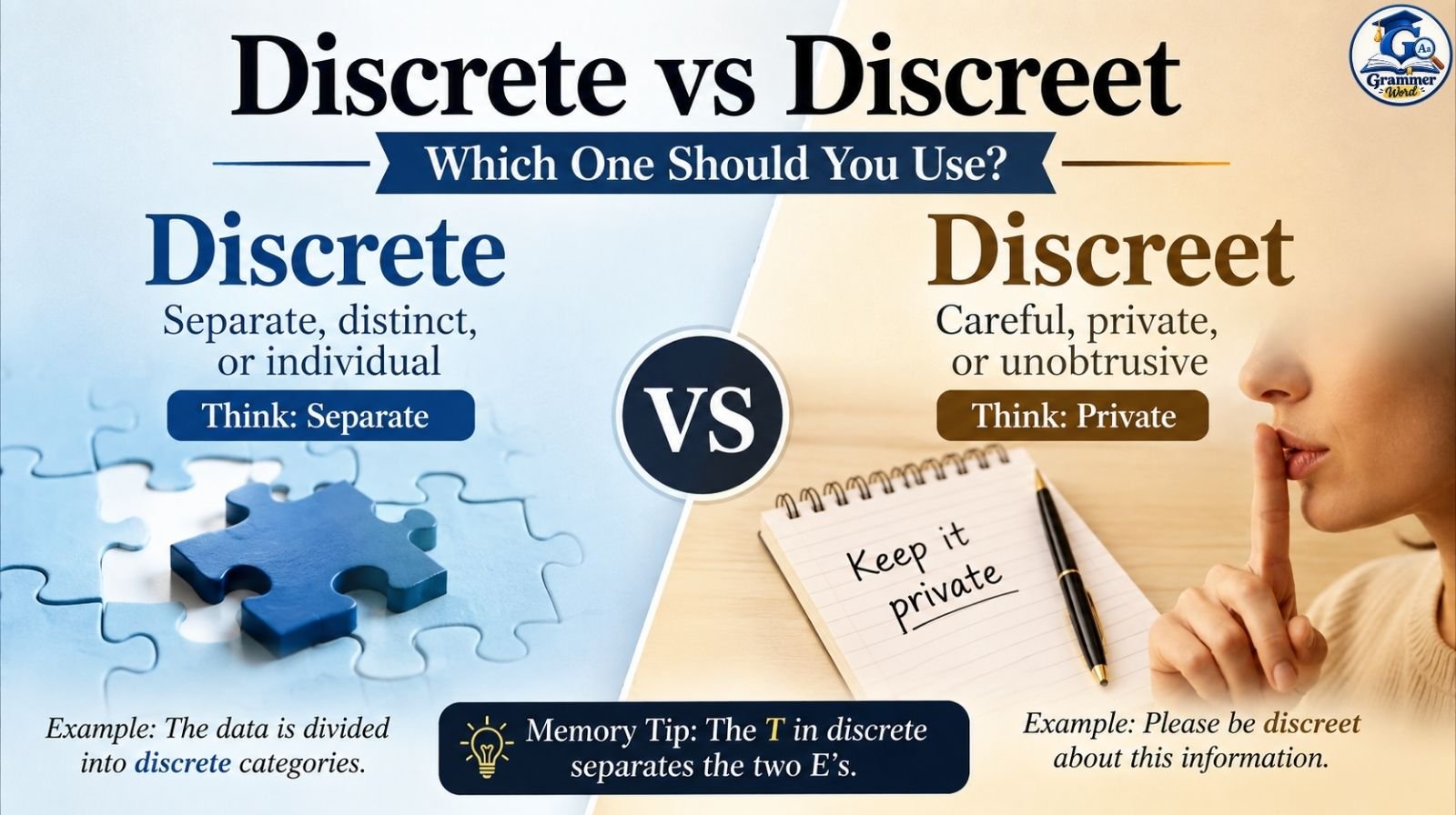
Discrete vs discreet is a common English word-choice problem because both words are pronounced the same but have different meanings. Discrete means separate, distinct, or individually identifiable, while discreet means careful, tactful, private, or unobtrusive.
The good news is that the difference is easy to remember once you connect each spelling with its meaning. In this guide, you’ll learn discrete vs discreet, when to use each word, common mistakes, real-world examples, and a simple trick that can help you choose the right spelling quickly.
Discrete vs Discreet: What Is the Difference?
The simplest way to remember the difference is:
Discrete = separate or distinct
Discreet = careful, private, or unobtrusive
Both words are adjectives and are pronounced essentially the same, which makes them homophones. However, they are not interchangeable.
Read More: Masonary vs Masonry: Which Spelling Is Correct And Why It Matters
What Does Discrete Mean?
Discrete describes something that is separate, distinct, individual, or clearly divided from something else.
For example:
- The project has three discrete stages.
- The researchers studied several discrete groups.
- The machine contains several discrete components.
- The teacher divided the lesson into discrete sections.
The word is particularly common in technical, mathematical, scientific, and academic writing. In mathematics and statistics, for example, discrete can describe values or variables that exist as separate, countable units rather than along a continuous range.
What Does Discreet Mean?
Discreet describes someone or something that is careful, tactful, private, restrained, or unlikely to attract attention.
For example:
- Please be discreet about the announcement.
- She was discreet when discussing his personal situation.
- The hotel provides discreet service to its guests.
- He made a discreet exit from the room.
Cambridge defines discreet as being careful not to cause embarrassment or attract too much attention, especially by keeping something secret.
When Should You Use Discrete?
Use discrete when you mean separate, distinct, individual, or divided.
Discrete Means “Separate”
Think about physical or conceptual things that can be identified individually.
For example:
The company operates through four discrete departments.
Here, discrete is correct because the departments are separate organizational units.
Another example:
The course is divided into six discrete modules.
The modules are separate sections of the course.
Discrete in Math and Science
You will often encounter discrete in academic and technical contexts.
Examples include:
- discrete mathematics
- discrete data
- discrete variables
- discrete values
- discrete components
- discrete categories
- discrete events
For example:
The survey records a discrete variable such as the number of children in a household.
In statistics, discrete variables generally involve separate countable values rather than a continuous range. Collins also identifies specialized statistical uses of discrete in relation to variables and distributions.
A Quick Test for Discrete
Ask yourself:
“Can I replace this word with separate or distinct?”
If yes, discrete is probably the word you need.
The two systems are discrete.
→ The two systems are separate.
That substitution makes the choice much easier.
When Should You Use Discreet?
Use discreet when you’re talking about privacy, tact, caution, secrecy, or avoiding attention.
Discreet Means “Careful or Private”
Consider this sentence:
Please be discreet about my job interview.
The speaker is asking someone not to reveal information. Therefore, discreet is correct.
Other examples include:
She was discreet about the family’s financial problems.
The assistant handled the complaint in a discreet manner.
He asked a few discreet questions about the situation.
Merriam-Webster similarly defines discreet around good judgment, restraint, careful handling of information, and unobtrusiveness.
Discreet Can Also Mean Unobtrusive
Discreet does not always involve a secret.
It can also describe something that doesn’t attract unnecessary attention.
For example:
The security cameras are small and discreet.
This means the cameras are not very noticeable.
You might also say:
- a discreet entrance
- discreet lighting
- discreet jewelry
- discreet service
- a discreet gesture
- a discreet location
Collins includes this meaning of discreet as something small, unobtrusive, or not easily noticed.
Read More: Patients vs Patient’s: Meaning, Difference, And Correct Usage
A Quick Test for Discreet
Ask:
“Am I talking about being careful, private, tactful, or unobtrusive?”
If yes, use discreet.
Please be discreet about this matter.
You could replace it with:
Please be careful/private about this matter.
Discrete vs Discreet: Comparison Table
| Feature | Discrete | Discreet |
|---|---|---|
| Basic meaning | Separate or distinct | Careful, private, or unobtrusive |
| Main idea | Separation | Privacy or restraint |
| Common contexts | Math, science, categories, systems | People, conversations, secrets, behavior |
| Example | Three discrete categories | A discreet conversation |
| Opposite idea | Continuous/connected | Indiscreet/noticeable |
| Memory clue | T separates the E’s | EE stay together |
The spelling itself provides a useful memory aid: in discrete, the T separates the two E’s, matching the idea of separation. In discreet, the two E’s stay together, which can remind you of keeping things private or together. Merriam-Webster specifically recommends the “T separates the E’s” trick for discrete.
Common Mistakes With Discrete and Discreet
Because the words sound identical, spelling mistakes are easy to make. The key is to focus on meaning rather than pronunciation.
Mistake: “Be Discrete About It”
❌ Please be discrete about the secret.
✅ Please be discreet about the secret.
Why? The sentence is about keeping information private, so discreet is required.
Mistake: “Discrete Categories” vs “Discreet Categories”
❌ The survey contains five discreet categories.
✅ The survey contains five discrete categories.
Why? The categories are separate from one another. Therefore, discrete is correct.
Mistake: Confusing “Discreet” With “Discrete” in Technical Writing
Technical writing often uses discrete because it describes separate units, categories, or values.
For example:
The software processes the information in discrete steps.
Here, discrete means the steps are individually distinguishable.
By contrast:
The technician handled the customer’s complaint discreetly.
Here, discreetly means with care and privacy.
LanguageTool’s 2025 guide, revised in 2026, likewise distinguishes discrete as separate or individual and discreet as cautious or unnoticeable.
A Real-Life Example: How One Letter Changes the Meaning
Imagine you’re working in a company where an employee has privately told their manager about a personal problem. The manager needs to discuss the situation with HR but doesn’t want the information shared unnecessarily.
The manager might say:
“Let’s handle this discreetly.”
That means the manager should act tactfully and protect the employee’s privacy.
Now imagine the HR department divides the case into several independent administrative steps: documentation, review, interview, and follow-up.
Those could be described as:
“The process consists of several discrete stages.”
Here, discrete means separate and individually identifiable.
Read More: Possum or Opossum: What’s The Correct Spelling And Usage?
Notice how the two words can appear in the same general situation but perform completely different jobs. Discreetly describes how people behave, while discrete describes how separate things are organized.
This distinction is especially useful in professional writing. A sentence such as “The manager created discreet stages” could accidentally suggest that the stages are secret or unobtrusive. If the intended meaning is simply that each stage is separate, discrete is the precise choice.
This is why relying on pronunciation doesn’t work. Both words sound alike, but their meanings determine their spelling. Major dictionaries continue to maintain this distinction in modern English usage.
Discrete vs Discreet in Modern English: 2025–2026 Usage Snapshot
There isn’t a reliable public statistic showing a universal “error rate” for confusing these two words, so it would be misleading to invent one. However, current dictionary and language resources from 2025–2026 continue to document both words as separate, active English terms.
What Current Sources Show
- Merriam-Webster’s 2026 dictionary entries continue to distinguish discreet as careful, prudent, and unobtrusive from discrete as separate or individually distinct.
- Merriam-Webster’s current sentence database includes examples of discreet from 2025 and 2026, demonstrating its continuing use in contemporary writing.
- Its discrete sentence database likewise includes contemporary examples from 2025 and 2026, including academic and technical contexts.
- Collins’ current dictionary identifies specialized mathematical/statistical meanings for discrete and privacy/tact-related meanings for discreet.
- A LanguageTool article published in June 2025 and revised in March 2026 continues to identify these words as commonly confused homophones.
The practical takeaway: both spellings are correct words in modern English. The issue isn’t choosing the “modern” spelling; it’s choosing the spelling that matches your intended meaning.
The Easiest Memory Trick for Discrete vs Discreet
Here’s the trick worth remembering:
Discrete = T separates
Look at:
D I S C R E T E
The T sits between the two E’s.
Think:
T = Two things separated
So:
Discrete = separate
Discreet = EE together
Look at:
D I S C R E E T
The two E’s are together.
Think:
EE = keeping things together/private
So:
Discreet = private or careful
It’s not a rule of English grammar, but it’s an effective spelling mnemonic and Merriam-Webster also highlights the separation of the E’s by T as a useful way to remember discrete.
Quick Checklist: Which Word Should You Use?
Before choosing the spelling, run through this checklist:
Use Discrete If…
- You mean separate.
- You mean distinct.
- You’re describing individual units.
- You’re discussing categories or groups.
- You’re writing about mathematics or statistics.
- You’re describing something as non-continuous.
Example:
The experiment produced four discrete results.
Use Discreet If…
- You mean private.
- You mean tactful.
- You mean careful about revealing information.
- You mean unobtrusive.
- You’re describing someone’s behavior.
- You’re trying to avoid unwanted attention.
Example:
She was discreet when discussing the confidential information.
Mini Quizzes
Quiz 1: Pick the Right Word
Which word fits this sentence?
“Please be ______ when discussing the private matter.”
A) Discrete
B) Discreet
Answer: Discreet — It means careful, tactful, or private.
Quiz 2: Separate or Private?
Which word means separate or distinct?
A) Discreet
B) Discrete
Answer: Discrete — Think “separate and distinct.”
Quiz 3: Spot the Correct Spelling
Choose the correct sentence:
A) The data is divided into discreet groups.
B) The data is divided into discrete groups.
Answer: B — The data is divided into discrete groups.
The groups are separate from one another.
Quiz 4: A Secret Conversation
“She had a ______ conversation with her manager.”
Which word works best?
A) Discrete
B) Discreet
Answer: Discreet — The conversation is private or tactfully handled.
Read More: Whoever or Whomever: A Complete Guide To Correct Usage
Quiz 5: Math Time!
Which phrase is correct?
A) Discreet mathematics
B) Discrete mathematics
Answer: B — Discrete mathematics — “Discrete” is the established mathematical term.
Quiz 6: Think “Separate”
If you can replace the word with separate, which spelling should you choose?
A) Discreet
B) Discrete
Answer: Discrete — Separate = discrete.
Quiz 7: Think “Private”
If you mean private or careful, which word belongs?
A) Discrete
B) Discreet
Answer: B — Discreet — Private or tactful = discreet.
Quiz 8: Find the Mistake
Which sentence contains the correct word?
A) She was discreet about the family problem.
B) She was discrete about the family problem.
Answer: A — She was discreet about the family problem.
The sentence is about privacy and tact.
Quiz 9: Countable Values
A statistician is discussing values that occur as separate, countable units. Which word is appropriate?
A) Discreet
B) Discrete
Answer: B — Discrete — Discrete can describe separate or countable values.
Quiz 10: Don’t Attract Attention
“The security team used a ______ entrance.”
Which word is most appropriate if the entrance is designed not to attract attention?
A) Discrete
B) Discreet
Answer: B — Discreet — Discreet can mean unobtrusive or not easily noticed.
Quiz 11: The Memory Trick
Which statement is the best memory trick?
A) The T in discrete separates the E’s.
B) The T in discreet separates the E’s.
Answer: A — The T in discrete separates the E’s.
This is a useful reminder that discrete means separate.
Quiz 12: Workplace English
“The report contains four ______ sections.”
The sections are clearly separated from each other. Choose:
A) Discreet
B) Discrete
Answer: B — Discrete — The sections are separate units.
Quiz 13: Which One Sounds Right?
Which sentence is correct?
A) Please keep the information discreet.
B) Please keep the information discrete.
Answer: A — Please keep the information discreet.
The intended meaning is to keep information private.
Quiz 14: Quick Meaning Check
What does discreet usually describe?
A) Separate objects
B) Careful or private behavior
C) Mathematical values
D) Divided categories
Answer: B — Careful or private behavior.
Quiz 15: Final Challenge!
Complete the sentence:
“The experiment produced several ______ results, while the researchers discussed them in a ______ manner.”
A) discreet / discrete
B) discrete / discreet
C) discrete / discrete
D) discreet / discreet
Answer: B — discrete / discreet
The results are separate, while the researchers’ manner is careful and private.
Read More: This Is She or This Is Her? The Correct Way To Answer The Phone
FAQs
Q. Is it “discrete” or “discreet”?
A: Both are correct words, but they have different meanings. Discrete means separate or distinct, while discreet means careful, tactful, private, or unobtrusive.
Q. What is an easy way to remember discrete vs discreet?
A: Remember that the T in discrete separates the E’s. Therefore, discrete = separate. In discreet, the two E’s stay together, which can remind you of privacy or keeping things together.
Q. Is “discreet” related to “secret”?
A: Not directly in spelling or origin, but the association can be useful as a memory aid. Discreet often involves keeping information private or avoiding attention.
Q. Is “discrete” used in mathematics?
A: Yes. Discrete is an important technical term in mathematics, statistics, and computer science. It commonly refers to separate, countable, or individually identifiable values or structures.
Q. Can “discreet” mean “not noticeable”?
A: Yes. Besides meaning tactful or careful, discreet can describe something unobtrusive or unlikely to attract attention.
Q. Are discrete and discreet pronounced the same?
A: Yes. They are commonly treated as homophones: both are pronounced approximately /dɪˈskriːt/.
Final Answer:
So, which one should you use?
Use discrete when you mean separate, distinct, or individual:
The report contains three discrete sections.
Use discreet when you mean careful, private, tactful, or unobtrusive:
Please be discreet about the conversation.
The fastest test is simple: if the idea is separation, choose discrete; if the idea is privacy or tact, choose discreet.
Once you remember that the T separates the E’s in discrete, this commonly confused pair becomes much easier to get right. Save this guide for the next time you’re unsure, and you’ll be able to choose between discrete vs discreet with confidence.
Authority References
Keep learning with more easy grammar lessons on Grammer Word.com

Hi, I’m Noor Fatima, the person behind this website. I created this site to make English grammar and confusing words easier to understand. I love breaking down tricky words, meanings, spellings, and grammar rules into simple explanations. My goal is to help you learn English naturally, avoid common mistakes, and feel more confident every time you write or speak.