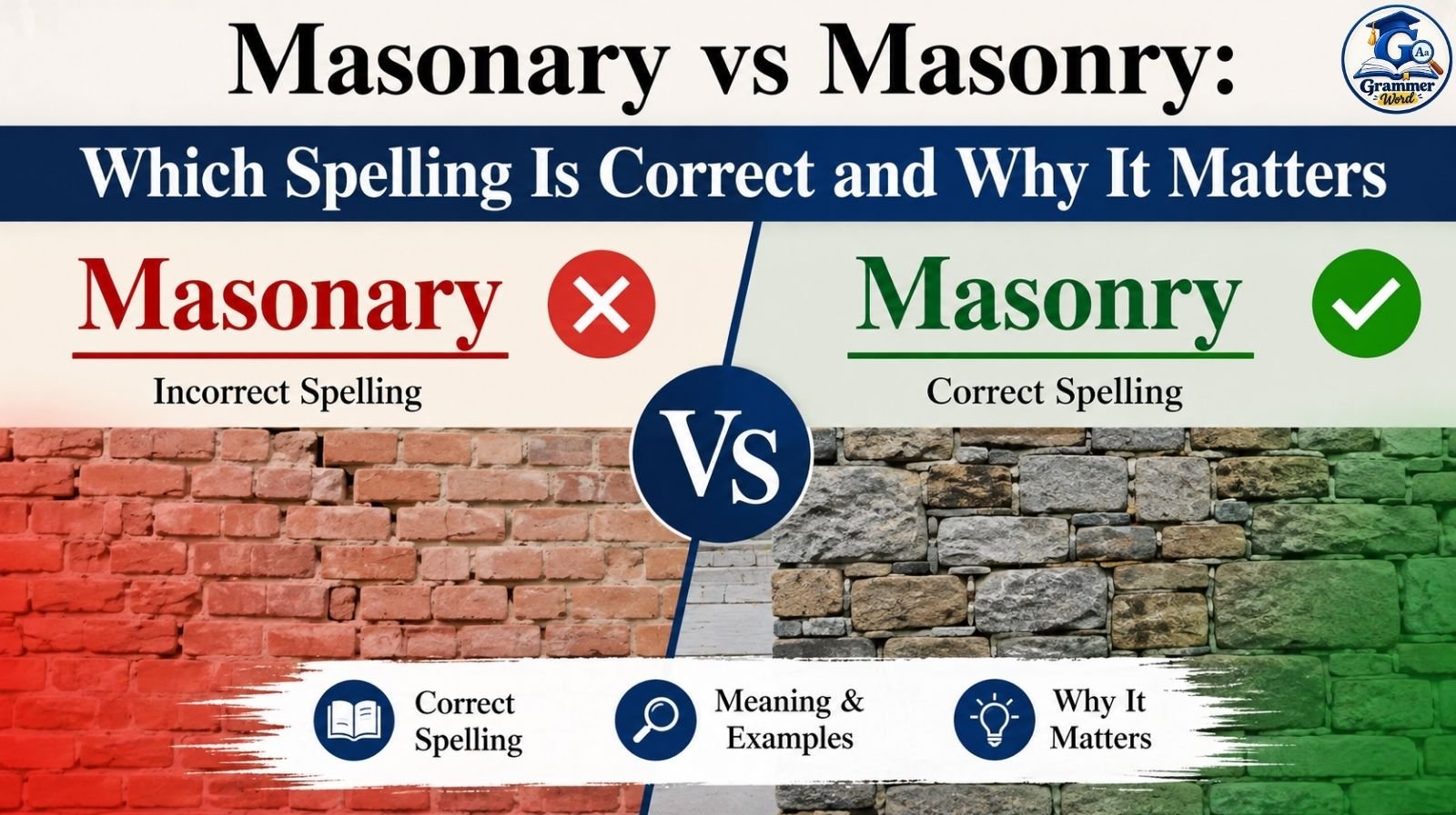
If you have ever typed “masonary” instead of “masonry,” you are not alone. The two spellings look almost identical, and the way masonry is pronounced can make the incorrect version feel perfectly natural.
However, when it comes to standard English, masonry is the correct spelling. Masonary is a misspelling, not an alternative spelling.
In this guide, we will explain the difference between masonary vs masonry, what masonry means, why people commonly spell it incorrectly, and how to remember the correct version every time.
Masonary vs Masonry: Which Spelling Is Correct?
The short answer is simple:
Masonry is correct. Masonary is incorrect.
Masonry is the standard English word for the craft of building with brick, stone, concrete blocks, and similar materials, as well as the resulting brick or stone construction.
Cambridge Dictionary defines masonry as the bricks and pieces of stone used to make a building and also as the skill of building with brick and stone.
The word is formed from mason + -ry, producing:
mason + ry = masonry
It is not spelled masonary. That extra “a” in the middle is what makes masonary incorrect in standard English.
For example:
- Correct: The contractor specializes in masonry construction.
- Incorrect: The contractor specializes in masonary construction.
- Correct: The old masonry wall needs repair.
- Incorrect: The old masonary wall needs repair.
Is “masonary” ever an accepted spelling?
In standard modern English, no. Major English dictionaries recognize masonry, not masonary, as the standard spelling.
Collins, for example, defines masonry as the craft or occupation of a mason and work constructed using materials such as stone, brick, or concrete. It also traces the word to Middle English masonerie.
So if you are writing an essay, website, construction document, email, résumé, report, or professional proposal, use masonry.
What Does “Masonry” Mean?
The word masonry has a straightforward connection to the work of a mason.
A mason is a skilled worker who builds or works with materials such as brick and stone. Masonry refers both to the craft and to structures or portions of structures made using masonry materials.
Masonry meaning in construction
In construction, masonry commonly involves:
- Brick
- Natural stone
- Concrete blocks
- Mortar
- Masonry walls
- Foundations
- Chimneys
- Decorative stonework
For example:
The house has an exterior brick masonry wall.
Here, masonry describes the construction made from brick.
Masonry vs brickwork
These words are related, but they are not always interchangeable.
Brickwork specifically refers to work made from bricks, whereas masonry is a broader term that can include brick, stone, concrete masonry units, and other building units.
For example:
- Brick wall → brickwork
- Stone wall → masonry
- Concrete block wall → masonry
- Brick-and-stone structure → masonry
This distinction is particularly useful in construction writing, architecture, engineering, and building specifications.
Why Do People Spell Masonry as “Masonary”?
If masonry is correct, why does masonary appear so often?
The main reason is pronunciation.
Pronunciation creates the spelling mistake
Masonry is generally pronounced approximately like:
MAY-sən-ree
The middle sounds can make the word feel as though there is an extra “a” before the final “ry.”
That can lead someone to mentally divide the word as:
mason + ary
instead of:
mason + ry
This is a common type of spelling error: people often spell a word according to how they think it sounds.
A simple memory trick
Think:
MASON + RY = MASONRY
Not:
MASON + ARY = MASONARY
Another useful trick is to connect the word directly to mason:
A mason does masonry.
Once you remember that connection, the spelling becomes easier.
Masonry in a sentence
Here are some natural examples:
- The building has a beautiful stone masonry façade.
- The engineer inspected the masonry wall for cracks.
- Masonry construction can involve brick, stone, or concrete blocks.
- The workers repaired the damaged masonry around the window.
- He trained in masonry as part of his construction apprenticeship.
Notice that the spelling remains masonry in every example.
Masonary vs Masonry: Quick Comparison
| Feature | Masonry | Masonary |
|---|---|---|
| Correct standard spelling | ✅ Yes | ❌ No |
| Found in major English dictionaries | ✅ Yes | ❌ Not as the standard word |
| Meaning | Brick/stone construction or the craft of building with them | Misspelling of masonry |
| Suitable for professional writing | ✅ Yes | ❌ No |
| Suitable for SEO/content | ✅ Yes | ❌ No |
| Example | Masonry wall | Masonary wall |
The easiest rule to remember
If you are unsure, use this:
Mason → Masonry
The word masonry does not contain an extra “a” after the n.
Why Correct Spelling Matters in Professional Writing
A single spelling mistake may seem insignificant, but it can affect how your writing is perceived especially when the word appears in a professional or technical context.
Read More: Midday vs Mid Day: Which Spelling Is Correct In Modern English?
Construction and engineering documents
Imagine seeing these two sentences in a contractor’s proposal:
“We specialize in masonry construction.”
versus:
“We specialize in masonary construction.”
The first looks polished and professional. The second immediately signals a spelling error.
This matters in:
- Construction proposals
- Engineering reports
- Architectural documents
- Building specifications
- Job applications
- Business websites
- Educational assignments
- Product descriptions
Websites and SEO content
Correct spelling also helps make content clearer for readers and search engines.
Google’s current Search guidance emphasizes using the words people actually use to search for a topic, while also creating helpful, reliable, people-first content. Google specifically lists avoiding spelling or stylistic issues among its quality considerations.
That does not mean you should repeat masonry unnaturally throughout a page. Instead, use the correct term naturally where it makes sense.
For example:
Masonry construction is commonly used for walls made from brick, stone, or concrete masonry units.
That is much better than forcing the keyword into every sentence.
A Real-Life Example: How One Extra Letter Changes Professional Communication
Consider a homeowner looking for a contractor to repair a damaged brick wall.
They visit two contractor websites.
The first website says:
“Our team provides professional masonry repair, brickwork, stonework, and structural restoration.”
The second says:
“Our team provides professional masonary repair, brickwork, and stone work.”
At first glance, the difference might seem minor. The services could even be identical. However, the spelling error can influence the reader’s perception of the business.
A homeowner who is already comparing several contractors may interpret masonary as a simple typo. But if the website contains several similar errors, the reader may begin questioning how carefully the company handles its work and documentation.
This is especially important in construction because clients are often hiring businesses for expensive, long-term projects. A website, quotation, proposal, or project description is part of the company’s professional presentation.
The lesson is not that one misspelled word automatically makes a contractor unreliable. Rather, it shows why accurate terminology supports professional credibility.
The correct form masonry also makes communication clearer with architects, engineers, contractors, suppliers, and clients. When everyone uses the recognized industry term, specifications and discussions become easier to understand.
For example, terms such as masonry wall, masonry construction, masonry units, and masonry repair are immediately recognizable in construction contexts. By contrast, masonary wall is simply an incorrect spelling of the same concept.
2025–2026 Data Snapshot: Is “Masonry” Still the Standard Term?

There is an important distinction between spelling evidence and search-volume data.
There is no authoritative public 2025–2026 dataset showing exactly how many people misspell masonry as masonary. Search engines do not publish a definitive global count of spelling mistakes. Therefore, it would be misleading to invent a percentage for the frequency of masonary.
What we can verify is that masonry remains the established term in current dictionaries and professional usage.
What current sources show
- Cambridge Dictionary currently lists masonry as the standard English noun for brick/stone construction and the skill of building with brick and stone.
- Collins English Dictionary lists masonry for the craft of a mason and work made by a mason, with its word history tracing the term back to Middle English.
- Merriam-Webster’s 2025 examples include current examples of masonry in phrases such as “masonry drill bit,” “masonry wall,” and “masonry heater,” demonstrating continued standard usage. Its examples page was last updated September 15, 2025.
- Current construction data also continues to use masonry as an established construction category. For example, Statistics Canada reported masonry as a distinct construction division in its first-quarter 2026 building construction price data.
So while we cannot responsibly give a made-up “X% of people spell it incorrectly” statistic, the available 2025–2026 evidence clearly supports masonry as the standard spelling.
Common Words Related to Masonry
Understanding related vocabulary can make the correct spelling easier to remember.
Mason
A mason is a person who works with materials such as brick or stone in construction.
Example:
The mason carefully laid each brick.
Masonry
Masonry is the craft itself or the resulting brick, stone, or similar construction.
Example:
The building has extensive stone masonry.
Masonry wall
A masonry wall is a wall constructed using masonry units such as bricks, stones, or concrete blocks.
Example:
The engineer inspected the masonry wall for structural damage.
Masonry construction
Masonry construction refers to construction using masonry materials and systems.
Example:
The project uses reinforced masonry construction.
These related terms all use the same spelling:
mason → masonry → masonry wall → masonry construction
How to Remember the Correct Spelling
If you regularly confuse masonary vs masonry, use this three-step method.
Step 1: Start with “mason”
Write:
MASON
This is the person or trade associated with the work.
Step 2: Add “ry”
Now add:
MASON + RY
You get:
MASONRY
Step 3: Remove the extra “a”
If you find yourself writing masonary, stop and check the middle.
❌ masonary
✅ masonry
There is no extra a between n and r.
Memory shortcut:
Mason + ry = masonry.
Mini Quiz 1: The Correct Spelling
Which spelling is correct?
A) Masonary
B) Masonery
C) Masonry
D) Masenry
Answer: C) Masonry
Mini Quiz 2: Spot the Mistake
Which sentence is written correctly?
A) The masonary wall needs repair.
B) The masonry wall needs repair.
C) The masonery wall needs repair.
D) The masnory wall needs repair.
Answer: B) The masonry wall needs repair.
Read More: Girlie or Girly: Which Word Is Correct? Meaning, Usage, Differences, And Examples For 2026
Mini Quiz 3: What Does Masonry Mean?
What does masonry mainly refer to?
A) Painting walls
B) Building with brick, stone, or similar materials
C) Installing electrical wires
D) Designing furniture
Answer: B) Building with brick, stone, or similar materials
Mini Quiz 4: Quick Spelling Check
Fill in the correct word:
Mason + ___ = Masonry
A) ary
B) ry
C) ery
D) ory
Answer: B) ry
Mini Quiz 5: Mason or Masonry?
A person who works with brick and stone is called a:
A) Mason
B) Masonry
C) Masonary
D) Masoner
Answer: A) Maso
Mini Quiz 6: Which One Looks Professional?
Which phrase should you use in a construction document?
A) Masonary construction
B) Masonery construction
C) Masonry construction
D) Masonrye construction
Answer: C) Masonry construction
Mini Quiz 7: Why the Confusion?
Why do people often write masonary?
A) It is an older spelling
B) It sounds natural when pronounced
C) It is a construction abbreviation
D) It is a British spelling
Answer: B) It sounds natural when pronounced
Mini Quiz 8: Brickwork or Masonry?
Which term is broader?
A) Brickwork
B) Masonry
C) Paintwork
D) Woodwork
Answer: B) Masonry
Mini Quiz 9: Find the Correct Phrase
Which phrase is spelled correctly?
A) Masonary wall
B) Masonery wall
C) Masonry wall
D) Masonary construction wall
Answer: C) Masonry wall
Mini Quiz 10: Extra Letter Challenge
Which letter should you NOT add when spelling masonry?
A) M
B) A
C) R
D) Y
Answer: B) A
Mini Quiz 11: Choose the Correct Sentence
Which sentence is correct?
A) The contractor repaired the masonary.
B) The contractor repaired the masonry.
C) The contractor repaired the masonery.
D) The contractor repaired the masnory.
Answer: B) The contractor repaired the masonry.
Mini Quiz 12: Construction Vocabulary
Which material can commonly be used in masonry construction?
A) Brick
B) Paper
C) Fabric
D) Carpet
Answer: A) Brick
Mini Quiz 13: SEO-Friendly Spelling
If someone searches for the correct construction term, which spelling should your article use?
A) Masonary
B) Masonery
C) Masonry
D) Masenary
Answer: C) Masonry
Mini Quiz 14: Remember the Formula
Which memory trick is correct?
A) Mason + ary = masonry
B) Mason + ry = masonry
C) Mason + ery = masonry
D) Mason + ory = masonry
Answer: B) Mason + ry = masonry
Mini Quiz 15: Final Brain Check
Which statement is true?
A) Masonary is the preferred spelling.
B) Masonry is a misspelling.
C) Masonry is the standard spelling.
D) Both spellings are equally standard.
Answer: C) Masonry is the standard spelling.
FAQs
Q. Is “masonary” a correct spelling?
A: No. Masonary is a misspelling. The correct standard English spelling is masonry.
Q. What is the correct spelling: masonry or masonary?
A: The correct spelling is masonry.
For example:
The contractor specializes in masonry construction.
Q. Why do people spell masonry as masonary?
A: The mistake is likely influenced by pronunciation. The sounds in masonry can make an additional “a” seem natural when spelling the word phonetically.
Q. What does masonry mean?
A: Masonry refers to the craft of building with materials such as brick and stone, as well as structures or portions of structures made from those materials.
Q. Is masonry the same as brickwork?
A: Not exactly. Brickwork specifically refers to construction or work involving bricks, while masonry is a broader term that can include brick, stone, concrete blocks, and related construction.
Q. How do you pronounce masonry?
A: Masonry is commonly pronounced approximately MAY-sən-ree in English, although pronunciation can vary somewhat by accent. Cambridge provides UK and US pronunciations for the word.
Q. Should I use “masonry” in professional writing?
A: Yes. Use masonry in construction documents, websites, reports, proposals, academic writing, and other formal contexts. Avoid masonary unless you are specifically discussing the misspelling itself.
Conclusion:
When comparing masonary vs masonry, there is a clear winner: masonry.
Masonry is the established English spelling for the craft of building with brick, stone, concrete blocks, and similar materials. Masonary is simply a common spelling mistake, often caused by the way the word sounds when spoken.
The easiest way to remember it is:
MASON + RY = MASONRY
So the next time you write masonry construction, masonry wall, or masonry repair, leave out that extra “a.”
Correct spelling may seem like a small detail, but using the right terminology makes your writing clearer, more professional, and easier for readers to trust. Google likewise recommends creating helpful, reliable, people-first content and avoiding spelling or stylistic issues.
Bookmark this guide or share it with someone who still writes “masonary” and help them get the spelling right.
Keep learning with more easy grammar lessons on Grammer Word.com

Hi, I’m Noor Fatima, the person behind this website. I created this site to make English grammar and confusing words easier to understand. I love breaking down tricky words, meanings, spellings, and grammar rules into simple explanations. My goal is to help you learn English naturally, avoid common mistakes, and feel more confident every time you write or speak.