If you have ever written a résumé, cover letter, job description, or professional email, you may have wondered whether skillset or skill set is the correct spelling. Both forms appear online, so the choice can feel confusing.
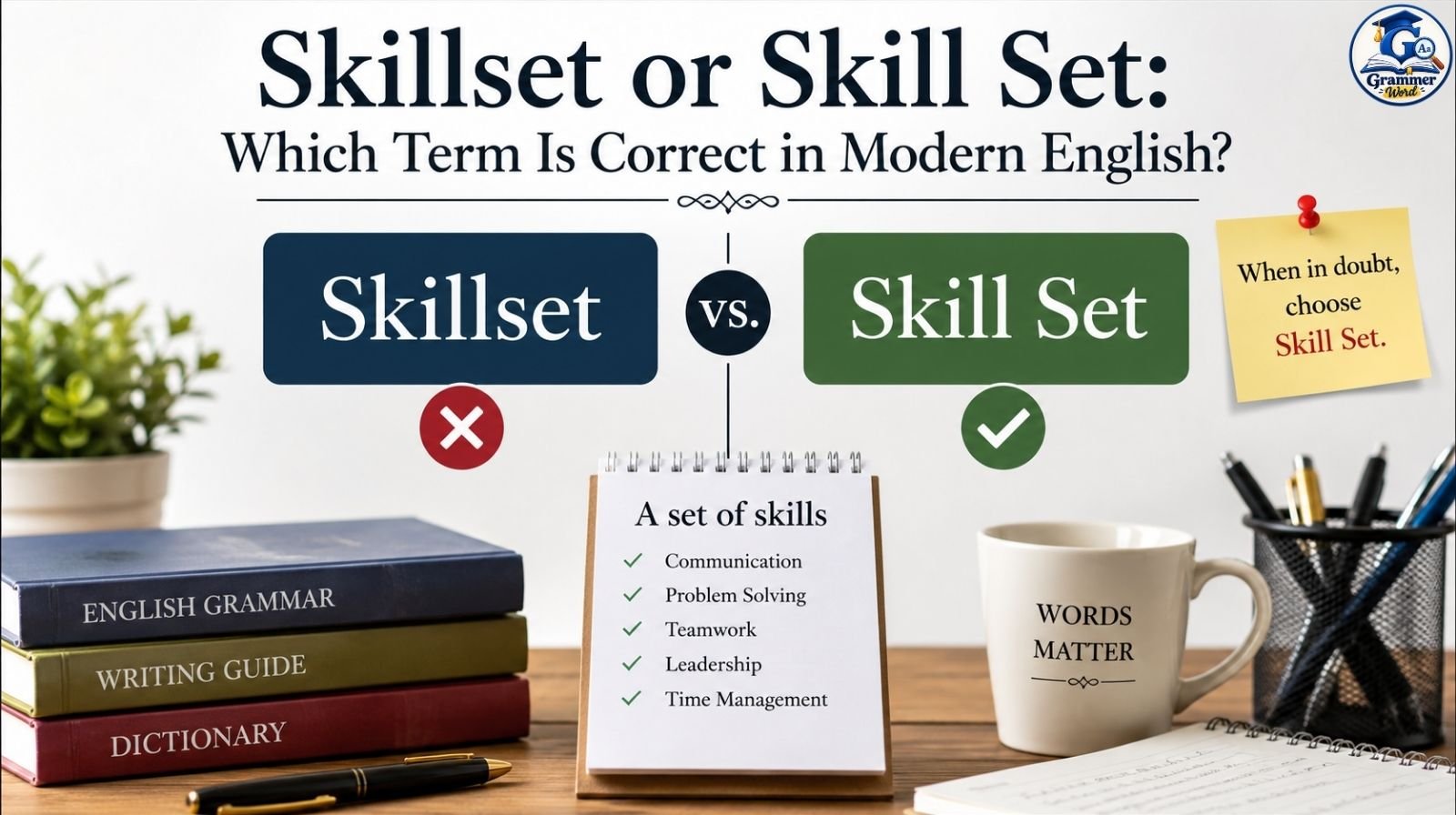
The good news is that the answer is fairly straightforward: skill set is the established and safest form for standard and formal English, while skillset is also encountered in modern usage, particularly in business and informal contexts. Major dictionaries, including Merriam-Webster and Oxford, list skill set as the standard headword.
So, if you’re unsure which version to use, skill set is the better default.
Read More: Dreamt or Dreamed: Which One Is Correct?
What Does “Skill Set” Mean?
A skill set is a collection or combination of skills and abilities that a person can use in a particular job, activity, or area of expertise.
Merriam-Webster defines skill set as “a set of skills,” especially a collection of skills and abilities applicable to professional or creative work.
Oxford gives a similarly simple definition: a person’s range of skills or abilities.
Skill Set Meaning in Simple English
Think of it this way:
- Skill = one ability
- Skills = several abilities
- Skill set = the collection of those abilities
For example, a digital marketer might have a skill set that includes:
- SEO
- Copywriting
- Data analysis
- Social media marketing
- Email marketing
These individual abilities together form the person’s skill set.
Is “Skill Set” One Word or Two?
In standard English, skill set is written as two words.
For example:
She has an impressive skill set.
Not:
She has an impressive skillset.
Although skillset appears in contemporary writing, skill set remains the safer choice for formal, academic, professional, and edited English.
Skillset vs. Skill Set: Which Is Correct?
The short answer is:
Use “skill set” when you want the standard, widely accepted form.
Cambridge Dictionary has an entry for skill set and defines it as the combination of different skills someone has and can use in a particular job.
Interestingly, Dictionary.com now recognizes skillset as an alternative spelling while presenting skill set as the main form.
This means the modern situation is more nuanced than simply calling skillset “wrong.”
Skill Set Is the Best Formal Choice
For professional writing, the two-word form is still the strongest choice.
Use:
- skill set
- technical skill set
- professional skill set
- leadership skill set
- digital skill set
- communication skill set
For example:
The position requires a strong technical skill set.
This sounds natural and follows established dictionary usage.
When You May See “Skillset”
You will increasingly encounter skillset as a closed compound, especially in business websites, recruitment content, marketing copy, and informal digital communication.
For example:
We’re looking for candidates with an advanced skillset.
The meaning is clear, and many readers will accept it without hesitation. However, that does not make it the best choice in every context.
If you’re writing a résumé, academic paper, business report, or polished website article, skill set remains the safer option.
Why Does “Skillset” Look Like a Real Word?
English frequently turns commonly used combinations into compound words.
Consider words such as:
- website
- workplace
- teamwork
- mindset
- toolkit
It is therefore understandable that writers naturally turn skill set into skillset.
The Language Is Evolving
Merriam-Webster says skill set began being used in the early to mid-1970s, while its dictionary currently gives the first known use as 1976.
That relatively recent history helps explain why spelling conventions around the term can feel less settled than with older vocabulary.
However, modern usage does not automatically mean that every spelling variant has equal status.
Dictionaries Give “Skill Set” Strong Support
Several major reference sources currently support skill set prominently:
| Source | Preferred/Listed Form | Meaning |
|---|---|---|
| Merriam-Webster | skill set | A set or collection of skills |
| Oxford Learner’s Dictionaries | skill set | A person’s range of skills |
| Cambridge Dictionary | skill set | Combination of skills used in a job |
| Dictionary.com | skill set, also “skillset” | Combination of developed skills |
Therefore, skill set is the most defensible choice when accuracy and formal style matter.
Skill Set Examples in Modern English
Understanding the term becomes easier when you see it in real sentences.
Professional Examples
Her skill set makes her an excellent candidate for the position.
The company needs employees with a diverse skill set.
His technical skill set includes programming, data analysis, and cybersecurity.
This role requires a different skill set from my previous position.
She developed a strong skill set through years of practical experience.
Résumé and Career Examples
On a résumé, you might write:
Key Skills:
Project management, communication, data analysis, and leadership.
Or:
My skill set combines technical expertise with strong communication skills.
The second sentence is especially useful in a cover letter or professional profile.
Everyday Examples
The expression isn’t limited to workplaces.
Cooking requires a different skill set from baking.
A successful athlete needs a broad skill set.
The new game requires a unique skill set.
So although skill set is heavily associated with careers, its meaning is broader than employment alone.
Read More: Laid Off or Layed Off: Which One Is Correct?
Skill Set in 2025–2026: Why the Term Matters
The phrase skill set has become especially relevant as employers increasingly focus on what people can actually do rather than relying solely on job titles or traditional qualifications.
The World Economic Forum’s Future of Jobs Report 2025 surveyed more than 1,000 employers representing over 14 million workers. It reported that employers expect 39% of workers’ key skills to change by 2030. AI and big data, networks and cybersecurity, technological literacy, creative thinking, and adaptability are among the areas increasing in importance.
What the Data Tells Us
The same report projects that 59 out of every 100 workers will require training by 2030, reinforcing the importance of continuously developing a relevant skill set.
This makes phrases such as technical skill set, digital skill set, AI skill set, and professional skill set increasingly common in career discussions.
In other words, the spelling question may seem small, but the concept behind the phrase is highly relevant to today’s changing workplace.
Real-Life Example: Choosing the Right Form in Professional Writing
Imagine that Sarah is applying for a digital marketing position in 2026. She has experience with SEO, content writing, Google Analytics, email campaigns, and social media.
While preparing her résumé, she writes:
“I have developed a strong digital skillset over five years of experience.”
The sentence is understandable, and most readers will know exactly what Sarah means. However, Sarah wants her résumé to use conventional professional English. She changes the sentence to:
“I have developed a strong digital skill set over five years of experience.”
That small change gives the sentence a more traditional and polished appearance.
Now consider a second situation. Sarah visits a modern recruitment website and sees:
“We’re searching for candidates with the right skillset.”
She doesn’t need to assume that the company has made a serious spelling mistake. Skillset is encountered in modern English and is recognized by some dictionaries as an alternative form. Dictionary.com, for example, lists skillset as an alternative spelling.
The practical lesson is therefore not that one form is completely incomprehensible and the other is always acceptable. Instead, skill set is the safest standard choice, particularly when you are producing polished professional or formal content.
A Simple Guide: When to Use Skill Set vs. Skillset
If you’re deciding between the two forms, use this quick guide.
| Situation | Recommended Form | Example |
|---|---|---|
| Academic writing | skill set | The course develops a valuable skill set. |
| Résumé | skill set | My skill set includes project management. |
| Cover letter | skill set | My skill set matches the role. |
| Business report | skill set | Employees need a broader skill set. |
| Formal website content | skill set | Build your professional skill set. |
| Casual online writing | skillset may appear | He has an impressive skillset. |
| General modern English | skill set is safest | She has the right skill set. |
A Quick Rule to Remember
When in doubt, write skill set.
You are unlikely to be criticized for using the established two-word form, whereas skillset may be treated as less conventional depending on the publication, editor, or style guide.
Common Mistakes With Skill Set
The spelling isn’t the only thing writers sometimes get wrong.
Mistake 1: Treating “Skill Set” as a Single Skill
A skill set usually contains multiple abilities.
For example:
Her skill set includes writing, editing, and research.
Here, the three individual skills collectively make up the skill set.
Mistake 2: Using a Hyphen Unnecessarily
You generally do not need to write skill-set.
Use:
He has a valuable skill set.
Rather than:
He has a valuable skill-set.
The standard noun form is skill set.
Mistake 3: Repeating “Skill Set” Too Often
Even when the spelling is correct, repetition can make professional writing sound mechanical.
Instead of:
My skill set includes communication skills. My skill set also includes leadership skills. This skill set helped me…
You can write:
My strengths include communication and leadership, which have helped me succeed in team-based projects.
This is clearer and more natural.
Mini Quiz Skillset or Skill Set
1. Quick Pick: One Word or Two?
Which form is the safest choice in formal English?
A) Skillset
B) Skill set
C) Skill-set
D) Skills set
Answer: B) Skill set
“Skill set” is the established and safest form for formal and professional writing.
2. Fill the Gap
“She has an impressive ______ for the job.”
A) skillset
B) skill set
C) skill-set
D) skills set
Answer: B) skill set
“Skill set” naturally fits this sentence as the standard noun form.
3. Resume Ready?
Which version is best for a résumé?
A) My skillset includes SEO.
B) My skill-set includes SEO.
C) My skill set includes SEO.
D) My skills set includes SEO.
Answer: C) My skill set includes SEO.
For professional documents such as résumés, “skill set” is the safest conventional choice.
4. What Does “Skill Set” Mean?
A skill set is:
A) One specific ability
B) A person’s collection of skills
C) A job title
D) A training certificate
Answer: B) A person’s collection of skills
A skill set combines several abilities that someone can use.
5. Spot the Correct Plural
Which sentence is correct?
A) Different careers need different skill sets.
B) Different careers need different skills set.
C) Different careers need different skillset.
D) Different careers need different skill-set.
Answer: A) Different careers need different skill sets.
The plural form of “skill set” is “skill sets.”
6. Is “Skillset” Wrong?
What is the most accurate statement?
A) Skillset is always incorrect.
B) Skillset is never used.
C) Skillset appears in modern English as an alternative form.
D) Skillset has a completely different meaning.
Answer: C) Skillset appears in modern English as an alternative form.
Although “skill set” is the safer standard form, “skillset” is also found in modern usage.
7. Avoid the Hyphen!
Which spelling is normally preferred?
A) skill-set
B) skill set
C) skill set
D) skill_set
Answer: B) skill set
The standard noun form is written as two separate words without a hyphen.
Read More: Whoever or Whomever: A Complete Guide To Correct Usage
8. One Skill vs. Many
Which example best represents a skill set?
A) Typing
B) Communication
C) SEO, writing, research, and analytics
D) A job interview
Answer: C) SEO, writing, research, and analytics
Several related abilities together can form a skill set.
9. Pick the Professional Sentence
Which sentence sounds most appropriate in formal writing?
A) She has a strong skillset.
B) She has a strong skill-set.
C) She has a strong skill set.
D) She has a strong skills set.
Answer: C) She has a strong skill set.
“Skill set” is the most conventional choice in polished professional English.
10. Career Vocabulary Check
Which phrase is correctly written?
A) Technical skill set
B) Technical skillset only
C) Technical skills set
D) Technical skill-set
Answer: A) Technical skill set
“Technical skill set” is a natural and standard phrase.
11. What’s the Simple Rule?
If you’re unsure whether to write “skillset” or “skill set,” what should you choose?
A) Skillset
B) Skill-set
C) Skill set
D) Skills-set
Answer: C) Skill set
When in doubt, “skill set” is the safest choice.
12. Test Your Editing Eye
Which sentence needs the least correction?
A) He developed a valuable skillset.
B) He developed a valuable skill set.
C) He developed a valuable skill-set.
D) He developed valuable skills set.
Answer: B) He developed a valuable skill set.
The two-word form is the standard choice.
13. Modern Workplace Check
Why is the term “skill set” especially useful in today’s workplace?
A) Jobs never change.
B) Workers increasingly need to develop changing combinations of skills.
C) Every job requires exactly one skill.
D) Skill sets only matter to students.
Answer: B) Workers increasingly need to develop changing combinations of skills.
Modern careers often require people to build and update combinations of technical and soft skills.
14. Find the Correct Sentence
Which sentence uses the plural correctly?
A) Her skill sets are impressive.
B) Her skills set are impressive.
C) Her skillset are impressive.
D) Her skill-set are impressive.
Answer: A) Her skill sets are impressive.
When referring to multiple collections of skills, “skill sets” is the correct plural.
15. Final Challenge!
Complete this sentence:
“When you’re writing a formal résumé, ______ is the better choice.”
A) skillset
B) skill set
C) skill-set
D) skills set
Answer: B) skill set
For formal and professional writing, “skill set” is the safest and most widely accepted form.
FAQs
Q1. Is “skill set” one word or two?
A: Skill set is normally written as two words. It is the established dictionary form and the safest choice in formal and professional English.
Q2. Is “skillset” grammatically correct?
A: Skillset is used in modern English and is recognized as an alternative spelling by some dictionaries. However, skill set remains the safer and more conventional choice for formal writing.
Q3. Should I use “skill set” on my résumé?
A: Yes. Skill set is an excellent choice for résumés, cover letters, LinkedIn profiles, and other professional documents.
For example:
My skill set includes SEO, content strategy, and data analysis.
Q4. What is the plural of skill set?
A: The plural is skill sets.
For example:
Different careers require different skill sets.
Notice that both words become plural only where appropriate: skill sets, not skills set.
Q5. Is “skill-set” correct?
A: Generally, skill set is preferred as the noun form. The hyphenated version is not normally necessary.
Q6. What is the difference between a skill and a skill set?
A: A skill is one particular ability, while a skill set is a collection of abilities.
For example, writing is a skill. Writing, editing, research, SEO, and communication together could form a content writer’s skill set.
Conclusion:
So, skillset or skill set which term should you use?
The best answer for modern standard English is skill set.
Although skillset appears increasingly often and is recognized as an alternative form by some dictionaries, skill set has stronger support as the conventional dictionary form and is the safest choice for formal, academic, professional, and edited writing.
Remember the simple rule:
One ability = skill.
A collection of abilities = skill set.
Whether you’re writing a résumé, improving a cover letter, preparing an article, or describing someone’s professional abilities, choosing skill set will keep your writing clear, conventional, and polished.
When you’re unsure, choose “skill set” two words.
Keep learning with more easy grammar lessons on Grammer Word.com

Hi, I’m Noor Fatima, the person behind this website. I created this site to make English grammar and confusing words easier to understand. I love breaking down tricky words, meanings, spellings, and grammar rules into simple explanations. My goal is to help you learn English naturally, avoid common mistakes, and feel more confident every time you write or speak.