Have you ever typed a sentence like “Anyway, let’s continue” and wondered whether it should actually be “Anyways, let’s continue”? You are not alone. The confusion between anyway or anyways is common because both forms appear in modern English, especially in conversation and online communication.
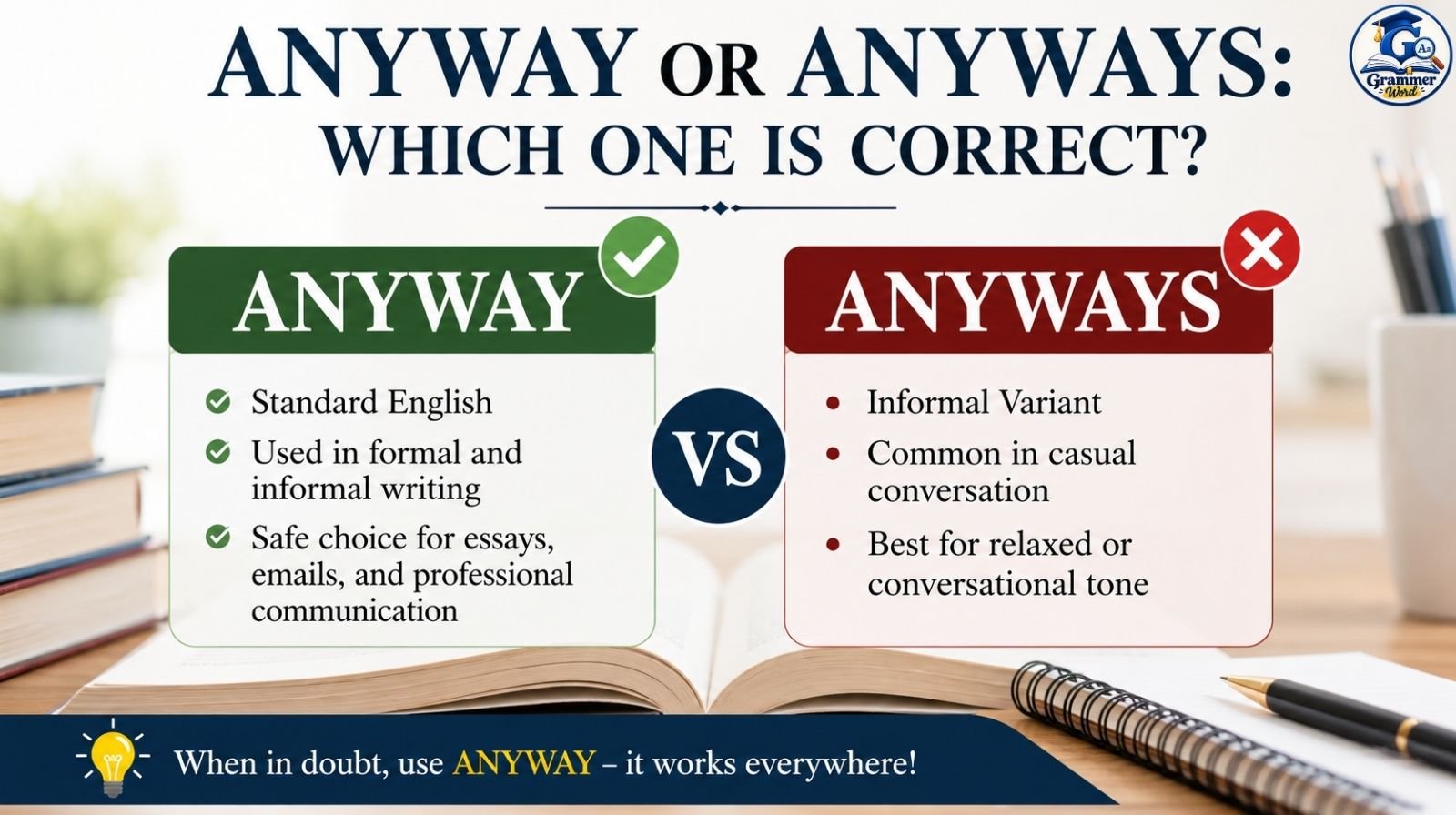
The short answer is simple: “Anyway” is the standard form and the safest choice in formal, academic, and professional English. “Anyways” is a real word, but it is generally informal and is particularly associated with North American English. Cambridge labels anyways as an informal US form of anyway, while Oxford similarly identifies it as informal North American English.
So, if you are writing an essay, business email, report, or professional article, choose anyway. In casual conversation, however, anyways can be perfectly natural.
Anyway vs. Anyways: The Quick Answer
Which one should you use?
Use “anyway” as your default choice.
| Word | Status | Best Use |
|---|---|---|
| anyway | Standard English | Formal and informal writing and speech |
| anyways | Informal variant | Casual speech and conversational writing |
Both words are dictionaries’ recognized forms. Merriam-Webster currently defines anyways as a US informal form meaning anyhow or anyway, while its entry for anyway gives meanings including “in any case” and “without regard to other considerations.”
Therefore, saying that “anyways” is not a word at all is too strong. It is a word but it carries a more informal tone.
What Does “Anyway” Mean?
Anyway is an adverb with several closely related uses. It can mean in any case, regardless, or despite that. It can also help a speaker return to a previous topic or move a conversation forward.
Anyway meaning “regardless”
Use anyway when something happens despite another fact or situation.
Examples:
- I was tired, but I went anyway.
- It was raining, but we played anyway.
- She knew it was difficult, but she tried anyway.
Here, anyway means something like “despite that” or “regardless.”
Anyway when changing the subject
You can also use anyway to return to a topic or move the conversation along.
Examples:
- Anyway, what were you saying?
- Anyway, let’s get back to work.
- Anyway, I need to leave now.
Cambridge identifies this conversational use explicitly: anyway can introduce a return to an earlier subject.
Anyway as an additional point
It can also introduce another consideration:
We don’t need a new laptop, and anyway, we can’t afford one.
In this sentence, anyway adds another reason supporting the speaker’s point.
Read More: Midday vs Mid Day: Which Spelling Is Correct In Modern English?
What Does “Anyways” Mean?
Anyways generally carries the same basic meaning as anyway, but its tone is different.
Cambridge defines anyways as an informal US form of anyway, while Merriam-Webster labels it US, informal.
Is “Anyways” a real word?
Yes.
This is one of the biggest misconceptions surrounding the word.
Merriam-Webster’s historical discussion explains that anyways has been used for centuries, with examples going back to the 13th century. Its modern conversational sense developed later, and the form continues to appear in contemporary usage.
So:
Anyways ≠ fake word
Instead:
Anyways = informal variant of anyway
When is “anyways” natural?
It can sound perfectly normal in relaxed conversation:
- Anyways, what are you doing tonight?
- I didn’t really like it anyways.
- Anyways, let’s move on.
- She was going to call me anyways.
The important point is context. A word can be grammatically recognized while still being unsuitable for a particular style of writing.
Anyway or Anyways: Which One Is Correct?
Anyway is the safer choice
If you are unsure which form to use, choose anyway.
It works in:
- Academic writing
- Business emails
- Professional articles
- Reports
- Essays
- Formal correspondence
- Everyday conversation
For example:
The results were unexpected, but we continued the experiment anyway.
This sentence works comfortably in both professional and everyday English.
Anyways is mainly informal
Anyways is better suited to casual communication:
Anyways, I’ll call you later.
That sentence sounds conversational. It would not necessarily be wrong, but anyway would be the more polished choice in formal writing.
Oxford’s dictionary likewise lists anyways as an informal North American form.
A simple rule to remember
Ask yourself:
“Would I use this sentence in a formal email or academic paper?”
If the answer is yes, use anyway.
If you’re writing dialogue, texting a friend, or deliberately using a relaxed conversational style, anyways can work.
Anyway vs. Anyways in American and British English
American English
Both forms can be encountered in American English, but they do not have exactly the same register.
Anyway remains the standard choice:
Anyway, I’ll see you tomorrow.
Anyways can give the sentence a more casual, conversational sound:
Anyways, I’ll see you tomorrow.
Merriam-Webster specifically classifies anyways as informal US English.
British English
Anyway is the much safer choice in British English, particularly in standard written English.
For example:
Anyway, let’s discuss the next point.
This sounds natural and standard.
Read More: Girlie or Girly: Which Word Is Correct? Meaning, Usage, Differences, And Examples For 2026
Canadian and other varieties
The use of anyways is not limited to one small group of speakers. Merriam-Webster’s usage discussion notes contemporary examples from Canada and India as well as North American usage.
That is another reason why calling anyways simply “wrong” does not accurately describe modern English.
Common Mistakes With Anyway and Anyways
Mistake 1: Saying “Anyways” is never correct
This is the biggest misconception.
Better understanding: Anyways is recognized as an informal variant, not an invented spelling.
Merriam-Webster continues to include it in its dictionary and provides contemporary examples, including examples dated 2025 and 2026.
Mistake 2: Using “anyways” in formal writing
Although understandable, it can make formal writing sound unnecessarily conversational.
Less suitable:
Anyways, the results demonstrate a clear difference.
Better:
Anyway, the results demonstrate a clear difference.
Mistake 3: Assuming the “s” makes it plural
Anyways is not the plural of anyway.
The -s is part of the informal adverbial form. You should not think of it as:
anyway + plural s = anyways
It is simply an established variant with a different stylistic profile.
Mistake 4: Confusing “anyway” with “any way”
These are different.
Anyway is an adverb:
I would do it anyway.
Any way means any method, manner, or means:
Is there any way to solve this problem?
That distinction is important because any way can be completely formal and grammatical when the two words genuinely function separately.
Real-Life Case Study: Why Context Matters
Imagine a university student named Sarah writing two different messages.
First, Sarah sends a text to her friend after discussing weekend plans:
“Anyways, I think I’ll just stay home tonight.”
There is nothing unusual about this choice in casual communication. The sentence sounds conversational and relaxed. Her friend understands exactly what she means.
Later, Sarah writes an academic assignment about study habits. She wants to conclude a paragraph by saying that students should continue studying despite distractions. She writes:
“Students may encounter many distractions, but they should continue studying anyways.”
The sentence is understandable, but the style is less appropriate for an academic paper. Sarah changes it to:
“Students may encounter many distractions, but they should continue studying anyway.”
The meaning has not changed. What changed is the register the level of formality appropriate for the situation.
This example demonstrates an important principle in English: correctness is sometimes about more than whether a dictionary recognizes a word. Good writing also depends on audience, purpose, tone, and context. Anyways is recognized by major dictionaries, but anyway is the stronger choice when Sarah wants her academic writing to sound standard and polished.
Read More: Skillset or Skill Set: Which Term Is Correct In Modern English?
2025–2026 Usage Snapshot
There is an important distinction between dictionary status and preferred formal usage.
Current dictionary evidence remains consistent in 2026:
- Merriam-Webster’s anyways entry was updated in February 2026 and continues to label it US, informal.
- Merriam-Webster’s anyway entry was updated in March 2026 and lists contemporary examples from 2026.
- Merriam-Webster’s current anyways example page includes examples dated 2025 and 2026, showing that the form remains actively used in contemporary English.
- Cambridge currently labels anyways US, informal, while its learner dictionary identifies it as spoken US usage.
What does this data tell us?
It does not mean that anyways has become the preferred standard form. Instead, the 2025–2026 evidence shows that anyways remains a living part of informal English while anyway continues to be the standard choice across formal contexts.
That distinction is much more useful than simply labeling one word “right” and the other “wrong.”
A Simple Step-by-Step Guide
Step 1: Identify your meaning
If you mean “regardless,” “despite that,” or “in any case,” you probably need anyway or its informal variant anyways.
Step 2: Consider your audience
Ask who will read or hear your sentence.
- Teacher → anyway
- Employer → anyway
- Client → anyway
- Academic reader → anyway
- Friend → anyway or anyways
Step 3: Consider the tone
For polished, standard English, choose anyway.
For deliberately casual conversation or dialogue, anyways may fit.
Step 4: When uncertain, choose “anyway”
This is the easiest rule.
Anyway is almost always the safer choice.
Examples: Anyway vs. Anyways
| Situation | Standard Choice | Example |
|---|---|---|
| Academic essay | anyway | The evidence remains important anyway. |
| Business email | anyway | Anyway, I’ll send the report tomorrow. |
| Formal report | anyway | The procedure was completed anyway. |
| Casual conversation | anyway / anyways | Anyways, what are we doing later? |
| Text message | anyway / anyways | I was tired anyways. |
| Character dialogue | anyway / anyways | “Anyways, let’s go.” |
| Professional presentation | anyway | Anyway, let’s move to the next point. |
Mini Quiz Anyway or Anyways
Quiz 1: Pick the Standard Word
Which word is the safest choice for formal English?
A) Anyways
B) Anyway
C) Anywhey
D) Any way
Answer: B) Anyway
Quiz 2: Casual Conversation
Which sentence sounds natural in casual conversation?
A) Anyways, what are you doing tonight?
B) Anywhey, what are you doing tonight?
C) Any way, what are you doing tonight?
D) Anywyes, what are you doing tonight?
Answer: A) Anyways, what are you doing tonight?
Quiz 3: Formal Writing
Choose the better word for an academic essay:
A) Anyways
B) Anyway
C) Anywhey
D) Anywase
Answer: B) Anyway
Quiz 4: Is It a Real Word?
Is “anyways” recognized as a word in modern English?
A) Yes, as an informal variant of anyway
B) No, it is always a spelling mistake
C) Yes, but only as a noun
D) No, dictionaries do not recognize it
Answer: A) Yes, as an informal variant of anyway
Quiz 5: Meaning Check
In “I was tired, but I went anyway,” what does “anyway” mean?
A) Before
B) Regardless
C) Immediately
D) Never
Answer: B) Regardless
Read More: Masonary vs Masonry: Which Spelling Is Correct And Why It Matters
Quiz 6: Choose the Correct Sentence
Which sentence uses “anyway” correctly?
A) I didn’t want to go, but I went anyway.
B) I didn’t want to go, but I went anywhey.
C) I didn’t want to go, but I went anywase.
D) I didn’t want to go, but I went anywyes.
Answer: A) I didn’t want to go, but I went anyway.
Quiz 7: Professional Email
Which sentence is more appropriate for a professional email?
A) Anyways, I’ll send the report tomorrow.
B) Anyway, I’ll send the report tomorrow.
C) Anywhey, I’ll send the report tomorrow.
D) Any way, I’ll send the report tomorrow.
Answer: B) Anyway, I’ll send the report tomorrow.
Quiz 8: Spot the Difference
What is the main difference between “anyway” and “anyways”?
A) Their basic meaning is completely different
B) “Anyways” is generally more informal
C) “Anyway” is only used in questions
D) “Anyways” is always formal
Answer: B) “Anyways” is generally more informal
Quiz 9: Complete the Sentence
“I know it’s difficult, but I’ll try ______.”
A) anyways
B) anyway
C) any way
D) anywhey
Answer: B) anyway
Quiz 10: American English
Which statement is most accurate?
A) “Anyways” is never used in American English
B) “Anyways” is commonly recognized as an informal US form
C) “Anyway” is incorrect in American English
D) “Anyways” is a formal academic term
Answer: B) “Anyways” is commonly recognized as an informal US form
Quiz 11: Any Way or Anyway?
Which sentence correctly uses “any way” as two words?
A) Is there any way to fix this?
B) Is there anyway to fix this?
C) I will finish it any way.
D) She went any way despite the rain.
Answer: A) Is there any way to fix this?
Quiz 12: Conversation Starter
Which word can naturally introduce a return to a topic?
A) Anyway
B) Anywhey
C) Anywayes
D) Anywayss
Answer: A) Anyway
Quiz 13: Best Choice for an Essay
You are writing a university essay. Which sentence is the better choice?
A) Anyways, the evidence is important.
B) Anyway, the evidence is important.
C) Anywhey, the evidence is important.
D) Any way, the evidence is important.
Answer: B) Anyway, the evidence is important.
Quiz 14: Quick Grammar Check
Which sentence is correct?
A) I was busy, but I called her anyways.
B) I was busy, but I called her anyway.
C) Both A and B can be used, but B is more standard.
D) Neither A nor B is correct.
Answer: C) Both A and B can be used, but B is more standard.
Quiz 15: Final Challenge
If you are unsure whether to use “anyway” or “anyways,” which is the best default choice?
A) Anyways
B) Any way
C) Anyway
D) Anywhey
Answer: C) Anyway
FAQs
Q1. Is “anyways” grammatically correct?
A: Yes, but it is informal. Major dictionaries recognize anyways as an informal variant of anyway. For formal writing, anyway is the safer standard choice.
Q2. Is “anyway” or “anyways” more correct?
A: Anyway is the standard form and is appropriate across formal and informal contexts. Anyways is an informal variant commonly associated with conversational English.
Q3. Can I use “anyways” in an essay?
A: It is generally better to use anyway in academic essays. Anyways can sound too conversational for formal academic writing.
Q4. Is “anyways” American English?
A: It is particularly associated with informal US English. Cambridge labels it US and informal, while Oxford describes it as informal North American English.
Q5. Do “anyway” and “anyways” mean the same thing?
A: Usually, yes. In modern informal usage, anyways generally has the same basic meaning as anyway, although its informal tone distinguishes it from the standard form.
Q6. What is the difference between “anyway” and “any way”?
A: Anyway is an adverb meaning in any case or regardless:
I’ll do it anyway.
Any way means any method or manner:
Is there any way to fix it?
Final Verdict:
So, anyway or anyways which one should you use?
The best default is anyway.
It is the standard form and works naturally in formal writing, academic English, professional communication, and everyday conversation. Anyways is also a recognized English word, but major dictionaries classify it as informal, particularly in US/North American usage.
The easiest rule is:
Formal or unsure? Use “anyway.” Casual conversation? “Anyways” can work.
Once you understand the difference between standard English and informal conversational usage, the choice becomes much easier.
If you’re trying to improve your English word choice, save this rule: when in doubt, go with “anyway.”
Keep learning with more easy grammar lessons on Grammer Word.com

Hi, I’m Noor Fatima, the person behind this website. I created this site to make English grammar and confusing words easier to understand. I love breaking down tricky words, meanings, spellings, and grammar rules into simple explanations. My goal is to help you learn English naturally, avoid common mistakes, and feel more confident every time you write or speak.