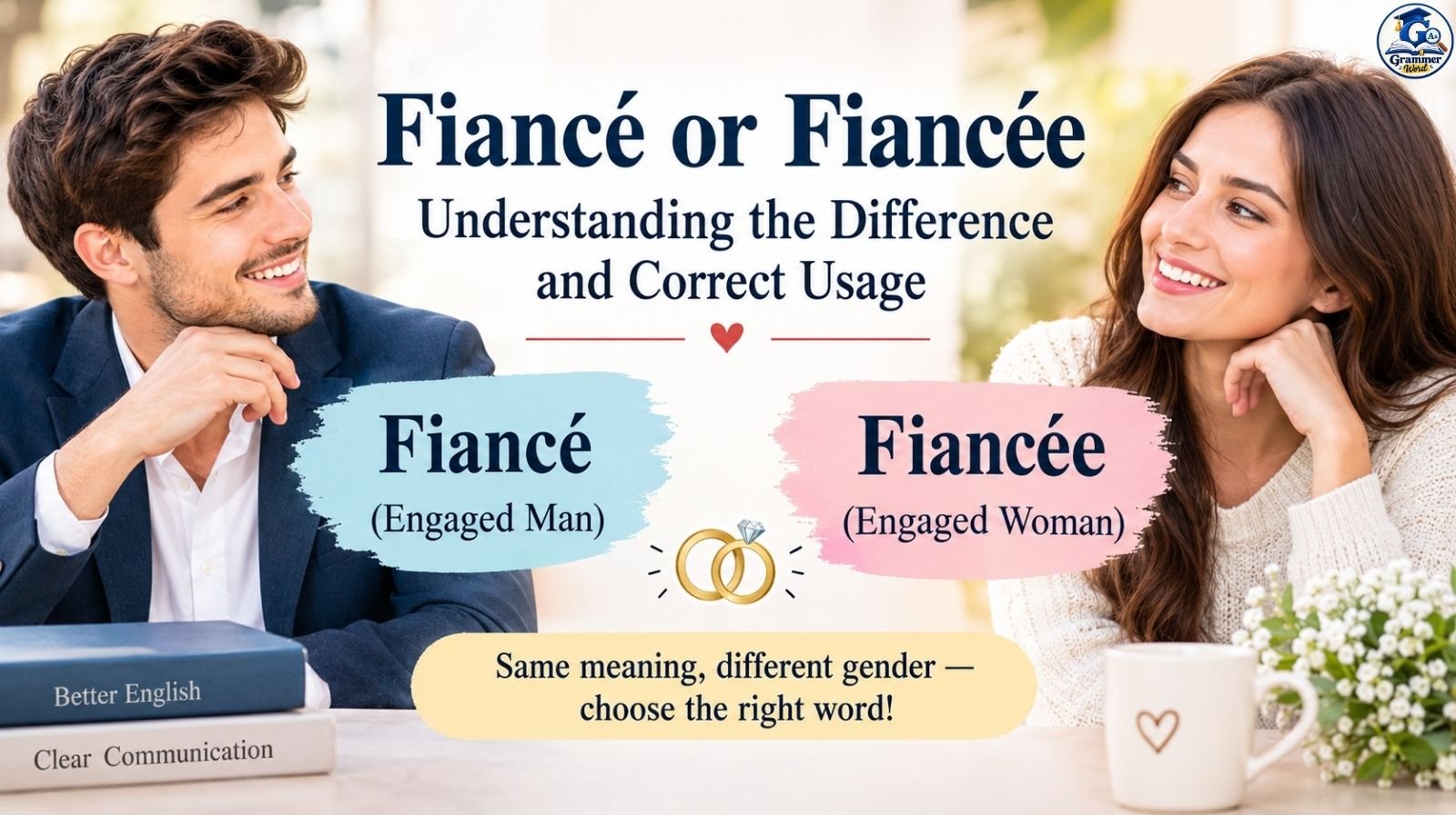
If you have ever wondered whether to write fiancé or fiancée, you are not alone. The two words look almost identical, sound nearly the same, and both describe someone who is engaged to be married. The key difference is traditionally gender: fiancé refers to an engaged man, while fiancée refers to an engaged woman. Cambridge Dictionary confirms this distinction in its current English definitions.
In this guide, you will learn the fiancé or fiancée difference, how to spell each word, how to pronounce them, when to use them, and how modern English sometimes uses fiancé more broadly.
Read More: Laid Off or Layed Off: Which One Is Correct?
What Is the Difference Between Fiancé and Fiancée?
The traditional distinction is straightforward:
- Fiancé = a man who is engaged to be married.
- Fiancée = a woman who is engaged to be married.
Cambridge Dictionary defines fiancé as a man who is engaged to be married and fiancée as a woman who is engaged to be married.
Fiancé Meaning
Fiancé is traditionally used for a man who has formally agreed to marry someone.
Example:
Sarah introduced her fiancé to her family.
Here, fiancé refers to Sarah’s male partner.
Another example:
My fiancé proposed to me last summer.
The speaker is referring to a man she plans to marry.
Fiancée Meaning
Fiancée is traditionally used for a woman who is engaged to be married.
Example:
Daniel introduced his fiancée to his friends.
Here, fiancée refers to Daniel’s female partner.
Another example:
His fiancée is helping plan the wedding.
So, the easiest distinction is:
One “e” at the end → traditionally male: fiancé
Two “e”s at the end → traditionally female: fiancée
Fiancé or Fiancée: Which Spelling Is Correct?
Both fiancé and fiancée are correct English words. The correct choice depends on the person you are describing.
Use Fiancé for a Man
Use fiancé when referring to a man who is engaged.
Examples:
- My fiancé works in London.
- Her fiancé bought the wedding rings.
- I met Emma’s fiancé yesterday.
- His fiancé is coming to dinner.
The spelling ends in -é:
fiancé
Use Fiancée for a Woman
Use fiancée when referring to a woman who is engaged.
Examples:
- His fiancée is a doctor.
- John’s fiancée loves photography.
- I spoke with her fiancée yesterday.
- Mark introduced his fiancée at the party.
The spelling ends in -ée:
fiancée
Is “Fiance” Without an Accent Correct?
You will frequently see fiance and fiancee written without accent marks, particularly in informal digital writing.
However, the traditional spellings are:
- fiancé
- fiancée
The accent marks come from French, where the words are gendered forms. Cambridge’s French-English dictionary identifies fiancé as masculine and fiancée as feminine.
For polished writing, keeping the accents is a good choice.
How to Remember the Fiancé vs Fiancée Difference
The spelling can be surprisingly easy to forget, but one simple memory trick helps.
Think “Fiancé = One Man”
Remember:
fiancé → one “e” at the end → traditionally a man
And:
fiancée → extra “e” → traditionally a woman
This is not a rule of English grammar in the same way as subject-verb agreement. It reflects the gender distinction inherited from French.
A Quick Comparison
| Word | Traditional meaning | Example |
|---|---|---|
| fiancé | Engaged man | Her fiancé is a teacher. |
| fiancée | Engaged woman | His fiancée is a lawyer. |
| fiance | Informal spelling without accent | My fiance is arriving. |
| fiancee | Informal spelling without accent | His fiancee called earlier. |
The accented forms are the standard traditional spellings.
How to Use Fiancé and Fiancée in Sentences
Knowing the definition is easy. Using the words naturally is where many writers hesitate.
Using Fiancé in a Sentence
Use fiancé as a noun when referring to an engaged man.
Examples:
I am meeting her fiancé tonight.
Her fiancé proposed during their vacation.
Maria’s fiancé is from Canada.
Notice that fiancé functions like an ordinary noun.
Using Fiancée in a Sentence
Use fiancée for an engaged woman.
Examples:
His fiancée is planning the wedding.
James introduced his fiancée to his colleagues.
My brother’s fiancée is studying medicine.
Again, the word simply identifies the person who is engaged.
Can Fiancé Be Used as a Gender-Neutral Word?
Modern English usage can be somewhat more flexible than the traditional French-based distinction.
Cambridge’s American Dictionary entry for fiancé also gives a broader definition: a person who has formally promised to marry another, while noting fiancée as the feminine form.
Therefore, context matters. If you are writing formal or carefully edited prose and you know the person’s gender, fiancé for a man and fiancée for a woman is the clearest traditional choice.
If you want completely gender-neutral wording, you can simply write:
They are engaged.
or:
My future spouse is coming to dinner.
Read More: Dreamt or Dreamed: Which One Is Correct?
Fiancé vs Fiancée: A Real-Life Usage Example
Imagine that Alex and Maya are engaged.
Alex is a man, while Maya is a woman.
If Maya is talking about Alex, she can say:
Alex is my fiancé.
If Alex is talking about Maya, he can say:
Maya is my fiancée.
The relationship is exactly the same. The word changes because the traditional forms identify the person being described.
Why This Confuses Writers
The pronunciation of fiancé and fiancée is essentially the same in modern English. Cambridge lists the same core pronunciation for the two forms, while their definitions distinguish the traditional masculine and feminine uses.
That means you cannot reliably hear the difference in ordinary conversation. The distinction mainly appears in writing and spelling.
This is why someone might know exactly what they mean but still hesitate when typing the word.
Fiancé or Fiancée in Modern English: 2025–2026 Data Snapshot
There is an important limitation when discussing statistics about these two words: major dictionaries and Google Trends do not publish a simple official statistic such as “X% of English speakers use fiancé and Y% use fiancée.”
Google Trends explains that its platform measures search interest and allows users to explore search behavior over time; it does not provide a dictionary-style percentage of correct versus incorrect usage.
What Current Reference Data Shows
As of 2026, current Cambridge Dictionary entries continue to recognize both forms:
- fiancé traditionally an engaged man.
- fiancée traditionally an engaged woman.
- Both are treated as established English vocabulary.
- The pronunciation is essentially the same in modern English.
- The distinction is primarily visible in spelling and traditional gendered usage.
This is useful for writers because it shows that the distinction has not disappeared from mainstream dictionary usage.
At the same time, the American Dictionary entry for fiancé demonstrates that broader, gender-neutral usage exists in contemporary English.
Practical takeaway: In 2025–2026 writing, use the traditional forms when you know the person’s gender and want maximum clarity; otherwise, choose a gender-neutral expression such as partner or person they are engaged to.
Common Mistakes With Fiancé and Fiancée
Mistake 1: Assuming They Are Two Different Relationships
They are not.
Both words describe someone who is engaged to be married. The traditional difference is the gender of the person being described.
Incorrect assumption:
A fiancé is someone you are dating seriously, while a fiancée is someone you are about to marry.
Correct understanding:
Both refer to an engaged partner.
Mistake 2: Using Fiancée for Every Woman Mentioned
The word fiancée does not mean “girlfriend.”
A woman is a fiancée only when she is engaged to be married.
Compare:
She is my girlfriend.
She is my fiancée.
The second sentence communicates a formal engagement.
Mistake 3: Using Fiancé for Every Romantic Partner
Similarly, fiancé does not simply mean boyfriend.
Boyfriend and fiancé describe different relationship stages.
My boyfriend lives nearby.
means the couple is dating.
My fiancé lives nearby.
means they are engaged to be married.
Mini Quiz Fiancé or Fiancée
Quiz 1: Pick the Right Word 💍
Sarah is engaged to John. What should Sarah call John?
A) Fiancée
B) Fiancé
C) Girlfriend
Answer: B) Fiancé Traditionally, fiancé refers to an engaged man.
Quiz 2: What About Her? 👰
David is engaged to Emma. What should David call Emma?
A) Fiancé
B) Fiancée
C) Boyfriend
Answer: B) Fiancée Fiancée traditionally refers to an engaged woman.
Raed More: Skillset or Skill Set: Which Term Is Correct In Modern English?
Quiz 3: One “E” or Two? ✍️
Which spelling traditionally refers to an engaged woman?
A) Fiancé
B) Fiancée
Answer: B) Fiancée The extra e marks the traditional feminine form.
Quiz 4: Spot the Correct Sentence 👀
Which sentence is correct?
A) Her fiancé is getting married next month.
B) Her fiancée is getting married next month.
Answer: A) Her fiancé is getting married next month. Here, fiancé refers to her male partner.
Quiz 5: Quick Gender Check ⚡
Which word traditionally means an engaged man?
A) Fiancée
B) Fiancé
Answer: B) Fiancé Think: fiancé = male.
Quiz 6: Complete the Sentence 🧩
“Maria introduced her ______ to her parents.”
Maria’s partner is a man.
A) fiancé
B) fiancée
Answer: A) fiancé A man who is engaged is traditionally called a fiancé.
Quiz 7: Complete the Sentence 💡
“James introduced his ______ at the family dinner.”
James’s partner is a woman.
A) fiancé
B) fiancée
Answer: B) fiancée A woman who is engaged is traditionally called a fiancée.
Quiz 8: Are They Different in Meaning? 🤔
Do fiancé and fiancée describe completely different relationships?
A) Yes
B) No
Answer: B) No Both describe someone who is engaged to be married. The traditional difference is gender.
Quiz 9: Pronunciation Challenge 🗣️
Are fiancé and fiancée generally pronounced differently in modern English?
A) Yes
B) No
Answer: B) No They are generally pronounced essentially the same.
Quiz 10: Fiancé or Boyfriend? 💑
Someone has formally agreed to marry his partner. Which word is more specific?
A) Boyfriend
B) Fiancé
Answer: B) Fiancé Fiancé specifically indicates an engaged male partner.
Quiz 11: Fiancée or Girlfriend? 💍
Someone has formally agreed to marry her partner. Which word is more specific?
A) Girlfriend
B) Fiancée
Answer: B) Fiancée Fiancée traditionally means an engaged woman.
Quiz 12: Find the Mistake 🔎
Which sentence uses the traditional form incorrectly?
A) My fiancé is planning our wedding.
B) My fiancée is planning our wedding.
The speaker’s partner is a man.
Answer: B) My fiancée is planning our wedding. If the partner is a man, the traditional spelling is fiancé.
Quiz 13: Accent Marks Matter? ✨
Which is the traditional spelling?
A) fiance
B) fiancé
Answer: B) fiancé The accented spelling is the traditional standard form.
Quiz 14: Gender-Neutral Choice 🌎
You don’t want to specify your partner’s gender. Which option works best?
A) Fiancé
B) Fiancée
C) Partner
Answer: C) Partner Partner is a simple gender-neutral alternative.
Quiz 15: Final Boss Quiz 🏆
Which statement is correct?
A) Fiancé = engaged woman
B) Fiancée = engaged man
C) Fiancé = traditionally engaged man; fiancée = traditionally engaged woman
Answer: C) Fiancé = traditionally engaged man; fiancée = traditionally engaged woman. That’s the key difference to remember!
Read More: Anyway or Anyways: Which One Is Correct?
FAQs
Q1. Is a fiancé a man or a woman?
A: Traditionally, fiancé refers to a man who is engaged to be married. Cambridge Dictionary gives this as its standard English definition.
Q2. Is a fiancée a man or a woman?
A: Traditionally, fiancée refers to a woman who is engaged to be married.
Q3. What is the easiest way to remember fiancé vs fiancée?
A: Remember that fiancé traditionally refers to a man, while fiancée traditionally refers to a woman. The extra e in fiancée can help you remember the feminine form.
Q4. Are fiancé and fiancée pronounced differently?
A: In modern English, they are generally pronounced essentially the same. Cambridge gives matching core pronunciation information for the two forms.
Q5. Can I write “fiance” without the accent?
A: You may see fiance without an accent in informal digital writing, but fiancé is the traditional standard spelling. The same applies to fiancée.
Q6. Is “fiancé” gender-neutral?
A: Usage can vary. Cambridge’s American Dictionary includes a broader definition of fiancé as a person who has formally promised to marry another, while also identifying fiancée as the feminine form.
For maximum clarity in traditional usage, however, fiancé is used for a man and fiancée for a woman.
Q7. What is the gender-neutral alternative to fiancé or fiancée?
A: You can use phrases such as partner, future spouse, or person they are engaged to when you do not want to specify gender.
Final Takeaway:
The fiancé or fiancée difference is simple once you remember the traditional distinction:
Fiancé = an engaged man
Fiancée = an engaged woman
Both words describe someone who is engaged to be married, and their pronunciation is essentially the same. The main difference appears in spelling and traditional gendered usage. Current Cambridge Dictionary entries continue to recognize this distinction in 2026, while also showing that broader usage exists in American English.
So, if you are writing a formal sentence and know the person is a man, choose fiancé. If the person is a woman, choose fiancée. If gender is irrelevant or unknown, simply use partner or future spouse.
Still unsure about another commonly confused English word? Keep exploring our grammar guides to find the correct spelling, meaning, and usage.
Authority References
Keep learning with more easy grammar lessons on Grammer Word.com

Hi, I’m Noor Fatima, the person behind this website. I created this site to make English grammar and confusing words easier to understand. I love breaking down tricky words, meanings, spellings, and grammar rules into simple explanations. My goal is to help you learn English naturally, avoid common mistakes, and feel more confident every time you write or speak.