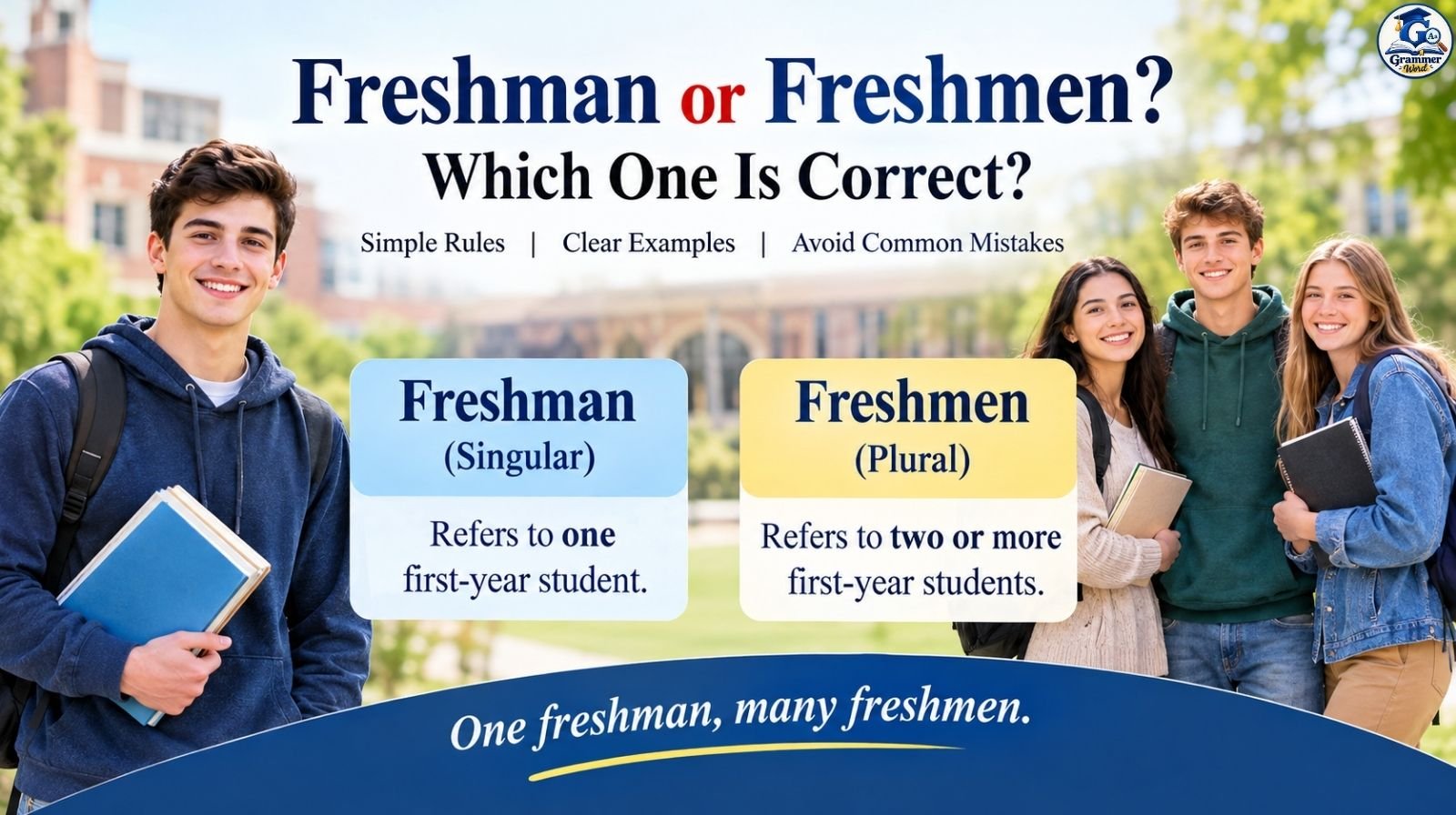
If you are unsure whether to write freshman or freshmen, you are not alone. The difference is simple once you understand whether you are talking about one first-year student or more than one.
The correct rule is:
- Freshman = singular
- Freshmen = plural
For example, “Maria is a freshman” is correct because Maria is one student. But “Maria and James are freshmen” is correct because the sentence refers to two students.
This guide explains the difference between freshman and freshmen, shows you how to use each word correctly, and covers an especially confusing point: why we say “freshman year” even when talking about an entire group.
What Is the Difference Between Freshman and Freshmen?
The main difference is number. Freshman is the singular noun, while freshmen is its plural form. Oxford lists freshmen as the plural of freshman, defining a freshman as a first-year student at a college, university, high school, or junior high school.
Freshman Means One Student
Use freshman when referring to one person in their first year.
Examples:
- Sarah is a freshman at the university.
- My brother became a freshman this year.
- I spoke with a freshman after class.
- Every freshman must attend orientation.
Notice the words a, one, and every naturally take the singular form.
Freshmen Means More Than One Student
Use freshmen when referring to two or more first-year students.
Examples:
- The freshmen attended orientation.
- Several freshmen joined the debate club.
- The university welcomed its new freshmen.
- Many freshmen live in the residence halls.
Cambridge Dictionary also gives freshmen as the plural form of freshman.
Freshman vs. Freshmen at a Glance
| Word | Number | Meaning | Example |
|---|---|---|---|
| freshman | Singular | One first-year student | She is a freshman. |
| freshmen | Plural | Two or more first-year students | They are freshmen. |
| freshman’s | Singular possessive | Something belonging to one freshman | The freshman’s book |
| freshmen’s | Plural possessive | Something belonging to multiple freshmen | The freshmen’s projects |
Is Freshman or Freshmen the Correct Plural?

Freshmen is the correct plural of freshman. The word freshmans is not the standard plural form.
Why Does Freshman Become Freshmen?
Freshman follows an irregular plural pattern similar to:
- man → men
- woman → women
- freshman → freshmen
Therefore:
one freshman → two freshmen
You do not normally add -s to make the plural.
For example:
❌ The college welcomed 500 freshmans.
✅ The college welcomed 500 freshmen.
Freshman vs. Freshmen: Common Mistakes
Here are some mistakes to avoid:
| Incorrect | Correct |
|---|---|
| She is a freshmen. | She is a freshman. |
| They are freshman. | They are freshmen. |
| Several freshman attended. | Several freshmen attended. |
| 200 freshmans enrolled. | 200 freshmen enrolled. |
| A freshmen student asked a question. | A freshman student asked a question. |
The easiest test is to identify whether you mean one or more than one.
Why Is “Freshman Year” Correct?
This is where things become slightly more interesting.
You may see both freshman and freshmen in the same sentence:
The freshmen enjoyed their freshman year.
At first, this can look inconsistent. It is actually correct.
Freshman Can Work as an Adjective
In expressions such as freshman year, freshman class, and freshman orientation, freshman functions as a modifier describing the type or stage of something.
For example:
- freshman year
- freshman class
- freshman orientation
- freshman seminar
- freshman dorm
- freshman course
University style guides specifically distinguish the singular noun freshman from the plural noun freshmen and note that freshman remains singular when used adjectivally.
Read More: Masonary vs Masonry: Which Spelling Is Correct And Why It Matters
Examples in Real Sentences
Correct:
The freshmen attended the freshman orientation.
Here, freshmen refers to the students, while freshman orientation names the type of orientation.
Another example:
The freshmen are finishing their freshman year.
Again, freshmen is plural because it refers to multiple students, while freshman year is a standard expression.
Freshman or Freshmen? A Simple Step-by-Step Guide

If you regularly confuse these words, use this quick method.
Step 1: Count the Students
Ask yourself: Am I talking about one student or multiple students?
If it is one:
freshman
If it is more than one:
freshmen
Step 2: Look for Number Words
Words such as a, one, each, and every generally point toward the singular:
Every freshman received an email.
Words such as many, several, two, hundreds, and all generally require the plural:
Several freshmen received awards.
Step 3: Check Whether the Word Modifies Another Noun
If freshman comes before another noun as a modifier, the singular form is normally used:
freshman year
freshman class
freshman orientation
A useful shortcut is:
One student = freshman
Multiple students = freshmen
Before another noun = usually freshman
Real-Life Example: A University Orientation Announcement
Imagine a university preparing its annual orientation program.
The communications team wants to publish this announcement:
“All freshman should report to the auditorium at 9 a.m.”
At first glance, the sentence may seem acceptable because everyone understands what it means. However, freshman is singular when used as a noun. Since the announcement is directed toward a group of students, freshmen is the appropriate noun:
All freshmen should report to the auditorium at 9 a.m.
Now consider the next sentence:
The freshmen will attend a freshman orientation session.
This sentence correctly uses both forms. Freshmen refers to the students attending the session, while freshman modifies orientation session.
Suppose the announcement continues:
Each freshman should bring a student ID.
Here, each focuses on students individually, so the singular freshman is correct.
This example demonstrates why simply memorizing “freshman means one and freshmen means many” is not always enough. You also need to recognize when freshman is functioning as a modifier.
The distinction is especially useful when writing college websites, student handbooks, emails, course descriptions, application materials, and orientation information. Using the correct form makes your writing clearer and more professional.
Read More: Girlie or Girly: Which Word Is Correct? Meaning, Usage, Differences, And Examples For 2026
Freshman vs. Freshmen: 2025–2026 Education Context

The distinction between these words remains relevant because millions of students enter or continue higher education every year.
Recent U.S. National Center for Education Statistics (NCES) data show substantial undergraduate enrollment. NCES’s Digest of Education Statistics reports approximately 16.4 million undergraduate students in 2025, with projections reaching about 16.6 million in 2026 in one of its enrollment series.
NCES also reports data specifically for first-time degree/certificate-seeking students, an important statistical category for understanding new entrants to postsecondary education.
These statistics help explain why terms describing first-year students remain common in educational writing. However, remember that “freshman” is a language term, not a statistical category. Educational institutions may use terms such as first-year student in official data or communications.
Freshman vs. First-Year Student
Modern institutions sometimes prefer first-year student because it is straightforward and avoids gendered wording associated with the -man ending.
For example:
Freshman students must complete orientation.
can be rewritten as:
First-year students must complete orientation.
Both can communicate the same basic idea, depending on the institution’s style.
Freshman vs. Freshmen: Comparison Checklist
Use this quick checklist whenever you’re unsure.
Use “Freshman” When:
- You mean one student.
- The sentence uses a or an.
- The sentence uses one, each, or every.
- You are using it as a modifier before another noun.
- You are talking about freshman year or a freshman class.
Use “Freshmen” When:
- You mean two or more students.
- The sentence uses many, several, or multiple.
- A specific number of students is involved.
- You are describing a group of first-year students.
Quick memory trick
One freshman, many freshmen just like one man, many men.
Mini Quizzes Freshman vs. Freshmen
Quiz 1: One Student, One Word
Which sentence is correct?
A. She is a freshmen.
B. She is a freshman.
C. She is freshmans.
D. She are a freshman.
Answer: B She is a freshman.
Quiz 2: A Whole Group
Choose the correct sentence:
A. The freshman attended the event.
B. The freshmans attended the event.
C. The freshmen attended the event.
D. The freshmanes attended the event.
Answer: C The freshmen attended the event.
Quiz 3: Quick Grammar Check
What is the plural of freshman?
A. Freshmans
B. Freshmanes
C. Freshmen
D. Freshman
Answer: C Freshmen.
Read More: Skillset or Skill Set: Which Term Is Correct In Modern English?
Quiz 4: Spot the Winner
Which sentence sounds grammatically correct?
A. Every freshman received an ID.
B. Every freshmen received an ID.
C. Every freshmans received an ID.
D. Every freshmanes received an ID.
Answer: A Every freshman received an ID.
Quiz 5: Two Students
John and Mike are both first-year students. Which sentence is correct?
A. John and Mike are freshman.
B. John and Mike are freshmen.
C. John and Mike are freshmans.
D. John and Mike is freshmen.
Answer: B John and Mike are freshmen.
Quiz 6: The “Year” Trick
Which phrase is correct?
A. Freshmen year
B. Freshmans year
C. Freshman year
D. Freshmanes year
Answer: C Freshman year.
Quiz 7: Fill It Naturally
“Sarah is a ______ at the university.”
A. freshmen
B. freshmans
C. freshman
D. freshmen student
Answer: C freshman.
Quiz 8: Group Alert!
“Several ______ joined the campus club.”
A. freshman
B. freshmen
C. freshmans
D. freshmanes
Answer: B freshmen.
Quiz 9: Which One Is the Mistake?
Which sentence contains an incorrect use of the word?
A. He is a freshman.
B. The freshmen arrived early.
C. Each freshman received a guide.
D. Five freshman joined the meeting.
Answer: D “Five freshmen joined the meeting” is correct.
Quiz 10: Freshman Class
Which phrase is standard?
A. Freshmen class
B. Freshman class
C. Freshmans class
D. Freshmanes class
Answer: B Freshman class.
Quiz 11: One or Many?
Which word should you use for one first-year student?
A. Freshmen
B. Freshman
C. Freshmans
D. Freshmen’s
Answer: B Freshman.
Quiz 12: One More Grammar Test
Which sentence is correct?
A. Many freshman attended orientation.
B. Many freshmen attended orientation.
C. Many freshmans attended orientation.
D. Many freshmanes attended orientation.
Answer: B Many freshmen attended orientation.
Quiz 13: Can You Catch It?
Choose the correct sentence:
A. The freshmen are enjoying their freshman year.
B. The freshman are enjoying their freshmen year.
C. The freshmans are enjoying their freshman year.
D. The freshmen is enjoying their freshman year.
Answer: A “Freshmen” refers to the students, while “freshman year” is the standard expression.
Quiz 14: “Every” Gives You a Clue
Which word fits best?
“Every ______ must attend orientation.”
A. freshmen
B. freshman
C. freshmans
D. freshmenes
Answer: B freshman.
Quiz 15: Final Challenge!
Which sentence uses both words correctly?
A. The freshman are meeting the freshmen class.
B. The freshmen are starting their freshman year.
C. The freshmans are starting their freshmen year.
D. The freshman are starting their freshman year.
Answer: B The freshmen are starting their freshman year.
Read More: Fiancé or Fiancée: Understanding The Difference And Correct Usage
FAQs
Q1. Is “freshman” singular or plural?
A: Freshman is singular. It refers to one first-year student at a school, college, or university.
Q2. What is the plural of freshman?
A: The correct plural is freshmen.
One freshman
Two freshmen
Freshmans is not the standard plural form.
Q3. Can “freshman” refer to a group?
A: Yes, when freshman is being used as a modifier.
For example:
The freshman class is meeting today.
Here, freshman describes class. But when referring directly to the students, use:
The freshmen are meeting today.
Q4. Is “freshman year” or “freshmen year” correct?
A: Freshman year is the standard expression.
I had a great freshman year.
Not:
❌ I had a great freshmen year.
The word freshman is functioning as a modifier.
Q5. Is “freshmen” gender-neutral?
A: In traditional American English, freshman and freshmen are established terms for first-year students and are not restricted to male students. However, some schools and universities prefer first-year student(s) as a more neutral modern alternative.
Q6. What is the difference between freshman and first-year student?
A: They generally refer to the same educational stage, particularly in U.S. English. Freshman is a traditional term, while first-year student is an increasingly common alternative in institutional and inclusive writing.
Final Answer:
The correct choice depends on how many students you mean.
- Freshman = one first-year student
- Freshmen = two or more first-year students
- Freshman year = the standard expression
- Freshman class = the standard expression
- Freshmans = incorrect as the standard plural
So, if you are writing about one student, choose freshman. If you’re talking about a group, choose freshmen.
The simplest rule to remember is:
One freshman, many freshmen.
Once you learn that pattern, choosing between freshman and freshmen becomes much easier.
Want to improve your English further? Save this guide for the next time you are writing an essay, school announcement, college application, or academic document and use the one-vs.-many rule to make the correct choice confidently.
Keep learning with more easy grammar lessons on Grammer Word.com

Hi, I’m Noor Fatima, the person behind this website. I created this site to make English grammar and confusing words easier to understand. I love breaking down tricky words, meanings, spellings, and grammar rules into simple explanations. My goal is to help you learn English naturally, avoid common mistakes, and feel more confident every time you write or speak.