Any time or anytime? Both forms are correct, but they are not always used in exactly the same way.
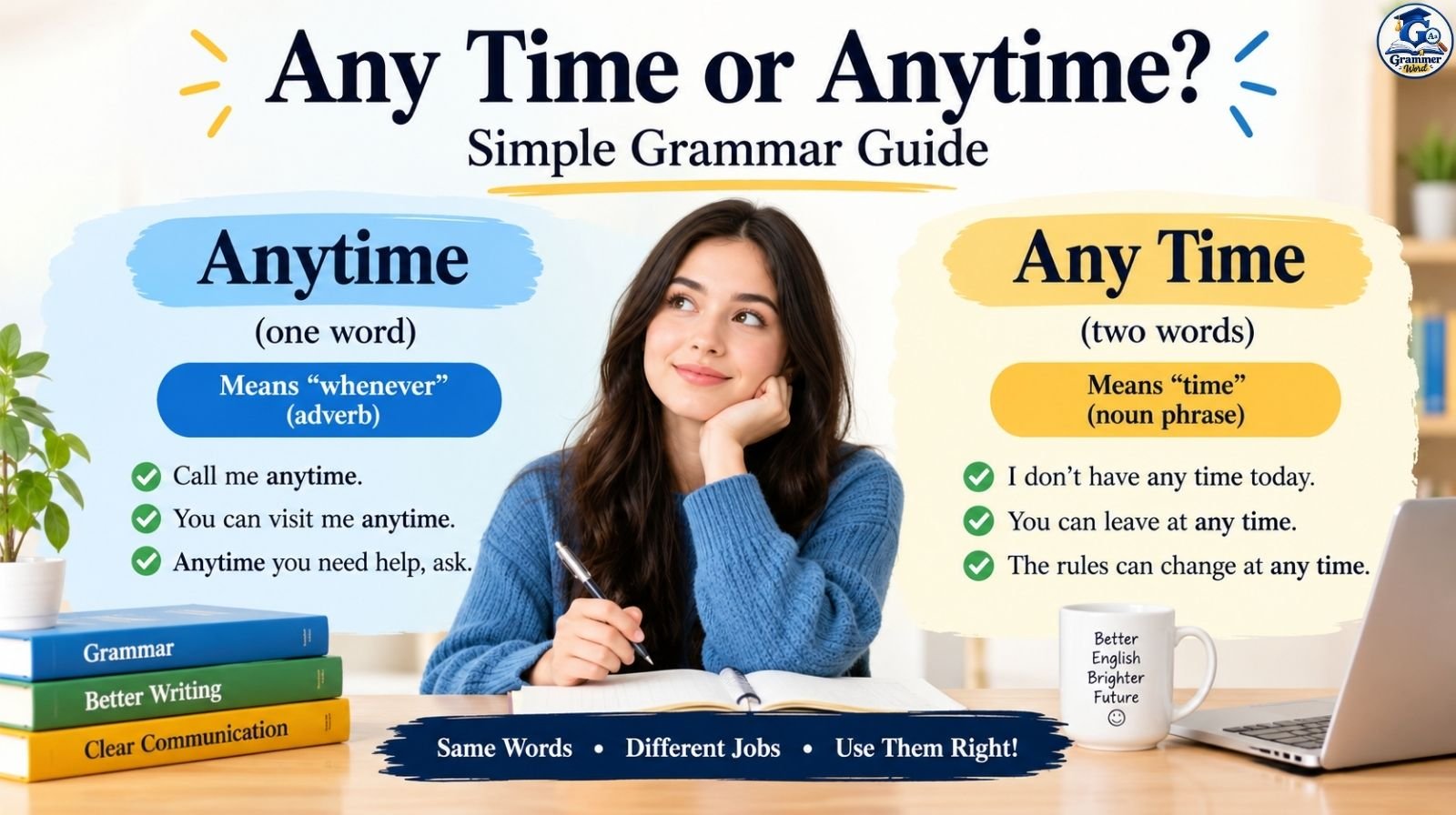
The easiest rule is this: use “anytime” when it works as an adverb meaning “whenever,” while “any time” is normally used when “time” functions as a noun phrase, especially after a preposition such as “at.”
For example:
- Call me anytime. ✅
- Call me at any time. ✅
- Call me at anytime. ❌
The difference seems small, but that single space can matter in certain sentences. Fortunately, once you understand the grammar behind the two forms, choosing the correct one becomes much easier.
Read More: Freshman or Freshmen: Which One Is Correct?
Any Time vs. Anytime: The Basic Difference
The words sound identical when spoken, which is one reason writers often confuse them. The distinction becomes clearer when you look at their grammatical roles.
What does “anytime” mean?
Anytime is generally an adverb meaning “whenever” or “at any time.”
Examples:
- You can call me anytime.
- Come over anytime.
- Anytime you need help, just ask.
- We can meet anytime next week.
Try replacing anytime with whenever:
You can call me whenever.
The sentence still works. That is a strong clue that anytime is appropriate.
Merriam-Webster defines anytime as an adverb meaning “at any time whatever,” and Cambridge also lists anytime as an adverb meaning a time that is not decided or does not need to be decided.
What does “any time” mean?
Any time is two words because time is functioning as a noun.
Examples:
- I don’t have any time today.
- Do you have any time to help me?
- We don’t have any time to waste.
- The machine may stop at any time.
Here, you are talking about time as a thing, amount, period, or particular point.
Compare:
I don’t have any time.
Here, “time” means an amount of available time.
But:
Call me anytime.
Here, “anytime” means whenever.
The quickest rule to remember
Use this simple test:
If you can replace “anytime” with “whenever,” use “anytime.”
- Visit me anytime. → Visit me whenever. ✅
- Call me anytime. → Call me whenever. ✅
If you are talking about an amount or particular point of time, any time is usually the better choice.
When to Use “Anytime”
Understanding when anytime works will make the difference much easier to recognize.
Use “anytime” to mean “whenever”
When the meaning is “whenever you want,” “whenever it happens,” or “at an unspecified time,” the one-word form is natural.
Examples:
- You can visit anytime.
- Email me anytime.
- Stop by anytime this afternoon.
- We can talk anytime you’re free.
- Anytime you feel confused, ask a question.
In each sentence, anytime functions adverbially.
“Anytime” is common in everyday English
The one-word form is especially natural in conversational and general-purpose writing.
For example:
“Thanks for your help!”
“Anytime!”
Here, anytime means something similar to “you’re welcome” or “whenever you need me.”
Merriam-Webster’s current dictionary entry also provides contemporary examples such as “You can call me anytime,” showing that the one-word form is established standard usage rather than simply a spelling mistake.
Read More: Fiancé or Fiancée: Understanding The Difference And Correct Usage
Examples of correct “anytime” usage
| Sentence | Why it works |
|---|---|
| Call me anytime. | Means “whenever.” |
| You can come anytime. | Means “whenever you want.” |
| Anytime you need help, ask. | Introduces a condition involving time. |
| We can leave anytime. | Means at any unspecified time. |
| Thanks! Anytime! | Common conversational response. |
When to Use “Any Time”
Now let’s look at situations where any time should remain two words.
Use “any time” after a preposition
One of the most useful rules is to write any time after at.
Correct:
- You can contact us at any time.
- The alarm may sound at any time.
- The rules can change at any time.
- You may leave at any time.
Incorrect in standard usage:
- You can contact us at anytime. ❌
- The alarm may sound at anytime. ❌
Why?
Because at is a preposition, and time is functioning as a noun in the phrase at any time.
Merriam-Webster specifically notes that any time is used as a noun phrase in constructions such as “at any time,” while anytime functions as an adverb.
Use “any time” when you mean an amount of time
When you’re discussing how much time someone has, needs, spends, or wastes, use the two-word form.
Examples:
- I don’t have any time today.
- She doesn’t have any time to rest.
- Do you have any time available?
- We shouldn’t waste any time.
- He needs any time he can get to finish the project.
Here, time is clearly a noun.
You can often test the sentence by asking:
“Am I talking about time as an amount or resource?”
If yes, any time is usually the right choice.
Use “any time” in formal constructions
In formal writing, phrases such as at any time are especially common and clear.
For example:
Customers may cancel their subscription at any time.
The company reserves the right to change these terms at any time.
This wording is straightforward and professional.
Any Time or Anytime: A Simple Comparison
The “whenever” test
The fastest practical test is to replace the expression with whenever.
Sentence:
You can call me anytime.
Test:
You can call me whenever.
The meaning remains essentially the same, so anytime works.
The “time as a noun” test
Now consider:
I don’t have any time today.
You cannot naturally replace any time with “whenever.”
You could say:
I don’t have whenever today. ❌
That tells you that any time is functioning as a noun phrase.
Read More: Dreamt or Dreamed: Which One Is Correct?
Side-by-side examples
| Correct sentence | Reason |
|---|---|
| Call me anytime. | “Whenever” works. |
| Call me at any time. | “Time” is a noun after “at.” |
| I don’t have any time. | Refers to an amount of time. |
| Come anytime you like. | Means “whenever you like.” |
| The problem can happen at any time. | Prepositional phrase. |
| We can meet anytime tomorrow. | Means at whatever time suits us. |
Common Mistakes With Any Time and Anytime
These mistakes are common because the two forms sound exactly alike.
Mistake 1: “At anytime”
Incorrect:
Please contact us at anytime.
Better:
Please contact us at any time.
The preposition at strongly signals the two-word construction.
Mistake 2: “I don’t have anytime”
Incorrect:
I don’t have anytime to finish this.
Correct:
I don’t have any time to finish this.
Here, you are talking about an amount of available time.
Mistake 3: Assuming the two forms are always interchangeable
They overlap in some adverbial contexts, but they aren’t identical in every grammatical construction.
For example:
1.You can visit anytime. ✅
2.You can visit any time. ✅
Both can work here.
But:
You can visit at any time. ✅
The phrase after at is normally written as any time, not anytime.
Mistake 4: Thinking “anytime” is always informal or incorrect
That is also an oversimplification.
Modern dictionaries recognize anytime as an established adverb. Cambridge lists it as an English adverb, while Merriam-Webster has a dedicated dictionary entry and gives contemporary examples.
The real question isn’t simply “Is anytime correct?”
The better question is:
What grammatical job is the expression doing in this sentence?
A Real-Life Example: Editing a Customer Service Message
Imagine you’re editing a company’s website.
The original message says:
“You can contact our support team at anytime if you have a problem.”
At first glance, the sentence looks perfectly normal because anytime and any time sound exactly the same.
However, an editor notices the phrase “at anytime.”
The revised version becomes:
“You can contact our support team at any time if you have a problem.”
Read More: Skillset or Skill Set: Which Term Is Correct In Modern English?
Why make the change?
The phrase begins with the preposition at, and any time is functioning as the noun phrase that follows it.
Now imagine a different sentence on the same website:
“Anytime you have a problem, our support team is ready to help.”
Here, anytime works naturally because it introduces the meaning “whenever you have a problem.”
This example shows why blindly replacing every occurrence with one spelling is a poor editing strategy. A careful writer looks at the grammar and meaning of the entire sentence, not just the appearance of the word.
This distinction is particularly useful for website copy, customer-service pages, emails, school assignments, and professional documents. A one-word/two-word decision may look tiny, but consistently choosing the form that fits the sentence makes writing cleaner and more polished.
2025–2026 Usage and Reference Snapshot
There isn’t a meaningful universal percentage showing how often English writers choose anytime over any time across every country, genre, and publication. Usage varies by context, region, and editorial style.
However, current reference sources provide useful evidence about modern English usage:
- Merriam-Webster’s 2026 dictionary entry lists anytime as an established adverb meaning “at any time whatever” and includes contemporary examples. Its entry was updated in February 2026.
- Cambridge Dictionary’s current entry defines anytime as an adverb and explicitly notes that British English also uses any time.
- Google Search Central’s December 2025 guidance emphasizes that useful, reliable, people-first content should be created primarily to help readers rather than manipulate search rankings. That principle supports explaining grammar through genuine examples and clear answers rather than repeating a keyword unnecessarily.
So, the 2025–2026 takeaway is simple: anytime is an established English word, but any time remains essential when “time” functions as a noun, particularly in constructions such as “at any time.”
A Step-by-Step Guide to Choosing the Correct Form
When you’re unsure whether to write anytime or any time, follow these steps.
Step 1: Look for “at”
If the phrase is:
at + ___
choose:
at any time
Example:
You may cancel at any time.
Step 2: Try replacing “anytime” with “whenever”
If the substitution works naturally, anytime is usually a good choice.
Call me anytime.
→ Call me whenever.
Step 3: Ask whether “time” means an amount
If you’re talking about available, required, wasted, or sufficient time, choose any time.
I don’t have any time to cook.
Step 4: Read the complete sentence
Don’t make the decision based only on the words next to each other. Consider the grammatical role and intended meaning.
Read More: Whoever or Whomever: A Complete Guide To Correct Usage
Quick checklist
- Means “whenever”? → anytime
- After “at”? → any time
- Means an amount of time? → any time
- Used as an adverb? → anytime is usually natural
- Formal phrase such as “at any time”? → any time
Mini Quiz Any Time or Anytime
Quiz 1: Quick Choice
Which sentence is correct?
A. Call me at anytime.
B. Call me anytime.
C. Call me anytimes.
D. Call me an anytime.
Answer: B Call me anytime.
“Anytime” works here because it means “whenever.”
Quiz 2: Spot the Grammar
Choose the correct sentence:
A. You can visit me anytime.
B. You can visit me anytimes.
C. You can visit me at anytime.
D. You can visit me any timeing.
Answer: A You can visit me anytime.
“Anytime” is correct when it means “whenever.”
Quiz 3: The “At” Rule
Which phrase is correct?
A. at anytime
B. at any time
C. at anytimes
D. at anytime time
Answer: B at any time
After the preposition “at,” use the two-word form any time.
Quiz 4: Amount of Time
Which sentence correctly refers to an amount of time?
A. I don’t have anytime today.
B. I don’t have any time today.
C. I don’t have anytimes today.
D. I don’t have an anytime today.
Answer: B I don’t have any time today.
Here, “time” is a noun referring to available time.
Quiz 5: Replace It!
Which word can replace “anytime” in this sentence?
“You can call me anytime.”
A. never
B. whenever
C. yesterday
D. rarely
Answer: B whenever
“You can call me whenever” keeps the same basic meaning.
Quiz 6: Fill the Gap
Choose the best option:
“Come ______ you like.”
A. anytime
B. anytimes
C. at anytime
D. an time
Answer: A anytime
“Anytime you like” means “whenever you like.”
Quiz 7: Formal Writing Check
Which sentence is best in standard edited English?
A. You may leave at anytime.
B. You may leave at any time.
C. You may leave at anytimes.
D. You may leave anytime time.
Answer: B You may leave at any time.
The standard phrase after “at” is at any time.
Quiz 8: Which One Means “Whenever”?
Which expression can mean “whenever”?
A. any time
B. anytime
C. timed
D. times
Answer: B anytime
“Anytime” can function as an adverb meaning “whenever.”
Quiz 9: Don’t Waste It!
Choose the correct sentence:
A. Don’t waste anytime.
B. Don’t waste any time.
C. Don’t waste anytimes.
D. Don’t waste an anytime.
Answer: B Don’t waste any time.
Here, “time” is a noun, so the correct form is any time.
Quiz 10: Customer-Service English
Which sentence would be correct on a website?
A. Contact us at anytime.
B. Contact us at any time.
C. Contact us at anytimes.
D. Contact us an any time.
Answer: B Contact us at any time.
The phrase at any time is the standard construction.
Quiz 11: Casual Conversation
Someone says, “Thanks for helping me!”
What is a natural reply?
A. Any time!
B. Anytime!
C. Both can be used.
D. Any times!
Answer: C Both can be used.
“Anytime!” is a common conversational response, while “Any time!” is also found in this expression.
Quiz 12: Grammar Detective
Which sentence uses any time correctly?
A. I don’t have any time to finish it.
B. I don’t have anytime to finish it.
C. I don’t have anytimes to finish it.
D. I don’t have an any time to finish it.
Answer: A I don’t have any time to finish it.
The sentence refers to an amount of available time.
Quiz 13: One Word or Two?
Choose the correct form:
“We can meet ______ next week.”
A. anytimes
B. anytime
C. an ytime
D. any timeing
Answer: B anytime
Here, “anytime” means at whatever time is convenient.
Quiz 14: True or False?
“At anytime” is the standard form in edited English.
A. True
B. False
Answer: B False
The standard form is “at any time.”
Quiz 15: The Golden Rule
Which rule is easiest to remember?
A. Anytime always means an amount of time.
B. Any time is always one word.
C. Anytime often means “whenever”; any time refers to time as a noun.
D. Both forms are always interchangeable.
Answer: C
A simple memory trick is: “Anytime = whenever; any time = time.”
FAQs
Q1. Is “anytime” one word or two?
A: Both anytime and any time are correct, depending on the sentence. Anytime is commonly used as an adverb meaning “whenever,” while any time is a noun phrase used in constructions such as “at any time” or “I don’t have any time.”
Q2. Is “at anytime” correct?
A: In standard edited English, use “at any time,” not “at anytime.”
For example:
You can contact us at any time. ✅
Q3. Is “call me anytime” correct?
A: Yes. “Call me anytime” is correct and natural. Here, anytime means “whenever.”
Q4. Is “I don’t have anytime” correct?
A: No, not when you mean that you have no available time.
Use:
I don’t have any time.
Q5. Can “any time” and “anytime” be interchangeable?
A: Sometimes, especially when they function adverbially.
For example:
Come anytime.
and
Come any time.
can both be found in English.
However, they are not interchangeable in every construction. At any time is the standard form after the preposition at.
Q6. Which is better for formal writing: “any time” or “anytime”?
A: It depends on the grammar. Don’t automatically replace anytime with any time simply because the writing is formal. If anytime is correctly functioning as an adverb, it is an established word. However, formal constructions such as “at any time” should retain the two-word form.
Q7. What is the easiest way to remember the difference?
A: Remember:
Anytime = whenever.
Any time = time as a noun.
And remember the especially useful pattern:
at any time ✅
at anytime ❌
Final Takeaway:
The answer to “any time or anytime?” is both but use them according to their grammatical role.
Use anytime when it means “whenever”:
You can call me anytime.
Use any time when time is functioning as a noun, especially after a preposition:
You can call me at any time.
And when you’re talking about an amount of available time:
I don’t have any time today.
The best rule to remember is simple: “Anytime” means whenever; “any time” refers to time. Once you apply that distinction, this commonly confused pair becomes much easier to use correctly.
If this guide helped you understand the difference, save the “anytime = whenever / any time = time” rule and use it the next time you’re proofreading an email, article, assignment, or professional document.
Authoritative References
Keep learning with more easy grammar lessons on Grammer Word.com

Hi, I’m Noor Fatima, the person behind this website. I created this site to make English grammar and confusing words easier to understand. I love breaking down tricky words, meanings, spellings, and grammar rules into simple explanations. My goal is to help you learn English naturally, avoid common mistakes, and feel more confident every time you write or speak.