If you often pause and wonder whether to write your or you’re, you are not alone. These two words sound almost identical when spoken, but they have completely different grammatical jobs. Knowing the difference between your and you’re is actually simple once you learn one reliable test.
In this guide, you’ll learn what your means, what you’re means, when to use each one, common mistakes to avoid, and a quick trick that can help you choose the correct word almost every time.
Your vs You’re: What Is the Difference?
The easiest way to remember the difference is this:
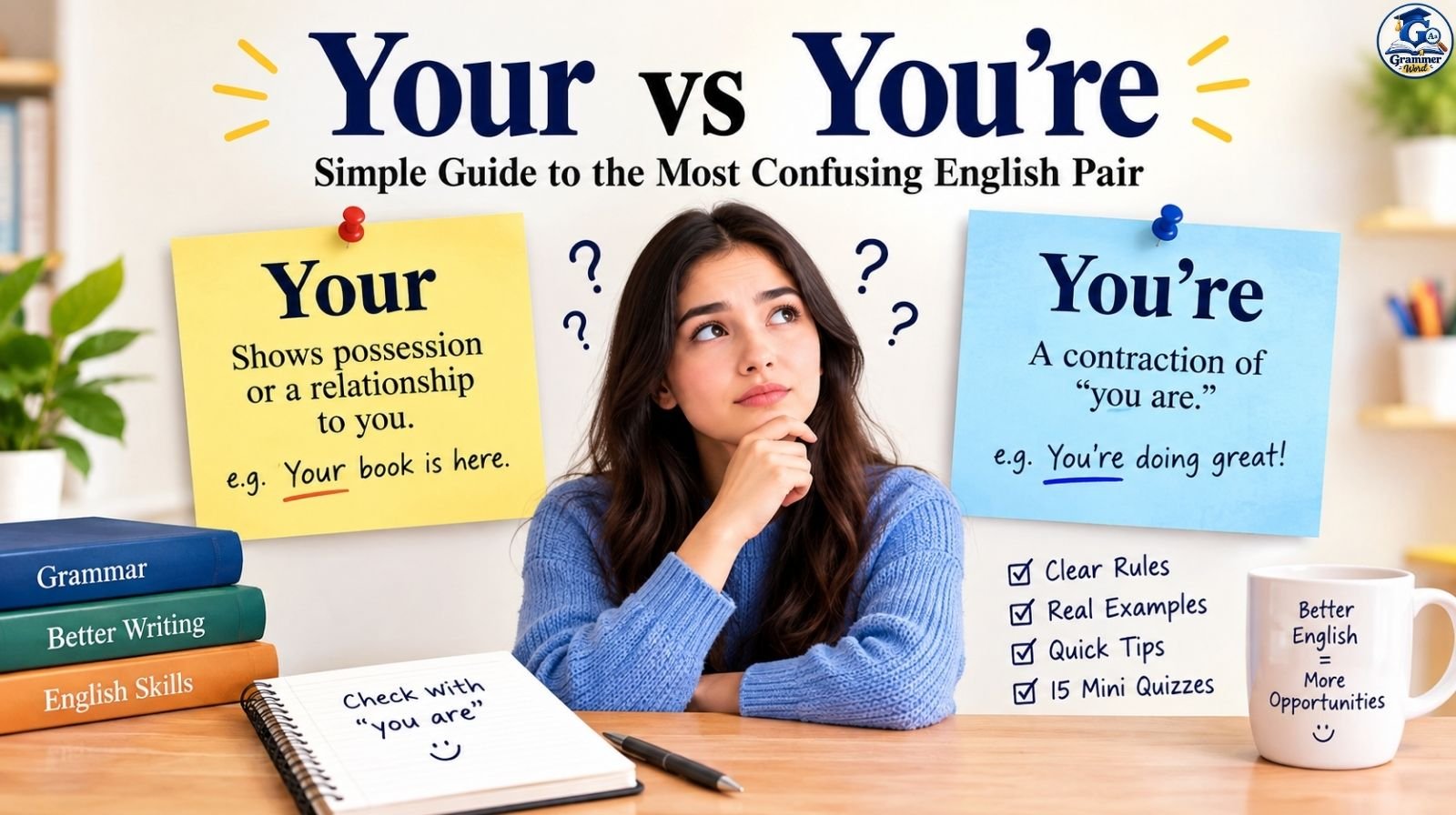
- Your shows possession or a relationship to something belonging to or associated with you.
- You’re is a contraction of you are.
Merriam-Webster gives the same basic distinction: you’re means “you are,” while your expresses something belonging or relating to you.
What Does “Your” Mean?
Your is a possessive determiner. It normally comes before a noun and tells us that something belongs to, relates to, or is associated with the person being addressed.
Examples:
- Your phone is ringing.
- I like your idea.
- Where is your brother?
- Please check your email.
- Your answer was correct.
Think of your as answering a question such as:
“Whose?”
For example:
Whose phone is this?
→ It is your phone.
The British Council also lists your as the possessive form associated with you and gives examples such as “your sister” and “your house.”
What Does “You’re” Mean?
You’re is a contraction of you are.
The apostrophe represents letters removed from the original phrase.
You are → You’re
Examples:
- You’re very kind.
- You’re doing a great job.
- You’re ready to leave.
- You’re going to enjoy this book.
- You’re correct.
Merriam-Webster defines you’re specifically as the contraction meaning “you are.”
The “You Are” Test
Here is the easiest your vs you’re test:
Replace the word with “you are.”
If the sentence still makes sense, use you’re.
If it does not make sense, use your.
For example:
You’re doing well.
Replace you’re:
You are doing well.
The sentence still works, so you’re is correct.
Now try:
I like your new jacket.
Replace your:
I like you are new jacket.
That does not work, so your is correct.
This substitution method is also recommended by Merriam-Webster as a practical way to distinguish the two words.
How to Use Your Correctly
Use your when you are talking about something that belongs to or is connected with the person you are addressing.
Your + Noun
One of the most useful patterns to remember is:
your + noun
Examples:
- your car
- your house
- your name
- your computer
- your opinion
- your friend
- your work
- your question
Consider these sentences:
Please bring your notebook tomorrow.
What is your opinion?
I like your new shoes.
In each sentence, your identifies something connected to the person being addressed.
Read More: Any Time or Anytime: Which One Is Correct?
Your Can Show More Than Ownership
Although people often describe your as showing possession, it can also express a relationship or association.
For example:
What is your favorite movie?
A movie does not literally belong to you. Instead, your tells us that the preference belongs to you.
Similarly:
Your doctor will call you tomorrow.
The doctor does not necessarily belong to you. The word your simply identifies the doctor associated with you.
Common Mistakes With Your
A frequent mistake is using you’re when your is needed.
Incorrect:
I like you’re new car.
Why is it wrong?
Replace you’re with you are:
I like you are new car.
That makes no grammatical sense.
Correct:
I like your new car.
Another example:
❌ You’re phone is ringing.
✅ Your phone is ringing.
The word before phone needs to show possession, so your is correct.
How to Use You’re Correctly
Use you’re whenever you mean you are.
You’re + Adjective
A common structure is:
you’re + adjective
Examples:
- You’re happy.
- You’re helpful.
- You’re talented.
- You’re late.
- You’re ready.
- You’re responsible.
Each one can be expanded:
You’re talented.
→ You are talented.
You’re ready.
→ You are ready.
You’re responsible.
→ You are responsible.
You’re + Verb
You’re can also appear before a verb ending in -ing.
Examples:
- You’re working hard.
- You’re learning quickly.
- You’re making progress.
- You’re improving every day.
- You’re reading an interesting article.
For example:
You’re learning the difference between these words.
Expanding the contraction gives:
You are learning the difference between these words.
Because the expanded version works, you’re is correct.
Read More: Freshman or Freshmen: Which One Is Correct?
You’re + Other Complements
You’re is not limited to adjectives or -ing verbs.
Examples include:
You’re a good friend.
You’re the person I was looking for.
You’re in the right place.
In every case, you’re can be replaced by you are.
Your vs You’re: Easy Comparison Table
| Word | Meaning | Grammar | Example |
|---|---|---|---|
| Your | Belonging or relating to you | Possessive determiner | Your book is here. |
| You’re | You are | Contraction | You’re reading a book. |
The simplest distinction is:
Your = belonging to you
You’re = you are
Compare These Sentences
Your answer is correct.
Here, your describes the answer associated with you.
You’re correct.
Here, you’re means you are.
Another pair:
I like your dress.
You’re wearing a beautiful dress.
And another:
Your children are very polite.
You’re raising your children well.
The words may sound similar, but their grammatical roles are different.
A Real-Life Example: Why Your vs You’re Matters
Imagine that Sarah is applying for a new job. She sends an email to a potential employer after an interview.
Her first draft says:
“Thank you for you’re time. I enjoyed speaking with you, and I hope your interested in my application.”
There are two mistakes.
The first should be:
“Thank you for your time.”
Why? Sarah is referring to the recipient’s time. Your shows association or possession.
The second should be:
“I hope you’re interested in my application.”
Why? Sarah means:
“I hope you are interested in my application.”
Therefore, you’re is correct.
Now imagine Sarah corrects the email:
“Thank you for your time. I enjoyed speaking with you, and I hope you’re interested in my application.”
The meaning is immediately clear.
This small correction matters because professional writing is often judged not only by the ideas being communicated but also by clarity and attention to detail. A 2025 discussion of common writing mistakes likewise identifies confusion between your and you’re as a recurring error and recommends the “you are” substitution test.
The lesson is not that one grammar mistake automatically makes someone a poor writer. People make typing mistakes, especially when writing quickly. Instead, the useful habit is to proofread sentences where two words sound alike but have different meanings.
Your vs You’re in Everyday English
The confusion appears in many types of writing, including texts, emails, school assignments, social media posts, workplace communication, and online comments.
In Text Messages
Informal writing is fast, so mistakes can happen easily.
Incorrect:
Your coming tonight?
Correct:
You’re coming tonight?
The corrected sentence means:
You are coming tonight?
But:
Is this your bag?
Here, your is correct because the bag is associated with the person being addressed.
In Emails
Professional emails deserve extra attention.
Incorrect:
Thank you for you’re help.
Correct:
Thank you for your help.
Why?
“Your help” means the help provided by or associated with the recipient.
Another example:
You’re welcome to contact me if you have questions.
Here, you’re means you are.
HubSpot’s writing guidance emphasizes clear, conversational communication in professional emails, while its etiquette guidance specifically identifies confusion between your and you’re among common grammar mistakes.
In Academic Writing
The same rules apply in essays, assignments, reports, and applications.
For example:
❌ Your expected to explain the results.
✅ You’re expected to explain the results.
The correct version expands to:
You are expected to explain the results.
Read More: Fiancé or Fiancée: Understanding The Difference And Correct Usage
Another example:
❌ Check you’re references carefully.
✅ Check your references carefully.
Here, references are associated with the reader, so your is correct.
Common Your vs You’re Mistakes to Avoid
“Your Welcome” vs “You’re Welcome”
One of the most recognizable mistakes is:
❌ Your welcome.
The standard expression is:
✅ You’re welcome.
Why?
You’re welcome = You are welcome.
The phrase does not mean that a welcome belongs to you. It uses the contraction you’re.
Merriam-Webster also lists “you’re welcome” as the standard expression used in response to thanks.
“Your Right” vs “You’re Right”
Both versions can technically appear in English, but they mean different things.
You’re right.
Means:
You are right.
But:
Your right hand is injured.
Here, your shows the hand is associated with you.
Therefore:
- You’re right. ✅
- Your right hand hurts. ✅
“Your Going” vs “You’re Going”
This is another common error.
❌ Your going to love it.
Correct:
✅ You’re going to love it.
Expansion:
You are going to love it.
But:
I like your way of explaining things.
Here, your is correct because it describes the noun phrase way of explaining things.
“I Appreciate You’re Help” vs “I Appreciate Your Help”
Correct:
I appreciate your help.
Incorrect:
I appreciate you’re help.
The test makes the answer obvious:
I appreciate you are help.
That does not work.
So use:
I appreciate your help.
The Fastest Way to Remember Your vs You’re
If you only remember one rule, remember this:
Use “You’re” If “You Are” Works
Try this every time you hesitate.
Example:
___ going to be late.
Test:
You are going to be late.
It works.
Therefore:
You’re going to be late.
Now:
I like ___ new car.
Test:
I like you are new car.
It fails.
Therefore:
I like your new car.
Read More: Anyway or Anyways: Which One Is Correct?
Use “Your” for Something Connected to You
Ask:
“Is this describing something that belongs to or relates to you?”
If yes, your is usually the correct choice.
Examples:
- your name
- your family
- your idea
- your job
- your house
- your question
- your opinion
A Three-Second Checklist
Before submitting an important piece of writing:
- Find your and you’re.
- Replace you’re with you are.
- If the sentence still makes sense, keep you’re.
- If it does not, check whether your is needed.
This simple proofreading habit can catch many mistakes without requiring a complicated grammar analysis.
Your vs You’re: 2025–2026 Usage Snapshot
There is an important distinction between current usage evidence and invented statistics.
As of 2026, authoritative grammar references continue to define the distinction consistently: your expresses possession or association, while you’re means you are. Merriam-Webster’s current dictionary entries maintain these definitions, and the British Council continues to teach your as the possessive form associated with you.
Recent 2025 material also continues to treat your vs you’re as a recurring English-writing problem. For example, a 2025 grammar guide specifically identifies mixing up these words as a common mistake and recommends replacing you’re with you are as the correction method.
An older but frequently cited survey from Tidio provides a useful numerical perspective: in its sample, 92.53% of respondents who noticed a presented your/you’re error identified it, while 85.16% of those respondents considered the mistake irritating or highly irritating. This is not a 2025–2026 population-wide statistic, so it should not be presented as current prevalence data; it is better understood as historical evidence that readers notice this particular error.
The practical 2026 takeaway: there is no need to memorize a complicated statistical rule. Current authoritative references still support the same simple grammatical distinction, and recent educational material continues to teach the “you are” test.
Mini Quiz: Your vs You’re
1. Quick Pick: Your or You’re?
Choose the correct word:
___ going to love this article.
A) Your
B) You’re
Answer: You’re
Because you’re = you are: “You are going to love this article.”
2. Spot the Possession
Which sentence is correct?
A) I like you’re new phone.
B) I like your new phone.
Answer: B — I like your new phone.
Your shows that the phone belongs to or is associated with you.
3. The Famous Mistake
Which one is correct?
A) Your welcome.
B) You’re welcome.
Answer: B — You’re welcome.
You’re means you are, so “You’re welcome” is correct.
4. Try the “You Are” Trick
Choose the correct option:
___ doing a great job.
A) Your
B) You’re
Answer: You’re
“You are doing a great job” works perfectly, so you’re is correct.
5. Which One Sounds Right?
Where is ___ backpack?
A) your
B) you’re
Answer: Your
The backpack is associated with you, so we use your.
Read More: Skillset or Skill Set: Which Term Is Correct In Modern English?
6. Catch the Grammar Slip
Which sentence has the mistake?
A) Your answer is helpful.
B) You’re answer is helpful.
Answer: B — You’re answer is helpful.
The correct sentence is “Your answer is helpful.” The word your comes before a noun and shows association.
7. Fill the Gap Fast!
I think ___ right.
A) your
B) you’re
Answer: You’re
“I think you are right” makes sense, so you’re is correct.
8. One-Second Grammar Test
Please bring ___ notebook tomorrow.
A) your
B) you’re
Answer: Your
A notebook is associated with the person being addressed, so your is correct.
9. Can You Catch This One?
Which sentence is correct?
A) Your going to be late.
B) You’re going to be late.
Answer: B — You’re going to be late.
“You’re” can be expanded to “you are.”
10. Your or You’re?
I really like ___ idea.
A) your
B) you’re
Answer: Your
The idea belongs to or comes from the person being addressed, so your is correct.
11. The Easy Swap Test
Which word belongs here?
___ very kind to everyone.
A) Your
B) You’re
Answer: You’re
Try the swap: “You are very kind to everyone.” It works.
12. Email Grammar Check
Which version is correct for a professional email?
A) Thank you for you’re help.
B) Thank you for your help.
Answer: B — Thank you for your help.
Your describes the help associated with the recipient.
13. Don’t Let the Sound Fool You!
Which sentence is correct?
A) Your learning English quickly.
B) You’re learning English quickly.
Answer: B — You’re learning English quickly.
“You’re” means “you are,” making “You are learning English quickly” correct.
14. Final Challenge
Complete the sentence:
I love ___ new shoes, and ___ looking great today.
A) your / you’re
B) you’re / your
Answer: A — your / you’re
Your describes the shoes, while you’re means “you are.”
15. The Ultimate Your vs You’re Test
Which sentence is completely correct?
A) Your going to love your new book.
B) You’re going to love you’re new book.
C) You’re going to love your new book.
D) Your going to love you’re new book.
Answer: C — You’re going to love your new book.
You’re = “you are,” while your shows association or possession. So both words are doing different jobs correctly.
FAQs
Q1. Is “your” or “you’re” correct?
A: Both are correct words, but they are used differently.
Your shows possession or association:
Your car is outside.
You’re means you are:
You’re outside.
Q2. Is “your welcome” correct?
A: No, not when you are responding to someone who says “thank you.”
The standard expression is:
You’re welcome.
It means:
You are welcome.
Q3. How can I remember the difference between your and you’re?
A: Use the “you are” test.
If you can replace the word with you are, use you’re.
If you cannot, use your.
Q4. Can “your” come before a verb?
A: Usually, your comes before a noun or noun phrase:
your car
your idea
your answer
However, structures such as your doing something can occur in English in particular grammatical constructions. For everyday writing, focusing on your + noun is a useful rule.
Q5. Can “you’re” come before a noun?
A: Yes, in some sentences.
For example:
You’re a talented writer.
Here, you’re means:
You are a talented writer.
So the important test is not simply “What comes after the word?” The safest test remains whether you are can replace you’re.
Q6. Why do your and you’re sound the same?
A: In normal speech, the two words are pronounced similarly enough that listeners generally rely on context rather than spelling to distinguish them.
That is why the confusion mainly becomes visible in writing. The spelling tells us whether the writer means possession (your) or the contraction (you’re).
Final Takeaway:
The difference between your and you’re comes down to one simple idea:
Your = belonging to or associated with you.
You’re = you are.
When you are unsure, stop and perform the “you are” test. If replacing the word with you are works, choose you’re. If it does not, your is probably the right choice.
Remember:
Your book is on the table.
You’re reading a book.
Your answer is helpful.
You’re helping me.
Once this distinction becomes automatic, one of the most confusing English word pairs becomes much easier to handle.
Want to improve your English writing? Save this simple rule and use the “you are” test whenever you hesitate between your and you’re.
Keep learning with more easy grammar lessons on Grammer Word.com

Hi, I’m Noor Fatima, the person behind this website. I created this site to make English grammar and confusing words easier to understand. I love breaking down tricky words, meanings, spellings, and grammar rules into simple explanations. My goal is to help you learn English naturally, avoid common mistakes, and feel more confident every time you write or speak.