Awhile or a while is a common English grammar question because both forms refer to time and sound almost identical. However, they do not always perform the same grammatical job.
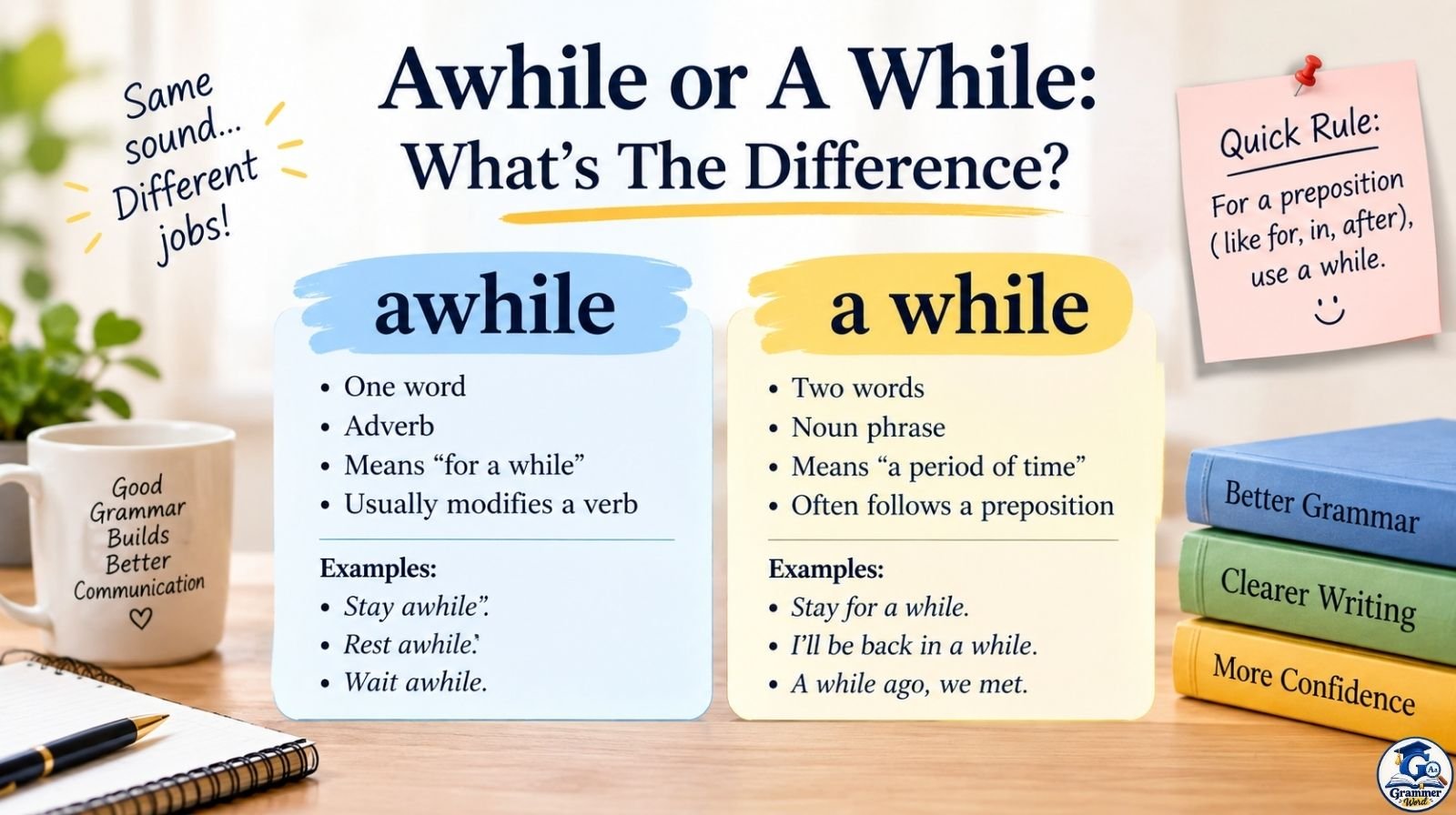
The simplest rule is this: “awhile” is an adverb meaning “for a while,” while “a while” is a noun phrase meaning “a period of time.” In traditional edited English, a while is especially common after prepositions such as for and in, while awhile normally modifies a verb.
For example:
- Stay awhile. ✅
- Stay for a while. ✅
- I’ll be back in a while. ✅
- I’ll be back in awhile. ❌ in traditional edited usage
- A while ago, we spoke. ✅
- Awhile ago, we spoke. ❌
Once you understand the grammatical difference, choosing between the two becomes much easier.
Awhile or A While: The Basic Difference
The biggest difference between awhile and a while is not really their meaning. It is their grammatical function.
Read More: Laid Off or Layed Off: Which One Is Correct?
What Does “Awhile” Mean?
Awhile is a one-word adverb. It means “for a while” or “for a short period of time.”
It normally modifies a verb.
Examples:
- Please wait awhile.
- We talked awhile after dinner.
- She rested awhile before continuing.
- Stay awhile and enjoy the music.
Merriam-Webster defines awhile as an adverb meaning “for a while” and notes that it typically modifies a verb.
What Does “A While” Mean?
A while is a two-word noun phrase. Here, a is an article and while is a noun meaning a period of time.
Examples:
- We waited for a while.
- I haven’t seen him in a while.
- A while ago, she called me.
- They stayed for a long while.
Because a while functions as a noun phrase, it can appear after a preposition such as for, in, or after.
The Quickest Rule to Remember
Think of it this way:
| Form | Grammar | Basic meaning | Example |
|---|---|---|---|
| awhile | Adverb | for a while | Stay awhile. |
| a while | Noun phrase | a period of time | Stay for a while. |
So, if for comes immediately before the expression, traditional edited usage calls for a while, not awhile.
When to Use Awhile
Knowing when awhile works is easier when you think about its role as an adverb.
Use “Awhile” to Modify a Verb
Use awhile when it directly describes the duration of an action.
For example:
- Sit awhile.
- Rest awhile.
- Wait awhile.
- Stay awhile.
- Talk awhile.
In each sentence, awhile tells us how long the action happens.
For instance:
Please sit awhile before you leave.
Here, awhile modifies sit.
The expression can generally be expanded to “for a while”:
Please sit for a while before you leave.
That substitution is a useful test recommended in grammar guidance from the MLA Style Center.
Awhile in Everyday Sentences
Here are some natural examples:
- Let’s wait awhile.
- You can stay awhile.
- She rested awhile after work.
- He worked awhile before taking a break.
- We talked awhile before dinner.
However, don’t assume that every sentence containing a verb must use awhile. The grammatical structure still matters.
For example:
The meeting lasted a while. ✅
Here, a while is functioning as a noun phrase, not an adverb.
Awhile or “For A While”?
These can communicate essentially the same duration:
- She stayed awhile.
- She stayed for a while.
Both are acceptable.
The difference is grammatical structure. In the first sentence, awhile is an adverb. In the second, a while is a noun phrase introduced by the preposition for.
Read More: Your vs You’re: Simple Guide To The Most Confusing English Pair
When to Use A While
A while is particularly important in expressions involving prepositions and references to a period of time.
Use “A While” After Prepositions
The safest traditional rule is:
Preposition + a while
Examples include:
- for a while
- in a while
- after a while
- within a while
Examples:
We talked for a while.
I’ll call you in a while.
After a while, everyone became comfortable.
Because a preposition normally takes a noun phrase as its object, a while fits this structure.
Use “A While” With “Ago” and “Back”
Use the two-word form in these common expressions:
- a while ago
- a while back
Examples:
I saw her a while ago.
We discussed this a while back.
He moved to London a while ago.
Merriam-Webster specifically identifies a while ago and a while back as standard two-word constructions.
Use “A While” When the Time Period Is the Noun
Sometimes while clearly represents a period of time.
For example:
The project will take a while.
It has been a while since we last talked.
We spent a while discussing the problem.
The Chicago Manual of Style recommends a while in constructions such as “the job will take a while,” rather than awhile.
Awhile vs. A While: Common Mistakes
The two forms are easy to confuse because their pronunciation is essentially the same. The problem becomes much easier once you recognize a few common patterns.
Mistake 1: “For Awhile”
Many writers use:
I waited for awhile. ❌
Traditional edited usage prefers:
I waited for a while. ✅
Why? For is a preposition, and a while is the noun phrase that follows it.
Alternatively, remove for and use the adverb:
I waited awhile. ✅
Merriam-Webster and the MLA Style Center both support this traditional distinction.
Mistake 2: “Awhile Ago”
Another frequent mistake is:
I saw him awhile ago. ❌
The preferred form is:
I saw him a while ago. ✅
Here, a while refers to an unspecified period of time in the past.
Mistake 3: Assuming “A While” Is Always Wrong After a Verb
This is where the issue gets slightly more interesting.
Consider:
Stay awhile. ✅
Stay a while. ✅
Both forms can be found in standard English. The one-word form functions as an adverb, while the two-word expression can function adverbially even though it has a noun-phrase structure. Recent explanations, including a 2026 Los Angeles Times grammar column, highlight this flexibility.
Therefore, the goal isn’t to treat a while and awhile as completely interchangeable. Instead, understand the grammatical structure and choose the clearest form for your context.
A Simple Step-by-Step Test
If you’re unsure whether to write awhile or a while, use this quick test.
Read More: Any Time or Anytime: Which One Is Correct?
Step 1: Look for a Preposition
Check the word immediately before the expression.
If you have:
- for ___
- in ___
- after ___
- within ___
choose a while.
Examples:
for a while ✅
in a while ✅
after a while ✅
Step 2: Try “For a While”
If the sentence works when awhile is replaced by for a while, the one-word form may be appropriate.
Example:
She stayed awhile.
Replace it:
She stayed for a while.
It works, so awhile is appropriate.
Step 3: Try a Specific Time Period
Replace a while with something like an hour, a week, or a day.
Example:
We waited for a while.
Try:
We waited for an hour.
The structure works, showing that a while is functioning as a noun phrase.
Step 4: Check “Ago” or “Back”
If you see ago or back, use:
a while ago ✅
a while back ✅
Not:
awhile ago ❌
awhile back ❌
Quick Checklist
- Stay awhile. → adverb
- Stay for a while. → noun phrase
- I’ll call in a while. → noun phrase
- I called a while ago. → noun phrase
- Rest awhile. → adverb
- We talked for a while. → noun phrase
This approach is more reliable than simply memorizing isolated examples.
A Real-Life Example: Choosing the Right Form in Professional Writing
Imagine that you’re writing an email to a client after a project meeting. You want to say that the client should wait because your team needs some time to prepare the final document.
You might initially write:
“Please wait for awhile while we review the final details.”
The meaning is clear, but the traditional grammatical form is a while, because for is a preposition:
“Please wait for a while while we review the final details.”
However, you could make the sentence more concise:
“Please wait awhile while we review the final details.”
Now awhile functions as an adverb modifying wait.
Suppose you want to explain that the team contacted the client earlier. You might write:
Read More: Freshman or Freshmen: Which One Is Correct?
“We spoke awhile ago about the revised schedule.”
For formal edited English, the preferred version is:
“We spoke a while ago about the revised schedule.”
Here, a while refers to a period of time in the past and occurs with ago.
This small distinction can make professional writing look more polished. It is especially useful in emails, reports, academic writing, website copy, and business communication, where consistency matters.
The key lesson is that the meaning alone does not determine the spelling. Both forms involve an unspecified period of time, but their grammatical roles differ. Modern usage can be flexible in some contexts, yet the traditional distinction remains a useful and reliable editing rule.
What Current 2025–2026 Usage Tells Us
There isn’t a reliable official statistic showing that a particular percentage of English speakers use awhile versus a while. Grammar dictionaries generally don’t publish annual usage percentages for this distinction. It would therefore be misleading to invent a numerical “2026 usage rate.”
However, recent 2025–2026 reference material provides useful evidence about current usage:
- The MLA Style Center published guidance on a while versus awhile in November 2025 and maintains the traditional grammatical distinction.
- Merriam-Webster updated its awhile dictionary entry in January 2026 and continues to define it as an adverb meaning “for a while.”
- LanguageTool published its comparison in 2025 and revised it in March 2026, noting that the traditional guideline remains a useful way to distinguish the forms.
- A June 2026 Los Angeles Times language column discussed the same distinction and noted that both “stay awhile” and “stay a while” can be acceptable, depending on grammatical analysis.
- Dictionary.com currently shows real-world examples from major publications in 2025 and 2026, demonstrating that awhile remains an active word in contemporary English.
So, the 2025–2026 evidence supports a practical conclusion: awhile is still a valid English word, but “a while” remains essential in many grammatical constructions, particularly after prepositions and in expressions such as “a while ago.”
Awhile vs. A While: Comparison Table
| Feature | Awhile | A While |
|---|---|---|
| Spelling | One word | Two words |
| Grammar | Adverb | Noun phrase |
| Meaning | For a while | A period of time |
| Common position | Usually modifies a verb | Often follows a preposition |
| “for” before it | Usually avoid | for a while |
| “in” before it | Usually avoid | in a while |
| With “ago” | Not preferred | a while ago |
| With “back” | Not preferred | a while back |
| Example | Stay awhile. | Stay for a while. |
This traditional distinction is consistent with guidance from Merriam-Webster, MLA, and other major language references.
American vs. British English Usage
Usage can vary somewhat by region and style.
American English
In American English, awhile is a well-established adverb:
Stay awhile.
She rested awhile.
At the same time, a while remains standard and extremely common:
Stay for a while.
It’s been a while.
Read More: Fiancé or Fiancée: Understanding The Difference And Correct Usage
British English
In British English, a while is often preferred in contexts where American English may use awhile.
Collins notes that awhile is an adverb meaning “for a short time” but describes a while as the more common spelling and particularly notes this preference in British English.
For international or formal writing, the safest approach is to follow the grammatical structure rather than trying to guess which regional variety your reader prefers.
Mini Quiz: Awhile or A While?
1. Pick the Correct One
Which sentence is correct?
A. Please wait awhile.
B. Please wait a while.
Answer: Both are acceptable.
“Wait awhile” uses awhile as an adverb, while “wait a while” uses the noun phrase a while.
2. Fill the Gap
“I’ll call you ___.”
A. awhile
B. a while
Answer: a while
The correct expression is “I’ll call you in a while.”
3. Spot the Mistake
Which version is preferred in traditional edited English?
A. We talked for awhile.
B. We talked for a while.
Answer: B We talked for a while.
After the preposition for, use a while.
4. Quick Grammar Check
What part of speech is awhile?
A. Noun
B. Adverb
C. Adjective
D. Verb
Answer: B Adverb.
Awhile means “for a while” and normally modifies a verb.
5. Choose the Natural Phrase
Which expression is correct?
A. a while ago
B. awhile ago
Answer: A a while ago.
The standard expression is “a while ago.”
6. Which Sounds Right?
“She rested ___ before leaving.”
A. awhile
B. a while ago
Answer: A awhile.
Here, awhile directly describes the action rested.
7. Preposition Challenge
Which is correct?
A. in awhile
B. in a while
Answer: B in a while.
After the preposition in, use the noun phrase a while.
Read More: Anyway or Anyways: Which One Is Correct?
8. Meaning Match
What does awhile generally mean?
A. Immediately
B. For a while
C. Every day
D. Forever
Answer: B For a while.
Awhile means for a short or unspecified period of time.
9. Choose the Better Formal Version
Which sentence follows the traditional grammar rule?
A. I haven’t seen her in awhile.
B. I haven’t seen her in a while.
Answer: B I haven’t seen her in a while.
The preposition in is followed by a while.
10. One-Word or Two?
Which sentence correctly uses the one-word form?
A. Stay awhile.
B. Stay for awhile.
C. In awhile, I’ll return.
D. Awhile ago, we met.
Answer: A Stay awhile.
Here, awhile works as an adverb modifying stay.
11. “Ago” Test
Complete the sentence:
“I met him ___.”
A. awhile ago
B. a while ago
Answer: B a while ago.
Use the two-word form in the standard expression a while ago.
12. True or False?
“For a while” and “awhile” can express essentially the same duration.
Answer: True.
For example, “She stayed awhile” and “She stayed for a while” can communicate essentially the same idea.
13. Grammar Detective
Which sentence contains the preferred form?
A. We waited for awhile.
B. We waited awhile.
C. Both A and B are equally preferred in traditional edited usage.
Answer: B We waited awhile.
Without for, awhile can function as the adverb modifying waited.
14. Complete the Sentence
“After ___, everyone relaxed.”
A. awhile
B. a while
Answer: B a while.
The preposition after is followed by the noun phrase a while.
15. The Golden Rule
Which rule is the easiest to remember?
A. Always use awhile.
B. Always use a while.
C. Use awhile as an adverb and a while as a noun phrase.
D. Never use awhile.
Answer: C Use awhile as an adverb and a while as a noun phrase.
This simple distinction helps you choose the correct form in most situations.
FAQs
Q1. Is “awhile” one word or two?
A: Awhile is one word. It is an adverb meaning “for a while” or “for a short period.”
Example:
Please stay awhile.
Q2. Is “a while” always two words?
A: Yes. A while consists of the article a and the noun while.
Example:
I’ll be there in a while.
Q3. Is “for awhile” grammatically correct?
A: In traditional edited English, for a while is preferred.
Correct:
We talked for a while.
You can also write:
We talked awhile.
The difference is that awhile already carries the meaning “for a while.”
Q4. Is “a while ago” correct?
A: Yes.
A while ago, I called you.
Awhile ago is generally not the preferred form because awhile is an adverb rather than the noun phrase required in this construction.
Q5. Is “stay awhile” correct?
A: Yes.
Stay awhile.
Here, awhile is an adverb modifying stay.
You can also say:
Stay a while.
The two-word version can function adverbially in this type of sentence as well.
Q6. Which is more formal: “awhile” or “a while”?
A: It depends on the sentence. A while is required in many traditional constructions, particularly after prepositions and with ago or back. Awhile is perfectly standard when used as an adverb.
For maximum clarity in formal writing, follow the grammatical structure rather than choosing based simply on formality.
Final Conclusion:
The difference between awhile or a while becomes simple once you focus on grammar instead of pronunciation.
Awhile is a one-word adverb meaning “for a while.”
Stay awhile.
A while is a two-word noun phrase referring to a period of time.
Stay for a while.
Remember the most useful patterns:
- wait awhile ✅
- rest awhile ✅
- stay awhile ✅
- for a while ✅
- in a while ✅
- a while ago ✅
- a while back ✅
When you’re unsure, look for a preposition such as for or in, or try replacing awhile with “for a while.” This quick test will solve most awhile or a while questions in seconds.
If this guide helped you understand the difference, bookmark it for the next time you come across this commonly confused English expression and share it with anyone who regularly gets stuck on awhile vs. a while.
Keep learning with more easy grammar lessons on Grammer Word.com

Hi, I’m Noor Fatima, the person behind this website. I created this site to make English grammar and confusing words easier to understand. I love breaking down tricky words, meanings, spellings, and grammar rules into simple explanations. My goal is to help you learn English naturally, avoid common mistakes, and feel more confident every time you write or speak.