If you have ever wondered whether “whether” or “wether” is the correct spelling, you are not alone. These words look almost identical and are pronounced similarly, but they have completely different meanings and grammatical uses.
The correct word for expressing doubt, choice, or alternatives is “whether.” For example, “I don’t know whether she will come.”
However, “wether” is also a real English word it refers to a castrated male sheep. So, it is not simply a misspelling of “whether.”
In this guide, you’ll learn the difference between whether and wether, when to use each word, common mistakes, useful examples, and an easy memory trick.
Read More: To Much or Too Much: Which One Is Correct?
Whether or Wether: Which Spelling Is Correct?
The answer depends on what you mean.
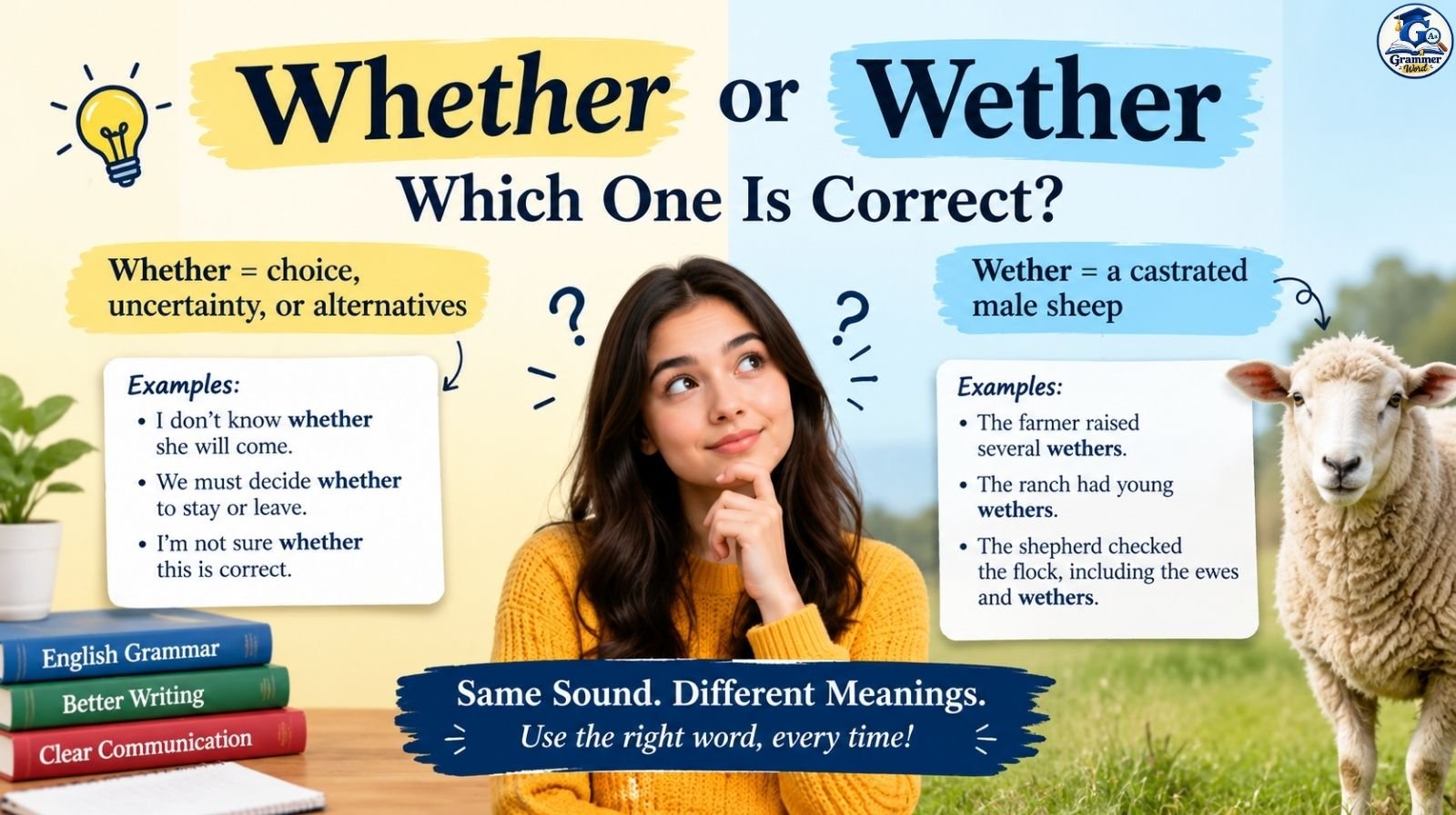
“Whether” is the correct word when you are talking about a choice, uncertainty, or two or more possibilities.
“Wether” is a separate noun referring to a castrated male sheep.
| Word | Meaning | Part of Speech | Example |
|---|---|---|---|
| Whether | Expresses uncertainty or alternatives | Conjunction | I don’t know whether he will come. |
| Wether | A castrated male sheep | Noun | The farmer raised several wethers. |
Oxford defines whether as a conjunction used to express doubt or a choice between possibilities. Cambridge likewise explains that whether is used especially when expressing uncertainty, alternatives, or “if or not.”
By contrast, Cambridge defines wether as a male sheep that has been castrated.
Therefore, if you are writing a sentence such as:
“I don’t know ___ she will attend.”
the correct choice is whether.
What Does “Whether” Mean?
Whether Means “If” or “Which of Two Possibilities”
Whether is a conjunction used when discussing uncertainty or alternatives.
For example:
- I don’t know whether he is coming.
- She asked whether I needed help.
- We must decide whether to stay or leave.
- I’m not sure whether this answer is correct.
Oxford gives similar uses for whether, including situations involving doubt and a choice between possibilities.
Whether With “Or”
One of the most common patterns is:
whether + option A + or + option B
Examples:
- I can’t decide whether to walk or take the bus.
- We need to determine whether to stay or leave.
- She wasn’t sure whether to study science or history.
You can also repeat whether:
- Whether we stay or whether we leave, the decision must be made today.
This construction makes the alternatives particularly clear.
Read More: Choose or Chose: Everything You Need To Know
Whether or Not
Another very common expression is “whether or not.”
It means that the outcome does not depend on which possibility occurs.
Examples:
- I will go whether or not you come.
- We need to finish the project whether or not they help.
- She will attend whether or not it rains.
Cambridge specifically lists whether or not as a standard usage.
What Does “Wether” Mean?
Wether Is a Real English Word
Although wether is uncommon in everyday conversation, it is a legitimate English word.
A wether is a male sheep that has been castrated. Cambridge lists wether as a countable noun with this meaning.
For example:
- The farmer separated the wethers from the breeding sheep.
- The ranch had several young wethers.
- The shepherd inspected the flock, including the ewes and wethers.
The word also appears in agricultural and livestock contexts.
Wether Is Not a Variant of Whether
This is an important distinction.
You should not write wether when you mean uncertainty or choice.
Incorrect:
I don’t know wether she will arrive.
Correct:
I don’t know whether she will arrive.
However, wether is not technically a meaningless spelling error. It has its own dictionary definition and can be correct when referring to a particular type of sheep.
Read More: Possum or Opossum: What’s The Correct Spelling And Usage?
Whether vs. Wether: The Key Difference
A Simple Meaning Test
Ask yourself:
Am I talking about a choice, possibility, or uncertainty?
If yes, use whether.
I don’t know whether to call her.
Am I talking about a male sheep?
If yes, use wether.
The farmer bought three wethers.
This simple test solves the confusion in most situations.
Whether or Wether Examples
Here are some side-by-side examples:
| Whether | Wether |
|---|---|
| I wonder whether he knows. | The farmer owns a wether. |
| We don’t know whether it will rain. | The wether was part of the flock. |
| She asked whether I was ready. | Several wethers were in the pasture. |
| Decide whether you want tea or coffee. | The rancher cared for the wether. |
Notice that the two words belong to completely different contexts.
Quick Rule to Remember
Whether = choice or uncertainty.
Wether = sheep.
If you remember those two meanings, you will rarely confuse them again.
A Real-Life Writing Scenario: How the Mistake Happens
Imagine you are writing an email to your manager about an upcoming meeting. You want to say that you are unsure if the meeting will happen.
You type:
“I’m not sure wether the meeting will take place tomorrow.”
At first glance, the sentence may look fine because wether and whether sound extremely similar. However, the sentence is incorrect because you are expressing uncertainty, not talking about livestock.
The corrected sentence is:
“I’m not sure whether the meeting will take place tomorrow.”
Now imagine the same word appearing in an agricultural report:
“The farm currently has 120 ewes and 35 wethers.”
Here, wethers is correct because the report is discussing sheep.
Read More: This Is She or This Is Her? The Correct Way To Answer The Phone
This example demonstrates why spelling alone is not always enough to determine whether a word is correct. Context determines meaning. The two words contain nearly the same letters, but they serve entirely different purposes.
This distinction is particularly important in professional emails, academic assignments, blog posts, and business documents.
A spell-checker may sometimes recognize both words as legitimate dictionary entries, so simply seeing that a word is “recognized” does not necessarily mean it is the right word for your sentence.
When proofreading, therefore, ask what you actually mean. If you are expressing doubt, asking about alternatives, or discussing whether something will happen, choose whether. If your sentence concerns a castrated male sheep, wether is the appropriate word.
2025–2026 Reference and Usage Snapshot
Current dictionary and language-reference resources continue to distinguish whether and wether clearly.
What Current Sources Show
- Oxford Advanced Learner’s Dictionary classifies whether as a conjunction and describes its use for doubt and choices between possibilities.
- Cambridge Dictionary identifies whether as a B1 conjunction used for uncertainty and alternatives.
- Cambridge Dictionary identifies wether as a countable noun meaning a castrated male sheep.
- Merriam-Webster’s Scrabble dictionary also recognizes both whether and wether as playable words, confirming that neither spelling is simply a nonexistent word.
- Collins’ current digital dictionary materials include a 2025 edition reference for wether, again documenting it as a legitimate noun rather than a spelling mistake.
These reference points are more useful than treating a simple search-volume number as proof of correctness. Search interest can change over time, whereas the grammatical distinction between these two words is based on their meanings and functions.
Read More: Patients vs Patient’s: Meaning, Difference, And Correct Usage
Common Mistakes With Whether and Wether
Mistake 1: Using “Wether” for Uncertainty
❌ I don’t know wether she will come.
✅ I don’t know whether she will come.
Because the sentence expresses uncertainty, whether is required.
Mistake 2: Writing “Wether or Not”
❌ Wether or not you agree, we need to continue.
✅ Whether or not you agree, we need to continue.
The standard expression is whether or not.
Mistake 3: Assuming “Wether” Is Always Wrong
❌ Wether is never a real English word.
That statement is also incorrect.
Wether is a legitimate noun used in livestock terminology to refer to a castrated male sheep.
The issue is not that wether is always wrong. The issue is using it where whether is required.
Read More: Masonary vs Masonry: Which Spelling Is Correct And Why It Matters
Whether vs. If: Are They the Same?
When “If” and “Whether” Can Both Work
In some sentences, if and whether can both be used.
For example:
- I don’t know if she will come.
- I don’t know whether she will come.
Both are acceptable in many contexts.
Oxford notes that both words can be used when reporting questions expecting a yes-or-no answer. It also notes that whether can sound more formal or appropriate in certain written contexts, especially when alternatives are involved.
When Whether Is Especially Useful
Use whether when you clearly present alternatives:
We need to decide whether to stay or leave.
The structure makes the two possibilities explicit.
A recent 2025/2026 language-usage guide from LanguageTool similarly distinguishes whether from if, noting that whether is particularly useful when more than one option is being considered.
How to Remember Whether vs. Wether
Use the “Sheep Test”
Here is an easy memory trick:
Wether has “her” in it but don’t let that confuse you. Think “wether = sheep.”
Or simply remember:
Whether = which possibility?
Wether = which sheep?
For example:
- Whether should I go? → A choice
- Wether in the field → A sheep
Use the Sentence Substitution Test
Try replacing the word with “if.”
If the sentence still makes sense, whether is probably the word you need.
Example:
I don’t know whether he will arrive.
Replace it:
I don’t know if he will arrive.
The meaning remains clear, so whether works.
But:
The farmer owns a wether.
You cannot replace wether with if.
That tells you that the sentence is using the livestock noun.
Read More: Girlie or Girly: Which Word Is Correct? Meaning, Usage, Differences, And Examples For 2026
Quick Checklist: Whether or Wether?
Before publishing or submitting your writing, use this checklist:
- Am I expressing doubt? → Use whether
- Am I presenting two or more possibilities? → Use whether
- Am I using “whether or not”? → Use whether
- Am I talking about a castrated male sheep? → Use wether
- Am I writing about farming or livestock? → Check whether wether fits the context
- Am I using “wether” simply because it sounds like “whether”? → Replace it with whether
This takes only a few seconds and can prevent an embarrassing spelling mistake.
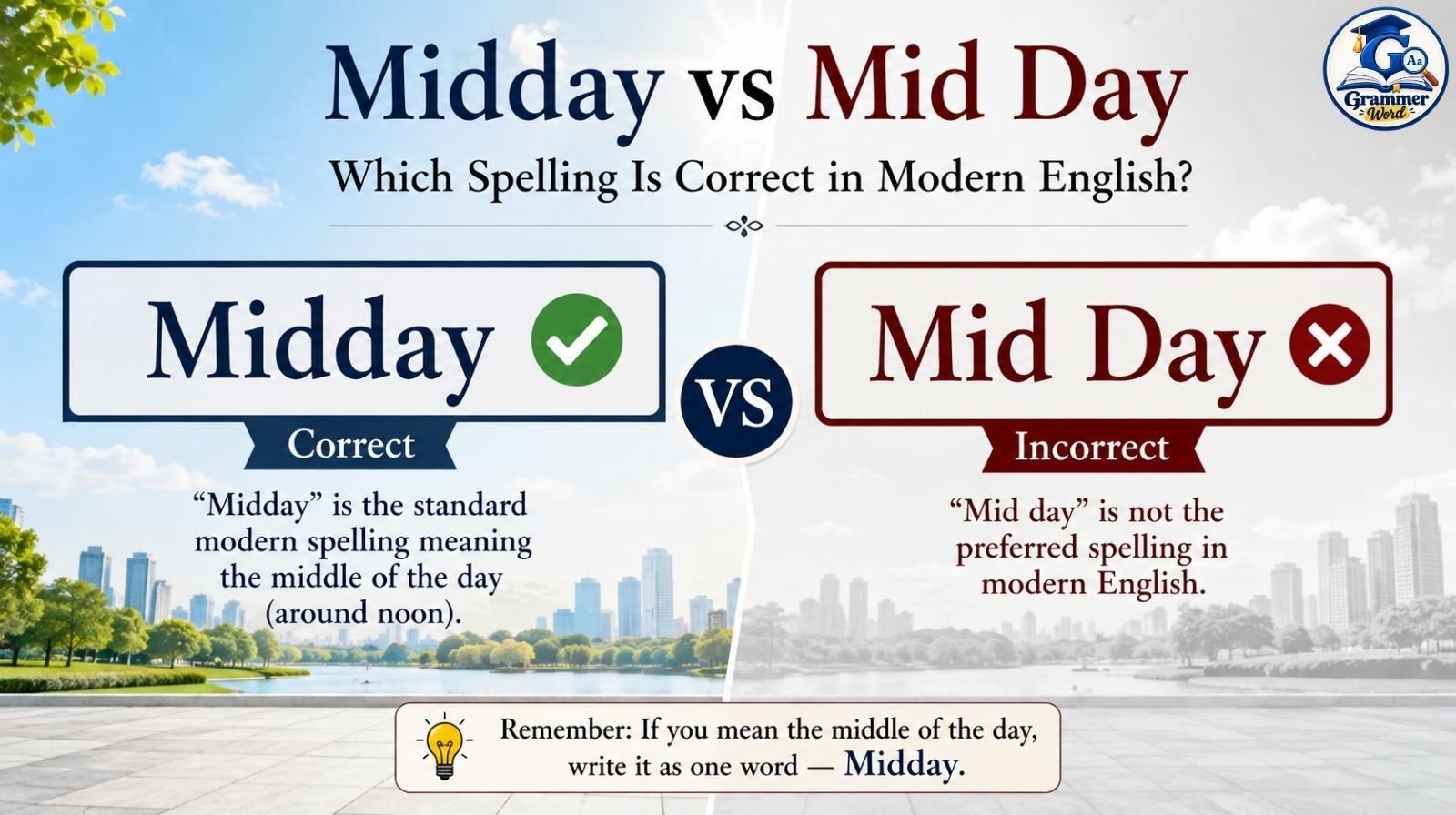
Read More: Midday vs Mid Day: Which Spelling Is Correct In Modern English?
Mini Quiz: Whether or Wether
1. Which word is correct for expressing uncertainty?
A) Wether
B) Whether
C) Wethar
D) Weither
Answer: B) Whether
2. What does “wether” mean?
A) A type of bird
B) A young horse
C) A castrated male sheep
D) A farm tool
Answer: C) A castrated male sheep
3. Choose the correct sentence:
A) I don’t know wether she will come.
B) I don’t know whether she will come.
C) I don’t know wethar she will come.
D) I don’t know weither she will come.
Answer: B) I don’t know whether she will come.
4. Which phrase is correct?
A) Wether or not
B) Whether or not
C) Whether or wether
D) Wether and not
Answer: B) Whether or not
5. Fill in the blank: “She asked ___ I was ready.”
A) wether
B) whether
C) wethar
D) weither
Answer: B) whether
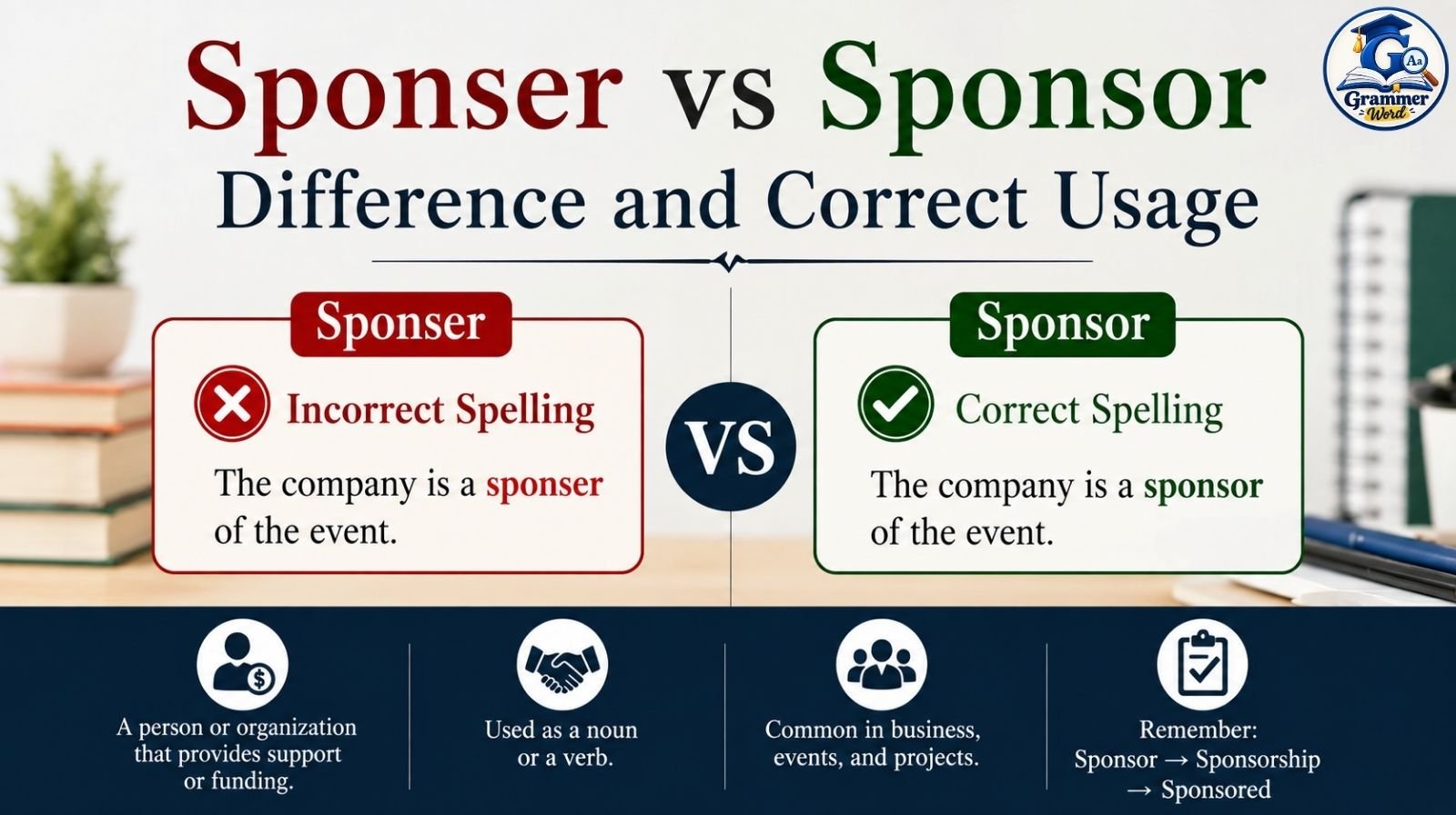
Read More: Sponser vs Sponsor: Difference And Correct Usage
6. Which word is related to livestock?
A) Whether
B) Wether
C) Weither
D) Wethered
Answer: B) Wether
7. What does “whether” commonly express?
A) A type of animal
B) A color
C) Choice or uncertainty
D) A location
Answer: C) Choice or uncertainty
8. Pick the correct sentence:
A) We must decide wether to stay or leave.
B) We must decide whether to stay or leave.
C) We must decide wether to stay and leave.
D) We must decide weither to stay or leave.
Answer: B) We must decide whether to stay or leave.
9. Which sentence correctly uses “wether”?
A) I don’t know wether he agrees.
B) She asked wether I was coming.
C) The farmer has several wethers.
D) I wonder wether it will rain.
Answer: C) The farmer has several wethers.
10. True or False: “Wether” is always a spelling mistake.
Answer: False.
Wether is a real English word referring to a castrated male sheep.
11. Which word can often be replaced by “if” in a sentence?
A) Wether
B) Whether
C) Neither
D) Weather
Answer: B) Whether
12. Complete the sentence: “I will go ___ or not you come.”
A) wether
B) whether
C) weather
D) weither
Answer: B) whether
13. What is the easiest way to remember “wether”?
A) Think about weather
B) Think about a sheep
C) Think about a decision
D) Think about a question
Answer: B) Think about a sheep
14. Which sentence is grammatically correct?
A) I wonder whether they will agree.
B) I wonder wether they will agree.
C) I wonder weither they will agree.
D) I wonder wethar they will agree.
Answer: A) I wonder whether they will agree.
15. Quick challenge: Which rule is correct?
A) Whether = sheep; Wether = choice
B) Whether = uncertainty or choice; Wether = castrated male sheep
C) Both words have exactly the same meaning
D) Wether is never a real English word
Answer: B) Whether = uncertainty or choice; Wether = castrated male sheep
Read More: Whoever or Whomever: A Complete Guide To Correct Usage
FAQs
Q1. Is “whether” the correct spelling?
Yes. Whether is the correct spelling when you mean “if,” express uncertainty, or discuss alternatives.
Example:
I don’t know whether she is coming.
Q2. Is “wether” a real word?
Yes. Wether is a real English noun referring to a castrated male sheep.
Q3. Is it “whether or not” or “wether or not”?
The correct expression is “whether or not.”
Example:
I will attend whether or not you come.
Q4. What is the difference between whether and wether?
Whether is a conjunction used for uncertainty, choices, and alternatives. Wether is a noun referring to a castrated male sheep.
Q5. Can “whether” mean “if”?
Yes. In many contexts, whether can mean “if,” particularly when discussing uncertainty.
Example:
I don’t know whether he will agree.
Q6. Is “wether” a spelling mistake?
Not necessarily. Wether is a legitimate English word. It becomes a spelling mistake when it is incorrectly used in place of whether.
Q7. How can I easily remember the difference?
Remember:
Whether = uncertainty or choice.
Wether = a male sheep.
If you’re talking about a decision, possibility, or question, you almost certainly need whether.
Conclusion:
So, whether or wether? The correct choice depends entirely on the meaning.
Use whether when expressing uncertainty, discussing alternatives, or saying “if” in many contexts:
I don’t know whether he will come.
Use wether when referring to a castrated male sheep:
The farmer has several wethers.
The easiest rule is:
Whether = choice or uncertainty.
Wether = sheep.
Both words are legitimate, but they belong in completely different contexts. When you’re writing an email, essay, article, or professional document, checking the meaning before choosing the spelling will help you avoid this common confusion.
For more clear explanations of commonly confused English words, keep exploring our grammar and word-usage guides.
Discover More Article
- Dieing or Dying: Which One Is Correct?
- Too or To: Complete Guide To Correct Usage
- Cancelation or Cancellation: Which Spelling Is Correct?
- Who’s or Whose? Simple Guide To The Difference (With Examples)
Keep learning with more easy grammar lessons on Grammer Word.com

Hi, I’m Noor Fatima, the person behind this website. I created this site to make English grammar and confusing words easier to understand. I love breaking down tricky words, meanings, spellings, and grammar rules into simple explanations. My goal is to help you learn English naturally, avoid common mistakes, and feel more confident every time you write or speak.