Have you ever typed “cancelation” and wondered whether it should actually be “cancellation”? You are not alone. These two spellings look almost identical, which makes the extra L easy to overlook.
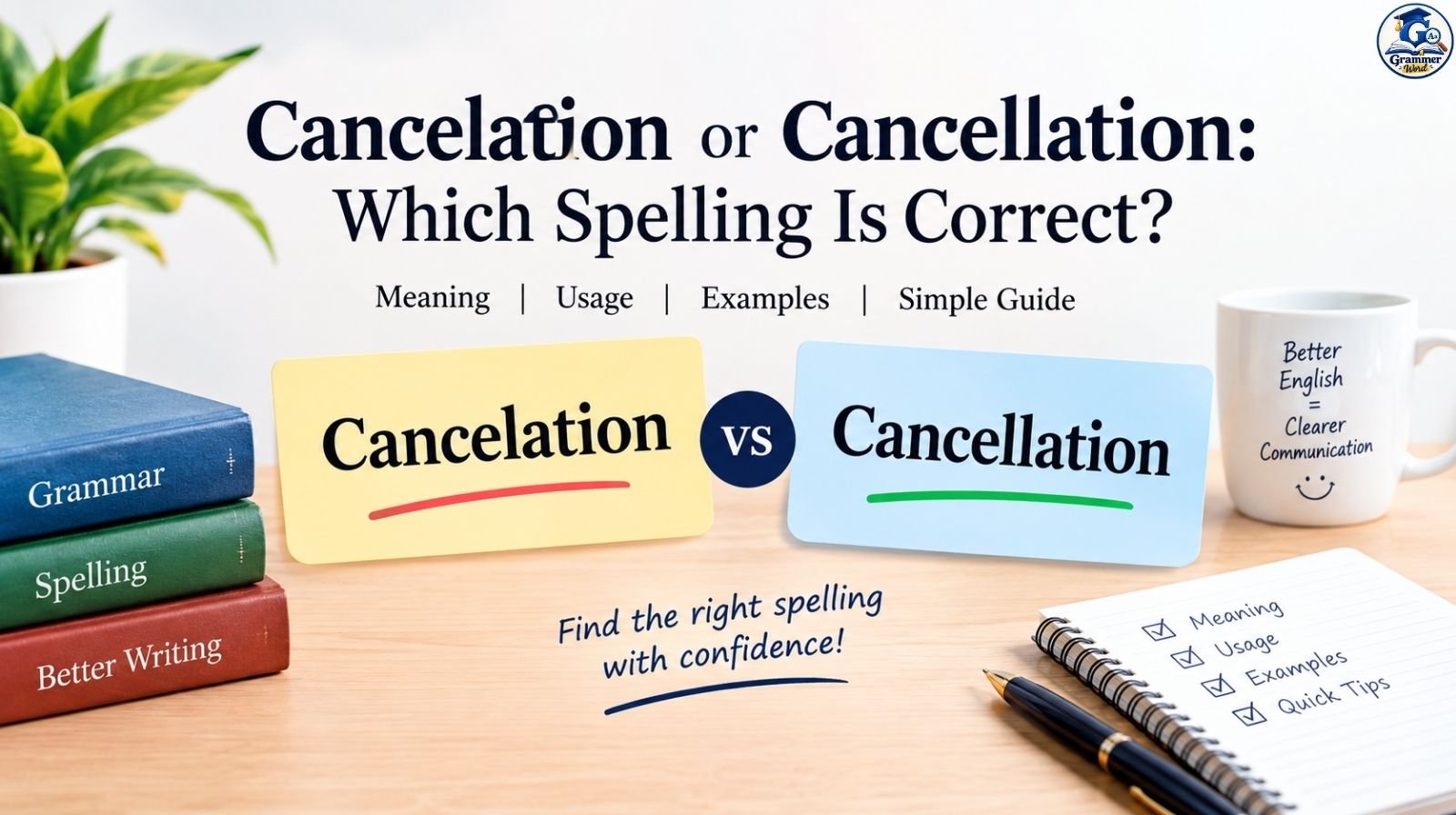
The simple answer is that cancellation is the standard and much more widely used spelling. However, cancelation is also recorded as an alternative spelling in some American-English references.
Oxford’s Advanced Learner’s Dictionary lists cancellation as the main form and notes cancelation as an American-English alternative.
So, if you are writing an email, article, school assignment, business document, or professional notice, cancellation is generally the safest choice.
Let’s look at the difference, meaning, usage, and examples so you can remember it easily.
Read More: Flyer or Flier: Which One Is Correct? A Clear Guide For Writers
Cancelation or Cancellation: What Is the Correct Spelling?
The two words have the same basic meaning: the act of canceling something or the fact that something has been canceled.
Is “Cancellation” the Standard Spelling?
Yes. Cancellation is the standard spelling used broadly in modern English.
For example:
- The cancellation of the flight caused major delays.
- I received a confirmation email after my cancellation request.
- The company announced the cancellation of the event.
- There is a $20 cancellation fee.
Oxford defines cancellation as a decision to stop something that has already been arranged from happening, as well as the fact of ending an agreement or arrangement.
Is “Cancelation” Wrong?
Not necessarily.
Cancelation, with one L, is recognized as an alternative spelling, particularly in American English. However, it is considerably less common than cancellation.
That distinction is important. A word can be technically recognized without being the spelling most readers expect.
For everyday and professional writing, therefore, cancellation is usually the better choice.
Why Is Cancellation Spelled With Two Ls?
The confusion becomes understandable when you compare cancellation with other forms of the word cancel.
Cancel, Canceled, and Cancellation
American English commonly uses:
- cancel
- canceled
- canceling
- cancellation
Notice something interesting: American English can use one L in canceled and canceling, while cancellation commonly retains two.
British English generally uses:
- cancel
- cancelled
- cancelling
- cancellation
This difference is one reason people assume that cancelation must be the American form of cancellation. However, American English does not require that change.
Dictionary.com, for example, lists cancellation as the main spelling while also recording cancelation as an American variant.
Read More: Busses vs Buses: The Correct Spelling You Need To Know In 2026
The Easy Memory Trick
If you are unsure, remember:
cancel + ation → cancellation
The safest spelling to remember is:
C-A-N-C-E-L-L-A-T-I-O-N
That gives you two Ls.
Cancellation vs. Cancelation: Quick Comparison
| Feature | Cancellation | Cancelation |
|---|---|---|
| Spelling | Two Ls | One L |
| Meaning | Act of canceling | Same meaning |
| Dictionary status | Standard/main form | Alternative/variant |
| General usage | Very common | Less common |
| Professional writing | Recommended | Less commonly used |
| British English | Standard | Rare |
| American English | Standard | Recognized alternative |
The key point is that this is not a difference in meaning. Both forms refer to the act of canceling something. The main difference is spelling and frequency of use.
When Should You Use “Cancellation”?
In most situations, cancellation is the clearest choice.
In Business Writing
Professional communication usually benefits from familiar spelling.
Example:
We received your cancellation request and will process it within two business days.
Another example:
Please review our cancellation policy before making a reservation.
In Travel and Booking
The word frequently appears in travel-related contexts:
- flight cancellation
- hotel cancellation
- booking cancellation
- ticket cancellation
- reservation cancellation
- cancellation fee
For example:
The airline notified passengers about the flight cancellation.
Oxford also uses examples involving flight cancellations, cancellation fees, and canceled arrangements.
Read More: Gases or Gasses – Which Spelling Is Correct?
In Academic and Online Writing
If you are writing an essay, website article, report, or school assignment, cancellation is generally the safer form.
For example:
The cancellation of the meeting was announced on Monday.
Using the familiar spelling helps readers understand the word immediately without stopping to wonder whether it is a typo.
Real-Life Example: Why the Extra L Matters

Imagine that Sarah works for a small travel company. One morning, the company receives an email from a customer saying, “I would like to request a cancelation of my hotel reservation.”
Sarah understands exactly what the customer means. There is no confusion about the message itself. However, when Sarah prepares the company’s formal response, she writes, “Your cancellation request has been received.”
Why?
The customer used cancelation, which is a recognized variant, but Sarah’s company uses cancellation throughout its website, booking forms, and customer-service templates. Keeping the spelling consistent makes the company’s communication look polished and professional.
Read More: Ax vs Axe: The Simple Difference Most People Don’t Know
Later that day, Sarah writes a notice about several booking changes:
“Due to unexpected circumstances, the cancellation of selected reservations may be necessary.”
Here, cancellation feels natural because it is the spelling most readers commonly encounter.
This example illustrates an important point: choosing cancellation is not about changing the meaning. It is about choosing the standard form that readers are most likely to recognize. When writing for a broad or international audience, this can be especially useful.
2025–2026 Usage and Language Data
There is an important distinction between language data and general cancellation statistics.
There is no universally authoritative 2025–2026 database that counts every occurrence of cancelation versus cancellation across all English writing. Therefore, claims about an exact worldwide percentage difference should be treated cautiously.
However, current dictionary evidence continues to support cancellation as the main form. Oxford’s current entry identifies cancellation as the headword and lists cancelation as an American-English alternative.
Recent consumer research also demonstrates how frequently the concept of cancellation appears in everyday communication.
Read More: Loosing or Losing: What’s The Correct Spelling And When To Use It?
In a March 2025 YouGov survey of 2,020 British adults, 21% reported canceling a streaming service since February 2024, while 9% had ended a mobile-phone contract and 9% had discontinued broadband or internet service. The survey also found that 57% preferred online self-service for cancellations.
These figures do not measure spelling frequency. They simply show that cancellation-related language remains highly relevant in modern consumer life.
What This Means for Writers
If your goal is clear, professional English, the practical takeaway is simple:
Use “cancellation” unless you have a specific reason to follow a source or style that uses “cancelation.”
Common Mistakes With Cancelation and Cancellation
Mistake 1: Assuming American English Must Use One L
A common assumption is:
canceled → cancelation
But this does not automatically follow.
American English commonly uses canceled, while cancellation remains the standard form.
Correct:
The cancellation was confirmed.
Mistake 2: Treating the Two Spellings as Different Words
Cancellation and cancelation do not normally have different meanings.
Both refer to stopping something that was planned, arranged, or previously agreed upon.
Mistake 3: Switching Spellings in the Same Document
Consistency matters.
Avoid writing:
The cancellation policy explains the cancelation process.
Instead, choose one spelling and use it consistently. For general professional writing, cancellation is the safer choice.
Read More: Apart or A Part: Understanding The Difference
Cancellation Examples You Can Use
Here are some natural examples:
Everyday Examples
- The cancellation of the meeting surprised everyone.
- I received a cancellation notice this morning.
- There is no fee for cancellation.
- Please confirm your cancellation by email.
Business Examples
- Your subscription cancellation has been processed.
- The company updated its cancellation policy.
- We require 24 hours’ notice for cancellation.
- The customer requested a cancellation of the order.
Travel Examples
- The airline announced the cancellation of the flight.
- We received a hotel cancellation confirmation.
- A cancellation fee may apply.
- The booking was refunded after the cancellation.
A Simple Rule to Remember
If you are unsure whether to write cancelation or cancellation, use this checklist:
Quick Checklist
- Are you writing formal or professional English? → Cancellation
- Are you writing for a broad international audience? → Cancellation
- Are you writing an academic assignment? → Cancellation
- Are you writing a business email? → Cancellation
- Have you specifically been asked to follow a source that uses cancelation? → Follow that style consistently.
- Are you simply trying to remember the most common spelling? → Cancellation
This makes the choice much easier.
Read More: Per Say or Per Se: Which One Is Correct?
Cancelation or Cancellation: Mini Quiz Questions
1. Which spelling is the standard form?
A) Cancelation
B) Cancellation
C) Cancelletion
D) Cancellasion
Answer: B) Cancellation
2. How many Ls are normally used in “cancellation”?
A) One
B) Two
C) Three
D) None
Answer: B) Two
3. Does “cancelation” have a recognized use?
A) Yes, as an alternative spelling
B) No, never
C) Only as a verb
D) Only in British English
Answer: A) Yes, as an alternative spelling
4. Which sentence uses the standard spelling?
A) The cancelation was confirmed.
B) The cancellation was confirmed.
C) The cancillation was confirmed.
D) The cancelationn was confirmed.
Answer: B) The cancellation was confirmed.
5. What does “cancellation” mean?
A) Starting something
B) Delaying something
C) Stopping something that was planned
D) Repeating something
Answer: C) Stopping something that was planned
Read More: Lets or Let’s: Which One Is Correct And When To Use It?
6. Which phrase is most commonly used?
A) Cancellation fee
B) Cancelation fee
C) Cancelling fee
D) Cancelled fee
Answer: A) Cancellation fee
7. True or False: “Cancellation” is generally the safer choice in formal writing.
Answer: True
8. Which word is commonly used in “flight cancellation”?
A) Cancel
B) Canceling
C) Cancellation
D) Cancelled
Answer: C) Cancellation
9. Is “cancelation” and “cancellation” different in meaning?
A) Yes
B) No
C) Sometimes they mean opposite things
D) Only in British English
Answer: B) No
10. Which spelling should you usually choose for a business email?
A) Cancelation
B) Cancellation
C) Cancelllation
D) Cancelationn
Answer: B) Cancellation
11. Which spelling is easier to remember for most formal writing?
A) Cancelation
B) Cancellation
C) Cancelatione
D) Cansellation
Answer: B) Cancellation
12. True or False: American English always requires “cancelation” with one L.
Answer: False
13. Complete the phrase: “cancellation _____”
A) fee
B) tree
C) book
D) color
Answer: A) fee
14. Which sentence is correct?
A) I requested a cancellation of my booking.
B) I requested a cancelllation of my booking.
C) I requested a cansellation of my booking.
D) I requested a cancelationn of my booking.
Answer: A) I requested a cancellation of my booking.
15. What is the easiest rule to remember?
A) Always use one L
B) Always use three Ls
C) Use “cancellation” when you want the standard form
D) Both spellings have different meanings
Answer: C) Use “cancellation” when you want the standard form
Read More: Choose or Chose: Everything You Need To Know
FAQs
Q1. Is “cancelation” a correct spelling?
Yes, cancelation is recognized as an alternative spelling in some dictionaries, particularly in American English. However, cancellation is the standard and more widely used form.
Q2. Which is correct: cancelation or cancellation?
Cancellation is the standard choice for most writing. Cancelation is an accepted variant but is much less common.
Q3. Is cancellation spelled with one L or two?
It is normally spelled with two Ls:
c-a-n-c-e-l-l-a-t-i-o-n
Q4. Is “cancelation” American English?
Cancelation is recorded as an American-English alternative by Oxford. However, American English also commonly uses the standard spelling cancellation, so you should not assume that American English requires one L.
Q5. Why is “canceled” spelled with one L but “cancellation” with two?
The spelling patterns for English words do not always transfer directly from one grammatical form to another. American English commonly uses canceled and canceling, while cancellation retains the double-L spelling.
Q6. Should I use cancellation in formal writing?
Yes. Cancellation is generally the safest and most recognizable choice for formal writing, professional communication, academic work, websites, and business documents.
Conclusion:
So, cancelation or cancellation which should you use?
The answer is straightforward: cancellation is the standard and most widely recognized spelling. Cancelation is a recognized alternative in some dictionaries, but it is much less common.
If you are writing an email, school assignment, business document, article, website, travel notice, or formal message, choose cancellation.
Remember the simple spelling:
Cancellation = C-A-N-C-E-L-L-A-T-I-O-N
When in doubt, use the double-L form. It is the safest choice for clear, polished, and widely understood English.
Discover More Article
- Each Other or Eachother? The Correct Spelling Explained Simply
- Master’s Degree or Masters Degree: Which One Is Correct?
- Dieing or Dying: Which One Is Correct?
- Too or To: Complete Guide To Correct Usage
Keep learning with more easy grammar lessons on Grammer Word.com

Hi, I’m Noor Fatima, the person behind this website. I created this site to make English grammar and confusing words easier to understand. I love breaking down tricky words, meanings, spellings, and grammar rules into simple explanations. My goal is to help you learn English naturally, avoid common mistakes, and feel more confident every time you write or speak.