Have you ever typed “Lets go!” and wondered whether you need an apostrophe? The difference between lets and let’s is only one tiny mark, but that apostrophe completely changes the meaning and grammatical function of the word.
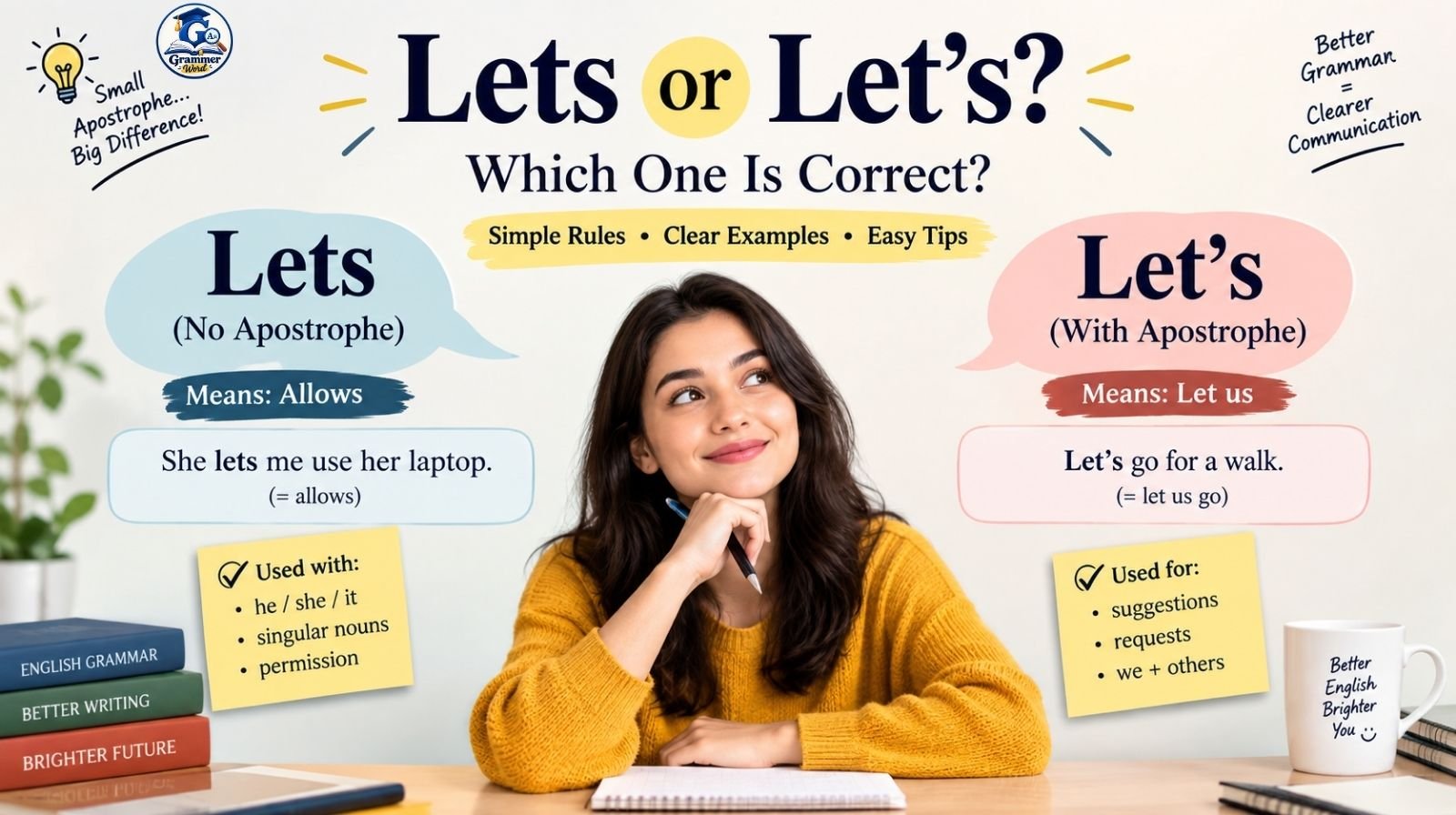
So, lets or let’s which one is correct? The answer is: both are correct, but they are used in different situations. Let’s is a contraction of “let us,” usually used to make a suggestion, while lets is the third-person singular form of the verb let, meaning “allows.”
This guide explains the difference between lets and let’s, shows you when to use each one, and gives you a simple trick to avoid the mistake.
Read More: Anyway or Anyways: Which One Is Correct?
Lets or Let’s: What Is the Difference?
The easiest way to understand the difference is to look at their meanings.
Let’s means “let us” and is generally used to suggest that the speaker and another person or group do something together.
Let’s go for a walk.
Here, let’s means something like “Let us go for a walk.”
On the other hand, lets is a form of the verb let and means allows or permits.
My mother lets me stay up late on weekends.
Here, lets means allows.
Cambridge Dictionary confirms that let’s is used to make a suggestion or request that includes the speaker and other people, while let can mean to allow someone to do something.
Quick Difference
| Word | Meaning | Example |
|---|---|---|
| let’s | let us; makes a suggestion | Let’s start now. |
| lets | allows or permits | She lets me use her laptop. |
Therefore, the apostrophe is not optional. It signals that let’s is a contraction.
When to Use “Let’s”
Use let’s when you are suggesting an action that includes yourself and another person or group.
The word is short for “let us.”
Let’s Means “Let Us”
Try expanding let’s to let us.
Let’s go home.
Let us go home.
The meaning still works, so let’s is correct.
Here are more examples:
- Let’s have some coffee.
- Let’s finish this project today.
- Let’s watch a movie tonight.
- Let’s take a short break.
- Let’s discuss the problem.
- Let’s try again tomorrow.
Cambridge describes let’s as the common shortened form used for suggestions that include the speaker and other people.
Let’s + Base Verb
After let’s, use the base form of the verb.
Correct:
Let’s go outside.
Let’s eat lunch.
Let’s start the meeting.
Incorrect:
Let’s goes outside.
Let’s eats lunch.
Let’s starting the meeting.
The basic pattern is:
Let’s + base verb
Negative Form: “Let’s Not”
When suggesting that people should avoid an action, use let’s not.
Examples:
Let’s not argue about this.
Let’s not waste any more time.
Let’s not forget the deadline.
Cambridge notes that let’s not is the more common negative form compared with the less common “don’t let’s.”
Read More: Skillset or Skill Set: Which Term Is Correct In Modern English?
When to Use “Lets”
Use lets without an apostrophe when it is the third-person singular form of let.
In this situation, lets usually means allows or permits.
Lets Means “Allows”
Consider this sentence:
My teacher lets us ask questions.
This means:
My teacher allows us to ask questions.
More examples:
- My dad lets me drive his car.
- Sarah lets her children play outside.
- The manager lets employees work from home.
- This app lets users edit their photos.
- The teacher lets students use dictionaries.
- The software lets you save your work.
Notice that the subject is usually he, she, it, or a singular noun.
Lets in a Simple Grammar Pattern
A useful structure is:
Subject + lets + person/object + base verb
For example:
She lets me use her computer.
The teacher lets students ask questions.
This feature lets users save files.
Do not add to after the object in this structure.
Correct:
She lets me go.
Incorrect:
She lets me to go.
Cambridge explains that let takes an object followed by an infinitive without to.
“Lets” Can Also Relate to Renting
In British English, let can also mean to rent a property to someone.
For example:
They let their apartment to a young couple.
This produces the third-person form:
The company lets several properties each year.
This meaning is less common for many learners, but it is another legitimate use of let/lets.
Read More: Freshman or Freshmen: Which One Is Correct?
Lets vs. Let’s: The Easy Trick That Works
If you are unsure whether to write lets or let’s, use a simple replacement test.
The “Let Us” Test
Replace the word with “let us.”
If the sentence still makes sense, use let’s.
Let’s go home.
↓
Let us go home.
Correct: let’s
Now try:
She lets me go home early.
↓
She let us me go home early.
That does not work.
Therefore, the correct word is lets.
The “Allows” Test
You can also replace lets with allows.
My teacher lets me leave early.
↓
My teacher allows me to leave early.
The meaning works, so lets is correct.
Read More: Fiancé or Fiancée: Understanding The Difference And Correct Usage
Try these two quick tests:
| If you can replace it with… | Use |
|---|---|
| let us | let’s |
| allows | lets |
This is one of the simplest ways to remember the difference.
A Simple Memory Rule
Remember:
Let’s = suggestion
Lets = allows
For example:
Let’s study together. → Suggestion
My teacher lets me study here. → Permission
That single distinction will help you get most examples right.
Read More: Any Time or Anytime: Which One Is Correct?
A Real-Life Example: “Lets” vs. “Let’s” in Everyday Writing
Imagine a student named Emma is working on a group project with two classmates. She sends a message to the group chat saying:
“Lets meet at 4 p.m. to finish our presentation.”
The sentence is understandable, but the apostrophe is missing. Emma is making a suggestion that includes herself and her classmates. She could expand the sentence to:
“Let us meet at 4 p.m. to finish our presentation.”
Therefore, the correct version is:
“Let’s meet at 4 p.m. to finish our presentation.”
Later, Emma tells her friend about her teacher:
“Our teacher lets us submit the presentation tomorrow.”
This time, there is no apostrophe. Why? Because lets means allows.
The teacher allows the students to submit the presentation tomorrow.
This example shows why the apostrophe matters. Compare the two sentences:
Let’s finish the presentation.
This is a suggestion: I suggest that we finish it.
Our teacher lets us finish the presentation tomorrow.
This describes permission: Our teacher allows us to do it tomorrow.
The pronunciation can make these words especially confusing because lets and let’s are normally pronounced the same. However, their grammatical roles are different. LanguageTool’s 2025 article, revised in 2026, likewise identifies let’s as the contraction of let us and lets as the third-person singular form of let.
This distinction is particularly useful in emails, assignments, work messages, captions, and other forms of writing where punctuation affects clarity.
Common Mistakes With Lets and Let’s
Even though the rule is simple, several mistakes appear frequently.
Mistake 1: Writing “Lets go”
Incorrect:
Lets go to the park.
Correct:
Let’s go to the park.
Why? You are suggesting that you and someone else go to the park.
You can test it:
Let us go to the park.
So the apostrophe belongs in let’s.
Mistake 2: Adding an Apostrophe to “Lets”
Incorrect:
My father let’s me use his car.
Correct:
My father lets me use his car.
Here, lets means allows.
The apostrophe changes the grammatical function.
Mistake 3: Using the Wrong Verb Form
Incorrect:
Let’s goes shopping.
Correct:
Let’s go shopping.
Incorrect:
She lets me goes home early.
Correct:
She lets me go home early.
Both structures use the base verb after let/lets.
Mistake 4: Adding “To” After Lets
Incorrect:
She lets me to use her phone.
Correct:
She lets me use her phone.
The verb after let + object is normally used without to.
Read More: Your vs You’re: Simple Guide To The Most Confusing English Pair
Lets vs. Let’s: 2025–2026 Usage and Grammar Evidence
There is an important distinction between usage data and grammar rules. Current public sources do not provide a reliable 2025–2026 percentage showing how often English writers confuse lets and let’s. Therefore, it would be misleading to invent a statistic or claim that a specific percentage of people make this error.
However, current 2025–2026 English-language resources continue to document the distinction consistently. LanguageTool published a dedicated “Lets vs. Let’s” explanation in June 2025 and revised it in February 2026, while Cambridge Dictionary’s current grammar guidance continues to define let’s as the short form used for suggestions and let as a verb used for permission.
A useful current-data point is therefore the publication/revision evidence itself:
- 2025: LanguageTool published its dedicated explanation of lets vs. let’s.
- 2026: LanguageTool revised that explanation, showing the distinction remains relevant in contemporary English-learning resources.
- 2026: Cambridge Dictionary’s current grammar guidance continues to distinguish let’s for suggestions from let for permission.
- Purdue OWL’s current apostrophe guidance reinforces the broader rule that apostrophes are used in contractions and are not simply added to ordinary plural forms.
So, while there is no trustworthy current percentage to quote, the grammatical distinction itself remains standard and well documented.
Quick Checklist: How to Choose the Correct Word
Before publishing or sending your sentence, run through this checklist.
Step 1: Identify the Meaning
Ask yourself:
Am I making a suggestion?
If yes, use let’s.
Let’s start now.
Am I saying that someone or something allows an action?
If yes, use lets.
The app lets you edit photos.
Step 2: Try “Let Us”
If you can replace the word with let us, use let’s.
Let’s begin.
→ Let us begin. ✓
Step 3: Try “Allows”
If you can replace the word with allows, use lets.
She lets me borrow her notes.
→ She allows me to borrow her notes. ✓
Step 4: Check the Subject
If the sentence describes what he, she, it, or a singular noun allows, lets may be the correct form.
He lets me use his phone.
If you are suggesting something that we should do, use let’s.
Let’s use his phone.
Read More: Awhile or A While: What’s The Difference?
Lets vs. Let’s: Comparison Table
| Feature | Lets | Let’s |
|---|---|---|
| Apostrophe | No | Yes |
| Full form | Let us | |
| Main meaning | Allows | Suggests an action |
| Grammar role | Verb | Contraction |
| Common subject | He, she, it, singular noun | Speaker + others |
| Example | She lets me stay. | Let’s stay. |
| Easy replacement | Allows | Let us |
The key difference is therefore meaning, not spelling preference.
Mini Quiz: Lets or Let’s
1. Quick Start: Which One Is Right?
___ go for a walk!
A) Lets
B) Let’s
Answer: B) Let’s
Because it means “Let us go for a walk.”
2. Permission Check
My dad ___ me use his laptop.
A) lets
B) let’s
Answer: A) lets
Here, lets means “allows.”
3. Spot the Apostrophe
Which sentence is correct?
A) Lets watch a movie.
B) Let’s watch a movie.
Answer: B) Let’s watch a movie.
It is a suggestion, so let’s is needed.
4. The “Allows” Trick
Which word can be replaced with “allows”?
A) Let’s
B) Lets
Answer: B) Lets
For example: “She lets me stay” = “She allows me to stay.”
5. The “Let Us” Test
“Let’s begin the meeting.”
What does let’s mean?
A) Let us
B) Allows us
Answer: A) Let us
Let’s is the contraction of “let us.”
6. Fill the Gap
The app ___ users edit photos.
A) lets
B) let’s
Answer: A) lets
The app allows users to edit photos.
7. Grammar Speed Test
Which sentence is correct?
A) Let’s go home.
B) Lets goes home.
Answer: A) Let’s go home.
After let’s, use the base form go.
8. Catch the Mistake
Which sentence needs an apostrophe?
A) She lets me borrow her book.
B) Lets have some coffee.
Answer: B) Lets have some coffee.
It should be “Let’s have some coffee.”
9. Suggestion or Permission?
“Let’s study together.”
Is this a suggestion or permission?
A) Suggestion
B) Permission
Answer: A) Suggestion
The speaker is suggesting that they study together.
10. One-Word Swap
Choose the correct word:
My teacher ___ us ask questions.
A) lets
B) let’s
Answer: A) lets
The teacher allows students to ask questions.
11. Negative Challenge
Which sentence is correct?
A) Let’s not argue.
B) Lets not argue.
Answer: A) Let’s not argue.
Let’s not is used to suggest avoiding an action.
12. Apostrophe Alert!
Which sentence uses let’s correctly?
A) My sister let’s me use her phone.
B) Let’s take a break.
Answer: B) Let’s take a break.
It is a suggestion, so let’s is correct.
13. The Easy Memory Rule
Complete the rule:
Let’s = ______
A) Let us
B) Allows
Answer: A) Let us
Remember: let’s = let us.
14. Final Fill-in-the-Blank
This feature ___ you save your work.
A) lets
B) let’s
Answer: A) lets
The feature allows you to save your work.
15. Final Boss: Can You Get It?
Which sentence is completely correct?
A) Lets go to the park.
B) Let’s goes to the park.
C) Let’s go to the park.
D) She let’s me go.
Answer: C) Let’s go to the park.
Let’s means “let us,” and it is followed by the base verb go.
Read More: Dreamt or Dreamed: Which One Is Correct?
FAQs
Q1. Is “lets” or “let’s” correct?
Both are correct, but they have different meanings. Let’s means “let us” and usually introduces a suggestion. Lets is the third-person singular form of let and usually means allows.
Q2. Is “Let’s go” correct?
Yes. “Let’s go” is correct because let’s means “let us” and is being used to suggest going.
Let’s go home.
Q3. Is “Lets go” grammatically correct?
Not when you mean “let us go.” In that situation, the correct form is:
Let’s go.
Without the apostrophe, lets is normally a verb meaning allows.
Q4. What is the easiest way to remember lets vs. let’s?
Use two replacement words:
- let’s → let us
- lets → allows
If let us works, choose let’s. If allows works, choose lets.
Q5. Does “let’s” always mean “let us”?
In standard grammar, let’s is the contraction of let us. It is commonly used to make suggestions or requests involving the speaker and another person or group.
Q6. Can I use “let us” instead of “let’s”?
Yes. Let us is the full form, while let’s is the contraction. The full form can sound more formal or emphatic in some contexts. Cambridge notes that the full let us is particularly associated with formal situations such as speeches and ceremonies.
Q7. Is “Let’s not” correct?
Yes. Let’s not is the standard negative form for making a suggestion not to do something.
Let’s not worry about it.
Let’s not make the same mistake again.
Conclusion:
So, lets or let’s which one is correct? The answer depends on what you mean.
Use let’s when you mean “let us” and are making a suggestion:
Let’s go outside.
Use lets when you mean “allows”:
My teacher lets us leave early.
The easiest trick is to remember:
Let’s = let us
Lets = allows
Once you connect the apostrophe with “let us,” the difference becomes much easier to recognize. Before you send your next email, assignment, or message, take a second to apply the “let us” or “allows” test. It can quickly catch this common English grammar mistake.
Discover More Article
- There or Their: Clear Guide To Correct Usage
- Greatful or Grateful: Which One Is Correct?
- To Much or Too Much: Which One Is Correct?
- Per Say or Per Se: Which One Is Correct?
Keep learning with more easy grammar lessons on Grammer Word.com

Hi, I’m Noor Fatima, the person behind this website. I created this site to make English grammar and confusing words easier to understand. I love breaking down tricky words, meanings, spellings, and grammar rules into simple explanations. My goal is to help you learn English naturally, avoid common mistakes, and feel more confident every time you write or speak.