Have you ever written “per say” and wondered whether it is actually correct? You are not alone. Per say or per se is a common English spelling confusion, especially because the phrase sounds very similar to “per say” when spoken.
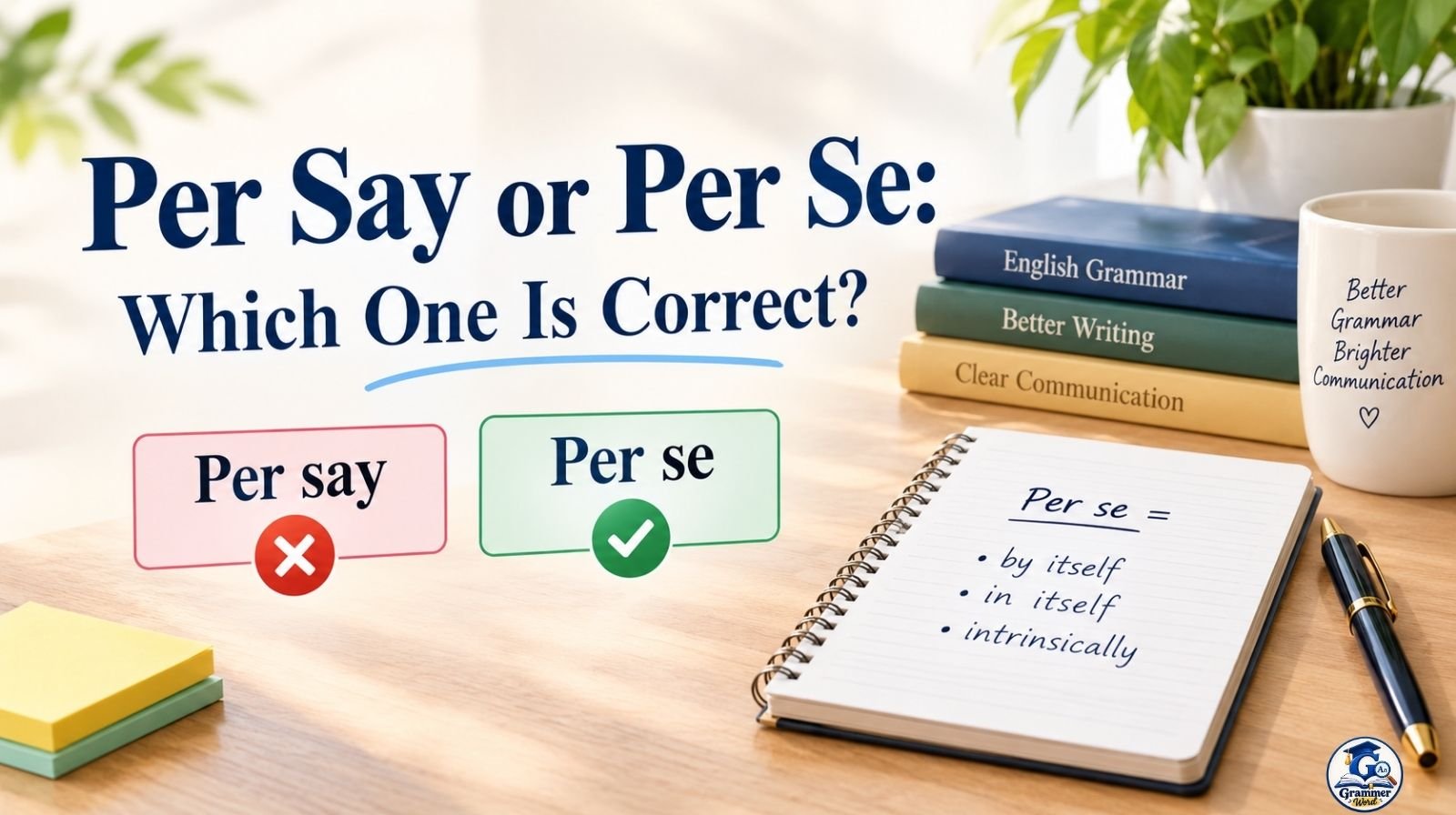
The correct expression is “per se.” It comes from Latin and means “by itself,” “in itself,” or “intrinsically.” The spelling “per say” is incorrect when you mean this expression.
In this guide, you’ll learn what per se means, why per say is a common mistake, how to pronounce it, and how to use it naturally in everyday and formal writing.
Read More: Any Time or Anytime: Which One Is Correct?
Per Say or Per Se: Which Spelling Is Correct?
The correct spelling is per se, not per say.
Per Se Is the Correct Expression
Per se is a Latin phrase that English has adopted. It generally means “by itself” or “in itself.”
For example:
The job isn’t difficult per se, but it requires a lot of patience.
Here, the speaker does not mean that the job is completely easy. Instead, they mean that the job itself is not difficult, although other factors may make it challenging.
Why “Per Say” Is Incorrect
Per say is usually a spelling mistake caused by pronunciation. When people hear per se, they may naturally write it as per say because “se” can sound like the English word “say.”
However, when you mean the Latin expression, the standard spelling is per se.
Quick rule:
- ✅ per se correct
- ❌ per say incorrect for this meaning
Per Say or Per Se in a Sentence
Compare these examples:
- ❌ The idea isn’t bad per say.
- ✅ The idea isn’t bad per se.
The second sentence is correct because per se means “in itself.”
What Does Per Se Mean?
Understanding the per se meaning makes the spelling much easier to remember.
Per Se Meaning in Simple English
Per se means:
- by itself
- in itself
- intrinsically
- considered on its own
It is often used when someone wants to distinguish a thing itself from its circumstances, effects, or related factors.
For example:
I don’t dislike coffee per se; I just don’t like drinking it late at night.
This means the speaker does not dislike coffee itself. The problem is drinking it late at night.
Per Se Meaning With an Easy Example
Consider this sentence:
The movie wasn’t boring per se, but it was much too long.
The speaker is making a distinction. The movie itself wasn’t necessarily boring, but its excessive length affected the experience.
Another example:
Money isn’t the goal per se; financial security is.
Here, per se emphasizes that money itself is not the speaker’s main objective.
Is Per Se Formal?
Per se is more common in formal, academic, professional, and analytical writing than in casual conversation.
However, it is not restricted to formal English. Native speakers also use it in everyday speech.
For example:
There’s nothing wrong with the plan per se.
This sounds natural in both professional and conversational contexts.
How to Use Per Se Correctly
Knowing the definition is helpful, but understanding the sentence pattern makes correct usage much easier.
Per Se Usually Follows a Noun or Adjective
Per se commonly appears after the thing being discussed.
Examples:
The product isn’t expensive per se.
I’m not against the idea per se.
The task isn’t difficult per se.
There’s nothing unusual about the situation per se.
In each example, per se focuses attention on the thing itself.
Per Se Examples in Everyday English
Here are some natural examples:
- I don’t hate winter per se, but I dislike driving in snow.
- The restaurant isn’t expensive per se; the portions are just small.
- Working from home isn’t distracting per se, but my environment can be.
- The rule isn’t unfair per se, although some people may find it inconvenient.
- She wasn’t angry per se; she was simply disappointed.
These examples show why per se is useful: it lets you make a careful distinction without completely agreeing or disagreeing with a statement.
Per Se vs. “By Itself”
In many sentences, you can replace per se with by itself or in itself.
For example:
The technology isn’t dangerous per se.
You could express the same basic idea as:
The technology isn’t dangerous in itself.
The first version is more concise and sometimes sounds more formal.
Read More: Awhile or A While: What’s The Difference?
Per Se Pronunciation: Why People Write “Per Say”
One reason per say appears so often online is pronunciation.
How Do You Pronounce Per Se?
Per se is commonly pronounced approximately:
“pur SAY”
The final se sounds like “say.”
That creates an obvious spelling trap.
People hear:
“pur say”
and naturally assume the phrase should be written:
per say
But the correct written form is:
per se
The pronunciation and spelling simply don’t match the way an English learner might expect.
A Simple Memory Trick
Think:
“Per se” = “in itself.”
If you’re using the expression to mean “by itself” or “in itself,” write per se.
You can remember:
SE = itself
So:
per se → in itself
This simple association can help prevent the per say vs. per se mistake.
Is “Per Say” Ever Correct?
The phrase per say is not the standard spelling of the Latin expression per se.
If you see per say in a sentence such as:
It isn’t bad per say.
the writer almost certainly intended:
It isn’t bad per se.
Per Se vs. Similar Expressions
Although per se has a clear meaning, it can sometimes be confused with other expressions.
Per Se vs. In Itself
These are often interchangeable.
| Expression | Basic meaning | Example |
|---|---|---|
| per se | in itself | The idea isn’t wrong per se. |
| in itself | considered alone | The idea isn’t wrong in itself. |
| by itself | alone/without help | The machine stopped by itself. |
The meanings overlap, but by itself can also describe physical or independent action. Per se is generally used to make a conceptual distinction.
Read More: Your vs You’re: Simple Guide To The Most Confusing English Pair
Per Se vs. Specifically
These expressions are not interchangeable.
Per se means “in itself.”
Specifically means something like “in particular” or “exactly.”
For example:
I don’t dislike the city per se.
This means the city itself isn’t the problem.
But:
I don’t dislike the city specifically.
This has a different meaning and could suggest that the speaker dislikes several cities rather than that particular one.
Per Se vs. Essentially
These can sometimes appear in similar contexts, but they have different meanings.
The problem isn’t expensive per se.
This focuses on the problem itself.
The problem is essentially financial.
This describes the fundamental nature of the problem.
Therefore, don’t automatically substitute one for the other.
A Real-Life Example of Per Se in Professional Writing
Imagine a manager discussing why a project is behind schedule during a team meeting.
The manager says:
“The project isn’t failing per se, but our original timeline was unrealistic.”
What does this mean?
The manager is making an important distinction. They are not saying the project is perfect or completely successful. Instead, they are separating the project itself from the problem with the timeline.
The project may still be producing useful results, meeting some objectives, and moving forward. However, the original schedule may have been too ambitious.
Read More: Blond or Blonde: What’s The Difference And Which One Is Correct?
Now consider a slightly different statement:
“Remote work isn’t unproductive per se, but communication can become more difficult.”
Again, the speaker is not claiming that remote work is always productive. They are saying that remote work itself is not inherently unproductive. Other circumstances, such as communication problems, can affect productivity.
This is why per se is valuable in professional communication. It allows writers and speakers to make nuanced statements without presenting an issue as completely good or completely bad. In business reports, essays, discussions, and analytical writing, that distinction can make an argument more precise.
Per Say or Per Se: Quick Comparison
If you are still unsure, this table provides the answer at a glance.
| Point | Per Say | Per Se |
|---|---|---|
| Correct for the Latin expression? | ❌ No | ✅ Yes |
| Standard English expression? | ❌ No | ✅ Yes |
| Meaning | Usually a spelling mistake | “In itself” / “by itself” |
| Origin | Latin | |
| Pronunciation | Often intended as “pur say” | Commonly “pur SAY” |
| Example | ❌ Not correct | ✅ The plan isn’t bad per se. |
The One-Second Rule
When you want to say “in itself,” use:
per se
Not:
per say
That’s the key rule you need to remember.
Data & Usage: What Recent Language Data Tells Us
There is an important distinction between how a phrase is spelled and how often people make spelling mistakes with it.
Modern English is increasingly encountered through digital communication, search engines, social media, and user-generated content. As a result, phrases that are pronounced one way but spelled differently can produce recurring spelling errors.
For per se, the pronunciation “per say” helps explain why the incorrect spelling appears in informal writing. However, dictionaries and established English style references continue to recognize per se as the standard spelling of the expression.
Rather than treating online misspellings as evidence that per say has become an accepted alternative, writers should distinguish between actual usage and spelling errors. Search frequency alone does not determine whether a spelling is standard English.
For authoritative confirmation, resources such as Merriam-Webster and Cambridge Dictionary can be used to check established meanings and usage.
Read More: Onto or On To: What’s The Difference And Which One Is Correct?
Common Mistakes With Per Se
Once you understand the expression, there are only a few common mistakes to watch for.
Mistake 1: Writing “Per Say”
❌ The idea isn’t bad per say.
✅ The idea isn’t bad per se.
The incorrect spelling comes mainly from pronunciation.
Mistake 2: Using Per Se When You Mean “Alone”
Sometimes writers use per se when they simply mean physically or independently alone.
For example:
❌ The child walked per se.
If you mean the child walked without assistance, say:
✅ The child walked by himself.
Per se is generally about considering something in itself, not simply being physically alone.
Mistake 3: Overusing the Expression
Because per se sounds sophisticated, some writers may use it unnecessarily.
Instead of:
The problem is difficult per se because of several factors.
You might simply write:
The problem is difficult because of several factors.
Use per se when you genuinely need the meaning “in itself.”
Read More: ECT or ETC? What’s The Correct Abbreviation?
Mini Quiz: Per Say or Per Se
1. Which spelling is correct?
A) Per say
B) Per se
C) Persay
D) Persee
Answer: B) Per se
2. What does “per se” mean?
A) In itself
B) Very quickly
C) For example
D) At once
Answer: A) In itself
3. “Per se” comes from which language?
A) French
B) Spanish
C) Latin
D) German
Answer: C) Latin
4. Why do people often write “per say”?
A) It is an older spelling
B) It sounds like “per say”
C) It is British English
D) It is a shortened form
Answer: B) It sounds like “per say”
5. Choose the correct sentence.
A) The idea isn’t bad per say.
B) The idea isn’t bad per se.
C) The idea isn’t bad persay.
D) The idea isn’t bad persee.
Answer: B) The idea isn’t bad per se.
6. Which phrase is closest in meaning to “per se”?
A) In itself
B) At first
C) By chance
D) For example
Answer: A) In itself
7. Fill in the blank: “The plan isn’t difficult □□□□, but it takes time.”
A) per say
B) per se
C) persee
D) persay
Answer: B) per se
8. How is “per se” commonly pronounced?
A) Per-see
B) Pur-say
C) Pair-see
D) Per-so
Answer: B) Pur-say
9. Which sentence uses “per se” correctly?
A) She walked per se to school.
B) The movie wasn’t bad per se.
C) He finished per se yesterday.
D) They arrived per se.
Answer: B) The movie wasn’t bad per se.
10. What does “per se” focus on?
A) Something itself
B) A person’s location
C) A specific date
D) A future event
Answer: A) Something itself
11. Which one is a common mistake?
A) Per se
B) In itself
C) Per say
D) By itself
Answer: C) Per say
12. Choose the best replacement: “The rule isn’t unfair per se.”
A) The rule isn’t unfair in itself.
B) The rule isn’t unfair tomorrow.
C) The rule isn’t unfair quickly.
D) The rule isn’t unfair specifically.
Answer: A) The rule isn’t unfair in itself.
13. Is “per se” suitable for formal writing?
A) Yes
B) No, never
C) Only in poetry
D) Only in texting
Answer: A) Yes
14. Which sentence correctly uses “per se”?
A) I don’t dislike the job per say.
B) I don’t dislike the job per se.
C) I don’t dislike the job persay.
D) I don’t dislike the job persee.
Answer: B) I don’t dislike the job per se.
15. What is the easiest way to remember “per se”?
A) It means “in itself”
B) It means “very soon”
C) It means “for everyone”
D) It means “at the end”
Answer: A) It means “in itself”
FAQs
Q1. Is “per say” or “per se” correct?
Per se is correct when you mean “in itself” or “by itself.” Per say is a common misspelling caused by the pronunciation of per se.
Q2. What does “per se” mean?
Per se means “in itself,” “by itself,” or “intrinsically.” It is commonly used to distinguish something itself from its circumstances or effects.
Q3. Is “per se” a Latin phrase?
Yes. Per se is a Latin expression that literally conveys the idea of something being considered by or in itself. It has become established in English usage.
Q4. How do you pronounce “per se”?
It is commonly pronounced approximately “pur SAY.” The pronunciation is one reason people sometimes mistakenly write “per say.”
Q5. Can I use “per se” in formal writing?
Yes. Per se is commonly used in professional, academic, legal, and analytical writing. It can also appear naturally in everyday conversation.
Q6. Is “per se” the same as “in itself”?
In many contexts, yes. For example:
The rule isn’t unfair per se.
can be rewritten as:
The rule isn’t unfair in itself.
However, the two expressions can differ slightly depending on context.
Q7. Is “per say” ever the correct spelling?
Not when you mean the established expression per se. In that context, per say is considered a misspelling.
Conclusion:
So, per say or per se which one is correct? The answer is per se.
Use per se when you mean “in itself,” “by itself,” or “considered on its own.” Although it is pronounced roughly like “pur say,” its standard spelling is per se.
Remember this simple rule:
If you mean “in itself,” write “per se.”
For example:
The idea isn’t wrong per se, but it needs some improvement.
Once you connect per se with “in itself,” you’ll be much less likely to make the per say spelling mistake.
Discover More Article
- There or Their: Clear Guide To Correct Usage
- Greatful or Grateful: Which One Is Correct?
- To Much or Too Much: Which One Is Correct?
- Ax vs Axe: The Simple Difference Most People Don’t Know
Keep learning with more easy grammar lessons on Grammer Word.com

Hi, I’m Noor Fatima, the person behind this website. I created this site to make English grammar and confusing words easier to understand. I love breaking down tricky words, meanings, spellings, and grammar rules into simple explanations. My goal is to help you learn English naturally, avoid common mistakes, and feel more confident every time you write or speak.