Onto and on to look almost identical, but they do not always mean the same thing. Knowing when to write onto as one word and when to use on to as two words can make your English clearer and more precise.
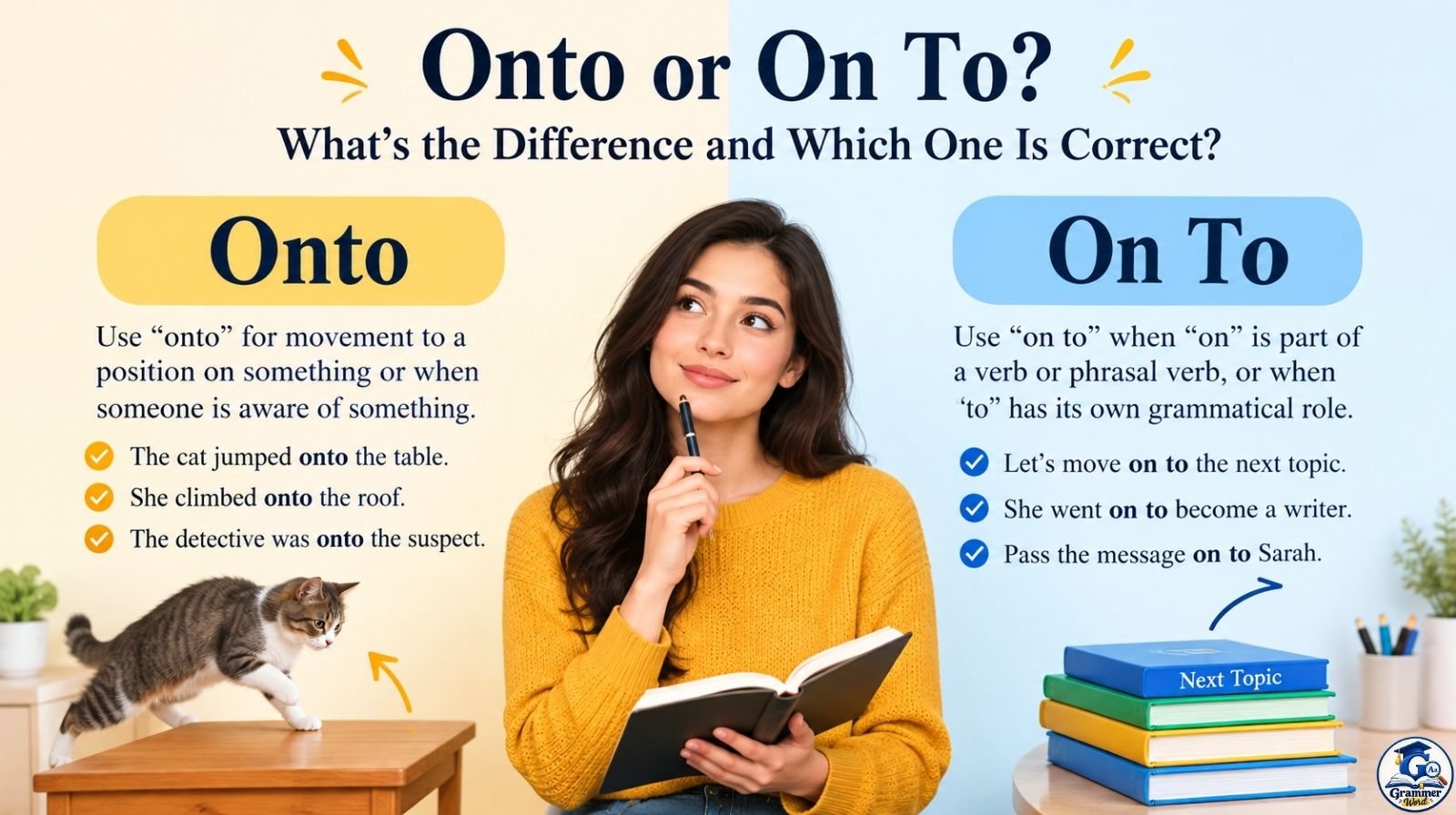
The basic rule is simple: use “onto” when it expresses movement to a position on something or means “aware of.” Use “on to” when “on” belongs to the verb or when “to” has its own grammatical role.
For example:
- The cat jumped onto the table. → movement to a surface
- We moved on to the next topic. → “move on” is the verb phrase
- She is onto his plan. → she is aware of his plan
Once you understand what each word is doing in the sentence, choosing between onto or on to becomes much easier.
Read More: Girlie or Girly: Which Word Is Correct? Meaning, Usage, Differences, And Examples For 2026
What Does “Onto” Mean?
Onto is normally a preposition that expresses movement toward or to a position on a surface. It can also mean that someone has become aware of something.
Merriam-Webster defines onto as meaning “to a position on,” with examples such as climbing onto a roof or turning onto a street.
Onto Means Movement to a Surface
Use onto when someone or something moves from one position to a position on another surface.
Examples:
- The boy climbed onto the roof.
- The cat jumped onto the sofa.
- She placed the bag onto the table.
- The bird flew onto the branch.
- He stepped onto the stage.
A useful way to think about this is:
movement + destination on a surface = onto
For example:
The child climbed onto the bed.
The child is moving toward a position on the bed.
Onto Can Also Mean “Aware Of”
There is another important use of onto.
When someone is onto something, they have discovered it, understood it, or become suspicious of it.
Examples:
- I think she’s onto us.
- The detective was onto the suspect.
- He realized that his boss was onto his plan.
Here, onto does not describe physical movement. It means aware of or suspicious of something.
What Does “On To” Mean?
On to is not always a single grammatical unit. In many sentences, on belongs to a verb or phrasal verb, while to introduces something that follows.
This is why simply looking at the two words is not enough. You need to examine the sentence.
“On” Can Be Part of a Phrasal Verb
Consider:
We moved on to the next lesson.
The expression is move on, meaning to continue or proceed. The word to then introduces the next thing.
Other examples include:
- Let’s move on to the next question.
- She went on to become a successful writer.
- We carried on to the next stage of the project.
- He passed the information on to his manager.
Dictionary.com similarly explains that on to commonly occurs when on is part of a phrasal verb and to has its own grammatical function.
Read More: Blond or Blonde: What’s The Difference And Which One Is Correct?
On To Often Means “The Next Thing”
A very common pattern is:
move on to + noun
Examples:
- Let’s move on to the next chapter.
- After lunch, we moved on to dessert.
- The teacher moved on to another example.
- Once you’ve finished this task, move on to the next one.
In these sentences, onto would change the meaning or sound incorrect.
Onto or On To: The Main Difference
The easiest way to understand onto vs. on to is to focus on meaning rather than spelling.
| Onto | On To |
|---|---|
| Usually expresses movement to a position on something | Often occurs when on belongs to a verb |
| Can mean “upon” | Often means continuing toward the next thing |
| Can mean “aware of” | “To” can introduce a noun, destination, or infinitive |
| She climbed onto the roof. | She moved on to the next task. |
| The cat jumped onto the chair. | He went on to explain the problem. |
| The police are onto him. | She passed the message on to me. |
Cambridge Dictionary explains that onto is used for direction or movement toward a position on a surface, while on can describe a position and onto can emphasize movement toward an end position.
How to Know Whether to Use Onto or On To
There are a few practical tests that can help you make the right choice.
Test 1: Can You Replace “Onto” With “Upon”?
If upon makes sense, onto is often the correct choice.
For example:
The child climbed onto the platform.
You could say:
The child climbed upon the platform.
Although “upon” may sound more formal, the basic relationship works.
Another example:
She placed the book onto the desk.
The meaning is clearly movement to a surface.
Test 2: Is “On” Part of the Verb?
If removing on would change the verb’s meaning, you probably need on to.
For example:
We moved on to the next subject.
The verb phrase is move on.
Similarly:
He went on to discuss the results.
The phrase go on means to continue.
So don’t automatically combine on + to into onto.
Test 3: Does the Sentence Describe Physical Movement?
When something physically moves to a position on a surface, onto is usually the natural choice.
Examples:
- The dog jumped onto the couch.
- She stepped onto the bus.
- The ball rolled onto the road.
- He climbed onto the horse.
This is one of the clearest uses of onto.
Test 4: Does “On To” Introduce the Next Step?
If the sentence means continue to the next subject, activity, stage, or idea, use on to.
Examples:
- Let’s move on to the next question.
- She went on to explain her decision.
- We can now move on to the final section.
Common Examples of Onto vs. On To
Seeing the difference in realistic sentences makes the rule much easier to remember.
Examples With “Onto”
1. The puppy jumped onto the bed.
The puppy moved to a position on the bed.
2. She climbed onto the stage.
She physically moved onto the stage.
3. The keys fell onto the floor.
The keys moved to the floor’s surface.
4. Turn onto the main road.
The vehicle moves toward the road.
5. The detective knew he was onto something.
Here, “onto” means he had discovered something important.
Examples With “On To”
1. Let’s move on to the next question.
“Move on” means continue.
2. She went on to become a successful author.
The phrase describes what happened later in her life.
3. Please pass the message on to Sarah.
“Pass on” is the verb phrase.
4. We should move on to the final chapter.
The sentence means continue to the next part.
5. He carried on to the next stage.
“On” is connected to the verb phrase rather than forming the preposition onto.
A Real-Life Example: Choosing the Right Form
Imagine a teacher is explaining a writing assignment to a class.
She says:
“First, write your introduction. Then move on to the first main point.”
Here, on to is correct because the teacher means continue to the next part. The phrase move on means to proceed.
Now imagine a different situation. A student walks across the classroom and places a notebook on the teacher’s desk.
You could say:
“The student put the notebook onto the desk.”
Here, onto describes movement toward a surface.
Now consider a third situation. The teacher notices that students are secretly planning a surprise party.
She might say:
“I think I’m onto you.”
Here, onto means she has figured out what they are doing.
These three sentences demonstrate why spelling alone cannot determine the answer:
- move on to the next point → continue
- put something onto a surface → physical movement
- be onto someone → become aware of something
The context determines the correct form.
This distinction is particularly useful for students and professional writers because a small spacing difference can change the grammatical relationship between the words. Grammar references consistently make the same basic distinction: onto functions as a preposition in movement-to-a-surface constructions, while on to often keeps on attached to a preceding verb or expression.
Read More: Any Time or Anytime: Which One Is Correct?
Onto or On To: 2025–2026 Usage and What Modern Guidance Says
There is an important point about modern English: onto is firmly established as a standard word, particularly in American English, and major dictionaries continue to define and document it as a preposition.
Merriam-Webster’s current entry lists onto as a preposition meaning “to a position on” and provides contemporary examples such as moving onto a road, shoulder, or other surface. Its entry was updated in March 2026.
Cambridge Dictionary likewise distinguishes on and onto, explaining that onto is commonly used to express movement toward a position on a surface.
For online writing in 2025–2026, the practical lesson is not to force one spelling everywhere. Modern search-quality guidance from Google emphasizes useful, reliable, people-first content rather than writing designed merely to manipulate rankings. Google’s documentation also specifically says there is no preferred article word count that guarantees ranking.
Therefore, good grammar remains the priority: choose onto or on to according to the meaning and grammatical structure of the sentence.
A Quick Step-by-Step Guide
When you’re unsure whether to write onto or on to, follow these steps.
Step 1: Look at the Verb
Ask yourself:
Is “on” part of the verb or phrasal verb?
If yes, on to is often correct.
We moved on to the next lesson.
Step 2: Check for Physical Movement
Ask:
Is something moving toward a position on a surface?
If yes, onto is usually correct.
The child climbed onto the chair.
Step 3: Check the Meaning
If onto means aware of or suspicious of, use the single word.
The police are onto the suspect.
Step 4: Try “Upon”
If replacing onto with upon preserves the basic meaning, that is a useful clue that onto may be appropriate.
Step 5: Read the Whole Sentence
Don’t make your decision based only on the words immediately next to each other. Look at the entire verb phrase.
Read More: Freshman or Freshmen: Which One Is Correct?
Common Mistakes to Avoid
Mistake 1: Writing “Onto” Every Time You See “On + To”
This is probably the most common mistake.
Incorrect:
Let’s move onto the next topic.
Better:
Let’s move on to the next topic.
Here, move on is the relevant expression.
Mistake 2: Separating “Onto” When Describing Movement
Incorrect:
The cat jumped on to the table.
In standard modern usage, onto is the clearer choice when the meaning is movement to a position on the table:
The cat jumped onto the table.
Mistake 3: Confusing “Onto” With “Into”
Onto describes movement toward a position on a surface.
Into describes movement toward the inside of something.
Compare:
- The dog jumped onto the bed.
- The dog ran into the room.
This distinction makes the meaning much clearer.
Mistake 4: Ignoring Context
Some constructions can legitimately be written in more than one way depending on meaning and style. For example, Dictionary.com notes that expressions such as log onto and log on to can both occur.
So context matters more than blindly following a one-word rule.
Mini Quiz: Onto or On To
1. Pick the Right One
The cat jumped ___ the table.
A) on to
B) onto
C) ontoo
D) on-too
Answer: B) onto
2. Keep It Moving
Which sentence is correct?
A) Let’s move onto the next topic.
B) Let’s move on to the next topic.
C) Let’s move ontoo the next topic.
D) Let’s moving onto the next topic.
Answer: B) Let’s move on to the next topic.
3. Surface Check
Which sentence uses onto for movement to a surface?
A) She went on to explain.
B) He moved on to another task.
C) The dog climbed onto the sofa.
D) She passed it on to me.
Answer: C) The dog climbed onto the sofa.
Read More: Skillset or Skill Set: Which Term Is Correct In Modern English?
4. What Does “Onto” Mean Here?
“I think the detective is onto him.”
What does onto mean?
A) Above him
B) Aware or suspicious of him
C) Behind him
D) Next to him
Answer: B) Aware or suspicious of him
5. Fill the Gap
The bird flew ___ the branch.
A) on to
B) onto
C) on too
D) ont
Answer: B) onto
6. Next Topic Alert!
Which is correct?
A) We moved onto the next chapter.
B) We moved on to the next chapter.
C) We moved ontoo the next chapter.
D) We move onto next chapter.
Answer: B) We moved on to the next chapter.
7. Quick Grammar Test
Which word usually expresses movement to a position on a surface?
A) Into
B) Onto
C) Under
D) Beside
Answer: B) Onto
8. Spot the Correct Sentence
A) The boy climbed on to the roof.
B) The boy climbed onto the roof.
C) The boy climbed onto to the roof.
D) The boy climbed onthe roof.
Answer: B) The boy climbed onto the roof.
9. “On” Belongs Where?
In “She went on to become a writer,” what is on connected with?
A) The noun writer
B) The verb phrase
C) The word become only
D) The article “a”
Answer: B) The verb phrase
10. Choose the Natural Sentence
Which sentence sounds correct when you mean “continue”?
A) Let’s move on to the next question.
B) Let’s move onto the next question.
C) Let’s move ontoo the next question.
D) Let’s onto the next question.
Answer: A) Let’s move on to the next question.
Read More: Anyway or Anyways: Which One Is Correct?
11. One Word or Two?
Choose the correct form:
“The puppy jumped ___ the bed.”
A) on to
B) onto
C) on-too
D) ont
Answer: B) onto
12. Meaning Matters!
Which sentence means someone has discovered or become suspicious of something?
A) She stepped onto the stage.
B) He moved on to lunch.
C) The detective is onto something.
D) They went on to the next room.
Answer: C) The detective is onto something.
13. Easy “Upon” Test
Which word can sometimes replace onto while keeping the basic meaning?
A) Upon
B) Around
C) Between
D) Through
Answer: A) Upon
14. Final Sentence Challenge
Choose the correct form:
“Please pass the message ___ Sarah.”
A) onto
B) on to
C) ont
D) ontoo
Answer: B) on to
15. The Big One!
Which rule is the best way to remember onto vs. on to?
A) Always use onto.
B) Always use on to.
C) Check the meaning and how “on” functions in the sentence.
D) Use whichever looks shorter.
Answer: C) Check the meaning and how “on” functions in the sentence.
FAQs
Q1. Is “onto” one word or two?
A: Onto is normally written as one word when it functions as the preposition meaning “to a position on” or “upon.” For example: “The cat jumped onto the table.”
Q2. What is the difference between onto and on to?
A: Onto usually expresses movement to a position on something or means “aware of.” On to often occurs when on is part of a verb or phrasal verb and to has its own grammatical function.
Q3. Is “move onto the next topic” correct?
A: It can be correct in some contexts, but move on to the next topic is the clearest choice when you mean “continue to the next topic.” The expression move on is functioning as the verb phrase.
Q4. Is “climbed onto the roof” correct?
A: Yes. Climbed onto the roof is correct because the sentence describes movement to a position on the roof.
Q5. Is “I am onto you” grammatically correct?
A: Yes. I’m onto you is an established expression meaning that you have discovered, understood, or become suspicious of what someone is doing.
Q6. Can “onto” and “on to” ever both be possible?
A: Yes. Some sentences can support either form depending on the intended meaning or grammatical analysis. For example, log onto your account and log on to your account are both found in standard usage.
Final Takeaway:
The difference between onto or on to becomes much easier when you focus on the meaning.
Use onto when you mean:
- movement to a position on something
- movement toward a surface
- “upon”
- being aware of or suspicious of something
Examples:
She jumped onto the sofa.
He climbed onto the roof.
The detective was onto the suspect.
Use on to when on belongs to the preceding verb or when to has its own grammatical function.
Examples:
Let’s move on to the next topic.
She went on to explain the answer.
Pass the information on to me.
The best rule is simple: don’t decide based only on whether “on” and “to” appear together. Look at what the words are doing in the sentence.
If you remember that one principle, choosing between onto and on to will become much more natural and your writing will be clearer and more accurate.
Discover More Article
- Fiancé or Fiancée: Understanding The Difference And Correct Usage
- Dreamt or Dreamed: Which One Is Correct?
- This Is She or This Is Her? The Correct Way To Answer The Phone
Keep learning with more easy grammar lessons on Grammer Word.com

Hi, I’m Noor Fatima, the person behind this website. I created this site to make English grammar and confusing words easier to understand. I love breaking down tricky words, meanings, spellings, and grammar rules into simple explanations. My goal is to help you learn English naturally, avoid common mistakes, and feel more confident every time you write or speak.