Have you ever wondered whether ax or axe is the correct spelling? You are not alone. The two words look slightly different, but they refer to the same basic tool and are pronounced the same way.
So, what is the real difference between ax vs axe?
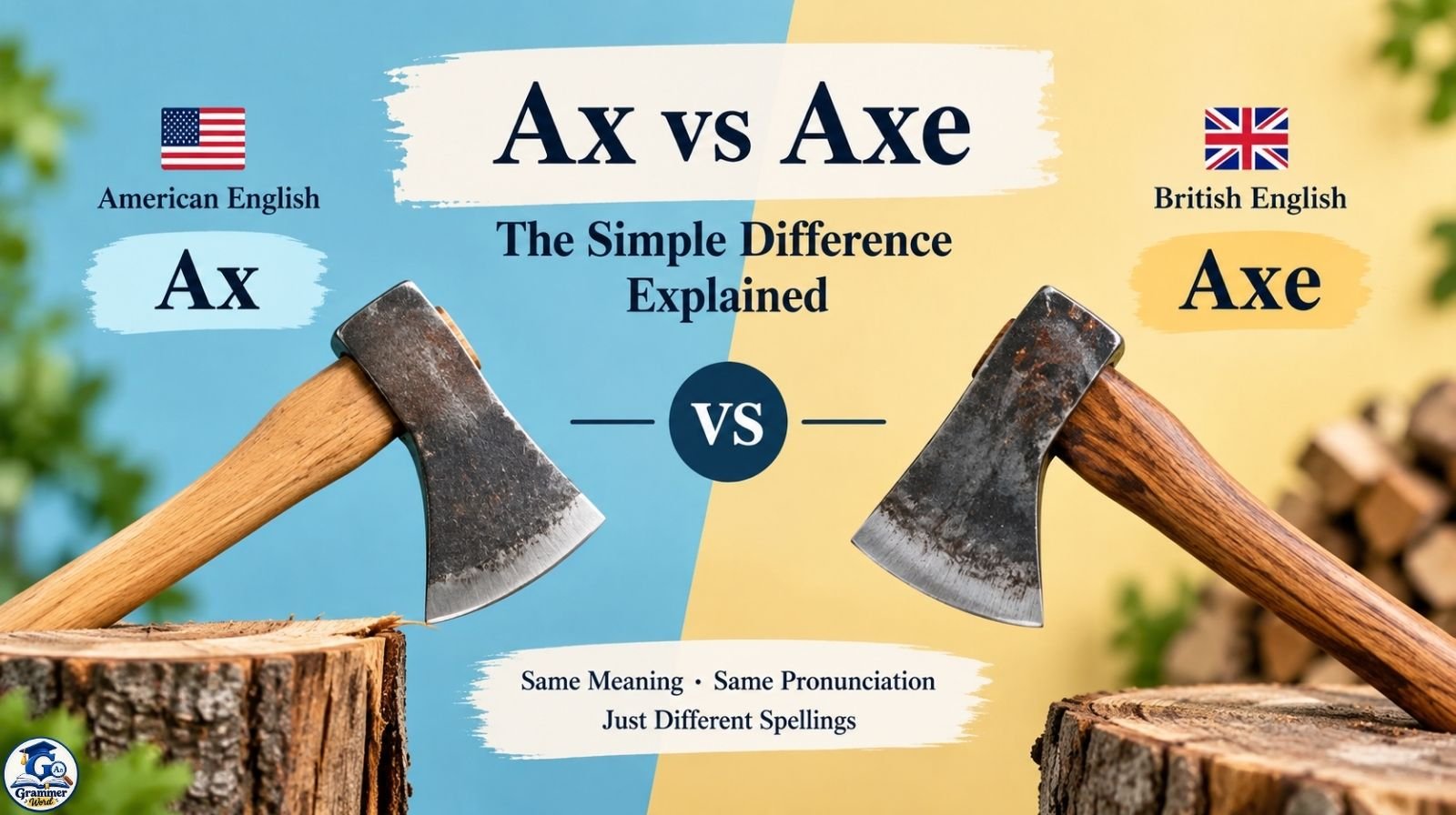
The short answer is that both spellings are correct. The main difference is regional usage: ax is especially associated with American English, while axe is the more traditional and commonly preferred spelling in British English. Cambridge Dictionary lists axe with ax as the US form and gives both the noun and verb uses.
In this guide, you will learn exactly when to use ax, when to use axe, how the words work as nouns and verbs, and which spelling is best for different English varieties.
Read More: Ageing or Aging: Which Spelling Is Correct? A Simple, Clear Guide
Ax vs Axe: Are They Actually Different?
The biggest misconception is that ax and axe describe two different tools. They do not.
Both words refer to a tool with a heavy blade attached to a handle, commonly used for cutting or chopping wood. Cambridge Dictionary gives axe as the main entry and identifies ax as an alternative US spelling.
Ax and Axe Have the Same Basic Meaning
For example:
- He used an ax to chop the wood.
- He used an axe to chop the wood.
Both sentences are correct.
The spelling changes, but the basic meaning does not.
They Are Pronounced the Same
Both ax and axe are pronounced /æks/.
The extra e in axe does not create a different pronunciation.
So you can think of them as two spelling forms of the same word rather than two separate vocabulary items.
Ax vs Axe: American English vs British English
This is where the distinction becomes useful.
Ax in American English
Ax is a well-established spelling in American English.
Examples:
- The lumberjack picked up an ax.
- He used an ax to split the log.
- The firefighter carried an ax into the building.
The shorter spelling is particularly associated with US English. Microsoft also notes that ax is the preferred American form while axe remains correct and used in the United States.
Axe in British English
Axe is the conventional spelling in British English.
Examples:
- He picked up an axe from the shed.
- The worker used an axe to cut the branches.
- She bought a new axe for camping.
Cambridge specifically labels axe as the British form and identifies ax as the US form.
Is “Axe” Wrong in American English?
No.
This is an important point.
Although ax is strongly associated with American English, axe is also an accepted spelling in American English. Therefore, calling axe an incorrect American spelling would be misleading.
Read More: Laid Off or Layed Off: Which One Is Correct?
Ax vs Axe: Quick Comparison
| Feature | Ax | Axe |
|---|---|---|
| Basic meaning | Cutting tool | Cutting tool |
| Pronunciation | /æks/ | /æks/ |
| American English | Common | Also accepted |
| British English | Less conventional | Conventional |
| Number of letters | 3 | 4 |
| Noun | Yes | Yes |
| Verb | Yes | Yes |
| Different tool? | No | No |
The easiest rule is:
Ax and axe mean the same thing. The main difference is spelling preference by English variety.
How to Use Ax and Axe as Verbs
The word is not limited to the physical tool. Both ax and axe can also be used as verbs.
Ax/Axe Meaning “To Cut or Remove”
As a verb, the word can mean to cut something down, remove something, or eliminate something.
For example:
- The company axed several unnecessary expenses.
- The network axed the television program.
- The airline axed several flights.
- The workers axed the damaged branches.
Cambridge Dictionary lists axe as a verb meaning to reduce or eliminate something, while also identifying ax as the US form.
The Workplace Meaning
You may also encounter ax/axe when talking about jobs.
For example:
Several employees were axed after the company reduced its workforce.
Here, axed does not mean someone literally used a cutting tool. It means the employees were dismissed.
Similarly:
- The project was axed.
- The program was axed.
- The company axed 200 jobs.
The meaning is usually clear from context.
Common Expressions With Ax and Axe
Both forms appear in several familiar expressions.
“Have an Ax/Axe to Grind”
This expression means to have a personal opinion, complaint, or reason for wanting to influence a situation.
Examples:
- He clearly has an axe to grind.
- She has an ax to grind with the company.
Both spellings can appear depending on the variety or style of English.
“Get the Ax/Axe”
This means to be removed, canceled, or dismissed.
For example:
- The television show got the axe.
- The project got the ax.
Cambridge gives get the axe and get the ax as forms of the same expression.
“Face the Ax/Axe”
This expression can refer to employees potentially losing their jobs or services being canceled.
For example:
Several departments are facing the axe because of budget cuts.
Again, the spelling depends largely on the English variety and the writer’s preferred style.
Read More: Patients vs Patient’s: Meaning, Difference, And Correct Usage
A Real-Life Example: Choosing the Right Spelling
Imagine that Sarah is writing an article for a British gardening website. She wants to describe a gardener cutting down a small tree.
Her first sentence reads:
“The gardener picked up an ax and began cutting the branches.”
The sentence is understandable and ax is not a meaningless or invented spelling. However, because Sarah’s publication consistently follows British English conventions, she decides to write:
“The gardener picked up an axe and began cutting the branches.”
Now imagine the same sentence appearing in an American publication:
“The gardener picked up an ax and began cutting the branches.”
That version fits naturally with American English spelling conventions.
The important lesson is that Sarah did not change the meaning of the sentence. She simply adjusted the spelling to match her publication’s style.
This matters especially for professional writing. A reader usually will not misunderstand ax or axe, because both clearly refer to the same tool. However, consistency makes writing look more polished.
If an entire article follows British spelling, repeatedly switching between ax and axe may make the writing appear inconsistent. Likewise, an American publication may prefer ax throughout if that is its established style.
Therefore, when deciding between ax vs axe, think less about “right versus wrong” and more about audience, regional English, and consistency.
2025–2026 Data & Usage Snapshot
There is an important limitation when discussing statistics about ax vs axe: major dictionaries do not publish a single authoritative worldwide percentage showing exactly how often each spelling is used in everyday English.
However, current reference resources provide useful evidence about their distribution.
What Current Sources Show
As of 2026:
- Cambridge Dictionary identifies axe as the British form and ax as the US form.
- Microsoft likewise describes axe as the preferred British spelling and ax as the preferred American spelling, while noting that both are correct.
- Google’s Ngram Viewer provides corpus-based historical usage data for ax and axe, with datasets extending through published books in recent historical corpora. Google also added a newer Ngram dataset in July 2024.
These sources support a practical conclusion for 2025–2026 writing: there is no need to treat either spelling as a spelling mistake simply because the other form is more familiar in a particular region.
For SEO and professional writing, the best approach is to use the form that matches your target audience while naturally mentioning the alternative when explaining the distinction.
Read More: This Is She or This Is Her? The Correct Way To Answer The Phone
Which One Should You Use?
If you are unsure, use this simple guide.
Choose “Ax” When:
Use ax when you are following American English conventions and want the shorter US-associated spelling.
Example:
The farmer carried an ax into the forest.
Choose “Axe” When:
Use axe when writing in British English or when following a style guide that prefers the traditional spelling.
Example:
The farmer carried an axe into the forest.
Keep Your Spelling Consistent
If your article uses American English, ax may fit naturally.
If your article uses British English, axe is generally the natural choice.
The most important thing is not to randomly alternate between the two without a reason.
Common Mistakes to Avoid

Mistake 1: Thinking One Spelling Is Always Wrong
It is incorrect to assume that either ax or axe is universally wrong.
Both are recognized English spellings.
Mistake 2: Thinking They Are Different Tools
An ax and an axe are not two separate tools simply because one has an extra letter.
They have the same basic meaning.
Mistake 3: Assuming “Axe” Is Only British
Although axe is strongly associated with British English, it is also used and accepted in American English.
Mistake 4: Ignoring Your Publication’s Style
Professional writers should consider their audience.
If your website consistently follows American English, use American conventions. If it follows British English, use British conventions.
Google’s own guidance also emphasizes creating useful, people-first content for the intended audience rather than writing primarily to manipulate search rankings.
Read More: Masonary vs Masonry: Which Spelling Is Correct And Why It Matters
Mini Quiz: Ax vs Axe
1. Which spelling is commonly associated with American English?
A) Axe
B) Ax
C) Aks
D) Axx
Answer: B) Ax
2. Which spelling is conventional in British English?
A) Ax
B) Aks
C) Axe
D) Axx
Answer: C) Axe
3. Are “ax” and “axe” different tools?
A) Yes
B) Sometimes
C) No
D) Only in Britain
Answer: C) No
4. How are “ax” and “axe” pronounced?
A) Differently
B) The same
C) Only “axe” is pronounced
D) They have two pronunciations
Answer: B) The same
5. Which sentence uses the American spelling?
A) He picked up an ax.
B) He picked up an aks.
C) He picked up an axee.
D) He picked up acks.
Answer: A) He picked up an ax.
6. Which sentence uses the British spelling?
A) She bought an ax.
B) She bought an axe.
C) She bought an aks.
D) She bought an axxe.
Answer: B) She bought an axe.
7. Can “ax” be used as a verb?
A) No
B) Yes
C) Only in questions
D) Only in British English
Answer: B) Yes
8. What can “axed” mean in a workplace context?
A) Promoted
B) Hired
C) Dismissed
D) Trained
Answer: C) Dismissed
9. What does “get the axe” commonly mean?
A) Get a new tool
B) Be removed or canceled
C) Start working
D) Win something
Answer: B) Be removed or canceled
10. Which spelling has fewer letters?
A) Axe
B) Ax
C) Both have four
D) Both have five
Answer: B) Ax
Read More: Girlie or Girly: Which Word Is Correct? Meaning, Usage, Differences, And Examples For 2026
11. Is “axe” completely wrong in American English?
A) Yes
B) No
C) Only online
D) Only in formal writing
Answer: B) No
12. What is the best rule for choosing between “ax” and “axe”?
A) Always use ax
B) Always use axe
C) Match your English variety and style
D) Use both randomly
Answer: C) Match your English variety and style
13. Which sentence is correct?
A) He used an ax to chop wood.
B) He used an axe to chop wood.
C) Both A and B
D) Neither A nor B
Answer: C) Both A and B
14. What is the main difference between “ax” and “axe”?
A) Their meaning
B) Their pronunciation
C) Their spelling and regional preference
D) Their size
Answer: C) Their spelling and regional preference
15. What is the easiest way to remember “ax vs axe”?
A) They describe different tools
B) Ax is associated with US English; axe with British English
C) Axe is always incorrect
D) Ax is always incorrect
Answer: B) Ax is associated with US English; axe with British English
FAQs
Q1. Is “ax” or “axe” correct?
Both are correct. Ax and axe are two spellings of the same word. Ax is especially associated with American English, while axe is conventional in British English.
Q2. Is “axe” British or American?
Axe is traditionally associated with British English, but it is also accepted and used in American English. American English commonly uses ax as the shorter spelling.
Q3. Is “ax” an American spelling?
Yes. Ax is a well-established American English spelling of the word commonly spelled axe in British English.
Q4. Do ax and axe sound the same?
Yes. Both are pronounced /æks/. The extra e in axe does not change the pronunciation.
Q5. Can “ax” be used as a verb?
Yes. Ax can be a verb meaning to cut, remove, cancel, or dismiss. For example: “The company axed several positions.”
Q6. Is “axe” acceptable in American English?
Yes. Axe is accepted in American English, although ax is commonly associated with the American spelling.
Q7. Which spelling should I use in formal writing?
Choose the spelling that matches your intended variety of English and remain consistent. Use ax for a US-oriented style and axe for a British-oriented style.
Conclusion:
The ax vs axe debate is much simpler than it first appears.
Ax and axe are both correct spellings of the same word. They refer to the same cutting tool, have the same pronunciation, and can both function as nouns and verbs.
The main distinction is regional:
- Ax → commonly associated with American English
- Axe → conventional in British English
- Both → recognized and understandable English spellings
So, if you’re writing for an American audience, ax is a natural choice. If you’re following British English, axe is generally the better fit. Most importantly, choose one form that matches your style and use it consistently.
If you found this Ax vs Axe guide helpful, save it as a quick reference and share it with anyone who is unsure which spelling to use.
Discover More Article
- Dreamt or Dreamed: Which One Is Correct?
- Sponser vs Sponsor: Difference And Correct Usage
- Midday vs Mid Day: Which Spelling Is Correct In Modern English?
Keep learning with more easy grammar lessons on Grammer Word.com

Hi, I’m Noor Fatima, the person behind this website. I created this site to make English grammar and confusing words easier to understand. I love breaking down tricky words, meanings, spellings, and grammar rules into simple explanations. My goal is to help you learn English naturally, avoid common mistakes, and feel more confident every time you write or speak.