Have you ever stopped while writing because you could not decide between “gases” or “gasses”? The confusion is understandable because both forms appear in dictionaries, and both can sound alike.
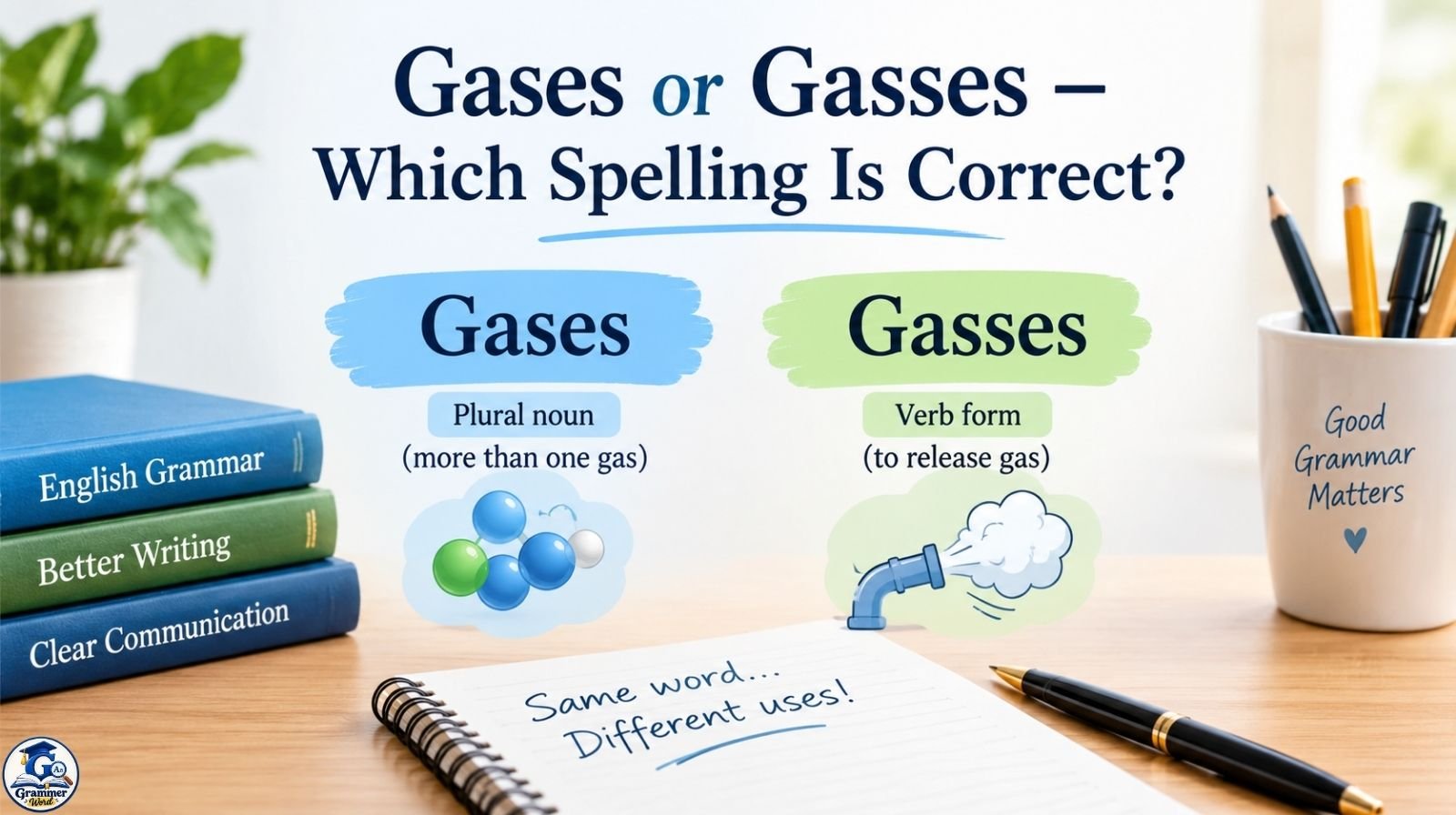
The important point is that gases is the normal plural form of gas when you are talking about more than one gas.
Gasses is also a legitimate English form, but it is less common as a plural and is especially important as a verb form. Oxford lists gases as the plural and gasses as less frequent, while Cambridge lists both plural forms.
So, should you write gases or gasses? Let’s clear up the difference with simple rules, examples, and practical guidance.
Read More: Any Time or Anytime: Which One Is Correct?
Gases or Gasses: What Is the Difference?
The easiest way to understand these words is to look at their grammatical function.
Gases Is the Standard Plural of Gas
When you mean more than one gas, the usual spelling is gases.
For example:
- Oxygen and nitrogen are gases.
- Scientists studied several gases in the laboratory.
- Greenhouse gases affect Earth’s atmosphere.
- Different gases behave differently under pressure.
- Toxic gases escaped from the container.
Oxford gives gases as the ordinary plural of gas and describes gasses as less frequent.
Gasses Can Be a Verb
Gasses can also be the third-person singular present form of the verb gas.
For example:
- The machine gasses the chamber.
- The battery gasses while it is charging.
- The equipment gasses the material during the process.
Here, gasses describes an action rather than naming multiple substances.
Merriam-Webster distinguishes the noun plural from the verb: it lists gases as a plural of gas and gasses as one of the verb variants.
Quick Rule to Remember
If you are naming multiple gases, use gases.
If you are describing what something does with or gives off gas, gasses may be the appropriate verb.
gas → gases = plural noun
gas → gasses = verb form
Why Is “Gases” Usually the Better Choice?
The spelling gases is the form most writers should choose when they simply need the plural of gas.
Gases in Science and Technical Writing
Scientific writing frequently discusses different kinds of gases, including oxygen, nitrogen, carbon dioxide, methane, and hydrogen.
For example:
The experiment measured several gases released during the reaction.
Here, gases clearly functions as a plural noun.
Cambridge’s dictionary gives examples involving oxygen, hydrogen, nitrogen, toxic gases, and greenhouse gases, reinforcing the ordinary use of gases when discussing substances.
Gases in Everyday English
You do not have to use gases only in scientific contexts.
It can refer to:
- cooking gases
- industrial gases
- exhaust gases
- greenhouse gases
- medical gases
- gases in the atmosphere
- gases inside a container
For example:
Several gases can be found in Earth’s atmosphere.
Or:
The factory monitors potentially harmful gases.
Gases in Formal Writing
For school assignments, business documents, technical reports, and general professional writing, gases is normally the clearest choice when you mean the plural noun.
A 2026 Physics World style guide is especially direct: it specifies “gas plural gases” and “gasses (verb).”
Read More: Ageing or Aging: Which Spelling Is Correct? A Simple, Clear Guide
When Should You Use “Gasses”?

Although gasses is less common as a plural noun, it is not simply a misspelling. It has legitimate grammatical uses.
Gasses as a Verb
The clearest use of gasses is as a verb.
Consider:
The machine gasses the chamber.
The word describes what the machine does. Therefore, it is a verb.
Other examples include:
- The chemical process gasses the material.
- The battery gasses during the charging cycle.
- The device gasses the enclosed space.
- The treatment system gasses the sample.
Merriam-Webster also identifies gasses as a verb form of gas.
Gasses as an Alternative Plural
Some dictionaries recognize gasses as an alternative plural of gas.
For example, Cambridge’s Business English Dictionary lists “gases or gasses” as plural forms. Merriam-Webster likewise lists gasses as a variant plural.
However, that does not mean the two spellings are equally common or equally useful in every context.
Oxford specifically identifies gasses as less frequent, making gases the safer default for ordinary plural-noun usage.
Why “Gasses” Can Be Confusing
The problem is that English sometimes doubles a final consonant when adding an ending.
For example:
- run → running
- stop → stopped
- plan → planned
That pattern can make gasses look like the obvious plural of gas. However, the standard plural noun is generally gases, while the doubled ss has an important role in the verb form.
Read More: Ax vs Axe: The Simple Difference Most People Don’t Know
Gases vs. Gasses: Comparison Table
| Word | Main grammatical role | Meaning | Example |
|---|---|---|---|
| gases | Plural noun | More than one gas | Oxygen and nitrogen are gases. |
| gasses | Verb | Gives, treats, fills, or exposes with gas | The machine gasses the chamber. |
| gasses | Less common plural variant | More than one gas | Some dictionaries recognize gasses as a plural variant. |
The practical distinction is simple: use “gases” when you mean multiple gases, and consider “gasses” when it is functioning as a verb.
2025–2026 Usage Evidence: What Do Current References Show?
Because spelling guidance can change over time, it is useful to check current reference sources rather than relying only on an old grammar rule.
A Current Evidence Snapshot
A review of four 2025–2026 reference points shows a consistent practical pattern:
- Oxford Advanced Learner’s Dictionary lists gases as the plural and gasses as less frequent.
- Cambridge Dictionary recognizes gases or gasses as plural forms but uses gases in its standard examples.
- Merriam-Webster’s 2025 material lists gases as a noun plural and gasses among the verb variants.
- Physics World’s 2026 Style Guide explicitly gives “gas plural gases” and “gasses (verb).”
This is not a corpus-frequency survey, so these four sources should not be treated as a statistical measurement of all English writing. However, they provide a useful current reference snapshot: gases is the clearest default when you need the plural noun.
Real-Life Example: Scientific Writing and Atmospheric Gases
A good real-world example comes from scientific writing about Earth’s atmosphere. Researchers, science journalists, and educational resources routinely need to describe several substances that exist in gaseous form. In this context, gases is the natural plural noun.
For example, a science report might discuss nitrogen, oxygen, carbon dioxide, methane, and other atmospheric substances.
A sentence such as “Scientists monitor gases in Earth’s atmosphere” uses gases because the word identifies multiple substances. It is not describing an action.
Current dictionary examples reflect this same real-world usage. Merriam-Webster’s usage examples include recent scientific and science-journalism references discussing atmospheric and greenhouse gases, including examples published in 2025.
Read More: There or Their: Clear Guide To Correct Usage
Now imagine a different sentence:
The equipment gasses the chamber before the experiment.
Here, gasses is no longer a noun. It describes what the equipment does. The change from gases to gasses is therefore not merely a spelling preference it changes the grammatical role of the word.
This distinction is especially useful for students and technical writers because scientific sentences frequently contain the noun gases, while specialized descriptions of equipment or processes can use the verb gasses.
Common Mistakes With Gases and Gasses

Mistake 1: Writing “gasses” as the Normal Plural
❌ Oxygen and hydrogen are gasses.
For standard general writing, use:
✅ Oxygen and hydrogen are gases.
Although some dictionaries recognize gasses as an alternative plural, gases is the more conventional choice.
Mistake 2: Assuming “Gasses” Is Always Wrong
It is also incorrect to say that gasses is never a real English word.
For example:
✅ The equipment gasses the chamber.
Here, gasses is a legitimate verb form. Merriam-Webster specifically records this use.
Mistake 3: Choosing Based Only on Pronunciation
In ordinary pronunciation, gases and gasses can sound alike.
Therefore, listening to the sentence is not always enough. Instead, ask:
Am I naming substances, or am I describing an action?
If you are naming substances, gases will normally be the right choice.
Read More: Greatful or Grateful: Which One Is Correct?
How to Remember Gases vs. Gasses
Use This Simple Three-Step Test
Step 1: Find the word’s job.
Is it naming something?
The atmosphere contains several gases.
Yes. It is a noun.
Step 2: Ask whether it describes an action.
The device gasses the chamber.
Yes. It is a verb.
Step 3: If you simply mean “more than one gas,” choose gases.
Different gases have different properties.
This simple test works in most everyday, academic, and professional situations.
Memory Trick
Think:
Gases = things
Gasses = action
It is not a perfect rule for every dictionary entry because gasses can also appear as an alternative plural, but it is an effective practical guide for standard writing.
Read More: To Much or Too Much: Which One Is Correct?
Mini Quiz: Gases or Gasses

1. Which spelling is the usual plural of “gas”?
A) Gasses
B) Gases
C) Gass
D) Gasies
Answer: B) Gases
2. Which sentence is correct?
A) Oxygen and nitrogen are gasses.
B) Oxygen and nitrogen are gases.
C) Oxygen and nitrogen is gases.
D) Oxygen and nitrogen are gase.
Answer: B) Oxygen and nitrogen are gases.
3. Is “gasses” a real English word?
A) Yes
B) No
Answer: A) Yes
4. What is the usual meaning of “gases”?
A) More than one gas
B) A type of verb
C) One solid
D) A punctuation mark
Answer: A) More than one gas
5. In which sentence is “gasses” used as a verb?
A) Several gases filled the room.
B) Greenhouse gases affect the climate.
C) The machine gasses the chamber.
D) Oxygen is one of several gases.
Answer: C) The machine gasses the chamber.
6. Fill in the blank: “The atmosphere contains several ___.”
A) gasses
B) gases
C) gass
D) gasies
Answer: B) gases
7. Which phrase is normally correct?
A) Greenhouse gasses
B) Greenhouse gases
C) Greenhouse gasess
D) Greenhouse gase
Answer: B) Greenhouse gases
8. What is the easiest way to choose between “gases” and “gasses”?
A) Count the letters
B) Check the word’s grammatical role
C) Choose the longer word
D) Always use “gasses”
Answer: B) Check the word’s grammatical role
9. “The battery gasses during charging.” What is “gasses” here?
A) Noun
B) Adjective
C) Verb
D) Pronoun
Answer: C) Verb
10. Which spelling is generally safer for formal writing when you mean multiple gases?
A) Gases
B) Gasses
C) Gass
D) Gasess
Answer: A) Gases
11. Which sentence uses “gases” correctly?
A) The scientist studied several gases.
B) The scientist studied several gasseses.
C) The scientist studied several gase.
D) The scientist studied several gass.
Answer: A) The scientist studied several gases.
12. Which word usually refers to multiple substances in gaseous form?
A) Gas
B) Gases
C) Gassed
D) Gassing
Answer: B) Gases
13. True or False: “Gasses” can be used as a verb.
Answer: True.
14. True or False: “Gases” is normally used as the plural of “gas.”
Answer: True.
15. Quick challenge: Which sentence should you choose?
A) Different gasses have different properties.
B) Different gases have different properties.
C) Different gasess have different properties.
D) Different gase have different properties.
Answer: B) Different gases have different properties.
Read More: Freshman or Freshmen: Which One Is Correct?
FAQs
Q1. Is “gases” or “gasses” correct?
Gases is the standard and most common choice when you mean the plural of gas. Gasses is also a recognized English form, particularly as a verb, and some dictionaries list it as an alternative plural.
Q2. What is the plural of gas?
The usual plural of gas is gases.
Example:
The atmosphere contains several gases.
Q3. Is “gasses” a real word?
Yes. Gasses is a legitimate English word. It can function as the third-person singular present form of the verb gas. Some dictionaries also recognize it as an alternative plural.
Q4. Is “gasses” grammatically correct?
Yes, depending on the sentence.
The machine gasses the chamber.
Here, gasses is grammatically correct as a verb.
For the ordinary plural noun, however, gases is generally the better choice.
Q5. Should I write “greenhouse gases” or “greenhouse gasses”?
Write “greenhouse gases.”
This is the standard expression for multiple gases that contribute to the greenhouse effect. Cambridge itself uses the phrase “greenhouse gases” in its dictionary examples.
Q6. Do Americans and British speakers spell it differently?
The basic distinction is not a simple American-versus-British spelling difference. Major dictionaries in both varieties recognize gases, while some also recognize gasses as a variant or verb form. Oxford lists gases as the plural and gasses as less frequent.
Q7. How do you pronounce “gases”?
Gases is commonly pronounced with two syllables, approximately “GASS-iz.” The pronunciation does not reliably tell you whether the spelling should contain one or two ss, so grammar and meaning are more useful guides.
Final Verdict:
So, gases or gasses which spelling is correct?
When you mean more than one gas, use gases:
Oxygen and nitrogen are gases.
When gasses functions as a verb, it can also be correct:
The machine gasses the chamber.
Some dictionaries recognize gasses as an alternative plural, but current reference sources identify gases as the normal or more frequent plural form.
Discover More Article
- Lets or Let’s: Which One Is Correct And When To Use It?
- Per Say or Per Se: Which One Is Correct?
- Choose or Chose: Everything You Need To Know
- Loosing or Losing: What’s The Correct Spelling And When To Use It?
Keep learning with more easy grammar lessons on Grammer Word.com

Hi, I’m Noor Fatima, the person behind this website. I created this site to make English grammar and confusing words easier to understand. I love breaking down tricky words, meanings, spellings, and grammar rules into simple explanations. My goal is to help you learn English naturally, avoid common mistakes, and feel more confident every time you write or speak.