If you have ever wondered whether “loosing” or “losing” is the correct spelling, you are not alone. These words look almost identical, but they come from two different verbs and have completely different meanings.
In most everyday situations, losing is the word you need. However, loosing is also a real English word it is simply much less common and comes from loose, not lose.
In this guide, you will learn the difference between loosing and losing, when to use each word, common mistakes, practical examples, and a simple memory trick that makes the distinction easy to remember.
Loosing or Losing: Which Spelling Is Correct?
The short answer is:
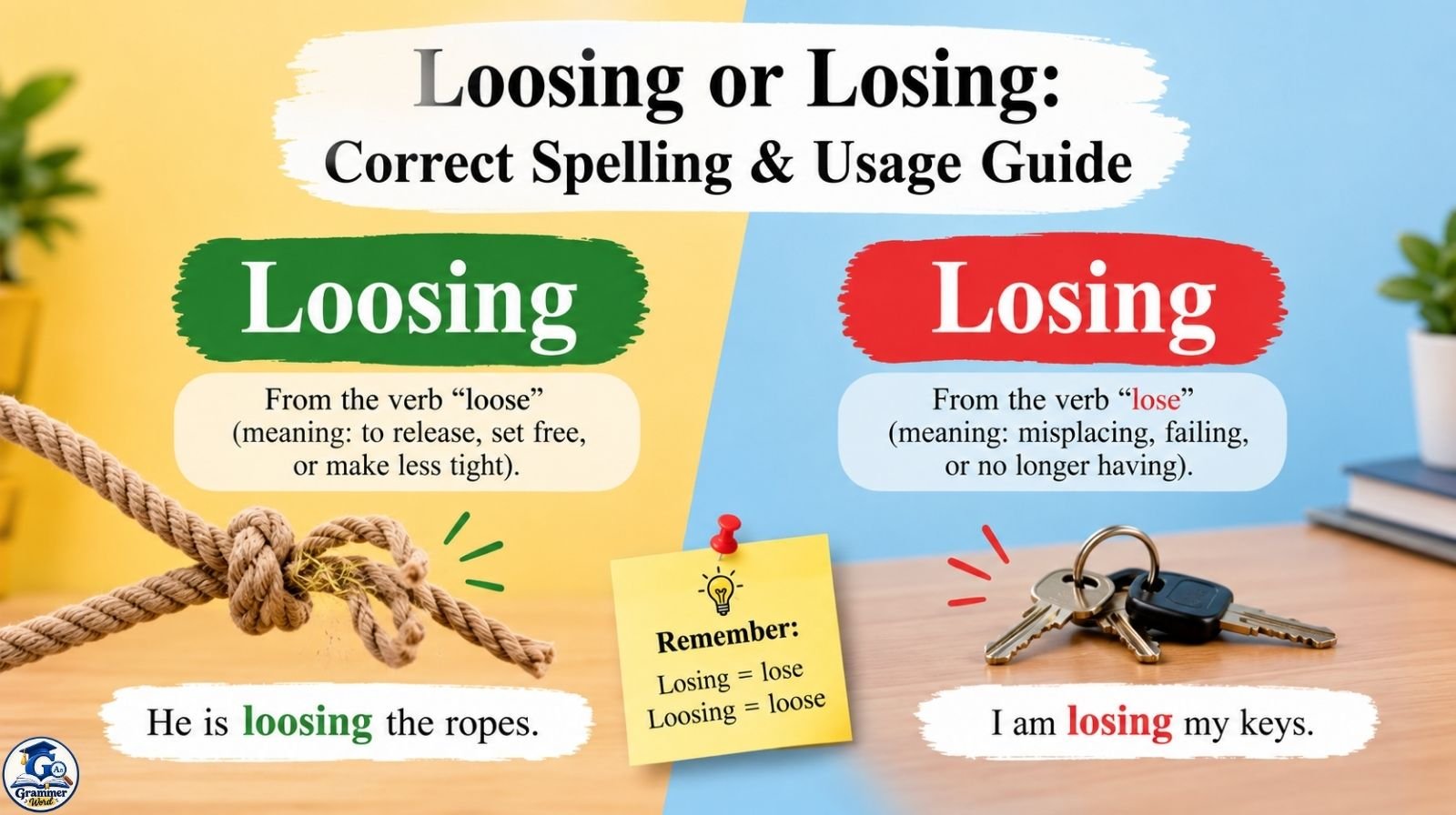
“Losing” is correct when it comes from the verb “lose.” “Loosing” is correct only when it comes from the verb “loose.”
The two words are not interchangeable.
Losing is the present participle of lose. It can mean misplacing something, no longer having something, failing to win, or having less of something. Cambridge Dictionary lists losing as the present participle of lose.
Loosing, on the other hand, is the present participle of loose. The verb loose can mean to release, set free, make something less tight, or allow something to be released.
Read More: Timeframe or Time Frame: Simple Grammar Explanation
Quick Answer
| Word | Comes from | Meaning | Example |
|---|---|---|---|
| Losing | lose | Misplacing, failing, decreasing, or no longer having | I am losing my keys. |
| Loosing | loose | Releasing or making something less tight | He is loosing the ropes. |
So, if you mean “not winning,” “misplacing,” or “no longer having,” use losing.
What Does “Losing” Mean?
Losing is the much more common word. It is formed from the verb lose.
The verb lose has several meanings, including no longer having something, being unable to find something, failing to win, and having less of something.
Losing Something
Use losing when you cannot find something or are about to no longer have it.
Examples:
- I am losing my keys again.
- She is losing her phone everywhere.
- We are losing valuable time.
- He is afraid of losing his job.
Losing a Competition
Use losing when someone is not winning a game, competition, or contest.
Examples:
- Our team is losing the match.
- They are losing by two points.
- I hate losing games.
- The company is losing the competition.
Cambridge specifically defines lose in this sense as failing to succeed in a game or competition.
Losing Weight, Money, or Interest
Losing can also describe a decrease.
For example:
- She is losing weight.
- The company is losing money.
- He is losing interest in the project.
- The plant is losing its leaves.
Therefore, whenever your sentence involves loss, defeat, reduction, or no longer having something, losing is generally the word you want.
Read More: Quite or Quiet? Simple Guide To The Common English Confusion
What Does “Loosing” Mean?
Loosing is a real English word, but it has a different origin and meaning.
It is the present participle of loose. Cambridge Dictionary records loosing as a form of loose, including meanings related to releasing something, setting something free, or making something less tight.
Loosing Means Releasing
One use of loose is to release or set free.
For example:
- The hunter was loosing the dogs.
- The soldiers were loosing arrows.
- The storm was loosing debris into the streets.
This usage is relatively uncommon in ordinary modern conversation.
Loosing Means Making Something Less Tight
The verb loose can also mean to make something less tight.
For example:
- She was loosing the knot.
- He was loosing the rope from the post.
However, modern English commonly uses loosening for this meaning:
- She was loosening the knot.
- He was loosening his tie.
Cambridge lists loosen as the verb meaning to make something less tight.
Loosing vs. Losing in One Sentence
Consider these two sentences:
The runner is losing the race.
Here, losing means failing to win.
The archer is loosing an arrow.
Here, loosing means releasing the arrow.
The extra o changes the word’s origin and meaning.
Losing vs. Loosing: The Main Difference
The easiest way to understand loosing or losing is to look at the original verbs.
Lose → Losing
The verb is lose.
When you add -ing, you get:
lose → losing
Examples:
- lose → losing
- lose weight → losing weight
- lose money → losing money
- lose a game → losing a game
Notice that the final e disappears before -ing.
Loose → Loosing
The verb is loose.
Its -ing form can be:
loose → loosing
Examples:
- loose an arrow → loosing an arrow
- loose the dogs → loosing the dogs
- loose the rope → loosing the rope
Grammarly similarly distinguishes lose from loose: lose relates to failing to win, misplacing something, or no longer having something, while loose generally describes something that is not tight.
Read More: Traveled or Travelled: Which Spelling Is Correct In English?
A Simple Comparison
| If you mean… | Use |
|---|---|
| Not winning | losing |
| Misplacing something | losing |
| Having less | losing |
| No longer having something | losing |
| Releasing something | loosing |
| Setting something free | loosing |
| Making something less tight | loosing / more commonly loosening |
Why Do People Confuse “Loosing” and “Losing”?
The confusion is understandable because lose and loose look and sound similar.
The Extra “O” Creates Confusion
Compare:
lose → losing
loose → loosing
That extra o can make loosing look like the natural spelling of losing. However, the spelling reflects two different base words.
The distinction becomes clearer when you remember:
- Lose = fail to keep, find, or win something.
- Loose = not tight or, as a verb, release something.
The “Loose Rope” Memory Trick
Imagine a rope.
A loose rope has an extra o.
So remember:
Loose has an extra O because a loose rope has more room.
But when you are talking about losing a game, losing your keys, or losing money, use losing.
This distinction is also reflected in common English usage guides. Grammarly recommends associating the extra o in loose with something that is physically less tight.
Don’t Write “Loosing” for Everyday Loss
These are incorrect:
- ❌ I am loosing my phone.
- ❌ Our team is loosing the game.
- ❌ She is loosing money.
- ❌ He is loosing interest.
Use:
- ✅ I am losing my phone.
- ✅ Our team is losing the game.
- ✅ She is losing money.
- ✅ He is losing interest.
Read More: Greatful or Grateful: Which One Is Correct?
Common Examples of “Losing” and “Loosing”
Seeing the words in context is one of the fastest ways to understand the difference.
Examples of Losing
- I keep losing my glasses.
- The team is losing the match.
- She is losing confidence.
- We are losing valuable time.
- He is losing money on the business.
- They are losing customers.
- I don’t want to risk losing this opportunity.
Examples of Loosing
- The archer was loosing an arrow.
- The handler was loosing the dogs.
- He was loosing the rope from the post.
- The commander was loosing his men upon the enemy.
The second group is much less common in everyday modern English. In many contexts, writers would naturally choose words such as releasing, setting free, or loosening instead.
A 2026 Usage Check: What Current Dictionaries Show
A useful way to verify a spelling question is to check authoritative dictionaries rather than relying only on how a word looks.
As of 2026, Cambridge Dictionary separately lists losing as the present participle of lose and loosing as the present participle of loose.
That gives us a useful reference point:
- Losing → present participle of lose
- Loosing → present participle of loose
- Lose → /luːz/ in Cambridge’s pronunciation listing
- Loose → /luːs/ as a separate word and verb family
A broader writing-quality point is also relevant. Grammarly reported in a survey of its social-media communities that 51% identified incorrect verb forms as one of the most frustrating categories of writing mistakes.
That survey was published before 2025, so it should not be treated as a 2025–2026 prevalence rate; it simply illustrates why verb-form errors remain an important writing issue.
For current SEO writing, Google likewise emphasizes content that is helpful, reliable, and created primarily for people rather than content produced mainly to manipulate rankings.
Read More: Choose or Chose: Everything You Need To Know
Real-Life Example: A Common Writing Mistake
Imagine a student writing an email to a teacher after missing an assignment deadline.
The student writes:
“I am sorry for loosing the opportunity to submit my assignment on time.”
At first glance, the sentence may seem reasonable because loosing resembles losing. But the intended meaning is that the student no longer has the opportunity. Therefore, the correct sentence is:
“I am sorry for losing the opportunity to submit my assignment on time.”
Now consider a completely different situation. Suppose a historical novel describes an archer preparing to fire:
“The archer drew his bow before loosing the arrow.”
Here, loosing can be correct because it comes from loose, meaning to release the arrow.
This example shows why simply memorizing that “loosing is wrong” is not enough. Loosing is a legitimate word, but it belongs to a different verb.
In modern everyday writing, however, most people who type loosing when they mean losing are making a spelling error.
Checking the underlying verb solves the problem: lose → losing, while loose → loosing. Cambridge’s current dictionary entries support this distinction.
How to Choose Between Losing and Loosing
Use this quick step-by-step method whenever you are unsure.
Step 1: Identify the Meaning
Ask yourself:
Am I talking about losing, misplacing, decreasing, or failing to win?
If yes, use losing.
Example:
I am losing my patience.
Step 2: Check Whether the Original Verb Is “Lose”
If you can replace the word with the base verb lose, choose losing.
I am losing my keys.
Base verb:
I lose my keys.
Therefore:
✅ losing
Read More: Lets or Let’s: Which One Is Correct And When To Use It?
Step 3: Check Whether the Original Verb Is “Loose”
If the meaning is release or make less tight, the base verb may be loose.
Example:
The archer was loosing an arrow.
Base verb:
The archer loosed an arrow.
Therefore, loosing can be correct.
Step 4: Remember the Everyday Rule
In ordinary sentences involving loss, the answer is almost always:
Losing
Losing or Loosing: Quick Checklist
Before publishing or submitting your writing, use this checklist:
- Not winning? → Losing
- Misplacing something? → Losing
- Having less? → Losing
- No longer having something? → Losing
- Releasing something? → Loosing
- Setting something free? → Loosing
- Making something less tight? → Usually loosening
Easy Memory Formula
LOSE → LOSING = loss
LOOSE → LOOSING = release
If your sentence is about a loss, you probably need losing.
Read More: Carmel or Caramel: Which One Is Correct?
Mini Quiz: Loosing or Losing?
1. Which spelling is correct for “not winning a game”?
A) Loosing
B) Losing
C) Loosening
D) Lossing
Answer: B) Losing
2. “I am ___ my keys.” Which word fits?
A) Loosing
B) Losing
C) Loose
D) Loss
Answer: B) Losing
3. Is “loosing” a real English word?
A) Yes
B) No
Answer: A) Yes
It can mean releasing or setting something free.
4. Which base verb gives us “losing”?
A) Loose
B) Loss
C) Lose
D) Loosening
Answer: C) Lose
5. Complete the sentence: “Our team is ___ the match.”
A) Loosing
B) Losing
C) Loose
D) Loss
Answer: B) Losing
6. Which sentence uses “loosing” correctly?
A) I am loosing my phone.
B) She is loosing the game.
C) The archer is loosing an arrow.
D) He is loosing money.
Answer: C) The archer is loosing an arrow.
7. What does “losing weight” mean?
A) Releasing weight
B) Gaining weight
C) Becoming lighter
D) Tightening weight
Answer: C) Becoming lighter
8. Which word is connected with something that is not tight?
A) Lose
B) Losing
C) Loose
D) Loss
Answer: C) Loose
9. “She is ___ interest in the project.” Choose the correct word.
A) Loosing
B) Losing
C) Loose
D) Loosed
Answer: B) Losing
10. Which sentence is correct?
A) He is loosing money.
B) He is losing money.
C) He is loose money.
D) He is lossing money.
Answer: B) He is losing money.
11. What is the easiest way to remember “loose”?
A) It has an extra “o”
B) It always means losing
C) It means winning
D) It has no vowels
Answer: A) It has an extra “o”
12. Complete this sentence: “The hunter was ___ the dogs.”
A) losing
B) loose
C) loosing
D) lossing
Answer: C) Loosing
13. Which phrase is normally correct in everyday English?
A) Loosing a game
B) Losing a game
C) Loose a game
D) Lossing a game
Answer: B) Losing a game
14. “Lose → Losing” and “Loose → ___”
A) Losing
B) Loosing
C) Lossing
D) Loosen
Answer: B) Loosing
15. Final challenge: “I don’t want to risk ___ this opportunity.”
A) Loosing
B) Losing
C) Loose
D) Loosening
Answer: B) Losing
Read More: Per Say or Per Se: Which One Is Correct?
FAQs
Q1. Is “loosing” a correct word?
Yes. Loosing is a real English word and is the present participle of loose. It can mean releasing or setting something free. However, it is much less common than losing.
Q2. Is “losing” the correct spelling?
Yes, when you mean the present participle of lose. For example, “I am losing my keys” and “Our team is losing the game.”
Q3. Is it “losing weight” or “loosing weight”?
The correct phrase is “losing weight.” The base verb is lose, so its -ing form is losing.
Q4. Is it “losing a game” or “loosing a game”?
The correct phrase is “losing a game.” Lose means to fail to win, so the -ing form is losing.
Q5. What is the difference between lose and loose?
Lose means to no longer have something, fail to win, misplace something, or have less of something. Loose generally means not tight and can also function as a verb meaning to release something.
Q6. How can I remember losing vs. loosing?
Remember that loose has an extra o. Think of a loose rope as having extra room. For normal situations involving loss or defeat, use losing.
Conclusion:
So, loosing or losing which is correct? The answer depends on the verb behind the word.
Use losing when you mean failing to win, misplacing something, having less, or no longer having something:
“She is losing her keys.”
Use loosing when it comes from loose and means releasing or setting something free:
“The archer was loosing an arrow.”
For most everyday writing, losing is the spelling you need. When in doubt, go back to the base verb: lose → losing and loose → loosing.
If you are working on your English writing, save this simple distinction and check the base verb whenever these two spellings cause confusion.
Clear word choices make your writing easier to understand and help you avoid one of the most common spelling mistakes involving lose and loose.
Discover More Article
- Ax vs Axe: The Simple Difference Most People Don’t Know
- Ageing or Aging: Which Spelling Is Correct? A Simple, Clear Guide
- To Much or Too Much: Which One Is Correct?
- Apart or A Part: Understanding The Difference
Keep learning with more easy grammar lessons on Grammer Word.com

Hi, I’m Noor Fatima, the person behind this website. I created this site to make English grammar and confusing words easier to understand. I love breaking down tricky words, meanings, spellings, and grammar rules into simple explanations. My goal is to help you learn English naturally, avoid common mistakes, and feel more confident every time you write or speak.