Is it timeframe or time frame? If you have ever paused while writing an email, report, essay, or professional document, you are not alone. Both forms appear in modern English, but their usage can depend on style, context, and the variety of English you are using.
In this guide, we will explain timeframe or time frame in simple terms, show you real examples, and give you an easy way to remember which form to choose.
Timeframe or Time Frame: Which One Is Correct?

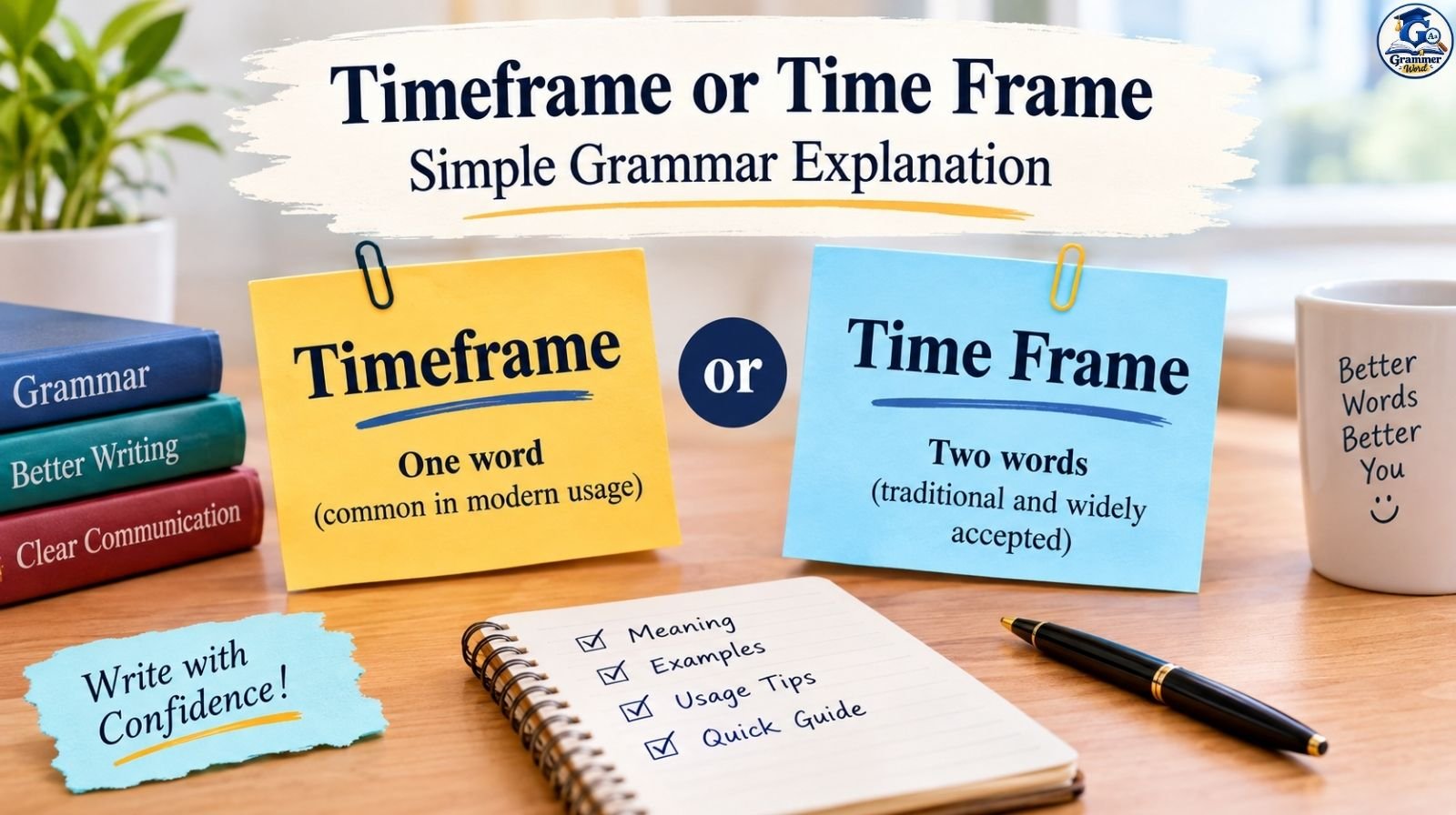
Both timeframe and time frame are used in English, but time frame is traditionally written as two words and remains a widely accepted form.
Timeframe, written as one word, has also become common in modern English, particularly in business, technology, project management, and professional writing.
The Simple Rule for Time Frame
If you want the safest choice in formal writing, use:
time frame
For example:
- We need a realistic time frame for completing the project.
- What is the expected time frame for delivery?
- The repair should be finished within a two-week time frame.
However, timeframe is not simply a spelling mistake. It is an established closed compound used by many modern writers.
Is Timeframe One Word?
Yes. Timeframe is commonly used as a single word, especially in contemporary professional and technical contexts.
For example:
- The project has a six-month timeframe.
- We need to establish a clear timeframe.
- The estimated timeframe for completion is three weeks.
Therefore, the choice is usually a matter of style and consistency, rather than a simple right-versus-wrong distinction.
Read More: ECT or ETC? What’s The Correct Abbreviation?
What Does Time Frame Mean?
A time frame is a period during which something is expected to happen, be completed, or remain relevant.
It is often used when talking about deadlines, schedules, projects, plans, processes, and expectations.
Time Frame Definition
In simple English:
Time frame = a specific period of time during which something happens or is expected to happen.
For example:
The company expects to complete the work within a three-month time frame.
Here, three-month time frame refers to the period available for completing the work.
Common Time Frame Examples
You can use time frame in many everyday situations:
- What is the time frame for the application process?
- We have a short time frame to finish the assignment.
- The delivery time frame is five to seven business days.
- The project has a flexible time frame.
- Please let me know the expected time frame.
- Within this time frame, we need to complete all testing.
The expression is especially common in business and workplace English.
Read More: Onto or On To: What’s The Difference And Which One Is Correct?
When Should You Use Timeframe?
Although time frame is the traditional two-word spelling, timeframe is widely used as a closed compound in contemporary English.
Timeframe in Modern Professional English
You may frequently encounter timeframe in:
- Business communication
- Project management
- Technology
- Marketing
- Customer service
- Planning documents
- Workplace emails
For example:
We are working within a strict timeframe to launch the new website.
Or:
The estimated timeframe for implementation is six weeks.
The important point is not to switch randomly between the two forms within the same document.
Timeframe or Time Frame in Formal Writing
If you are writing an academic paper, professional report, or formal document, check the style guide or publication’s preferred usage.
If no specific style guide is provided, time frame is a conservative and widely understood choice.
For less formal or modern business writing, timeframe is also perfectly recognizable and commonly used.
Timeframe vs. Time Frame: Quick Comparison

| Feature | Time frame | Timeframe |
|---|---|---|
| Spelling | Two words | One word |
| Meaning | Period of time | Period of time |
| Common usage | Very widely accepted | Common in modern usage |
| Formal writing | Safe choice | Often acceptable |
| Business writing | Common | Very common |
| Meaning difference | None | None |
The key takeaway is simple: there is generally no difference in meaning between the two forms.
Which Form Should You Choose?
Use this quick guide:
- Formal or academic writing: Prefer time frame unless your style guide says otherwise.
- Modern business writing: timeframe is commonly used.
- Following a company’s style: Match its established spelling.
- SEO or website content: Choose one form and use it consistently.
- When in doubt: time frame is a safe traditional choice.
Read More: Blond or Blonde: What’s The Difference And Which One Is Correct?
Real-Life Example: Choosing the Right Form
Imagine that Sarah works as a project coordinator for a software company. Her team is preparing to launch a new mobile application, and management asks when the project will be completed.
Sarah writes:
“The expected timeframe for the final testing stage is approximately four weeks.”
Her colleague prefers traditional style and changes it to:
“The expected time frame for the final testing stage is approximately four weeks.”
Has Sarah made a serious grammar mistake? No.
The meaning remains exactly the same. The difference is primarily the way the compound is written.
Now imagine Sarah is preparing a formal report for a client. The company’s editorial guidelines consistently use time frame as two words. In that situation, Sarah should follow the company’s preferred style and write:
“The expected time frame for the final testing stage is approximately four weeks.”
Later, she prepares an internal project dashboard. The software interface and company documentation consistently use timeframe. In that context, using the closed form makes sense.
This example demonstrates an important principle of modern English: spelling conventions can develop over time, and professional writing often depends on consistency, audience, and style requirements rather than treating every variation as a simple grammatical error.
Time Frame Examples in Everyday English
Seeing the expression in context makes the difference easier to understand.
Examples With Time Frame
- We need to agree on a reasonable time frame.
- The estimated time frame is two months.
- There is a limited time frame for completing the work.
- The doctor explained the expected time frame for recovery.
- What time frame are you working with?
- The application should be processed within a 10-day time frame.
Examples With Timeframe
- We need to agree on a reasonable timeframe.
- The estimated timeframe is two months.
- There is a limited timeframe for completing the work.
- The project has an aggressive timeframe.
- What timeframe are you working with?
- The application should be processed within a 10-day timeframe.
Notice that the meaning does not change.
Time Frame vs. Timeline: Are They the Same?
People sometimes use time frame and timeline interchangeably, but there can be a subtle difference.
Time Frame
A time frame usually describes a period or window in which something is expected to happen.
The project must be completed within a six-month time frame.
Timeline
A timeline often describes a sequence of events or milestones arranged over time.
The project timeline includes planning, development, testing, and launch.
So, a time frame focuses more on the period available, while a timeline can emphasize the order and scheduling of events.
2025–2026 Data: Why Clear Language Still Matters
Clear online writing remains important even as content formats and search behavior continue to change. HubSpot’s 2026 marketing statistics report says blog posts were among the top five highest-ROI content formats according to marketers, with 22.26% identifying them among the strongest-performing formats. It also reports that website/blog/SEO remained the #1 ROI-generating channel according to marketers.
HubSpot’s 2025 blogging research similarly found that 65% of surveyed marketers worked for companies that maintained blogs, while 93% of those marketers considered blogging important or very important to their marketing strategy.
These figures reinforce a practical lesson for writers: online content still needs to be useful, readable, and easy to understand. Choosing clear wording and using terms consistently helps readers move through your content without unnecessary confusion.
Google likewise recommends creating helpful, reliable, people-first content rather than content designed primarily to manipulate search rankings.
Read More: Awhile or A While: What’s The Difference?
A Simple Checklist for Choosing Timeframe or Time Frame
Before publishing, use this checklist:
- Does time frame fit your formal writing style?
- Does your organization consistently use timeframe?
- Have you checked the relevant style guide?
- Are you using the same spelling throughout the document?
- Does the sentence clearly communicate a period of time?
- Have you avoided unnecessarily switching between both forms?
Consistency is often more important than worrying about a minor spelling variation.
Mini Quiz: Timeframe or Time Frame

1. Quick Pick: Which Form Is Traditional?
Which spelling is the traditional two-word form?
A) Timeframe
B) Time frame
C) Time-frame
D) Times frame
Answer: B) Time frame
2. One Word or Two?
Which form is written as one word?
A) Time frame
B) Time-frame
C) Timeframe
D) Time frames
Answer: C) Timeframe
3. Test Your Grammar
Which sentence uses the traditional form correctly?
A) We need a realistic time frame.
B) We need a realistic times frame.
C) We need a realistic time-frame.
D) We need a realistic timeframee.
Answer: A) We need a realistic time frame.
4. Same Meaning?
Do timeframe and time frame generally have the same meaning?
A) Yes
B) No
C) Only in questions
D) Only in emails
Answer: A) Yes
5. What Does It Mean?
What does a time frame describe?
A) A place
B) A period of time
C) A person
D) A type of document
Answer: B) A period of time
6. Spot the Better Choice
Which sentence is correctly written?
A) The project has a six-month timeframe.
B) The project has a six-month timesframe.
C) The project has a six-month timeframes.
D) The project has a six-month time-framee.
Answer: A) The project has a six-month timeframe.
Read More: Freshman or Freshmen: Which One Is Correct?
7. Formal Writing Check
If you want the safest traditional choice in formal writing, which form can you use?
A) Timeframe
B) Time frame
C) Times frame
D) Time-frame
Answer: B) Time frame
8. Business English
Which word is commonly seen in modern business writing?
A) Timeframe
B) Timespace
C) Timeperiods
D) Timeplace
Answer: A) Timeframe
9. Fill the Gap
“We need to agree on a reasonable ______ for the project.”
A) time frame
B) times frame
C) timeframes
D) time-framing
Answer: A) time frame
10. Time Frame or Timeline?
Which term usually focuses on a sequence of events or milestones?
A) Time frame
B) Timeline
C) Timepiece
D) Timespan
Answer: B) Timeline
11. Plural Power
What is the plural of time frame?
A) Time frames
B) Times frame
C) Time framees
D) Time framing
Answer: A) Time frames
12. Modern Spelling
What is the plural form of timeframe?
A) Time frames
B) Timeframes
C) Timesframe
D) Timeframing
Answer: B) Timeframes
13. Choose the Natural Sentence
Which sentence sounds natural in professional English?
A) What is the expected timeframe?
B) What is the expected timesframe?
C) What is the expected timeframing?
D) What is the expected time-framee?
Answer: A) What is the expected timeframe?
14. True Understanding
Is timeframe simply a spelling mistake?
A) Yes, always
B) No, it is a common modern form
C) Yes, in every country
D) Only when used in business
Answer: B) No, it is a common modern form
15. Final Challenge
What is the best overall rule when choosing between timeframe and time frame?
A) Always use both together
B) Change spelling in every sentence
C) Follow your style guide and stay consistent
D) Never use either form
Answer: C) Follow your style guide and stay consistent
FAQs
Q1. Is Timeframe or Time Frame Correct?
A: Both timeframe and time frame are used in modern English. Time frame is the traditional two-word form, while timeframe is a common closed compound, particularly in contemporary professional writing.
Q2. Is Timeframe One Word or Two?
A: Timeframe is one word. Time frame is two words. Both forms are used, although time frame is the more conservative traditional spelling.
Q3. Is Timeframe Formal English?
A: Yes. Timeframe is widely used in professional and formal contexts. However, if you are following a specific style guide, use the spelling recommended by that guide.
Q4. What Is the Plural of Time Frame?
A: The plural is normally time frames when using the two-word form.
Example:
Several time frames were discussed during the meeting.
When using the closed form, the plural is timeframes.
Several timeframes were discussed during the meeting.
Q5. What Is Another Word for Time Frame?
A: Depending on the context, alternatives include period, timeframe, duration, window, schedule, and timeline. However, these words are not always exact substitutes.
Q6. Is Time Frame Hyphenated?
A: Usually, time frame is written as two words, not as time-frame. However, compound modifiers can sometimes require different punctuation depending on sentence structure and style.
For example:
We agreed on a six-month time frame.
Final Verdict:
So, timeframe or time frame which should you use?
The safest traditional choice is time frame, especially in formal or academic writing. However, timeframe is a well-established modern form and is widely used in business, technology, and professional communication.
The most important rule is consistency. Choose the form that fits your audience, publication, or style guide and use it consistently throughout your writing.
If you are unsure, remember:
Time frame = traditional two-word form.
Timeframe = modern one-word form.
Both refer to a period of time.
For more clear and practical English usage guides, keep exploring our grammar and word-choice articles.
Discover More Article
- Any Time or Anytime: Which One Is Correct?
- Your vs You’re: Simple Guide To The Most Confusing English Pair
- Fiancé or Fiancée: Understanding The Difference And Correct Usage
Keep learning with more easy grammar lessons on Grammer Word.com

Hi, I’m Noor Fatima, the person behind this website. I created this site to make English grammar and confusing words easier to understand. I love breaking down tricky words, meanings, spellings, and grammar rules into simple explanations. My goal is to help you learn English naturally, avoid common mistakes, and feel more confident every time you write or speak.