Have you ever typed “here here” when you meant to show that you strongly agree with someone? If so, you’re not alone. The confusion between “here here” and “hear hear” happens because the two expressions sound exactly alike when spoken.
But when you write the phrase, the difference matters.
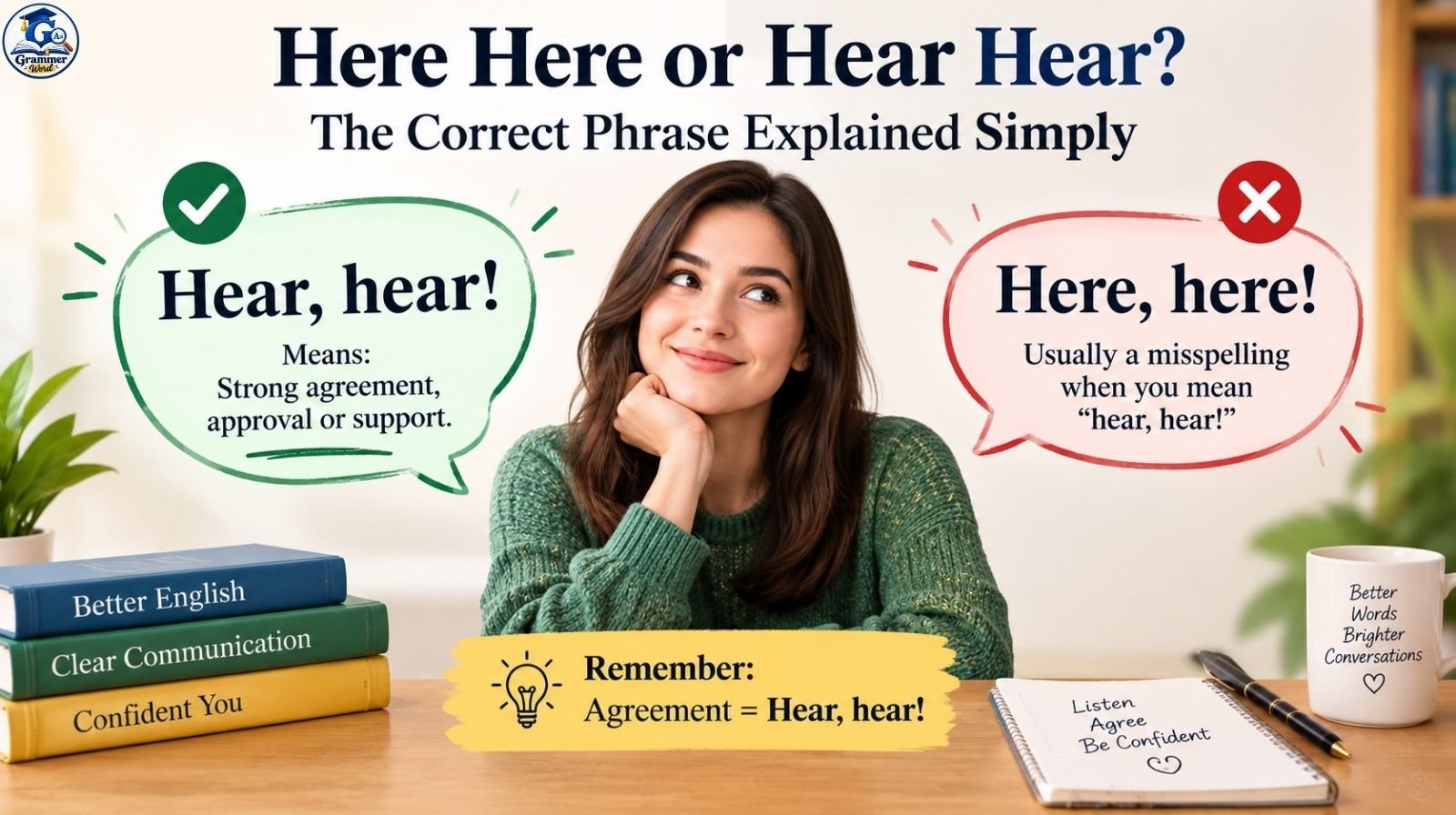
The correct expression is “Hear, hear!” It is used to show strong agreement, approval, or support for something another person has just said. Cambridge Dictionary defines hear, hear! as something said when you strongly agree with another person.
So, if someone makes an excellent point and you want to respond with the equivalent of “Exactly!” or “Well said!”, write:
“Hear, hear!”
Not:
“Here, here!”
In this guide, we’ll explain here here or hear hear, why the mistake is so common, where the expression came from, how to use it naturally, and how to remember the correct spelling every time.
Read More: Masonary vs Masonry: Which Spelling Is Correct And Why It Matters
Here Here or Hear Hear: Which One Is Correct?
If you’re using the expression to agree with someone, “Hear, hear!” is the correct form.
The important distinction comes down to the meanings of the individual words.
“Hear, Hear!” Means “I Agree”
Hear is a verb connected with listening or perceiving sound. In the expression “Hear, hear!”, it works as an exclamation encouraging people to listen to or recognize what someone has said.
For example:
“We should spend more time helping new employees understand the system.”
“Hear, hear!” replied Maya.
Here, Maya isn’t talking about a physical location. She is expressing strong agreement with the statement.
You can think of “Hear, hear!” as meaning:
- I agree.
- Well said.
- That’s a good point.
- I strongly support what you just said.
- Everyone should listen to that point.
Cambridge Dictionary gives the modern meaning as strong agreement with something someone else has said.
“Here” Means a Place
Here is an adverb that normally refers to a location or position.
For example:
“Please put the book here.”
“I live here.”
“Come here for a moment.”
So “here” and “hear” are completely different words even though they sound the same.
If you write “Here, here!” when you mean “I agree,” you’re using the wrong spelling for the established expression.
Quick Comparison
| Phrase | Meaning | Correct for agreement? |
|---|---|---|
| Hear, hear! | Strong agreement or support | ✅ Yes |
| Here, here! | Usually an accidental spelling of “hear, hear” | ❌ No |
| Hear | Listen or perceive sound | ✅ Yes |
| Here | In or at this place | ✅ Yes, for location |
The easiest rule is simple:
Agreement = hear, hear.
Location = here.
Read More: Women vs Woman: Which One Is Correct And When To Use It?
What Does “Hear, Hear!” Mean?
The phrase “hear, hear!” is an interjection used to express approval or agreement.
It is especially associated with speeches, debates, meetings, public discussions, and formal settings. However, you can also use it casually in everyday conversation.
Hear Hear as a Way to Show Agreement
Imagine your friend says:
“Everyone should get a chance to explain their side before we judge them.”
You could respond:
“Hear, hear!”
You’re essentially saying, “I completely agree with you.”
Another example:
“Good communication can solve many problems before they become serious.”
“Hear, hear!”
The expression lets you agree without needing a full sentence.
Hear Hear Can Mean “Well Said”
The phrase isn’t limited to simple agreement. It can also show enthusiastic approval of a particularly good statement.
For example:
“We shouldn’t just complain about the problem. We should help solve it.”
“Hear, hear!”
In this situation, the response means something close to “Well said!”
That’s why you may see the phrase in speeches and debates.
Is “Hear, Hear!” Formal or Informal?
It can be either.
In a formal debate, it can sound traditional or parliamentary:
“We must make sure every student has access to quality education.”
“Hear, hear!”
In a casual conversation, it can be playful:
“Pizza is better when you don’t overcomplicate it.”
“Hear, hear!”
However, in very casual modern conversation, people often simply say “I agree,” “Exactly,” “Absolutely,” or “Well said.”
Read More: Further or Farther: Simple Rules And When To Use Each
Why Do People Confuse “Here Here” and “Hear Hear”?
The main reason is pronunciation.
Here and hear are homophones. That means they have the same or very similar pronunciation but different meanings and spellings.
Here and Hear Sound the Same
Compare these sentences:
“I can hear the music.”
“Come over here.”
The two words sound alike, but their meanings are different.
This becomes especially confusing with “hear, hear!” because the phrase is usually spoken aloud.
When you hear someone say it, you don’t see the spelling.
That means a person can know the expression perfectly well when speaking but still guess the wrong spelling when writing it.
Grammarly specifically identifies “here, here” as a common misspelling caused by the fact that hear and here are homophones. Its May 2025 explanation confirms that “hear, hear” is the established expression for agreement.
Why “Here, Here” Looks Logical
There is another reason the mistake feels natural.
If someone says:
“This is the best idea we’ve heard all day.”
You might instinctively think:
“Here, here!”
The word here is extremely common in everyday English, while the repeated phrase “hear, hear” is less familiar to many speakers.
But spelling an expression based only on how it sounds can lead you into trouble.
The same problem occurs with other homophones, such as:
- their / there / they’re
- your / you’re
- to / too / two
- weather / whether
- right / write
The solution is to learn the expression as a complete phrase rather than trying to spell it from pronunciation.
The Origin of “Hear, Hear!”
The history of “hear, hear!” explains why the word hear is used twice.
The expression has a long connection with British parliamentary language. The Australian Parliamentary Education Office explains that “hear, hear” is used by members of Parliament to show support for a speech and describes it as a shortened form of “hear them, hear them.”
It traces the tradition back to the 1600s and notes that it developed as a form of cheering.
Read More: Quite or Quiet? Simple Guide To The Common English Confusion
From “Hear Him, Hear Him” to “Hear, Hear”
Historical sources connect the expression with forms such as “Hear him, hear him!”
The idea was essentially:
Listen to what this person is saying!
Over time, the longer expression became shorter, eventually producing the familiar:
“Hear, hear!”
The historical record shows the phrase appearing in parliamentary contexts centuries ago. Grammarphobia notes an early published reference from 1689 using forms such as “hear him!” and identifies a 1769 House of Commons report containing “hear! hear!”
So the spelling isn’t arbitrary.
The phrase uses hear because it developed from a call for people to listen.
Why Is “Hear” Repeated?
Repeating a word can add emphasis.
Think about expressions such as:
“Listen, listen!”
or:
“Look, look!”
The repetition draws attention.
Similarly, “Hear, hear!” originally called attention to what a speaker was saying. Its meaning later developed into the modern expression of approval or agreement.
The Phrase Is Still Used Today
This isn’t just an old expression found in historical books.
A 2026 UK Parliament debate document includes members responding with “Hear, hear!”, showing that the expression remains part of parliamentary language today.
The Australian Parliamentary Education Office also describes the expression as a continuing parliamentary practice.
Hear Hear Examples: How to Use It Correctly
Now that the difference is clear, let’s look at practical examples.
Example 1: Agreeing With an Opinion
“People should be judged by their actions, not by assumptions.”
“Hear, hear!”
Here, the speaker is showing strong agreement.
Example 2: During a Meeting
“We need to improve communication between different departments.”
“Hear, hear!”
This works naturally in a workplace meeting, especially when someone makes a point others strongly support.
Example 3: During a Speech
“Every child deserves access to a good education.”
“Hear, hear!” said several people in the audience.
This describes collective approval.
Example 4: During a Toast
The expression can also appear after a toast or celebratory statement.
“Here’s to friendship and many more good memories.”
“Hear, hear!”
The phrase can therefore express approval of a toast as well as agreement with an argument.
Example 5: Casual Conversation
“I think weekends should be three days long.”
“Hear, hear!”
This is a humorous or enthusiastic way of saying:
“I completely agree!”
Incorrect Example
“That was an excellent presentation.”
“Here, here!”
If the intended meaning is “I agree” or “Well said,” the conventional spelling is:
“Hear, hear!”
Read More: Lay or Lie? The Simple Grammar Rule Most People Get Wrong
A 2025–2026 Usage and Evidence Check
Because this topic is about spelling and language, there isn’t a reliable official statistic that tells us exactly how many people type “here here” instead of “hear hear” worldwide in 2025 or 2026. Search-engine queries and informal web pages shouldn’t be presented as precise language-use statistics.
However, current evidence gives us several useful data points.
What Current Sources Show
| Evidence | What it tells us |
|---|---|
| 2025 Grammarly update | Confirms “hear, hear” as the correct expression for agreement and identifies “here, here” as a common misspelling. |
| 2026 UK Parliament record | “Hear, hear!” continues to appear in official parliamentary proceedings. |
| Cambridge Dictionary | Lists “hear, hear!” as an English idiom meaning strong agreement. |
| Australian Parliamentary Education Office | Documents the phrase’s parliamentary history and continuing use. |
| Historical records | Forms of the expression date back to the late 17th century, with “hear! hear!” documented in an 18th-century parliamentary report. |
The important takeaway is that “hear, hear!” isn’t merely a preferred spelling invented by modern grammar websites. It is an established English expression with centuries of documented usage.
Case Study: “Hear, Hear!” in a Real Parliamentary Setting
A useful real-world example comes from parliamentary proceedings, where the expression has historically been used to show support for a speaker.
The Australian Parliamentary Education Office explains that members of Parliament use “hear, hear” to show support for a speech.
It connects the expression to the British parliamentary tradition and explains that the practice developed partly because applause or clapping was discouraged in parliamentary settings.
Instead of simply applauding, members could verbally signal their approval by saying “hear, hear.”
This helps explain why the phrase can feel different from ordinary expressions such as “I agree.”
Imagine a parliamentary member makes a strong point during a debate. Other members who support that point may respond with “Hear, hear!”
They aren’t saying that they are physically located “here.” They are signaling that the speaker’s words deserve attention and approval.
The tradition continues beyond historical examples. In a February 3, 2026 UK Parliament committee debate, the official record includes members saying “Hear, hear!” in response to a speaker’s remarks.
This modern example demonstrates why the spelling remains hear, not here. The expression retains its connection to listening and responding to someone’s words.
How to Remember “Hear, Hear” Every Time
The good news is that you don’t need to memorize the entire history of the expression.
A simple memory trick is enough.
Think: “I Hear You, and I Agree”
When someone says something you strongly support, imagine responding:
“I hear you.”
Then shorten that idea to:
“Hear, hear!”
That connection makes the spelling much easier to remember.
Use This Simple Rule
If you’re talking about agreement → HEAR, HEAR.
If you’re talking about a place → HERE.
For example:
“Your argument makes sense. Hear, hear!”
But:
“Put the chair here.”
That’s the entire distinction.
A One-Second Test
Whenever you’re unsure about here here or hear hear, ask yourself:
“Am I talking about a place?”
If the answer is no, and you’re expressing agreement, use:
Hear, hear!
This quick test works particularly well when you’re writing comments, emails, articles, or social media posts.
Common Mistakes With “Here Here” and “Hear Hear”
Even though the correct form is straightforward, several mistakes appear frequently.
Mistake 1: Writing “Here, Here!”
Incorrect when expressing agreement:
❌ “Here, here! That’s exactly what I think.”
Correct:
✅ “Hear, hear! That’s exactly what I think.”
Mistake 2: Removing the Comma
You may sometimes see:
“Hear hear!”
The spelling is still recognizable, especially in informal digital writing, but “Hear, hear!” is the traditional and clearest punctuation.
The comma separates the repeated interjection.
Read More: Ageing or Aging: Which Spelling Is Correct? A Simple, Clear Guide
Mistake 3: Mixing the Two Words
Another error is:
❌ “Hear here!”
That combines the two homophones but doesn’t produce the standard expression.
Use:
✅ “Hear, hear!”
Mistake 4: Assuming “Here” Must Be Right Because It Makes Sense
English doesn’t always spell expressions according to the meaning that seems most obvious.
The phrase’s history matters.
“Hear, hear!” comes from an expression encouraging people to listen, which is why hear is the correct word.
Hear Hear vs. Other Ways to Say “I Agree”
“Hear, hear!” isn’t the only way to express agreement.
The best choice depends on the situation.
| Expression | Tone | Example |
|---|---|---|
| Hear, hear! | Strong, traditional agreement | “Hear, hear!” |
| I agree. | Neutral and direct | “I agree with your point.” |
| Exactly. | Casual and confident | “Exactly!” |
| Absolutely. | Enthusiastic | “Absolutely!” |
| Well said. | Approval of someone’s statement | “Well said.” |
| That’s a good point. | Conversational | “That’s a good point.” |
“Hear, hear!” can sometimes sound more traditional than “I agree,” particularly in everyday American conversation.
However, it remains perfectly understandable and can be useful when you want to add a little personality to your response.
Read More: Nosy or Nosey? The Correct Spelling Explained (With Examples)
Mini Quiz: Here Here or Hear Hear?
1. Quick Pick: Which One Is Correct?
You want to show strong agreement with someone. Which phrase should you use?
Answer: Hear, hear!
2. Spot the Right Spelling
Which sentence is correct?
A. Here, here! That’s a great point.
B. Hear, hear! That’s a great point.
Answer: B. Hear, hear!
3. What Does “Hear, Hear!” Mean?
Does “Hear, hear!” usually mean “I agree”?
Answer: Yes.
4. Here or Hear?
Which word relates to listening: here or hear?
Answer: Hear.
5. Location Check
Complete the sentence: “Come ___ and sit down.”
Answer: Here.
6. Agreement Check
Complete the sentence: “That was an excellent idea. ___!”
Answer: Hear, hear!
7. Why the Confusion?
Why are here and hear so easy to mix up?
Answer: They sound the same but have different meanings and spellings.
8. Meaning Match
What is another natural way to understand “Hear, hear!”?
A. Come over here
B. Well said
C. Listen to music
D. Be quiet
Answer: B. Well said
9. Grammar Detective
Which word refers to a place?
A. Hear
B. Here
Answer: B. Here
10. Fill the Gap
“I completely agree with you. ___, ___!”
Answer: Hear, hear!
11. History Hint
The expression “Hear, hear!” has strong historical connections with which setting?
A. Parliamentary debates
B. Sports training
C. Cooking classes
D. Shopping malls
Answer: A. Parliamentary debates
12. True or False?
“Here, here!” is the standard spelling when you want to express agreement.
Answer: False. The standard expression is “Hear, hear!”
13. Pick the Natural Reply
Your friend says, “We should help people instead of only complaining.” What fits best?
A. Hear, hear!
B. Here, here!
C. Hear, here!
D. Here, hear!
Answer: A. Hear, hear!
14. Memory Trick
If you mean “I hear you, and I agree,” which phrase should you remember?
Answer: Hear, hear!
15. Final Challenge
Complete this rule:
Agreement = ____ ____
Answer: Hear, hear!
FAQs
Q1. Is it “here here” or “hear hear”?
The correct expression for showing agreement is “hear, hear!” The phrase is used to express strong agreement or approval. “Here, here!” is generally a misspelling when used with this meaning.
Q2. Why do people say “hear, hear”?
The phrase developed from older expressions such as “hear him, hear him,” which called attention to what a speaker was saying. Over time, it became the shorter “hear, hear!” used to show approval and agreement.
Q3. Is “here, here” ever correct?
Yes, here itself is a perfectly normal English word when referring to a location. For example, “Put your bag here.” However, “here, here!” is not the standard spelling of the expression used to mean “I agree.”
Q4. Should “hear, hear” have a comma?
The traditional form is “Hear, hear!” The comma separates the repeated words and is the clearest punctuation for the expression.
Q5. Is “hear, hear” still used today?
Yes. The expression remains in dictionaries and continues to appear in parliamentary settings. For example, official UK parliamentary proceedings from February 2026 contain the expression, while the Australian Parliamentary Education Office describes its continuing parliamentary use.
Q6. Can I use “hear, hear” in casual conversation?
Yes. You can use it whenever you want to show enthusiastic agreement. However, depending on the situation, “Exactly!” or “I agree!” may sound more natural in everyday conversation.
Q7. Is “hear, hear” British or American?
The expression has strong historical connections to British parliamentary language, but it is understood beyond Britain and is also used in other English-speaking countries. The Australian Parliamentary Education Office, for example, documents its use in Australian Parliament.
Final Answer:
When you’re wondering “here here or hear hear?”, remember one simple rule:
Use “Hear, hear!” when you agree with someone.
The word hear connects to listening, which fits the phrase’s historical development from expressions calling attention to a speaker. Here, on the other hand, refers to a place.
So:
❌ Here, here! incorrect when you mean “I agree.”
✅ Hear, hear! correct.
The expression has survived for centuries and is still used today in speeches, conversations, celebrations, and parliamentary debates. Current dictionary guidance and modern parliamentary records continue to support “hear, hear!” as the established form.
The next time someone makes an excellent point, you can confidently write “Hear, hear!” and never have to wonder about the spelling again.
Discover More Article
- Apart or A Part: Understanding The Difference
- Choose or Chose: Everything You Need To Know
- Lets or Let’s: Which One Is Correct And When To Use It?
- Loosing or Losing: What’s The Correct Spelling And When To Use It?
Keep learning with more easy grammar lessons on Grammer Word.com

Hi, I’m Noor Fatima, the person behind this website. I created this site to make English grammar and confusing words easier to understand. I love breaking down tricky words, meanings, spellings, and grammar rules into simple explanations. My goal is to help you learn English naturally, avoid common mistakes, and feel more confident every time you write or speak.