Have you ever paused while writing and wondered whether to use further or farther? You are not alone. These two words are closely related, and in some situations, both can describe distance. However, they are not always interchangeable.
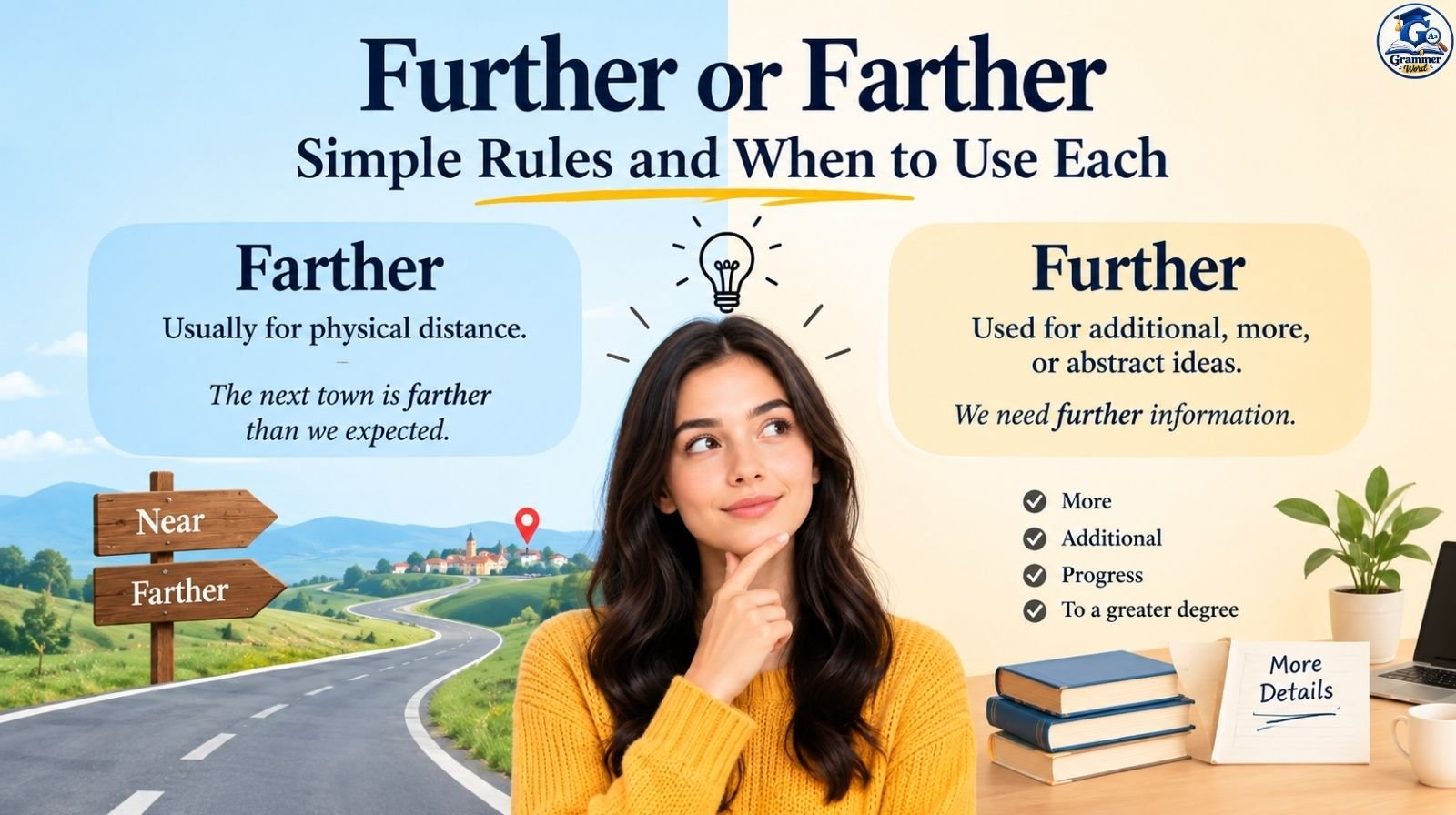
The easiest rule is this: use farther mainly for physical distance, while further is commonly used for additional information, progress, degree, or abstract ideas. In modern English, however, further can also refer to physical distance, and it is often more common in that use.
This guide explains further or farther, their meanings, differences, examples, common mistakes, and a simple trick you can use to choose the correct word confidently.
Read More: Whoever or Whomever: A Complete Guide To Correct Usage
Further or Farther: What Is the Difference?
The words further and farther are both comparative forms of far. Traditionally, farther is associated with measurable physical distance, while further is used for abstract or figurative meanings.
For example:
- We walked farther than we expected.
- We need further information.
The distinction becomes especially useful when distance is not something you can physically measure.
Use Farther for Physical Distance
Use farther when you are talking about physical distance from one place to another.
Examples:
- How much farther is the airport?
- We walked farther than the other group.
- The blue house is farther down the road.
- She ran farther than she did yesterday.
Here, the idea of distance is concrete and physical.
Use Further for Additional or Abstract Ideas
Use further when you mean more, additional, extra, or to a greater degree.
Examples:
- We need further information.
- The teacher asked for further explanation.
- Let’s discuss this further.
- No further action is required.
- The investigation requires further research.
Cambridge specifically notes that further can mean “more” or “extra,” and it can also describe progress toward a more advanced stage.
When to Use Further or Farther
A quick way to remember the difference is to ask yourself: Am I talking about physical distance or additional/abstract meaning?
Farther = Physical Distance
If you can imagine measuring the distance between two physical locations, farther is a useful choice.
Examples:
The next town is farther than I thought.
We drove farther into the countryside.
How much farther do we have to walk?
These examples involve actual geographical or physical distance.
Further = More or Additional
When you mean additional, extra, or more, use further.
Examples:
Please provide further details.
We need further evidence before making a decision.
I don’t want to discuss the matter any further.
Further changes may be necessary.
Notice that none of these examples describes a physical distance.
Further Can Also Describe Distance
This is where the distinction gets slightly tricky.
Modern English does not always maintain a strict physical-distance rule. Cambridge explains that further and farther can both be used for distance, with no difference in meaning in that context, and notes that further is more common.
So both can be correct:
- We walked farther down the road.
- We walked further down the road.
This means the traditional rule is helpful, but it is not an absolute rule.
Read More: Patients vs Patient’s: Meaning, Difference, And Correct Usage
Further vs. Farther Examples
Seeing the words in context makes the difference much easier to understand.
Examples With Farther
Use farther when emphasizing physical distance:
- The school is farther from my house than I expected.
- We need to walk farther before we reach the village.
- The runner went farther than everyone else.
- How much farther is the station?
- The mountain looked farther away in the fog.
Examples With Further
Use further for additional information, progress, or an abstract degree:
- Please contact us for further information.
- We need further discussion before deciding.
- She wants to take her education further.
- I don’t want to argue about this further.
- The company needs further evidence.
A Useful Comparison
| Meaning | Preferred Word | Example |
|---|---|---|
| Physical distance | Farther | We walked farther. |
| Additional information | Further | Please provide further information. |
| More discussion | Further | Let’s discuss this further. |
| More progress | Further | We need to take this further. |
| Physical distance | Further or farther | We walked further/farther down the road. |
| Extra/additional | Further | Further instructions will follow. |
The table shows why further has a wider range of uses than farther.
A Simple Trick to Remember Further vs. Farther
If you frequently confuse these words, use this simple memory trick.
Think “Farther = Farther Away”
The word farther contains far, which can remind you of physical distance.
The store is farther away.
She lives farther from the city.
This is not a strict linguistic rule, but it is a practical memory aid.
Think “Further = More”
If you can replace the word with more, additional, or extra, further is usually the right choice.
For example:
We need further information.
You can think:
We need more information.
Similarly:
Let’s discuss this further.
means:
Let’s discuss this more.
This trick is particularly useful in formal writing.
Read More: This Is She or This Is Her? The Correct Way To Answer The Phone
Further or Farther in Formal and Everyday English
Both words appear in everyday English, but further has several uses that are especially common in professional and academic writing.
Further Information
One of the most common expressions is:
For further information, contact the office.
You would not normally write:
For farther information, contact the office.
Here, further means additional, not physically more distant. Cambridge specifically identifies further information as a standard use of further.
Further Discussion
You can also say:
We need further discussion.
This means more discussion.
Similarly:
The issue requires further investigation.
means additional investigation.
Further Notice
Another common expression is:
The building is closed until further notice.
Here, further means additional or later information.
These expressions are worth learning as complete phrases because they appear frequently in workplace, academic, and official writing.
Further and Farther: A Real-Life Example
Imagine that Emma and Daniel are planning a weekend road trip.
Emma checks the map and says, “The next town is farther than I expected.”
Here, farther works naturally because she is talking about the physical distance between two locations.
Later, they stop at a visitor center. Emma asks the staff member for further information about the hiking trail.
Now the meaning has changed. She is not asking for information that is physically farther away. She wants additional information, so further is correct.
During the hike, Daniel asks, “Can we go farther?”
Emma looks at the trail and replies, “Yes, but let’s get further instructions from the guide first.”
This short conversation demonstrates the traditional distinction clearly:
- farther → physical distance
- further → additional information
However, if Daniel said, “Can we go further?” that would also be perfectly natural. Modern English commonly uses further for physical distance too. Cambridge’s current grammar guidance explicitly recognizes both forms for distance.
The important lesson is therefore not to treat farther as the only possible word for physical distance. Instead, remember that farther is strongly associated with physical distance, while further has the broader range of meanings.
Read More: Masonary vs Masonry: Which Spelling Is Correct And Why It Matters
2025–2026 Usage Snapshot: What Current Grammar Guidance Says
Grammar rules sometimes change in emphasis as English usage develops. For a current 2026 reference point, Cambridge’s English Grammar Today explains that further and farther can both be used when talking about distance, with no difference in meaning in that context, while further is more common.
Cambridge also identifies uses of further that do not normally allow farther, including meanings such as:
- additional information
- more discussion
- a more advanced stage
- extra time or action
- progress or development
What This Means for Modern Writers
The practical 2026 takeaway is:
Don’t assume that “farther = correct” and “further = incorrect” whenever physical distance is involved.
Both are established English forms for distance.
However:
- farther remains a clear choice for physical distance.
- further is essential for meanings such as additional, more, and to a greater degree.
- In contemporary English, further is also widely used for physical distance.
This approach reflects current dictionary and grammar guidance rather than an outdated absolute rule.
Common Mistakes With Further and Farther
Understanding common errors can make the difference much easier to remember.
Mistake 1: “Farther Information”
Incorrect:
Please contact us for farther information.
Better:
Please contact us for further information.
Why? Because the meaning is additional information, not physical distance.
Mistake 2: “Farther Discussion”
Incorrect:
We need farther discussion.
Better:
We need further discussion.
Again, further means more or additional.
Mistake 3: Thinking “Further” Can Never Describe Distance
This is another common misconception.
It is perfectly normal to say:
We walked further down the road.
It is also possible to say:
We walked farther down the road.
Current Cambridge guidance recognizes both forms for distance.
Read More: Midday vs Mid Day: Which Spelling Is Correct In Modern English?
Further vs. Farther: Quick Decision Guide
When you are unsure, follow these steps.
Step 1: Ask What “Distance” Means
Is the sentence about physical distance?
- Yes: farther is a clear traditional choice.
- No: Continue to Step 2.
Step 2: Try “More” or “Additional”
Can you replace the word with more or additional?
- Yes: use further.
- No: continue to Step 3.
Step 3: Check for a Common Expression
Some phrases naturally use further, such as:
- further information
- further discussion
- further research
- further action
- further notice
- further details
- further explanation
If you recognize one of these patterns, further is the appropriate choice.
Mini Quiz: Further or Farther
1. Which word is traditionally used for physical distance?
A) Further
B) Farther
C) Furthered
D) Farthest
Answer: B) Farther
2. Which phrase is correct?
A) Farther information
B) Further information
C) Far information
D) Farthest information
Answer: B) Further information
3. “We need ___ discussion.” Which word fits best?
A) farther
B) further
C) farthest
D) far
Answer: B) further
4. Which sentence uses “farther” correctly?
A) Please give me farther details.
B) We need farther research.
C) The village is farther away.
D) Let’s discuss it farther.
Answer: C) The village is farther away.
5. Which word means “additional” or “more”?
A) Farther
B) Further
C) Farthest
D) Far
Answer: B) Further
6. “How much ___ do we have to walk?”
A) further
B) farther
C) furthered
D) farthest
Answer: B) farther
7. Which phrase is commonly used in formal writing?
A) Farther notice
B) Further notice
C) Far notice
D) Farthest notice
Answer: B) Further notice
8. Pick the correct sentence.
A) We need further information.
B) We need farther information.
C) We need farthest information.
D) We need far information.
Answer: A) We need further information.
9. Can “further” also describe physical distance?
A) Never
B) Only in poetry
C) Yes
D) Only in American English
Answer: C) Yes
10. “Let’s discuss this ___.” Which word is best?
A) farther
B) further
C) farthest
D) far
Answer: B) further
11. Which word is strongly associated with “far away”?
A) Further
B) Farther
C) Furthered
D) Furthermost
Answer: B) Farther
12. Choose the correct phrase.
A) Further research
B) Farther research
C) Farthest research
D) Far research
Answer: A) Further research
13. “The next town is ___ than we expected.”
A) further
B) farther
C) furthered
D) farthest
Answer: B) farther
14. Which sentence uses “further” for an abstract idea?
A) We walked further down the road.
B) The shop is farther away.
C) We need to take this project further.
D) The house is farther from here.
Answer: C) We need to take this project further.
15. What is the easiest memory trick?
A) Further = physical only
B) Farther = additional
C) Farther = physical distance; Further = more/additional
D) Both words are always incorrect
Answer: C) Farther = physical distance; Further = more/additional
FAQs
Q1. Is farther or further correct?
A: Both are correct. Traditionally, farther is associated with physical distance, while further is used for additional or abstract meanings. However, modern English commonly uses further for physical distance as well.
Q2. Is it farther away or further away?
A: Both farther away and further away are used. Farther can emphasize physical distance, while further is also standard in modern English.
Q3. Should I say further information or farther information?
A: Use further information. Here, further means additional information.
Q4. Is it go further or go farther?
A: Both can be correct when referring to physical movement or distance. For example:
We need to go farther.
We need to go further.
If go further means advancing an idea, project, or situation, further is the correct choice:
We need to take the project further.
Q5. What is the difference between farther and further?
A: The traditional distinction is that farther refers to physical distance, while further means additional, more, or a greater degree. Modern usage also allows further for physical distance, making the distinction less absolute.
Q6. Is “further” more common than “farther”?
A: According to Cambridge’s current grammar guidance, further is more common when the two are used to talk about distance.
Final Takeaway:
The easiest way to remember further or farther is:
Farther → traditionally used for physical distance.
The airport is farther than I expected.
Further → used for additional, more, abstract ideas, and many expressions.
We need further information.
But there is an important modern-English detail: further can also describe physical distance, and it is often more common in that role.
So don’t worry about treating the distinction as an unbreakable rule. Focus on the meaning of the sentence and the expression you are using.
When you remember “farther for physical distance” and “further for more or additional,” choosing between the two becomes much easier.
Discover More Article
- Traveled or Travelled: Which Spelling Is Correct In English?
- Women vs Woman: Which One Is Correct And When To Use It?
- Quite or Quiet? Simple Guide To The Common English Confusion
Keep learning with more easy grammar lessons on Grammer Word.com

Hi, I’m Noor Fatima, the person behind this website. I created this site to make English grammar and confusing words easier to understand. I love breaking down tricky words, meanings, spellings, and grammar rules into simple explanations. My goal is to help you learn English naturally, avoid common mistakes, and feel more confident every time you write or speak.