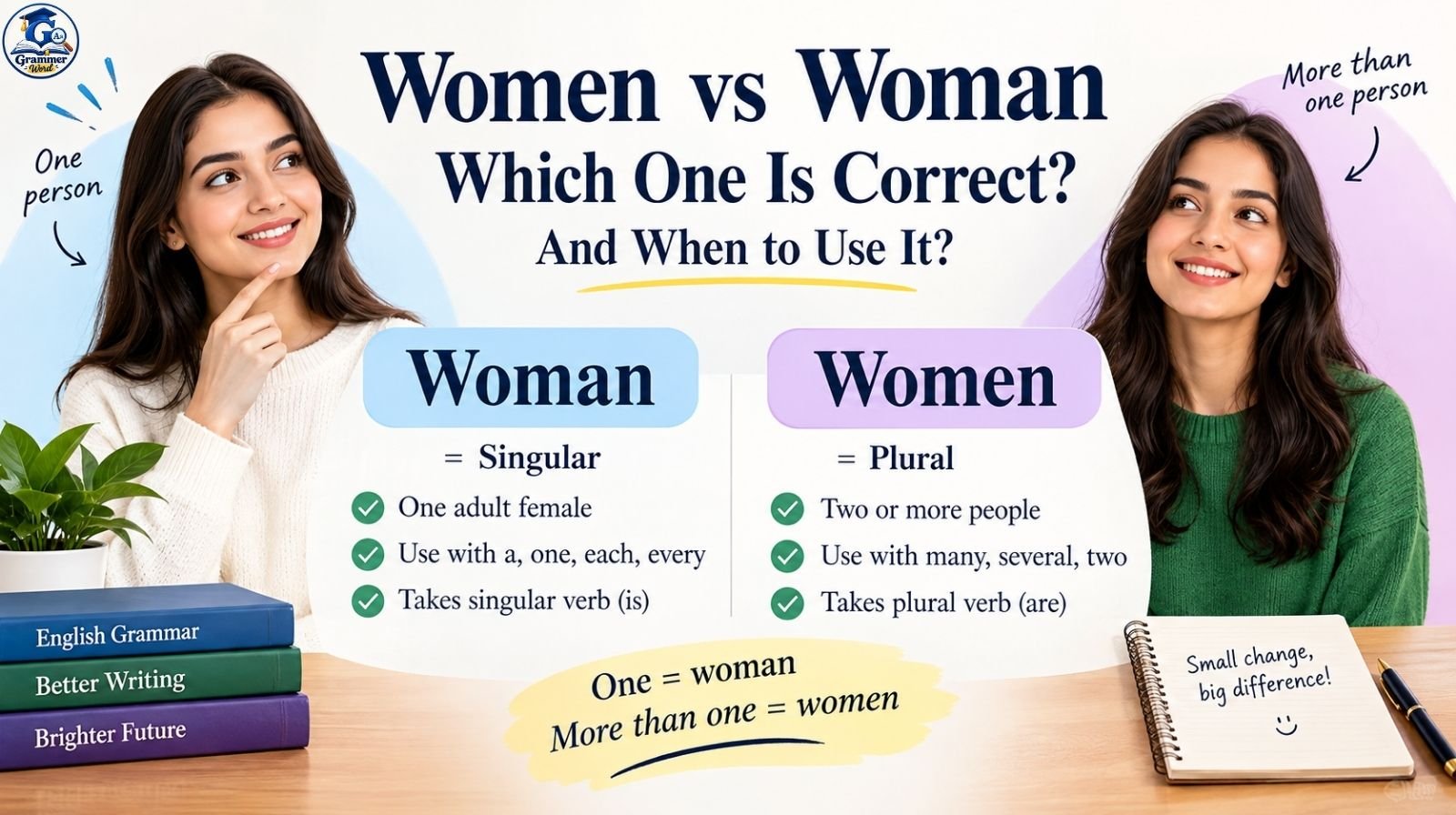
If you often pause when writing women vs woman, you’re not alone. These two words look very similar, but they don’t have the same grammatical function. The simple rule is this: woman is singular, while women is plural. Cambridge Dictionary confirms that woman has women as its plural form.
The confusion becomes even more understandable when you consider pronunciation. Woman and women are spelled differently but also have noticeably different vowel sounds.
In this guide, you’ll learn exactly when to use woman and when to use women, how their pronunciation differs, what happens with possessives such as woman’s and women’s, and how to avoid common mistakes.
Read More: Masonary vs Masonry: Which Spelling Is Correct And Why It Matters
Woman vs Women: What Is the Difference?
The easiest way to understand women vs woman is to remember that one refers to one person, while the other refers to more than one person.
Woman Is Singular
Woman is a singular noun. You use it when you’re talking about one adult female person.
For example:
- That woman is my teacher.
- A woman called earlier.
- She is a successful woman.
- The woman near the door is my sister.
Because woman is singular, it normally takes singular grammar around it.
For example:
That woman is very helpful.
Not:
That woman are very helpful.
Cambridge Dictionary lists woman as a noun and gives women as its plural form.
Women Is Plural
Women is the plural form of woman. Use it when you’re talking about two or more people.
Examples include:
- The women are talking outside.
- Three women joined the meeting.
- These women work together.
- Women have contributed to many fields throughout history.
Notice the verb changes too:
The woman is here.
but:
The women are here.
This is an example of subject-verb agreement. The singular noun woman goes with is, while the plural noun women goes with are.
Quick Comparison
| Word | Number | Example |
|---|---|---|
| woman | Singular | One woman is waiting. |
| women | Plural | Two women are waiting. |
| woman’s | Singular possessive | The woman’s bag |
| women’s | Plural possessive | The women’s bags |
So, if you’re wondering is women plural of woman?, the answer is yes.
When to Use Woman
Knowing the definition isn’t enough. You also need to recognize how woman behaves in an ordinary sentence.
Use Woman for One Person
Use woman when the noun represents one individual.
Consider these examples:
- I spoke to a woman at the reception desk.
- That woman lives next door.
- She became the first woman to hold the position.
- I saw one woman waiting for the bus.
Words such as a, one, each, and every can help you recognize that a singular noun is required.
For example:
Every woman deserves respect.
Here, every refers to people individually, so woman remains singular.
Read More: Girlie or Girly: Which Word Is Correct? Meaning, Usage, Differences, And Examples For 2026
Woman and Singular Verb Agreement
A useful way to check your sentence is to look at the verb.
The woman is reading.
The woman was tired.
The woman has arrived.
These structures make sense because woman is singular.
However:
The women are reading.
The women were tired.
The women have arrived.
Here, women requires plural verb forms.
Common Examples With Woman
Here are a few natural examples:
Correct:
- A woman is sitting outside.
- That woman has a new car.
- Every woman received a certificate.
- One woman answered the question.
Incorrect:
- A women is sitting outside.
- That women has a new car.
- Every women received a certificate.
The reason is simple: a, one, every, and each generally point to a singular noun, so woman is the correct choice.
When to Use Women
Now let’s look at the plural form.
Use Women for Two or More People
Use women when you mean more than one adult female person.
For example:
- The women are preparing dinner.
- Five women attended the event.
- Those women are my colleagues.
- Many women enjoy reading.
You don’t use women after a or one because those words indicate singular meaning.
For example:
One woman called me.
But:
Two women called me.
Women and Plural Verb Agreement
When women is the subject, use a plural verb.
Compare:
The woman is working.
with:
The women are working.
And:
The woman has finished the report.
with:
The women have finished the report.
This small change is one of the easiest ways to catch an error in your writing.
Words That Commonly Go With Women
You will often see women after words that express a plural quantity.
Examples include:
- many women
- several women
- two women
- three women
- some women
- these women
- those women
- most women
For example:
Several women attended the workshop.
The word several clearly indicates more than one, so women is required.
Read More: Midday vs Mid Day: Which Spelling Is Correct In Modern English?
Women vs Woman: A Simple Rule to Remember
If you only remember one thing from this guide, remember this:
One = woman. More than one = women.
A Quick Decision Guide
| If you mean… | Use… | Example |
|---|---|---|
| One person | woman | A woman called me. |
| Two people | women | Two women called me. |
| Three or more | women | Three women called me. |
| One person’s belongings | woman’s | The woman’s phone |
| Belongings of several people | women’s | The women’s phones |
This rule works in most everyday situations.
Why the Plural Is Unusual
Many English nouns form plurals simply by adding -s:
- book → books
- car → cars
- student → students
But woman doesn’t become womans. Instead, its plural is women.
This is called an irregular plural.
The same pattern appears with:
- man → men
- child → children
- foot → feet
- tooth → teeth
Cambridge’s grammar material specifically identifies woman → women as an example of a noun whose plural form changes spelling rather than simply adding -s.
Woman’s vs Women’s: The Possessive Forms
Another common source of confusion is woman’s vs women’s.
These forms are related to woman and women, but they show possession.
Woman’s Means Belonging to One Woman
Use woman’s when something belongs to or is associated with one woman.
Examples:
- The woman’s coat is blue.
- I found the woman’s phone.
- That is the woman’s office.
- The woman’s opinion was respected.
Think:
one woman → woman’s
Women’s Means Belonging to Women
Use women’s when something belongs to or is associated with more than one woman.
Examples:
- The women’s team won the match.
- Women’s clothing is available upstairs.
- The women’s locker room is on the left.
- The women’s organization held a meeting.
Think:
multiple women → women’s
Merriam-Webster also records common expressions such as women’s rights and women’s studies, demonstrating this plural possessive construction.
A Simple Possessive Test
Ask yourself:
Does it belong to one woman?
Use woman’s.
The woman’s bag.
Does it belong to several women?
Use women’s.
The women’s bags.
That one question can solve many spelling and grammar problems.
Woman and Women Pronunciation: Why They Sound Different
Spelling isn’t the only reason learners struggle with these words. Woman and women also have different pronunciations.
How to Pronounce Woman
Woman is commonly pronounced approximately like:
WUH-mən
The first vowel sound is similar to the sound in words such as book or good.
Cambridge gives the pronunciation as /ˈwʊm.ən/.
Example:
She is a woman.
How to Pronounce Women
Women is pronounced approximately like:
WIM-in
Cambridge gives the pronunciation as /ˈwɪm.ɪn/.
Example:
The women are waiting.
The spelling can therefore be misleading. The first syllable of women doesn’t sound like the first syllable of woman.
An Easy Memory Trick
Try remembering:
woman → WUH-mən
women → WIM-in
The spelling difference isn’t large, but the pronunciation difference is important.
A Real-Life Example: Choosing Between Woman and Women
Imagine you’re writing a short report about a community workshop.
You want to say that one person organized the event:
A woman organized the workshop.
That’s correct because you’re referring to one person.
Now imagine that four people helped organize it:
Four women organized the workshop.
Again, the choice is straightforward because the number has changed.
Suppose you continue writing:
The woman thanked the women who helped her.
This sentence contains both forms correctly. The woman refers to one organizer, while the women refers to multiple helpers.
Now imagine you want to describe their belongings:
The woman’s notebook was on the desk, while the women’s bags were near the door.
Here, woman’s refers to one person’s notebook, while women’s refers to belongings associated with multiple people.
This kind of real-world context shows why the difference matters. The words aren’t interchangeable; changing woman to women can change the number of people you’re talking about.
Women vs Woman: Common Mistakes to Avoid
Even though the basic rule is simple, several mistakes appear frequently.
Mistake 1: Adding -s to Woman
Incorrect:
There were three womans at the event.
Correct:
There were three women at the event.
The plural form is irregular, so womans is not the standard plural.
Read More: Capital or Capitol: Which One Is Correct And When To Use It?
Mistake 2: Using Women After “A”
Incorrect:
She is a women.
Correct:
She is a woman.
The article a is used with a singular countable noun.
Mistake 3: Using Woman for Multiple People
Incorrect:
Many woman attended the conference.
Correct:
Many women attended the conference.
Because many indicates a plural quantity, women is required.
Mistake 4: Mixing Singular and Plural Verbs
Incorrect:
The women is waiting outside.
Correct:
The women are waiting outside.
Likewise:
Incorrect:
The woman are waiting outside.
Correct:
The woman is waiting outside.
Checking the subject and verb together is an easy proofreading technique.
What Current Data and Grammar References Tell Us
There isn’t a meaningful annual statistic showing how many times English speakers should use woman versus women. These are fundamental vocabulary and grammar forms rather than terms whose correctness changes with yearly trends.
However, current dictionary references continue to identify the same grammatical relationship: woman is singular and women is its plural form. Cambridge’s current dictionary entries list woman with the plural women, while its separate women entry defines it directly as the plural of woman.
This is also consistent with established English grammar resources. Cambridge’s grammar material identifies woman → women among irregular plural nouns.
For content published in 2025–2026, the practical takeaway is therefore not a changing language trend. It’s that writers and English learners should continue applying the established singular/plural distinction correctly.
Google’s current guidance also emphasizes creating helpful, reliable, people-first content and avoiding content created primarily to manipulate rankings. A Quick Checklist for Choosing Woman or Women
Before publishing your sentence, use this checklist.
Step-by-Step Grammar Check
Step 1: Count the people.
Are you talking about one person?
→ Use woman.
Are you talking about two or more?
→ Use women.
Step 2: Check the word before the noun.
Does the sentence use a, one, each, or every?
→ You probably need woman.
Does it use many, several, two, three, these, or those?
→ You probably need women.
Step 3: Check the verb.
Singular:
The woman is here.
Plural:
The women are here.
Step 4: Check possession.
One owner:
The woman’s car.
Multiple owners:
The women’s cars.
Read More: Skillset or Skill Set: Which Term Is Correct In Modern English?
Mini Reference Table
| Situation | Correct form |
|---|---|
| One adult female | woman |
| More than one adult female | women |
| Something belonging to one woman | woman’s |
| Something belonging to multiple women | women’s |
| One person + singular verb | woman is |
| Multiple people + plural verb | women are |
Mini Quiz: Women vs Woman
1. One Person or More?
Which word means one adult female person?
A) Women
B) Woman
C) Womens
D) Womans
Answer: B) Woman
2. Spot the Plural
What is the plural of woman?
A) Womans
B) Womens
C) Women
D) Womanses
Answer: C) Women
3. Pick the Right Sentence
Which sentence is correct?
A) A women is waiting.
B) A woman is waiting.
C) A womens is waiting.
D) A womans is waiting.
Answer: B) A woman is waiting.
4. Two People? Easy!
Which sentence correctly talks about two adult female people?
A) Two woman are here.
B) Two womans are here.
C) Two women are here.
D) Two womens is here.
Answer: C) Two women are here.
5. Woman or Women?
Complete the sentence:
“That ___ is my teacher.”
A) women
B) womans
C) woman
D) womens
Answer: C) woman
6. Many Means More!
Complete the sentence:
“Many ___ attended the meeting.”
A) woman
B) women
C) womans
D) womanses
Answer: B) women
7. Watch the Verb!
Which sentence has correct subject-verb agreement?
A) The woman are here.
B) The women is here.
C) The woman is here.
D) The women was here.
Answer: C) The woman is here.
8. A Little Possessive Challenge
Which phrase means something belongs to one woman?
A) Women’s bag
B) Woman’s bag
C) Women bag
D) Womans bag
Answer: B) Woman’s bag
9. One Owner or Several?
Which phrase refers to something associated with multiple women?
A) Woman’s team
B) Women team
C) Women’s team
D) Womans’ team
Answer: C) Women’s team
10. Pronunciation Check
Which pronunciation is commonly associated with women?
A) WUH-mən
B) WIM-in
C) WOH-man
D) WEE-man
Answer: B) WIM-in
11. Find the Mistake
Which sentence needs fixing?
A) One woman called me.
B) Three women called me.
C) Every woman received a card.
D) Three womans called me.
Answer: D) Three womans called me.
The correct sentence is “Three women called me.”
12. Fill the Blank
“She is ___ successful woman.”
A) a
B) an
C) many
D) several
Answer: A) a
13. Quick Grammar Test
Which word should follow “several”?
A) woman
B) women
C) womans
D) woman’s
Answer: B) women
14. Singular or Plural?
In the sentence “The women are working,” is women singular or plural?
A) Singular
B) Plural
C) Both
D) Neither
Answer: B) Plural
15. The Golden Rule
What’s the easiest way to remember woman vs women?
A) One = women, more = woman
B) One = woman, more than one = women
C) Both words are interchangeable
D) Woman is always plural
Answer: B) One = woman, more than one = women
FAQs
Q1. Is “women” the plural of “woman”?
A: Yes. Women is the standard plural form of woman. For example, one woman becomes two women. Cambridge Dictionary explicitly lists women as the plural of woman.
Q2. Which is correct: “a woman” or “a women”?
A: A woman is correct.
The article a is used with a singular countable noun:
She is a woman.
You cannot normally say:
She is a women.
Q3. Is “women” singular or plural?
A: Women is plural.
For example:
One woman is speaking.
Two women are speaking.
Q4. What is the difference between “woman’s” and “women’s”?
A: Woman’s is the singular possessive form, while women’s is the plural possessive form.
- The woman’s book = the book belongs to one woman.
- The women’s books = the books belong to multiple women.
Q5. Why is the plural of woman “women” instead of “womans”?
A: Woman → women is an irregular plural. English has several nouns whose plural forms change rather than simply adding -s. Other examples include man → men and child → children.
Q6. Are woman and women pronounced differently?
A: Yes. Woman is commonly pronounced /ˈwʊm.ən/, while women is pronounced /ˈwɪm.ɪn/.
Conclusion:
The difference between women vs woman is straightforward once you focus on number.
Use woman when you’re talking about one person:
A woman is waiting outside.
Use women when you’re talking about more than one person:
Several women are waiting outside.
For possession, remember woman’s for one woman and women’s for multiple women.
The biggest mistake is trying to treat women as simply woman + s. It isn’t. Women is an irregular plural form, just as men is the plural of man.
If you’re writing an article, email, school assignment, or social post, use the one = woman, more than one = women rule as your first check. Then verify the verb and possessive form. With that simple habit, choosing between women vs woman becomes much easier.
Discover More Article
- This Is She or This Is Her? The Correct Way To Answer The Phone
- Patients vs Patient’s: Meaning, Difference, And Correct Usage
- Possum or Opossum: What’s The Correct Spelling And Usage?
Keep learning with more easy grammar lessons on Grammer Word.com

Hi, I’m Noor Fatima, the person behind this website. I created this site to make English grammar and confusing words easier to understand. I love breaking down tricky words, meanings, spellings, and grammar rules into simple explanations. My goal is to help you learn English naturally, avoid common mistakes, and feel more confident every time you write or speak.