Have you ever typed “my neighbor is so nosey” and then paused, wondering if you’d just made a spelling mistake? You’re not alone. Nosy or nosey is one of the most common spelling mix-ups in everyday English, and it trips up native speakers just as often as English learners.
Both versions look reasonable, both sound identical out loud, and both show up in casual writing all the time in text messages, social media captions, even the occasional business email.
The confusion makes sense once you think about where the word comes from. “Nosy” clearly relates to “nose,” and most English speakers assume that if a word is built from “nose,” it should keep that spelling intact. But English doesn’t always work that way, and this is one of those cases where visual logic and grammatical rule pull in opposite directions.
The good news is that there’s a clear, dictionary-backed answer. In this guide, you’ll learn which spelling is correct, when the other version is technically acceptable, why the confusion exists in the first place, how professional writers and editors treat it, and how to remember the right form for good so you never have to second-guess this word again.
Read More: Awhile or A While: What’s The Difference?
Nosy or Nosey: What’s the Real Difference?
The Short Answer
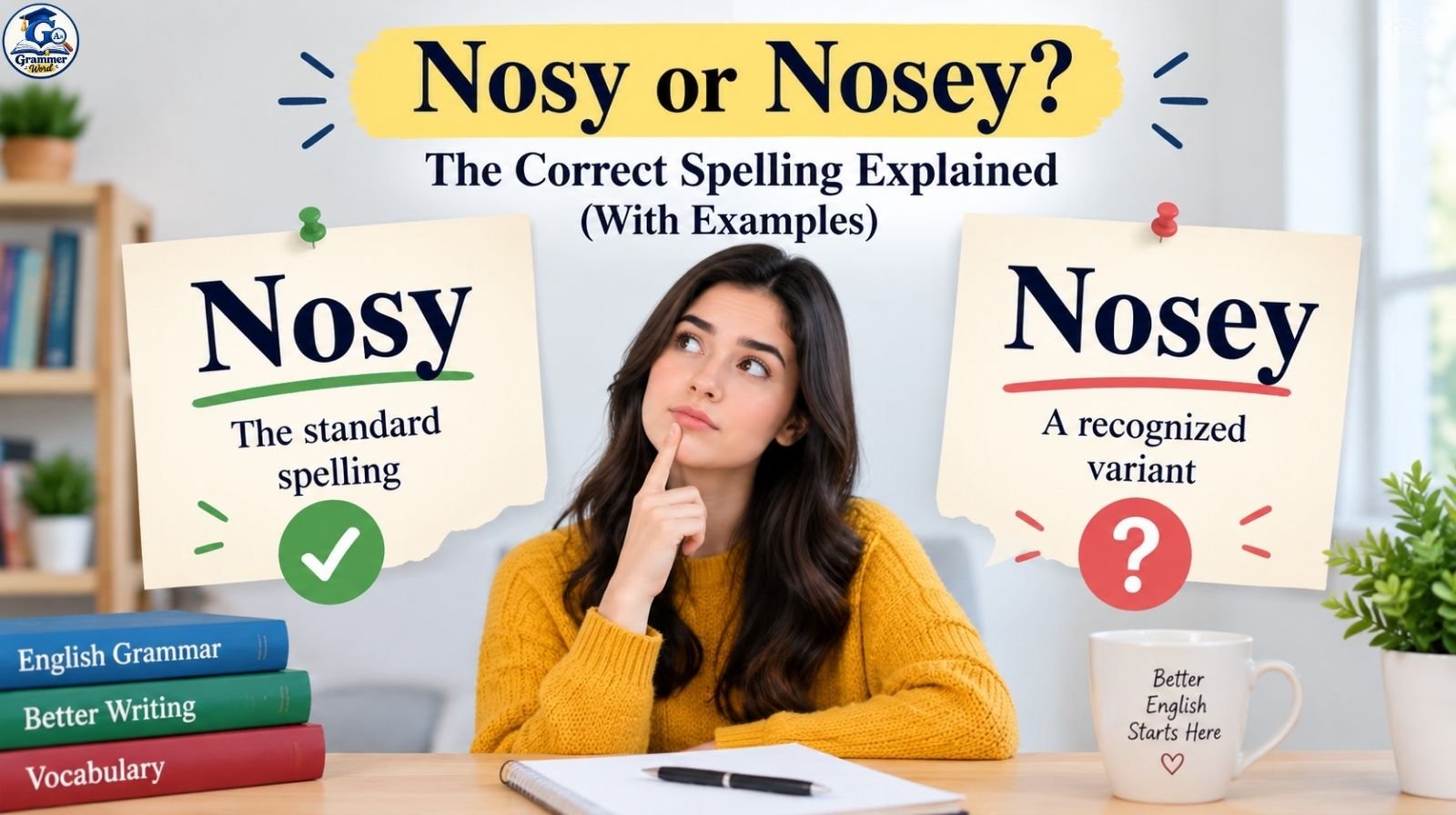
“Nosy” and “nosey” mean exactly the same thing. Both describe someone who shows excessive curiosity about other people’s private business the kind of person who asks too many personal questions or can’t resist peeking into things that don’t concern them.
The difference isn’t meaning; it’s spelling convention, and nosy (without the “e”) is the standard, dictionary-preferred spelling in modern English.
What Both Words Mean
Whether spelled “nosy” or “nosey,” the word functions as an adjective describing intrusive curiosity. For example:
- “My coworker is nosy about everyone’s salary.”
- “Stop being so nosy it’s none of your business.”
- “The nosy neighbor watched every car that pulled into the driveway.”
Neither spelling changes the pronunciation or the definition. The confusion exists purely because English speakers instinctively expect the word to keep the “e” from “nose,” even though the grammar rule works differently once a suffix is added.
Why This Confusion Is So Common
Part of the reason this mix-up persists is that spell-checkers rarely flag “nosey” as wrong. Since it’s a recognized dictionary variant, most grammar tools let it pass silently, which means writers rarely get corrected in the moment.
That’s very different from a word like “noisy,” where “noisey” is never accepted in any dictionary it’s simply treated as a misspelling. Nosy sits in a gray area that noisy doesn’t, and that gray area is exactly why so many people never realize there’s a “more correct” option.
Why “Nosy” Is the Correct Spelling
The “-y” Suffix Rule
English has a consistent pattern for turning nouns into “-y” adjectives: drop the silent “e” and add “y.” That’s why we write bossy (not “bossey”), fussy (not “fussey”), and clumsy (not “clumsey”). Applying that same rule to “nose” gives you nosy, not “nosey.”
This mirrors the established English rule for adding suffixes to words that end in a silent “e,” and it’s the main reason style guides and editors treat “nosy” as the default choice.
What Major Dictionaries Say
If you check the leading English dictionaries, the pattern is consistent. Merriam-Webster, Oxford Learner’s Dictionaries, and Cambridge Dictionary all list “nosy” as the main entry, while “nosey” appears only as a secondary or informal variant.
That consistency across independent dictionary authorities is a strong signal for anyone deciding which spelling to trust in formal writing. When multiple respected dictionaries agree on which form is primary, that agreement functions as the closest thing English has to an official ruling.
A Quick Note on Etymology
Interestingly, “nosy” doesn’t come directly from a deliberate decision to describe the body part. It evolved metaphorically, from the image of someone figuratively “sticking their nose” into other people’s affairs.
Over time, English simplified the spelling the same way it did with other “-y” adjectives, rather than preserving the full spelling of “nose.” Understanding that history helps explain why the “no e” version eventually became standard, even though it feels counterintuitive at first glance.
Read More: Women vs Woman: Which One Is Correct And When To Use It?
Is “Nosey” Ever Correct? American vs British English
American English Usage
In American English, “nosy” is the dominant and expected spelling. You’ll see it in news writing, academic papers, professional communication, and virtually every major U.S. publication. If you’re writing for an American audience whether that’s a blog, a business report, or a college essay “nosy” is the safe, correct choice every time.
British English Usage
Here’s where it gets interesting: in British English, “nosey” enjoys more acceptance than it does in American English, even though “nosy” is still considered correct there too. So if you’re writing for a UK audience, “nosey” won’t look wrong but it will still read as the more casual, informal choice compared to “nosy.”
British newspapers and formal publications still lean toward “nosy” in edited copy, while “nosey” shows up more often in conversational writing, social media, and dialogue.
What About Other English-Speaking Countries?
In Canadian, Australian, and other international English varieties, usage tends to follow the same general pattern as American English, with “nosy” treated as the standard spelling and “nosey” appearing occasionally in informal contexts.
In short: nosy works everywhere. Nosey is a regional, informal variant that’s more tolerated in British and casual contexts than in American or formal ones.
How to Use “Nosy” in a Sentence
Seeing the word in different contexts can make the correct spelling easier to remember. Here are a few natural examples:
- As a description: “She’s a nosy person who always wants to know what’s going on with everyone.”
- As a warning: “Don’t be nosy some things are private.”
- In dialogue: “‘Why are you so nosy about my dating life?’ she asked, laughing.”
- In a professional context: “The reviewer’s questions felt more nosy than constructive.”
- As a noun form (nosiness): “His nosiness eventually cost him a few friendships.”
Notice that even the noun form, “nosiness,” follows the same no-“e” pattern another clue that “nosy” is the spelling family this word belongs to.
Real-Life Example: When Spelling Choice Affects Professional Credibility
Consider a marketing coordinator named Sarah, who worked for a mid-sized software company preparing a client-facing case study. In her first draft, she described a competitor’s aggressive data-collection tactics as “nosey,” intending it as a light, conversational aside.
Her editor flagged it immediately not because the meaning was wrong, but because the spelling clashed with the polished, professional tone the rest of the document maintained. Sarah swapped it for “nosy,” and the sentence instantly read as more deliberate and authoritative.
This small example illustrates a bigger truth about professional writing: readers, especially decision-makers reviewing proposals, reports, or client materials, notice inconsistencies even when they can’t always name what feels off.
A single informal spelling choice can subtly undercut an otherwise well-researched piece of content. Sarah’s takeaway was simple when in doubt, default to the dictionary-standard spelling, especially in anything that represents a brand or a business relationship.
Her team later added a short internal style note to their brand guide: “Use nosy, not nosey, in all external content.”
It was a tiny addition, but it saved future writers from making the same last-minute correction, and it kept the company’s content consistent across blog posts, case studies, and social captions. It’s a small habit, but it’s one that consistently protects credibility across emails, reports, and marketing copy alike.
Read More: Capital or Capitol: Which One Is Correct And When To Use It?
Why Correct Spelling Matters for SEO and Credibility
Spelling choices like “nosy vs nosey” might seem minor, but research consistently shows that readers judge writing quality fast and that judgment affects trust, engagement, and even sales.
- In a survey of over a thousand UK respondents, poor spelling and grammar was identified as the single most damaging factor to brand perception, cited by 42.5% of participants ahead of being “too salesy” or posting too frequently.
- A separate survey of over a thousand consumers found that 59% would avoid using a company altogether if its website or marketing materials contained obvious spelling or grammatical mistakes, and 74% said they actively notice spelling and grammar quality on a company’s site.
- Search engines aim to reward content that demonstrates trustworthiness and authority, and grammatical or spelling errors can undermine both signals, which in turn can affect how content performs in search rankings.
- Beyond search visibility, inconsistent spelling can quietly reduce time-on-page and conversions, since readers who spot careless writing are more likely to click away before reaching a call to action.
For anyone producing content professionally bloggers, marketers, students, or business writers getting small details like “nosy” versus “nosey” right is part of a larger pattern that readers and search engines both pick up on. It’s rarely one typo that damages credibility; it’s the accumulation of small inconsistencies that shapes how trustworthy a piece of writing feels.
Nosy vs Nosey: Quick Reference
| Feature | Nosy | Nosey |
|---|---|---|
| Standard spelling | ✅ Yes | ❌ No |
| Dictionary main entry | ✅ Merriam-Webster, Cambridge, Oxford | Listed as variant |
| American English | Preferred | Rare, informal |
| British English | Correct and common | Accepted, more casual |
| Formal/business writing | ✅ Recommended | ❌ Avoid |
| Casual texting or speech | Fine | Fine |
| SEO-safe for content writing | ✅ Yes | Not recommended |
Other English Words With the Same Spelling Pattern
If “nosy” feels like an exception, it helps to see it alongside similar words that follow the same drop-the-“e”-add-“y” rule:
- Bossy not “bossey”
- Fussy not “fussey”
- Clumsy not “clumsey”
- Messy not “messey”
Some words in this family do have accepted variants, similar to nosy: “pricey” and “pricy” both exist, though “pricey” is far more common; “homey” and “homy” are both accepted, with “homey” preferred; and “spacey” and “spacy” are both used, though their meanings shift slightly depending on context.
Nosy fits into this same pattern a word with a standard form and a less common, still-recognized variant. Compare that to “noisy,” which has no accepted variant at all; “noisey” is simply incorrect in every dictionary and every style guide, with no regional exception.
That contrast is useful context: nosy isn’t uniquely irregular, it’s part of a small, predictable group of English adjectives where one small vowel decision separates the standard form from the casual one.
Read More: Loose or Lose? The Common Mistake Explained Clearly
Common Mistakes and How to Remember the Right Spelling

Why People Default to “Nosey”
Most people assume the word keeps the “e” because it visually comes from “nose.” That instinct is understandable, but English spelling doesn’t always follow visual logic it follows suffix patterns instead. Autocorrect and spell-check tools rarely help here either, since “nosey” isn’t technically wrong, just non-standard.
A Simple Memory Trick
Think of other common “-y” adjectives that drop the silent “e”: bossy, fussy, messy, and pricy. None of them keep the extra vowel, and neither does nosy. If you can remember “bossy and fussy,” you can remember “nosy.” Some writers also use the phrase “no e in nosy” as a quick mental cue before hitting publish.
Quick Self-Check Before You Publish
- Am I writing something formal, professional, or SEO content? → Use nosy.
- Am I texting a friend or writing casually for a UK audience? → Nosey is acceptable, though still less standard.
- Am I unsure which audience I’m writing for? → Default to nosy. It’s correct in every context, which makes it the safer universal choice.
Nosy or Nosey: Quick Mini Quiz Questions
1. Which spelling is the dictionary-standard one “nosy” or “nosey”?
Answer: Nosy is the standard, dictionary-preferred spelling.
2. True or False: “Nosy” and “nosey” mean different things.
Answer: False both mean the same thing: overly curious about others’ private business.
3. Which spelling rule explains why we write “nosy” instead of “nosey”?
Answer: The drop-the-silent-“e”-add-“y” rule, the same one used for bossy, fussy, and messy.
4. Is “nosey” a completely made-up word with no dictionary support?
Answer: No it’s a recognized variant spelling, just not the primary one.
5. Which region shows more tolerance for “nosey” American or British English?
Answer: British English tolerates “nosey” more, though “nosy” is still correct there too.
6. Fill in the blank: “Stop being so ___ about my personal life!”
Answer: Nosy (the standard, safest choice in any context).
Read More: Timeframe or Time Frame: Simple Grammar Explanation
7. Which word does NOT follow the same no-“e” pattern as nosy bossy, fussy, or noisey?
Answer: “Noisey” it’s simply incorrect; “noisy” has no accepted variant.
8. Should you use “nosy” or “nosey” in a business email?
Answer: Nosy it’s the professional, formal-writing choice.
9. What’s the noun form of “nosy” (describing the trait itself)?
Answer: Nosiness.
10. Which major dictionaries list “nosy” as the main entry?
Answer: Merriam-Webster, Cambridge, and Oxford Learner’s Dictionaries.
11. True or False: Spell-checkers usually flag “nosey” as wrong.
Answer: False since it’s a recognized variant, most spell-checkers let it pass silently.
12. Which word pair follows a similar “two accepted spellings” pattern as nosy/nosey pricey/pricy or car/cars?
Answer: Pricey/pricy.
13. Why does research suggest spelling choices matter for brand credibility?
Answer: Because readers form fast trust judgments, and errors can lower perceived credibility and even hurt conversions.
14. Quick decision: You’re unsure who your audience is. Do you play it safe with “nosy” or “nosey”?
Answer: Nosy it’s correct in every context, formal or casual.
15. One-sentence memory trick: How do you remember the correct spelling of “nosy”?
Answer: Think “bossy, fussy, nosy” no “e” in any of them.
FAQs
Q1. Is “nosey” a real word?
A: Yes. It’s a recognized variant spelling of “nosy” in several dictionaries, but it’s not the standard or preferred form, especially in American English and formal writing.
Q2. Which spelling should I use in a resume or business email?
A: Always use “nosy.” It’s the dictionary-standard spelling and the safer choice for any professional or academic context.
Q3. Do “nosy” and “nosey” mean different things?
A:No. Both describe someone who is excessively curious about others’ private matters. The only difference is spelling convention, not definition.
Q4. Is “nosey” British and “nosy” American?
A: exactly. “Nosy” is correct and standard in both American and British English. “Nosey” is simply more commonly tolerated in informal British writing, but it’s still considered a variant rather than the standard form.
Q5. What’s an easy way to remember the correct spelling?
A: Compare it to similar words like bossy, fussy, and messy none of them keep a silent “e” before adding “y,” and neither does nosy.
Q6. Does using “nosey” instead of “nosy” count as a spelling error?
A: In formal or professional writing, yes most style guides and editors will flag it. In casual or British informal writing, it’s generally tolerated but still not the preferred choice.
Q7. Are there other words like “nosy” that have two accepted spellings?
A: Yes. Words like “pricey/pricy,” “homey/homy,” and “spacey/spacy” follow a similar pattern, where one spelling is dominant and the other survives as a recognized but less common variant.
Conclusion
When it comes down to nosy or nosey, the dictionary-backed answer is clear: “nosy” is the correct, standard spelling in both American and British English, while “nosey” survives only as an informal variant that’s more common in casual British writing.
Whether you’re drafting a client email, a blog post, or a school essay, choosing “nosy” keeps your writing polished, consistent, and aligned with what major dictionaries and editors expect.
The next time you catch yourself typing that extra “e,” pause and remember the bossy-fussy-nosy pattern it’s a small habit that keeps your writing sharp and credible every time you publish.
Discover More Article
- Tomatoes or Tomatos: Which Spelling Is Correct?
- ECT or ETC? What’s The Correct Abbreviation?
- Onto or On To: What’s The Difference And Which One Is Correct?
Keep learning with more easy grammar lessons on Grammer Word.com

Hi, I’m Noor Fatima, the person behind this website. I created this site to make English grammar and confusing words easier to understand. I love breaking down tricky words, meanings, spellings, and grammar rules into simple explanations. My goal is to help you learn English naturally, avoid common mistakes, and feel more confident every time you write or speak.