Have you ever written “busses” and then wondered whether it should actually be “buses”? You’re not alone. The spelling can look confusing because English often doubles the final consonant in certain words.
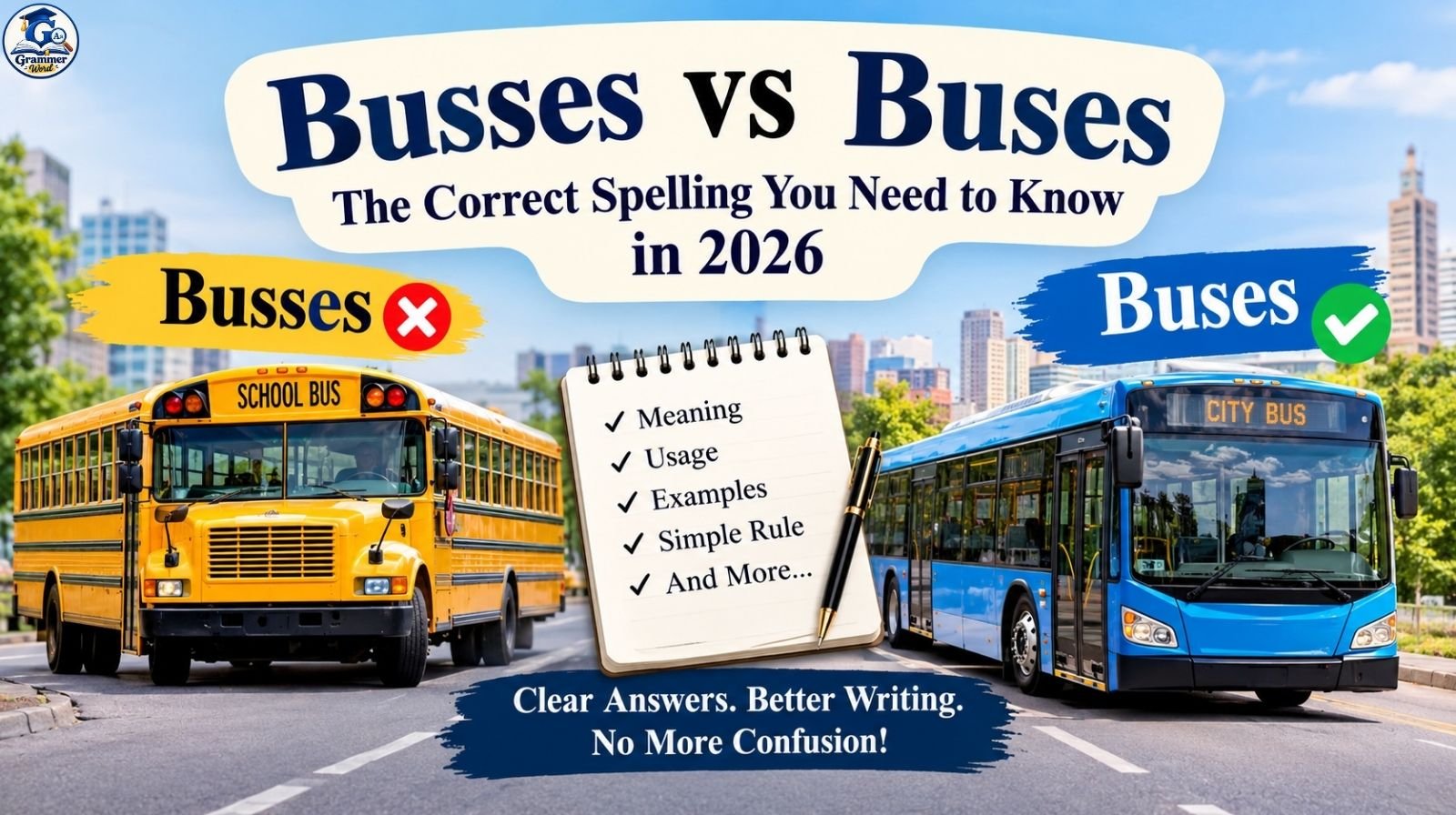
When discussing more than one passenger vehicle, buses is the standard and most commonly used spelling in modern English.
However, busses is not simply an invented or meaningless form. Major dictionaries recognize it as a variant, particularly in American English.
So, busses vs buses is more interesting than it first appears.
In this guide, you’ll learn the difference between busses and buses, which spelling you should normally use in 2026, why the confusion exists, and how to remember the correct form.
Read More: Whoever or Whomever: A Complete Guide To Correct Usage
What Is the Correct Spelling: Busses vs Buses?
Buses Is the Standard Choice
If you are talking about two or more passenger vehicles, buses is the safest and most natural spelling.
For example:
- The buses arrived at the station.
- Several school buses were parked outside.
- The city operates hundreds of buses every day.
- We waited for the buses near the bus stop.
Cambridge Dictionary lists buses as the plural of bus, while its grammar guidance specifically gives bus → buses as an example of forming a plural with -es.
Oxford likewise lists buses as the plural and notes busses as an additional US English form.
Is “Busses” Wrong?
Not exactly.
This is where the answer needs a little nuance. Merriam-Webster lists the noun bus with the plurals “buses also busses.” Cambridge also recognizes busses as a US variant.
Therefore, saying that busses can never be a plural of bus would be too absolute.
However, buses is the much more conventional choice for modern general writing. If you’re writing an essay, website, email, school assignment, or professional document, buses is usually the form readers will expect.
Why Is the Plural of Bus “Buses” Instead of “Busses”?
The -es Plural Rule
One reason buses makes sense is that nouns ending in an -s sound commonly form their plurals with -es.
For example:
| Singular | Plural |
|---|---|
| bus | buses |
| class | classes |
| box | boxes |
| dish | dishes |
| watch | watches |
| kiss | kisses |
Cambridge’s English Grammar Today specifically includes bus → buses among nouns that form their plural by adding -es.
So the basic spelling pattern is:
bus + es = buses
The pronunciation also changes naturally:
- bus → /bʌs/
- buses → /ˈbʌsɪz/
Why Does “Busses” Look So Natural?
English has many words where a final consonant is doubled in related forms. That makes busses look logical at first glance.
For example:
- run → running
- stop → stopped
- plan → planned
Because bus has a short vowel followed by s, some writers naturally assume the final s should be doubled before adding -es.
But English spelling doesn’t always follow one perfectly predictable pattern. In the case of bus, buses became the normal modern plural.
Read More: Any Time or Anytime: Which One Is Correct?
Busses vs Buses: What Is the Difference?
Buses Means More Than One Bus
The most common meaning of buses is simply the plural of bus.
A bus is a large road vehicle designed to carry passengers, often along a fixed route.
Examples:
The buses leave every 15 minutes.
Five buses were waiting outside the terminal.
Electric buses are being introduced in several cities.
In all these examples, buses refers to multiple passenger vehicles.
Busses Can Have More Than One Meaning
Busses can also appear as a plural form of bus, although it is much less common.
There is another important possibility, too: buss is a separate word meaning a kiss. Therefore, busses can also be the plural of buss.
For example:
The romantic scene included several playful busses.
Here, busses does not refer to vehicles. It comes from the noun buss.
This is one reason context matters when you encounter the spelling busses.
Quick Comparison
| Word | Meaning | Typical Use |
|---|---|---|
| bus | One passenger vehicle | Singular |
| buses | More than one bus | Standard modern plural |
| busses | Variant plural of bus | Uncommon |
| buss | A kiss | Separate word |
| busses | More than one kiss | Plural of buss |
When Should You Use “Buses” in 2026?
Use “Buses” in Formal Writing
For most contemporary writing, choose buses.
This includes:
- Academic assignments
- Business documents
- Blog posts
- News writing
- Emails
- Schoolwork
- Websites
- Reports
- General communication
For example:
Preferred:
The company operates 50 buses across the city.
Less conventional:
The company operates 50 busses across the city.
The second sentence may be understood, and dictionaries recognize the variant, but the first is the more familiar modern spelling.
Use “Busses” Only When Context Calls for It
You might encounter busses in older texts, American English sources, or dictionaries that list it as an alternative plural.
Merriam-Webster currently lists both buses and busses, while Oxford similarly identifies busses as an additional US form.
Therefore, busses is recognized, but buses is generally the better default.
Read More: Freshman or Freshmen: Which One Is Correct?
A Simple Way to Remember the Correct Spelling

Use This Formula: Bus + Es = Buses
If you frequently forget whether to write buses or busses, use this simple memory trick:
ONE BUS → TWO BUSES
Think of other familiar words:
- bus → buses
- class → classes
- glass → glasses
- box → boxes
- brush → brushes
The -es ending makes the plural easier to recognize and pronounce.
A Quick Writing Test
Whenever you’re unsure, ask:
Am I talking about more than one passenger vehicle?
If yes, write:
buses
For example:
❌ The busses were late.
✅ The buses were late.
The first sentence isn’t necessarily impossible under dictionary definitions, but the second is the standard choice for clear contemporary writing.
Real-Life Example: Why the Spelling Matters
Imagine you’re writing a school newsletter about transportation. You want to tell parents that several vehicles will be available for students after an event.
Your first draft says:
“Three busses will arrive outside the school at 4 p.m.”
A reader will almost certainly understand the sentence. However, because busses is an uncommon spelling for the vehicle plural, it may look like a typo to many readers.
You revise it to:
“Three buses will arrive outside the school at 4 p.m.”
The meaning hasn’t changed. The difference is simply that buses is the conventional modern spelling.
This becomes even more important in professional communication. Suppose a transportation company publishes:
“Our busses are clean, reliable, and comfortable.”
The message is understandable, but “Our buses are clean, reliable, and comfortable” looks more familiar and polished to most contemporary readers.
This is not because busses has no dictionary history. In fact, Merriam-Webster still records it as an alternative plural, and Cambridge identifies it as a US variant.
The practical lesson is therefore simple: when your meaning is passenger vehicles, use “buses” unless you have a specific reason to preserve the less common variant.
Read More: Fiancé or Fiancée: Understanding The Difference And Correct Usage
Buses in Modern English: 2025–2026 Data
The word buses is not just a spelling question. Buses remain an important part of modern transportation.
According to the American Public Transportation Association’s 2026 research materials, U.S. public transit riders took 8.1 billion trips in 2025, representing a 6% increase from the previous year. The same APTA research reports that the share of hybrid-electric buses reached 20.8% in 2025, while more than 1,600 zero-emission buses were in service.
School transportation also demonstrates how frequently the word appears in everyday life. In April 2025 data from the National Center for Education Statistics, 87% of U.S. public schools reported having school buses available, and 40% of public-school students were reported to travel to and from school by school bus on a typical day.
These figures provide useful modern context: buses is a word that continues to appear across transportation, education, technology, environmental policy, and everyday communication.
Common Examples of “Buses”
Correct Everyday Examples
Here are some natural examples using the standard plural:
- The buses stopped at the station.
- Several school buses arrived early.
- The airport operates free shuttle buses.
- We saw dozens of buses on the highway.
- Electric buses are becoming more visible in public transportation.
- The city added new buses to its fleet.
- The buses were crowded during rush hour.
Examples With “Busses”
Because dictionaries recognize busses as a variant, you may occasionally encounter:
The busses were parked outside the terminal.
This can be understood as a plural of bus, but buses would normally be the better choice in contemporary general writing.
And in a completely different context:
The movie contained several affectionate busses.
Here, busses refers to kisses because it is the plural of buss.
Buses vs Busses: Quick Comparison Checklist
Before publishing your writing, use this checklist:
- One vehicle: bus
- Two or more vehicles: buses
- Standard modern spelling: buses
- Recognized variant: busses
- Buss: a separate word meaning a kiss
- Formal writing: normally choose buses
- School assignments: normally choose buses
- Professional writing: normally choose buses
The One-Line Rule
If you mean more than one passenger vehicle, write “buses.”
That’s the easiest rule to remember.
Read More: Dreamt or Dreamed: Which One Is Correct?
Mini Quiz: Busses vs Buses
Test yourself with these quick, easy questions. Answers are revealed after each one!
1. Which spelling is the standard plural of “bus”?
A) Busses
B) Buses
C) Bussies
D) Busess
Answer: B) Buses Buses is the standard modern plural of bus.
2. Fill in the blank: “The school ___ arrived early.”
A) buss
B) busses
C) buses
D) bus
Answer: C) buses You need the plural because more than one vehicle arrived.
3. Is “busses” completely wrong?
A) Yes
B) No
C) Only in British English
D) Only in school writing
Answer: B) No Busses is recognized as a variant plural, although buses is the usual choice.
4. What is the singular form?
A) Buses
B) Busses
C) Bus
D) Buss
Answer: C) Bus One passenger vehicle is a bus.
5. Which sentence uses the standard spelling?
A) The busses are waiting.
B) The buses are waiting.
C) The busess are waiting.
D) The buss are waiting.
Answer: B) The buses are waiting.
6. Complete the pattern: One bus → two ___.
A) buss
B) busses
C) bus
D) buses
Answer: D) buses The standard plural is formed with -es.
7. Which word can mean “a kiss”?
A) Bus
B) Buss
C) Buses
D) Busse
Answer: B) Buss Buss is a separate word meaning a kiss.
8. Which plural can refer to more than one kiss?
A) Buses
B) Busses
C) Bussies
D) Bus
Answer: B) Busses Busses can be the plural of buss.
9. Which spelling is usually better for a school assignment?
A) Busses
B) Buses
C) Buss
D) Busess
Answer: B) Buses Buses is the conventional spelling in modern general writing.
Read More: Anyway or Anyways: Which One Is Correct?
10. Which sentence is correct?
A) Five busses stopped here.
B) Five buss stopped here.
C) Five buses stopped here.
D) Five bus stopped here.
Answer: C) Five buses stopped here.
11. What ending is normally added to “bus” to make its plural?
A) -s
B) -ed
C) -es
D) -ing
Answer: C) -es Bus + es = buses.
12. Which word is the safest choice in professional writing?
A) Busses
B) Buses
C) Buss
D) Busess
Answer: B) Buses It is the standard and familiar modern form.
13. Choose the correct sentence.
A) The city bought ten busses.
B) The city bought ten buss.
C) The city bought ten buses.
D) The city bought ten bus.
Answer: C) The city bought ten buses.
14. True or False: “Busses” can be found as a variant spelling of the plural of “bus.”
A) True
B) False
Answer: True Major dictionaries recognize busses as a variant, though buses is the more common modern form.
15. What is the easiest rule to remember?
A) One bus → two buss
B) One bus → two busses only
C) One bus → two buses
D) One bus → two busess
Answer: C) One bus → two buses Remember this simple pattern whenever you’re unsure.
Read More: Skillset or Skill Set: Which Term Is Correct In Modern English?
FAQs
Q1. Is “buses” or “busses” correct?
Buses is the standard and most common modern spelling for the plural of bus. However, major dictionaries recognize busses as a variant.
Q2. Is “busses” a spelling mistake?
Not necessarily. Busses is recognized as a variant plural of bus, particularly in US English. However, it is much less common than buses, so many readers may interpret it as a spelling mistake.
Q3. What is the plural of bus?
The standard plural is buses.
Example:
One bus → two buses.
Q4. Why does bus become buses instead of busses?
The normal plural formation uses -es after words ending in an s sound. Cambridge specifically gives bus → buses as an example of this plural pattern.
Q5. Can I use “busses” in formal writing?
You can encounter it as a recognized variant, but buses is the safer and more conventional choice for formal, academic, professional, and general contemporary writing.
Q6. Is “busses” the plural of “buss”?
Yes. Buss is a separate noun meaning a kiss, so busses can be its plural.
Q7. Which should I use in 2026: “buses” or “busses”?
For ordinary writing about passenger vehicles, use buses. It is the standard modern form listed by major dictionaries, while busses remains a recognized but less common variant.
Conclusion:
When it comes to busses vs buses, the practical answer is straightforward: use “buses” when you mean more than one passenger vehicle.
Although busses is recognized by major dictionaries as a variant plural, buses is the conventional spelling you’ll want in most modern writing.
Remember the simple pattern:
One bus → two buses
So whether you’re writing a school assignment, professional email, blog post, report, or everyday message, buses is the spelling to reach for first.
If this guide helped clear up the confusion, save it for the next time you encounter a tricky English spelling and share it with another writer who might be wondering whether busses or buses is correct.
Discover More Article
- Apart or A Part: Understanding The Difference
- Choose or Chose: Everything You Need To Know
- Gases or Gasses – Which Spelling Is Correct?
- Here Here or Hear Hear? The Correct Phrase Explained Simply
Keep learning with more easy grammar lessons on Grammer Word.com

Hi, I’m Noor Fatima, the person behind this website. I created this site to make English grammar and confusing words easier to understand. I love breaking down tricky words, meanings, spellings, and grammar rules into simple explanations. My goal is to help you learn English naturally, avoid common mistakes, and feel more confident every time you write or speak.