Have you ever typed “dieing” and wondered whether it should actually be “dying”? This is a common English spelling confusion because adding -ing to die does not produce the form many people expect.
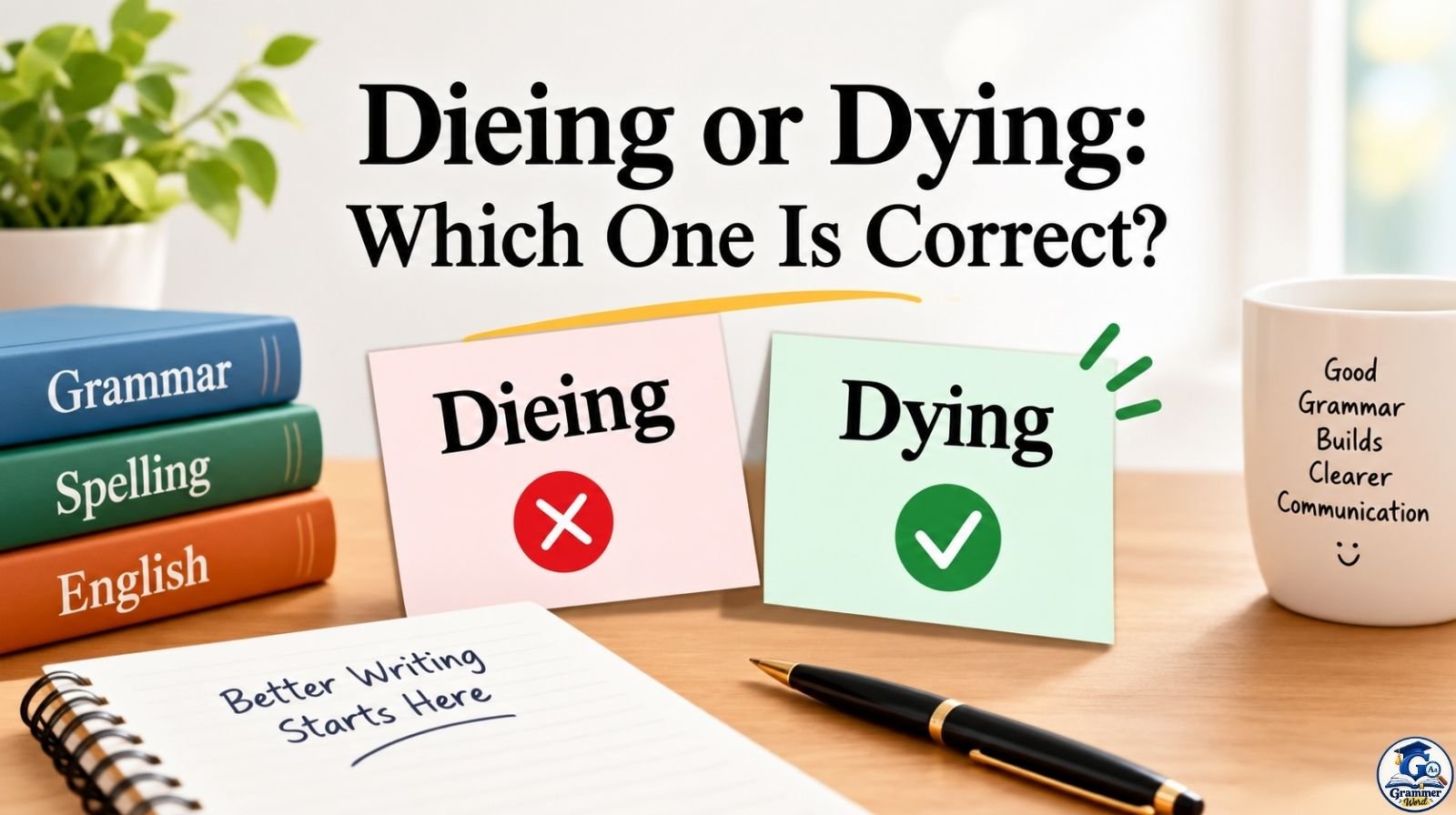
If you are asking, “Dieing or dying: which one is correct?”, the standard answer is dying when you mean the present participle of die.
Cambridge Dictionary identifies dying as the present participle of die, while Collins gives the same grammatical form.
In this guide, you will learn why dying is correct, whether dieing can ever appear, how dying differs from dyeing, and how to use each form correctly in everyday writing.
Read More: Loose or Lose? The Common Mistake Explained Clearly
Dieing or Dying: Which Spelling Is Correct?
When you mean the process of ceasing to live, the correct standard spelling is dying.
Dying Is the Correct Form of Die
The verb die changes to dying when it takes the present participle or -ing form.
- Base verb: die
- Present participle: dying
- Past tense: died
- Past participle: died
Cambridge Dictionary specifically lists dying as the present participle of die.
Examples:
- The old tree is dying.
- The flowers are dying without water.
- The battery is dying.
- He was dying to hear the news.
Why “Dieing” Looks Correct at First
The confusion happens because English learners often expect to simply add -ing to a verb:
die + ing = dieing
However, English spelling does not always work by simply attaching the ending.
For die, the spelling changes:
die → dying
The same type of spelling pattern can be seen in:
| Base Verb | -ing Form |
|---|---|
| die | dying |
| lie | lying |
| tie | tying |
Therefore, when you mean the process of dying, write dying, not dieing.
Quick Answer
Dying is the standard spelling when it is the present participle of die.
✅ The plant is dying.
❌ The plant is dieing.
Why Does Die Become Dying?
The spelling of dying can seem unusual, but it follows an established English spelling pattern.
The Die → Dying Spelling Rule
When die becomes its present participle, the final -ie changes to y before -ing is added:
die → dying
This is why the word does not normally become dieing in the sense of ceasing to live.
A useful comparison is:
- lie → lying
- tie → tying
- die → dying
A grammar reference from the Australian National University also lists die → dying among present-participle spelling patterns.
Read More: Lay or Lie? The Simple Grammar Rule Most People Get Wrong
Examples of Dying in Sentences
Here are several natural examples:
- The leaves are dying because they are not getting enough water.
- The patient was dying when the ambulance arrived.
- My phone battery is dying.
- The candle is dying out.
- That old tradition is slowly dying.
- I am dying to know what happened.
Notice that dying does not always refer literally to death. It can also describe something that is fading, ending, weakening, or becoming less common. Cambridge gives examples involving a dying tradition and the “dying moments” of an event.
What Does “Dying” Mean?
Dying has several related meanings depending on context.
Dying and Literal Death
The most direct meaning relates to someone or something approaching death.
For example:
The injured animal is dying.
Here, dying describes the process of approaching death.
Cambridge defines dying as an adjective for someone or something that is very ill and likely to die soon, as well as the present participle of die.
Dying Can Mean Declining or Ending
The word can also describe something that is becoming weaker or less common.
For example:
The tradition is dying.
This does not mean the tradition is literally alive. It means the tradition is gradually disappearing.
Other examples include:
- a dying industry
- a dying tradition
- a dying culture
- the dying days of an era
- the dying minutes of a game
Collins similarly records dying in expressions describing something approaching its end.
“Dying to” Has a Different Everyday Meaning
You may also see dying to in informal English.
I’m dying to see the new movie.
This usually means very eager, rather than literally approaching death.
Cambridge specifically lists be dying to do something as an expression meaning to be very eager to do it.
Read More: Traveled or Travelled: Which Spelling Is Correct In English?
Is “Dieing” Ever Correct?
For ordinary English, dieing is not the form you should use when talking about death.
Dieing vs. Dying in Standard English
If your sentence means that someone, an animal, plant, or thing is approaching an end, use dying.
| Incorrect for ordinary “die” meaning | Correct |
|---|---|
| The plant is dieing. | The plant is dying. |
| The battery is dieing. | The battery is dying. |
| The animal is dieing. | The animal is dying. |
| The tradition is dieing. | The tradition is dying. |
There is, however, an important dictionary nuance. Merriam-Webster’s Scrabble dictionary records dieing as a specialized form associated with the verb die meaning to cut with a die, a shaping device. It separately gives dying for the ordinary verb meaning “to cease living.”
So, for normal writing about death or decline, dying is the form to use.
Don’t Confuse Dieing With Dyeing
Another word creates even more confusion: dyeing.
These words have different meanings:
- dying = approaching death or declining
- dyeing = coloring something with dye
- dieing = a rare/specialized technical form associated with a shaping die
For example:
The flowers are dying.
But:
She is dyeing her hair.
The difference of one letter changes the meaning completely.
Read More: Nosy or Nosey? The Correct Spelling Explained (With Examples)
Dying vs. Dyeing vs. Dieing: A Simple Comparison
Understanding these three spellings makes the difference much easier to remember.
Comparison Table
| Word | Meaning | Example |
|---|---|---|
| dying | approaching death, ending, declining | The plant is dying. |
| dyeing | coloring something with dye | She is dyeing her shirt. |
| dieing | specialized form related to a shaping die | The term may appear in technical contexts. |
A Simple Memory Trick
Think of the three words this way:
Die → dying
Dye → dyeing
If you are talking about death or decline, choose dying.
If you are talking about changing a color, choose dyeing.
This simple distinction prevents most spelling mistakes.
What Current Dictionary Evidence Shows in 2025–2026
A useful way to verify a spelling question is to check established dictionaries rather than relying on how a word looks.
A 2025–2026 Reference Check
Current dictionary/reference sources reviewed for this article consistently identify dying as the ordinary present participle of die:
- Cambridge Dictionary lists dying as the present participle of die.
- Collins English Dictionary defines dying as the present participle of die.
- Larousse gives the conjugation as die → dying → died.
- Merriam-Webster’s Scrabble Dictionary distinguishes dying for “cease living” from a specialized dieing associated with cutting with a die.
This gives us an important practical takeaway: in ordinary modern English, “dying” is the form to use when you mean the process of dying.
Google’s Ngram Viewer also explains that its corpus can be used to examine how words and phrases occur across published books; its July 2024 release notes describe a newer dataset and explain that the corpus can change as books and language-processing improvements are added.
Because dictionary entries and corpus data measure different things, neither should be treated as a simple measure of internet search popularity. For spelling decisions, the dictionary evidence is more directly relevant.
Read More: Quite or Quiet? Simple Guide To The Common English Confusion
A Real-Life Writing Example: How One Letter Changes the Meaning
Imagine you are editing a gardening article about a houseplant.
The writer originally submits this sentence:
“My indoor plant is dieing because I forgot to water it.”
At first glance, dieing may look reasonable. The writer has taken the verb die and added -ing, just as we do with many English verbs. However, the standard present participle of die is dying.
The edited sentence should therefore read:
“My indoor plant is dying because I forgot to water it.”
Now imagine the article contains another sentence:
“She is dying her old curtains blue.”
That sentence changes the meaning entirely. If the writer means that she is changing the curtains’ color, dying would be incorrect. The correct word is dyeing:
“She is dyeing her old curtains blue.”
This example shows why proofreading only for individual letters is not enough. You need to consider the meaning of the word in context.
In the first sentence, the subject is a plant whose life is ending, so dying is correct. In the second sentence, the subject is changing the color of fabric, so dyeing is correct.
The rarely encountered dieing may appear in specialized terminology involving a manufacturing die, but it should not replace dying in ordinary English. Merriam-Webster’s dictionary material makes this specialized distinction explicit.
For students, bloggers, editors, and business writers, the safest practical rule is simple: death or decline = dying; color = dyeing.
Common Mistakes With Dying
Knowing the rule is useful, but seeing common mistakes makes it easier to apply.
Mistake 1: Adding -ing Directly to Die
Wrong:
The flower is dieing.
Correct:
The flower is dying.
The spelling changes from die to dy- before the -ing ending.
Read More: Further or Farther: Simple Rules And When To Use Each
Mistake 2: Confusing Dying With Dyeing
Wrong:
She is dying her hair red.
Correct:
She is dyeing her hair red.
Here, the action involves dye, not die.
Mistake 3: Assuming Dieing Is the Normal Present Participle
It is tempting to think:
die + ing = dieing
But standard English uses:
die + spelling change + ing = dying
So remember the complete form rather than trying to build it from scratch every time.
Mini Quiz: Dieing or Dying?
1. Which spelling is correct when someone is approaching death?
A) Dying
B) Dieing
C) Dyeing
Answer: Dying ✅
2. Fill in the blank: “The plant is ___.”
A) Dieing
B) Dying
C) Dyeing
Answer: Dying ✅
3. What is the past tense of “die”?
A) Dying
B) Dieing
C) Died
Answer: Died ✅
4. Which word means coloring something?
A) Dying
B) Dyeing
C) Dieing
Answer: Dyeing ✅
Read More: Carmel or Caramel: Which One Is Correct?
5. “My phone battery is ___.” Which word fits?
A) Dying
B) Dieing
C) Dyeing
Answer: Dying ✅
6. What is the correct -ing form of “die”?
A) Dieing
B) Dying
C) Dieding
Answer: Dying ✅
7. Which sentence is correct?
A) She is dyeing her hair.
B) She is dieing her hair.
C) She is dying her hair.
Answer: She is dyeing her hair. ✅
8. “The old tradition is ___.” Choose the correct word.
A) Dieing
B) Dyeing
C) Dying
Answer: Dying ✅
9. Which word belongs with “die”?
A) Dying
B) Dyeing
C) Dieding
Answer: Dying ✅
10. What does “I’m dying to know” usually mean?
A) I am very eager to know.
B) I am already dead.
C) I am changing color.
Answer: I am very eager to know. ✅
11. “The flowers are ___ without water.”
A) Dyeing
B) Dying
C) Dieing
Answer: Dying ✅
12. “She is ___ the fabric blue.”
A) Dying
B) Dieing
C) Dyeing
Answer: Dyeing ✅
13. Which spelling is normally used in everyday writing about death?
A) Dieing
B) Dying
C) Dyeing
Answer: Dying ✅
14. Which sentence is correct?
A) The candle is dying out.
B) The candle is dieing out.
C) The candle is dyeing out.
Answer: The candle is dying out. ✅
15. What is the easiest rule to remember?
A) Death/decline = dying; color = dyeing
B) Death/decline = dyeing; color = dying
C) Both words mean the same thing
Answer: Death/decline = dying; color = dyeing. ✅
Read More: Timeframe or Time Frame: Simple Grammar Explanation
FAQs
Q1. Is “dying” the correct spelling?
Yes. Dying is the standard present participle of die when referring to ceasing to live or something approaching its end.
Q2. Is “dieing” a real word?
Dieing can occur in specialized terminology connected with a die, a tool used for shaping or cutting materials. However, it is not the ordinary present participle of die meaning “to cease living.”
Q3. Why is it “dying” and not “dieing”?
The spelling of die changes when the -ing form is made. The standard form is dying, just as lie becomes lying and tie becomes tying.
Q4. What is the difference between dying and dyeing?
Dying relates to die and can mean approaching death, declining, or ending. Dyeing relates to dye and means coloring something.
The plant is dying.
She is dyeing her dress.
Q5. Is “dying” always about death?
No. It can also describe something that is declining or coming to an end.
The old tradition is dying.
It can also appear in the informal expression dying to, meaning very eager:
I’m dying to hear the story.
Q6. What is the past tense of die?
The past tense is died.
- Present: die
- Present participle: dying
- Past: died
- Past participle: died
Cambridge and Larousse both give died as the past form and dying as the present participle.
Conclusion:
So, dieing or dying: which one is correct? In ordinary English, when you mean the process of die, the correct spelling is dying.
Remember these three forms:
- Die = base verb
- Dying = present participle
- Died = past tense and past participle
Also keep dyeing separate because it means coloring something.
The easiest rule is:
Death or decline → dying
Changing color → dyeing
Although dieing can occur in a specialized technical sense involving a shaping die, it is not the normal spelling you need in everyday writing.
If you found this Dieing or Dying guide helpful, bookmark it for future writing and share it with anyone who frequently gets these confusing English spellings mixed up.
Discover More Article
- Jist or Gist: Which Spelling Is Correct And How To Use It Properly?
- Every Time or Everytime: Which One Is Correct?
- Master’s Degree or Masters Degree: Which One Is Correct?
- Each Other or Eachother? The Correct Spelling Explained Simply
Keep learning with more easy grammar lessons on Grammer Word.com

Hi, I’m Noor Fatima, the person behind this website. I created this site to make English grammar and confusing words easier to understand. I love breaking down tricky words, meanings, spellings, and grammar rules into simple explanations. My goal is to help you learn English naturally, avoid common mistakes, and feel more confident every time you write or speak.