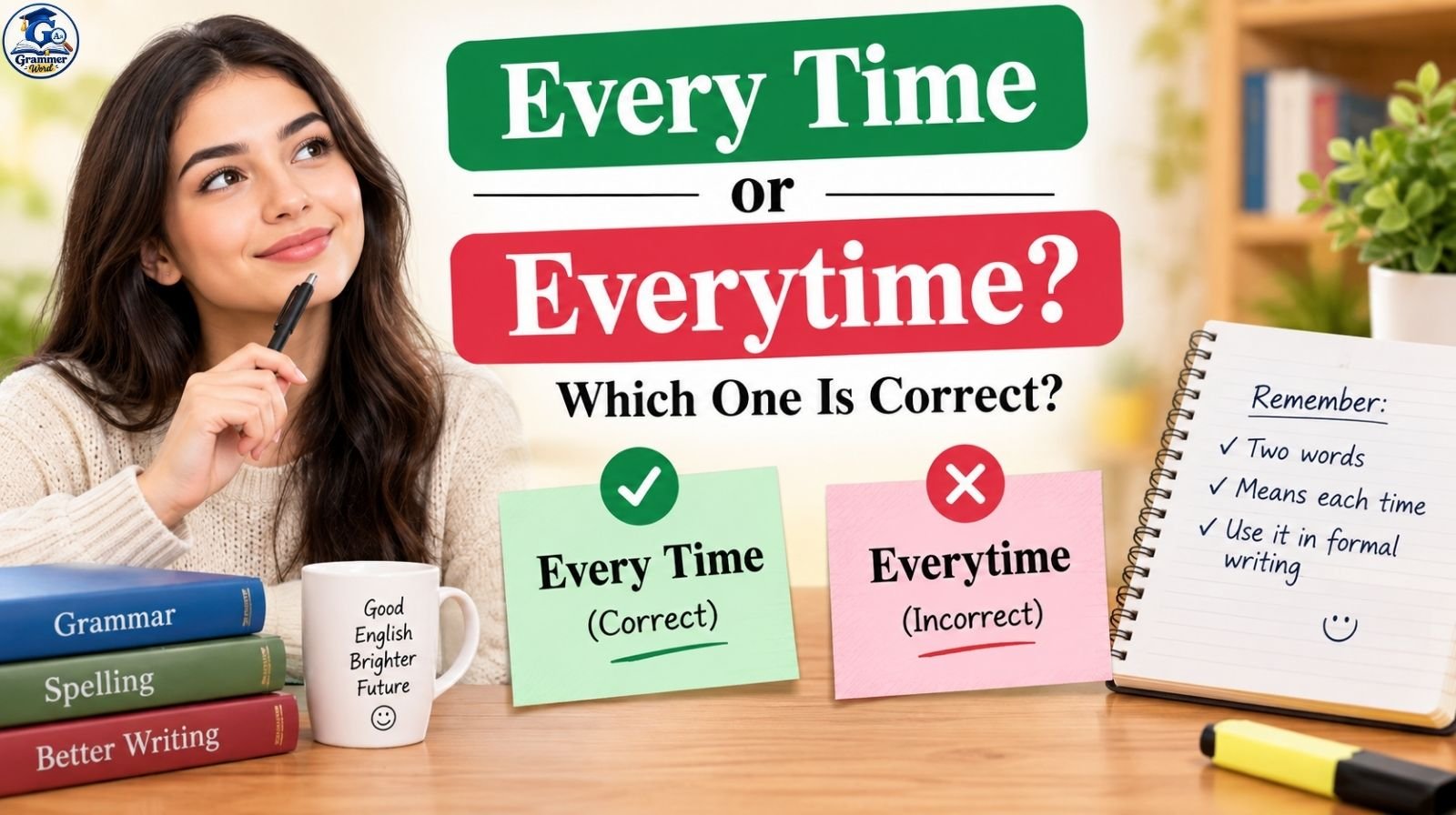
Have you ever wondered whether “every time” should be written as two words or whether “everytime” is acceptable as one word? This is a common English spelling and grammar question, especially because the phrase sounds like a single unit when spoken.
The correct standard-English form is every time two words. “Everytime” is generally considered a misspelling when it is used to mean “each time” or “whenever.”
Cambridge Dictionary uses every time in examples such as “Every time I go to Chicago…” and defines every as referring to repeated or individual occurrences.
In this guide, you’ll learn every time vs. everytime, what each form means, how to use the phrase correctly, common mistakes to avoid, and easy examples you can remember.
Read More: Lets or Let’s: Which One Is Correct And When To Use It?
Every Time or Everytime: What Is the Correct Spelling?
The correct form in standard English is every time, written as two separate words.
Every time means each time, on every occasion, or whenever something happens. Cambridge Dictionary gives examples such as “Every time I go to Chicago I get caught in a traffic jam,” demonstrating the standard two-word construction.
By contrast, everytime is commonly used as a mistaken one-word spelling of the phrase. Scribbr specifically explains that every time is an adverbial phrase meaning “each time” or “without exception,” while everytime should be avoided in standard writing.
Every Time = Correct
Use every time when you mean “each time.”
- Every time I see that movie, I laugh.
- She calls me every time she visits the city.
- Every time it rains, the streets become slippery.
- He makes the same mistake every time.
Everytime = Incorrect in Standard Writing
Avoid using everytime as a replacement for every time.
- ❌ I smile everytime I hear that song.
- ✅ I smile every time I hear that song.
- ❌ She forgets her keys everytime she leaves.
- ✅ She forgets her keys every time she leaves.
What Does Every Time Mean?
Every time describes something that happens on each relevant occasion. It can introduce a clause or appear later in a sentence.
Cambridge Dictionary explains that every can describe something that is repeated regularly, such as an event happening at regular intervals.
Every Time Meaning “Each Time”
The easiest way to understand every time is to replace it with each time.
Every time I visit her, we drink coffee.
This means:
Each time I visit her, we drink coffee.
Both expressions communicate the idea of repeated occasions.
Every Time Meaning “Whenever”
In many sentences, every time can also be replaced with whenever.
- Every time I hear that song, I remember school.
- Whenever I hear that song, I remember school.
Cambridge Dictionary defines whenever as meaning “every or any time” in this type of construction.
However, whenever can have additional meanings, so the two expressions are not interchangeable in every possible context.
Every Time as a Repeated-Action Phrase
Use every time when an action or situation repeatedly occurs.
Examples:
- The computer freezes every time I open that program.
- My brother laughs every time he tells that story.
- I check my email every time I finish a task.
Read More: Loosing or Losing: What’s The Correct Spelling And When To Use It?
Why Is Everytime Incorrect?
The confusion mainly comes from pronunciation. When people say every time quickly, the two words can sound almost like one word.
However, pronunciation does not determine whether English writes a phrase as one word.
Every Time Is a Phrase
Every is a determiner, while time is a noun. Together, they form the phrase every time.
Compare:
| Correct | Incorrect |
|---|---|
| every time | everytime |
| each time | eachtime |
| every day | everyday |
| every week | everyweek |
The last comparison is especially useful because every day and everyday have different grammatical functions. The same principle does not make everytime correct.
A Simple Replacement Test
When you’re unsure, replace every time with each time.
If the sentence still makes sense, use every time.
Example:
I get nervous every time I speak in public.
Replace it:
I get nervous each time I speak in public.
The sentence still works, so every time is the correct form.
Don’t Add “When” After Every Time
Another common mistake is writing every time when.
Usually, this is unnecessary.
- ❌ Every time when I visit, she cooks dinner.
- ✅ Every time I visit, she cooks dinner.
- ✅ Whenever I visit, she cooks dinner.
The phrase every time already expresses the time relationship.
Every Time vs. Everytime: Quick Comparison
Here’s the simplest way to remember the difference.
| Form | Standard English? | Meaning | Example |
|---|---|---|---|
| every time | ✅ Yes | Each time; on every occasion | I call her every time I need help. |
| everytime | ❌ No, as the standard phrase | Intended to mean each time | Avoid this spelling. |
| each time | ✅ Yes | Every individual occasion | Each time we meet, we talk. |
| whenever | ✅ Yes | Every or any time, depending on context | Call me whenever you need help. |
Scribbr likewise identifies every time as the correct two-word form and advises avoiding everytime in standard writing.
Common Mistakes With Every Time
Knowing the correct spelling is important, but there are a few other mistakes worth avoiding.
Mistake 1: Writing Everytime
This is the most common error.
❌ Everytime I visit, it rains.
✅ Every time I visit, it rains.
Remember: two words.
Mistake 2: Writing Every Time When
The word when is normally unnecessary.
❌ Every time when she calls, I’m busy.
✅ Every time she calls, I’m busy.
You can also write:
✅ Whenever she calls, I’m busy.
Mistake 3: Confusing Every Time With Always
Every time and always can sometimes express similar ideas, but they are not grammatically identical.
Compare:
I smile every time I see him.
This focuses on each occasion when you see him.
I always smile when I see him.
This emphasizes the regularity or consistency of the action.
Cambridge Dictionary defines always as meaning “every time or all the time” in one of its uses.
Mistake 4: Confusing Every Time With Everyday
These expressions are different.
Every day = each day.
I walk every day.
Everyday = ordinary or usual.
These are my everyday shoes.
So don’t assume that because some English words are combined, every time should also become one word.
2025–2026 Usage Check: What Current References Show

There isn’t a meaningful universal percentage showing how often writers incorrectly type everytime. Search engines and dictionaries also don’t treat raw search frequency as proof that a spelling is grammatically standard.
A useful 2025–2026 reference check, however, is consistent across current English-language resources:
- Cambridge Dictionary uses every time as the standard phrase and provides examples showing the two-word form.
- Scribbr, whose current page explains the distinction, states that every time is the correct phrase and that everytime should be avoided.
- A grammar reference updated in June 2026 likewise identifies every time as the correct form and treats everytime as an error.
So, in this three-source reference check, 3 out of 3 current resources support “every time” as the standard spelling. This is a reference-source comparison rather than a statistical measurement of all English writing, but it provides a useful current check for writers.
The practical rule remains simple: write “every time” as two words in standard English.
Read More: Choose or Chose: Everything You Need To Know
Case Study: Fixing “Everytime” in a Blog Draft
Consider a content writer preparing a blog post about productivity. During editing, the writer finds this sentence:
“Everytime I make a to-do list, I feel more organized.”
At first glance, the sentence looks perfectly understandable. A reader would probably know exactly what the writer means. However, the writer wants the article to follow standard English conventions, so the phrase needs correction.
The editor changes it to:
“Every time I make a to-do list, I feel more organized.”
The meaning has not changed. The only change is the spelling of the phrase. The editor then searches the rest of the document and finds several other instances of everytime, including “I check my goals everytime I finish a project” and “Everytime I lose focus, I take a short break.”
Each occurrence is changed to every time.
The editor also notices one sentence that says, “Every time when I feel tired, I take a break.” Because every time already establishes the time relationship, the unnecessary when is removed.
The final version reads naturally:
“Every time I make a to-do list, I feel more organized. I check my goals every time I finish a project. Every time I lose focus, I take a short break.”
This small editing pass improves consistency and follows standard English usage without changing the writer’s original ideas or voice.
How to Remember Every Time Is Two Words
If you frequently make this mistake, use a simple memory trick.
Think: Every + Time
Break the phrase into its two components:
Every + time = every time
Examples:
- every time I go
- every time she calls
- every time we meet
- every time it rains
Read More: Gases or Gasses – Which Spelling Is Correct?
Replace It With “Each Time”
This is probably the easiest test.
If you can replace the phrase with each time, write every time.
I laugh every time I watch that video.
→ I laugh each time I watch that video.
Therefore:
✅ Every time
Remember the Golden Rule
Every time = two words.
For normal English writing, don’t write everytime as one word.
Mini Quiz: Every Time or Everytime?
1. Which spelling is correct?
A) Everytime
B) Every time
C) Every-time
Answer: B) Every time ✅
2. Fill in the blank
“_____ I see her, she smiles.”
A) Everytime
B) Every time
C) Every-time
Answer: B) Every time ✅
Read More: Here Here or Hear Hear? The Correct Phrase Explained Simply
3. What does “every time” mean?
A) Never
B) Once
C) Each time
D) Rarely
Answer: C) Each time ✅
4. True or False?
“Everytime” is the standard spelling in formal English.
Answer: False ❌ The standard form is every time.
5. Pick the correct sentence
A) I laugh everytime I watch it.
B) I laugh every time I watch it.
C) I laugh every-time I watch it.
Answer: B) I laugh every time I watch it. ✅
6. Which phrase can often replace “every time”?
A) Each time
B) No time
C) Last time
D) One time
Answer: A) Each time ✅
7. Spot the mistake
“She calls me everytime she needs help.”
What should be corrected?
A) calls → call
B) everytime → every time
C) needs → need
D) No mistake
Answer: B) everytime → every time ✅
8. Which sentence is written correctly?
A) Every time it rains, I stay home.
B) Everytime it rains, I stay home.
C) Every-time it rains, I stay home.
Answer: A) Every time it rains, I stay home. ✅
9. True or False?
“Every time” is written as two words.
Answer: True ✅
10. Choose the natural sentence
A) I check my phone every time I wake up.
B) I check my phone everytime I wake up.
C) I check my phone every-time I wake up.
Answer: A) I check my phone every time I wake up. ✅
11. Which word can sometimes replace “every time”?
A) Whenever
B) Yesterday
C) Never
D) Before
Answer: A) Whenever ✅
12. Which sentence contains a spelling mistake?
A) Every time we meet, we talk.
B) She smiles every time she wins.
C) He calls me everytime he needs advice.
D) Every time I visit, I learn something.
Answer: C) He calls me everytime he needs advice. ❌ It should be every time.
13. Complete the sentence
“_____ I hear this song, I remember school.”
A) Everytime
B) Every time
C) Every-time
Answer: B) Every time ✅
14. Which is best for formal writing?
A) everytime
B) every-time
C) every time
D) everyTime
Answer: C) every time ✅
15. Final Challenge: What’s the golden rule?
A) Write “everytime” as one word.
B) Write “every time” as two words.
C) Always hyphenate “every-time.”
D) Either spelling is always correct.
Answer: B) Write “every time” as two words. 🎯
Read More: To Much or Too Much: Which One Is Correct?
FAQs
Q1. Is “everytime” a correct English word?
No. When you mean “each time” or “whenever,” the standard form is every time, written as two words. Current grammar references advise avoiding everytime in standard writing.
Q2. Is it every time or everytime?
Every time is correct.
✅ I feel happy every time I see my friends.
❌ I feel happy everytime I see my friends.
Q3. Why do people write “everytime”?
The error is easy to make because every time is pronounced naturally as a closely connected phrase. People may also assume it should behave like established one-word expressions such as always or whenever. However, standard English retains the space.
Q4. Can I use “everytime” in informal texting?
You may encounter everytime in informal online writing, usernames, song titles, or other stylized contexts. However, if you’re writing an essay, article, email, academic assignment, professional document, or other standard English text, use every time.
Q5. Is “every time” the same as “whenever”?
They can have the same meaning in many sentences.
Every time I visit, we eat together.
Whenever I visit, we eat together.
Cambridge defines whenever as “every or any time” in this usage.
However, whenever can also mean that the exact time does not matter, so context can make the expressions slightly different.
Q6. Is “every time when” correct?
Usually, no. In ordinary constructions, when is unnecessary after every time.
Use:
✅ Every time I call, she answers.
Rather than:
❌ Every time when I call, she answers.
Final Verdict:
When you’re asking “Everytime or every time?”, the answer is straightforward: every time is the correct standard-English form.
Use every time when you mean each time, on every occasion, or whenever. The one-word spelling everytime should generally be avoided in standard writing. Current dictionary and grammar references consistently support the two-word form.
The easiest rule to remember is:
Every time = two words.
So write:
✅ Every time I read this book, I learn something new.
Not:
❌ Everytime I read this book, I learn something new.
If you’re working on your English writing, save this simple rule and use the each time replacement test whenever you’re unsure. It takes only a few seconds and can help you avoid a very common spelling mistake.
Discover More Article
- Busses vs Buses: The Correct Spelling You Need To Know In 2026
- Flyer or Flier: Which One Is Correct? A Clear Guide For Writers
- Jist or Gist: Which Spelling Is Correct And How To Use It Properly?
- Led or Lead: What’s The Difference?
Keep learning with more easy grammar lessons on Grammer Word.com

Hi, I’m Noor Fatima, the person behind this website. I created this site to make English grammar and confusing words easier to understand. I love breaking down tricky words, meanings, spellings, and grammar rules into simple explanations. My goal is to help you learn English naturally, avoid common mistakes, and feel more confident every time you write or speak.