If you have ever wondered whether to write led or lead, you are not alone. These two words are closely related, but choosing the wrong one can change the grammar or even the meaning of a sentence.
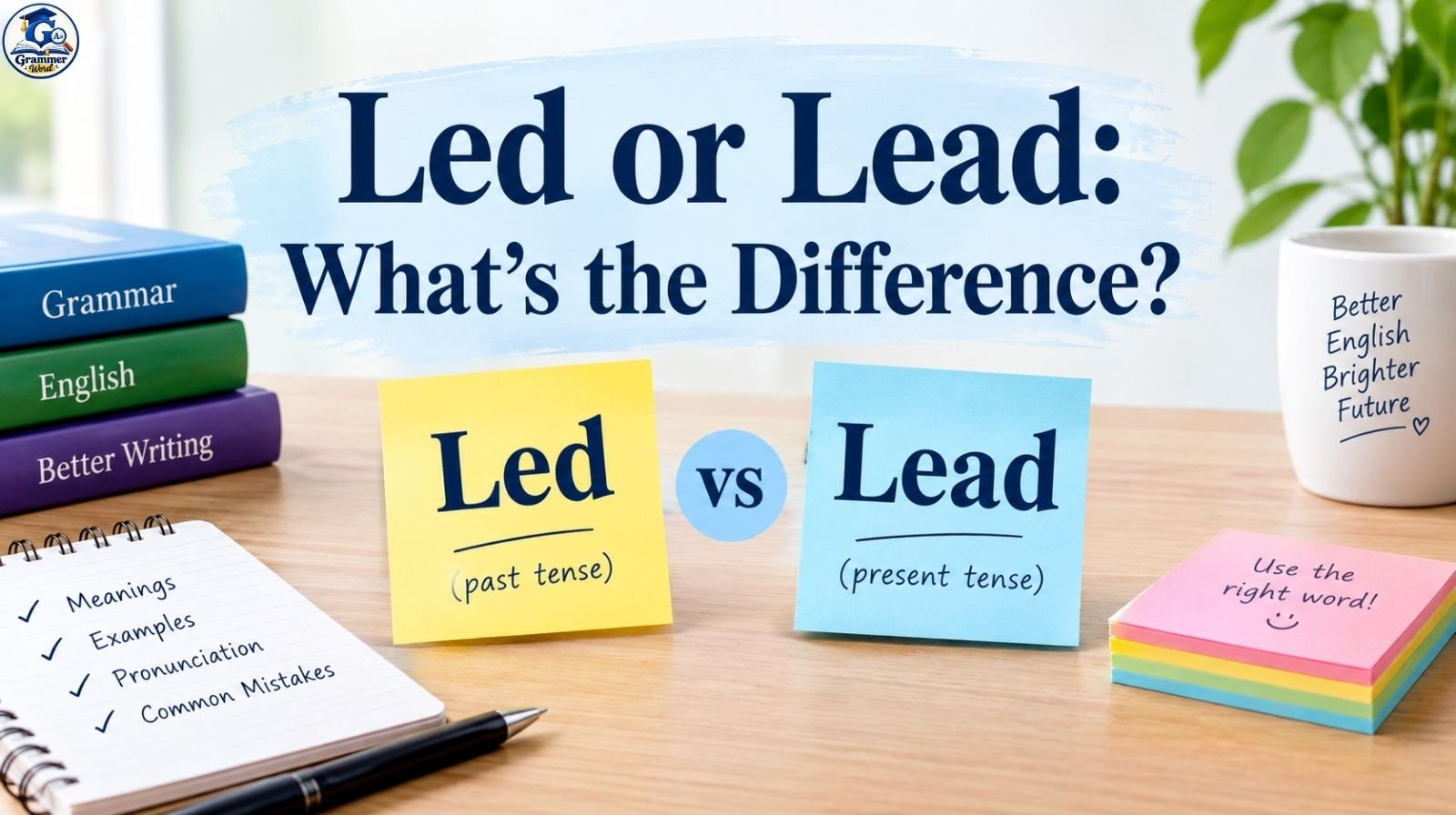
The simplest rule is this: lead is normally the present-tense form of the verb, while led is its past tense and past participle.
For example, “I lead the team” describes something happening now, while “I led the team” describes something that happened in the past. Oxford and Cambridge dictionaries both identify led as the past form of lead.
But there is an additional complication: lead can also be a noun with several meanings, and in some uses its pronunciation changes.
Let’s break down led or lead with simple rules, examples, and an easy way to remember the difference.
Read More: Lay or Lie? The Simple Grammar Rule Most People Get Wrong
What Is the Difference Between Led and Lead?
The main difference between led and lead is grammatical tense when they are used as forms of the same verb.
Lead is the present form:
I lead the team every Monday.
Led is the past form:
I led the team yesterday.
Oxford lists the verb forms as lead → led → led → leading.
Lead Means to Guide or Direct
When lead is used as a verb, it commonly means to guide, direct, or be responsible for someone or something.
Examples:
- She leads the marketing team.
- I lead the discussion.
- They lead the students through the museum.
- He will lead the project next month.
The present-tense verb is pronounced like “leed” /liːd/.
Read More: Quite or Quiet? Simple Guide To The Common English Confusion
Led Is the Past Tense of Lead
Led describes an action that has already happened.
Examples:
- She led the marketing team last year.
- He led us to the correct room.
- The coach led the players onto the field.
- They led the discussion yesterday.
Cambridge defines led as the past simple and past participle of lead, while Oxford gives the same verb relationship.
Led or Lead: The Basic Rule
| Word | Main grammatical role | Example |
|---|---|---|
| lead | Present-tense verb | I lead the team. |
| leads | Present-tense verb with he/she/it | She leads the team. |
| led | Past tense | She led the team yesterday. |
| led | Past participle | She has led the team before. |
| leading | -ing form | She is leading the team. |
Quick memory trick:
If you can replace the word with “guided”, and the action happened in the past, you probably need led.
When to Use Lead in a Sentence
Understanding lead becomes easier when you look at the different ways the word functions.
Lead as a Present-Tense Verb
Use lead when talking about something happening now, something that regularly happens, or something expected to happen in the future.
Examples:
- I lead a team of five designers.
- We lead the project together.
- She will lead the meeting tomorrow.
- They lead the industry in this area.
Remember that with he, she, or it, the present-tense form becomes leads:
She leads the team.
Not:
She lead the team.
Read More: Further or Farther: Simple Rules And When To Use Each
Lead Can Mean “Cause”
Lead can also mean to cause something to happen, especially when followed by to.
Examples:
- Poor planning can lead to delays.
- Regular practice can lead to better results.
- The mistake may lead to serious problems.
- Hard work often leads to improvement.
Compare the present and past:
Poor planning leads to delays.
Poor planning led to delays.
The second sentence refers to a past situation.
Lead as a Noun
Lead is not always a verb. It can also be a noun.
For example:
- Our team has a two-point lead.
- She took the lead in the race.
- The police discovered a new lead.
- He played the lead in the movie.
Oxford lists several noun meanings, including being ahead in a competition, a clue or piece of information, and the main role in a performance.
Led or Lead: Pronunciation Makes It More Confusing
One reason led or lead causes so much confusion is that lead has more than one pronunciation.
How to Pronounce Lead as a Verb
When lead means “guide” or “direct,” it is pronounced:
lead = /liːd/
It rhymes with words such as:
- need
- feed
- read (present tense)
- seed
Example:
She will lead the meeting.
Cambridge gives the pronunciation /liːd/ for this verb use.
How to Pronounce Led
Led is pronounced:
led = /led/
It rhymes with:
- bed
- red
- said
- head
Example:
She led the meeting yesterday.
Oxford and Cambridge both list led with the /led/ pronunciation.
Lead Can Also Be Pronounced “Led”
Here is where things get especially interesting.
The noun lead, when it means the metal, is pronounced /led/.
For example:
The pipes contained lead.
So these two words can sound exactly the same in speech:
- led = past tense of the verb lead
- lead = the metal
However, they have completely different meanings and spellings.
Cambridge specifically distinguishes the pronunciations of the verb lead and the noun lead meaning the metal.
Common Mistakes With Led and Lead
The easiest way to avoid mistakes is to look at the time of the action and the grammatical role of the word.
Mistake 1: Using Lead for a Past Action
Incorrect:
She lead the team last year.
Correct:
She led the team last year.
Why? The phrase last year clearly places the action in the past.
Read More: Carmel or Caramel: Which One Is Correct?
Mistake 2: Using Led for a Present Habit
Incorrect:
He led the team every Monday.
If you mean that this is his current routine, use:
He leads the team every Monday.
The third-person present form is leads, not lead.
Mistake 3: Confusing Lead With Led Because They Sound Similar
Consider:
The manager led the meeting.
The word is spelled led because it is the past form of lead.
But:
The manager will lead the meeting.
Here, lead is required because the action is future.
A Simple Test for Choosing the Correct Word
Ask yourself:
Is the action happening now or in the future?
→ Use lead or leads.
Did the action already happen?
→ Use led.
For example:
- Today: “I lead the team.”
- Yesterday: “I led the team.”
- Tomorrow: “I will lead the team.”
A Real-Life Example: A Team Leader’s Weekly Report

Imagine that Sarah manages a small marketing team.
On Monday, Sarah writes:
“I lead a team of six employees.”
This is correct because she is describing her current role.
At the end of the week, she writes a report:
“I led the team through our product launch.”
This is also correct because the sentence describes an action that has already happened.
Now imagine Sarah describing the next project:
“I will lead the campaign next month.”
Again, lead is correct because the action is in the future.
The distinction becomes even clearer when Sarah talks about results:
“Our research led to a major change in the campaign.”
Here, led to means that the research caused or resulted in something.
Now imagine Sarah discussing another person:
“James leads the design team.”
Because James currently has that responsibility, the correct present-tense form is leads.
This example demonstrates why choosing between led, lead, and leads is not simply a spelling decision. The surrounding words tell you the tense and meaning.
A time expression such as yesterday, last year, or earlier often points toward led, while today, usually, every week, or a future construction can point toward lead or leads.
The important lesson is to examine the entire sentence rather than relying on how the word sounds. Oxford’s verb entry similarly distinguishes lead as the present form from led as the past and past participle forms.
Read More: Ageing or Aging: Which Spelling Is Correct? A Simple, Clear Guide
2025–2026 Data & Usage Snapshot
There is an important limitation when discussing statistics about led vs lead: major English dictionaries do not publish a yearly statistic showing exactly how many writers confuse these two words.
However, current reference sources continue to document the distinction consistently. As of 2026, Oxford lists lead with present forms such as lead/leads and led as both the past simple and past participle. Cambridge likewise identifies led as the past simple and past participle of lead.
A useful 2025–2026 usage snapshot is therefore:
- 2 primary verb forms to remember: lead and led
- 1 additional present form: leads
- 1 -ing form: leading
- 2 common pronunciations of “lead”: /liːd/ for the guiding verb and /led/ for the metal noun
- 1 key past-tense rule: lead → led
These distinctions remain reflected in current Oxford and Cambridge dictionary entries.
For online writing, accuracy matters more than trying to force an exact keyword into every paragraph. Google’s current Search guidance emphasizes helpful, reliable, people-first content rather than content written primarily to manipulate rankings.
Led vs Lead Comparison Checklist

Use this quick checklist whenever you are unsure which word belongs in your sentence.
Step-by-Step Guide
Step 1: Find the verb.
Ask whether the word means guide, direct, or be in charge.
Step 2: Check the time.
- Present → lead/leads
- Past → led
- Future → will lead
Step 3: Check whether it is a noun.
If lead means an advantage, clue, main role, or another noun meaning, it may be lead, not led.
Step 4: Read the whole sentence aloud.
Do not depend on pronunciation alone. The spelling depends on meaning and grammar.
Quick Comparison
| Situation | Correct word | Example |
|---|---|---|
| Present | lead | I lead the team. |
| Present, he/she/it | leads | She leads the team. |
| Past | led | She led the team yesterday. |
| Future | lead | She will lead the team. |
| Past participle | led | She has led the team before. |
| Advantage | lead | We have a five-point lead. |
| Clue | lead | Police found a new lead. |
| Metal | lead | The pipe contains lead. |
Read More: Ax vs Axe: The Simple Difference Most People Don’t Know
Led or Lead Mini Quiz
1. Which word is correct for a present action?
A) Led
B) Lead
Answer: B) Lead “I lead the team every day.”
2. Which sentence is correct?
A) She lead the meeting yesterday.
B) She led the meeting yesterday.
Answer: B) She led the meeting yesterday.
3. What is the past tense of “lead”?
A) Lead
B) Led
Answer: B) Led
4. Fill in the blank: “He will ___ the project tomorrow.”
A) led
B) lead
Answer: B) lead After “will,” use the base form lead.
5. Which sentence talks about the past?
A) They lead the team.
B) They led the team.
Answer: B) They led the team.
6. What is the present form of “led”?
A) Lead
B) Leading
Answer: A) Lead
7. Choose the correct sentence:
A) Maria leads the department.
B) Maria led the department every day now.
Answer: A) Maria leads the department.
8. “Poor planning ___ to delays last month.” What fits?
A) lead
B) led
Answer: B) led The phrase refers to a past event.
9. Which word means “guided” in a past-tense sentence?
A) Lead
B) Led
Answer: B) Led
10. Choose the correct sentence:
A) I have led the team before.
B) I have lead the team before.
Answer: A) I have led the team before.
11. Which word can also refer to a metal?
A) Lead
B) Led
Answer: A) Lead In this meaning, lead is pronounced like “led.”
12. Complete the sentence: “She ___ the group last year.”
A) lead
B) led
Answer: B) led
13. Which sentence is about the future?
A) We led the project yesterday.
B) We will lead the project tomorrow.
Answer: B) We will lead the project tomorrow.
14. What is the correct verb pattern?
A) Lead → Led → Led
B) Led → Lead → Leading
Answer: A) Lead → Led → Led
15. Quick challenge: Which sentence is correct?
A) The manager lead the team last week.
B) The manager led the team last week.
Answer: B) The manager led the team last week. “Last week” tells us the action happened in the past.
Read More: There or Their: Clear Guide To Correct Usage
FAQs
Q1. Is led the past tense of lead?
Yes. Led is the past tense and past participle of the verb lead.
Present: She leads the group.
Past: She led the group.
Both Cambridge and Oxford identify led as the past form of lead.
Q2. Is it “I lead” or “I led”?
It depends on when the action happened.
Use I lead for the present:
I lead the team.
Use I led for the past:
I led the team yesterday.
Q3. Is “lead” pronounced like “led”?
Sometimes, but not always.
The verb lead, meaning “guide,” is pronounced /liːd/. The past form led is pronounced /led/. However, lead meaning the metal is also pronounced /led/.
Q4. What is the difference between lead and led?
Lead is generally the present form of the verb, while led is its past and past participle form.
They lead the group now.
They led the group yesterday.
Q5. Is “led” a word?
Yes. Led is a standard English word and is the past tense and past participle of lead. It can also appear in compound adjectives such as student-led and consumer-led.
Q6. Which is correct: “lead by” or “led by”?
Both can be correct depending on tense.
Use lead by when describing a present or future action:
The manager will lead by example.
Use led by when describing something that was directed by someone in the past or is being described with a past participle:
The project was led by an experienced manager.
Conclusion:
The difference between led or lead becomes simple once you remember the basic verb pattern:
lead → led → led
Use lead for the present or after helping verbs such as will, and use led for the past and as the past participle.
Present: I lead the team.
Past: I led the team.
Future: I will lead the team.
Perfect: I have led the team.
Also remember that lead has several noun meanings and can have a different pronunciation when it refers to the metal.
Once you focus on tense, meaning, and context, choosing between led and lead becomes much easier.
Discover More Article
- Greatful or Grateful: Which One Is Correct?
- To Much or Too Much: Which One Is Correct?
- Choose or Chose: Everything You Need To Know
- Jist or Gist: Which Spelling Is Correct And How To Use It Properly?
Keep learning with more easy grammar lessons on Grammer Word.com

Hi, I’m Noor Fatima, the person behind this website. I created this site to make English grammar and confusing words easier to understand. I love breaking down tricky words, meanings, spellings, and grammar rules into simple explanations. My goal is to help you learn English naturally, avoid common mistakes, and feel more confident every time you write or speak.