If you have ever wondered whether the correct spelling is “jist” or “gist,” you are not alone. These two spellings can be confusing because gist is pronounced /dʒɪst/, which sounds like it begins with a J.
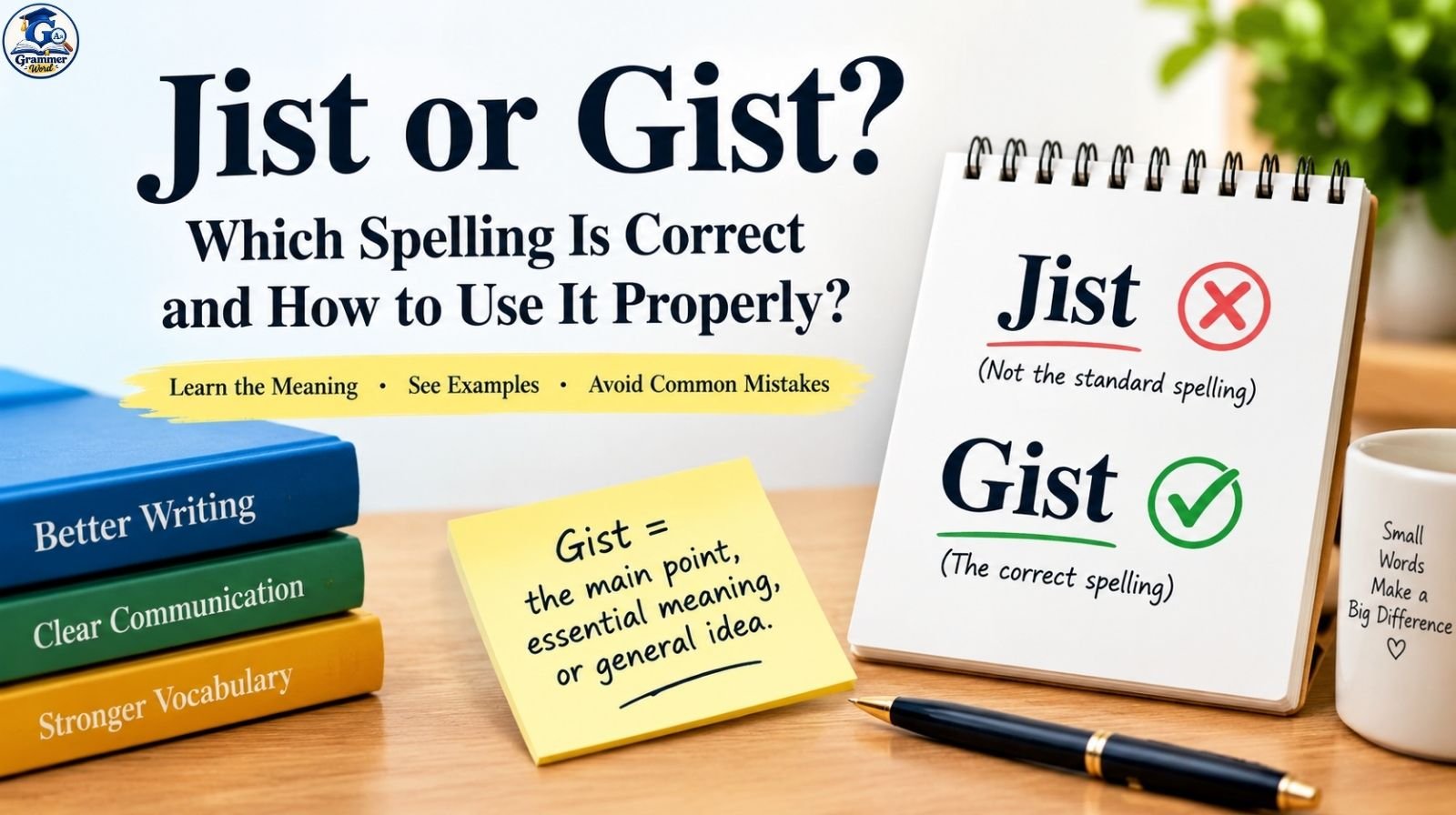
However, when you mean “the main point” or “the essential meaning,” the standard spelling is gist.
Gist is a noun meaning the main point, essential meaning, or general idea of something. Cambridge Dictionary and Oxford Learner’s Dictionaries both list gist with this meaning.
So, if you are writing an email, essay, article, report, or school assignment, use gist, not jist.
In this guide, you will learn the difference between jist and gist, what gist means, how to pronounce it, how to use it naturally, and why the spelling can be confusing.
Read More: Lay or Lie? The Simple Grammar Rule Most People Get Wrong
Jist or Gist: Which Spelling Is Correct?
The correct standard spelling for the word meaning “the main point” is gist.
Gist Is the Standard Spelling
Gist is a noun used when talking about the central idea or most important part of something.
For example:
- I understood the gist of the conversation.
- Can you give me the gist of the article?
- She explained the gist of the proposal.
- I didn’t read the entire report, but I got the gist.
Cambridge defines gist as the most important pieces of information or the general information about something without all the details.
What About “Jist”?
Jist is not the standard spelling you should use in modern formal English when you mean “the main point.”
Some historical and collaborative dictionary sources record jist as a rare alternative spelling of gist, while also recording other dialectal uses of jist.
Therefore, the practical rule is simple:
Use “gist” when you mean the main point or general meaning.
| Spelling | Standard for “main point”? | Recommended? |
|---|---|---|
| gist | Yes | ✅ Yes |
| jist | Rare/nonstandard alternative in some sources | ❌ Avoid in standard writing |
What Does Gist Mean?
The word gist means the main point, essential meaning, or general idea of something.
Gist Meaning in Simple English
If someone tells you a long story and you understand the important part without remembering every detail, you understand the gist.
For example:
“I didn’t understand every part of the presentation, but I got the gist.”
This means the speaker understood the general meaning even though they missed some details.
Oxford defines gist as the main or general meaning of a piece of writing, speech, or conversation.
Gist as a Noun
Gist is primarily used as a noun.
Common patterns include:
- the gist of something
- get the gist
- give someone the gist
- understand the gist
- catch the gist
Examples:
I got the gist of her explanation.
Can you give me the gist of the meeting?
He quickly caught the gist of the discussion.
She understood the gist of the report.
Gist vs. Summary
Gist and summary are related, but they are not always identical.
A summary can contain several important details from a longer piece of information. The gist focuses more strongly on the central meaning or main point.
For example:
Summary: The meeting discussed the new schedule, budget, staffing changes, and upcoming deadlines.
Gist: The company is changing its schedule and responsibilities next month.
The second sentence gives the general idea rather than a detailed summary.
Read More: Quite or Quiet? Simple Guide To The Common English Confusion
How to Use Gist Correctly in a Sentence
Learning a few common sentence patterns makes gist much easier to use naturally.
“The Gist of” Something
One of the most common constructions is:
the gist of + noun
Examples:
- I understood the gist of the story.
- She explained the gist of the argument.
- He missed the beginning but understood the gist of the lecture.
- We discussed the gist of the proposal.
This structure is especially useful in academic and professional writing.
“Get the Gist”
Another extremely common expression is get the gist.
It means to understand the general meaning or most important part of something.
Examples:
- Did you get the gist of the presentation?
- I didn’t understand every word, but I got the gist.
- After reading the introduction, I got the gist of the article.
Cambridge specifically lists get the gist as a collocation meaning to understand the general meaning or most important information.
“Give Me the Gist”
You can also use give me the gist when asking someone for a quick explanation.
Examples:
- Give me the gist of what happened.
- I don’t have time to read the whole report, so give me the gist.
- Can you give me the gist of the meeting?
This expression is natural in everyday English.
Why Do People Spell Gist as Jist?
The confusion mainly comes from pronunciation.
Gist Is Pronounced Like “Jist”
The word gist is pronounced approximately /dʒɪst/.
The initial sound is the same sound heard at the beginning of words such as:
- job
- jump
- giant
- journey
Because the g in gist produces a “j” sound, it is easy to assume that the word should be written jist.
However, English spelling does not always match pronunciation perfectly.
For example:
- giant → the g sounds like J
- gym → the g sounds like J
- general → the g sounds like J
- gist → the g sounds like J
Therefore, hearing the word is not enough to determine its spelling.
A Simple Memory Trick
Remember:
The main point is the GISt of the matter.
Think of G = gist = general idea.
This can help you remember that the standard spelling begins with G, even though the pronunciation begins with a J sound.
Read More: Per Say or Per Se: Which One Is Correct?
Jist vs. Gist: A Quick Comparison
If you regularly confuse these words, use this quick reference.
Side-by-Side Comparison
| Feature | Gist | Jist |
|---|---|---|
| Standard spelling for “main point” | ✅ Yes | ❌ No |
| Meaning “main idea” | Yes | Only as a rare alternative in some sources |
| Pronunciation | /dʒɪst/ | Can appear with similar pronunciation |
| Suitable for formal writing | ✅ Yes | ❌ Avoid |
| Common expression | “get the gist” | Not standard |
| Example | “I got the gist.” | “I got the jist.” ❌ |
Correct and Incorrect Examples
Correct:
I didn’t read the entire report, but I got the gist.
Incorrect for standard English:
I didn’t read the entire report, but I got the jist.
Correct:
Can you tell me the gist of the conversation?
Incorrect for standard English:
Can you tell me the jist of the conversation?
The safest choice in academic, professional, and general standard English is always gist.
Real-World Case Study: “Gist” in Legal and Professional English
The word gist is not limited to casual conversations. It also appears in professional and legal writing, where identifying the central point of an argument can be important.
A useful real-world example comes from a 2025 Maryland appellate court opinion, where the court’s discussion referred to the “gist” of an abuse-of-process claim. In that legal context, gist was used to identify the essential substance or central issue of the claim rather than every fact surrounding the dispute.
This illustrates an important point about the word: gist does not mean that every detail is unimportant. Instead, it identifies the part that best represents the central meaning of a larger body of information.
The same principle applies outside the courtroom. Imagine a manager reading a 20-page business proposal. The manager may not need to repeat every statistic, paragraph, or supporting detail when explaining the proposal to a colleague.
The manager could say, “The gist of the proposal is that we should reduce costs by changing the supplier.” That sentence communicates the central idea while leaving out supporting details.
This is why gist works naturally in reports, meetings, articles, conversations, academic discussions, and legal contexts. It helps speakers and writers identify the essential point without reproducing everything.
2025–2026 Data and Evidence: What Current References Show
When researching spelling questions, it is important not to invent search-volume percentages or claim that one spelling is “used X% more” without a reliable corpus source.
For 2025–2026, the available reference evidence strongly supports gist as the standard spelling for the meaning discussed in this article.
Current Reference Check
| Current reference | What it shows |
|---|---|
| Cambridge Dictionary | Lists gist as the standard noun for the main/general meaning |
| Oxford Learner’s Dictionaries | Lists gist and gives “the main or general meaning” |
| Collins | Lists gist, including its general and legal senses; its page references the 2025 Webster’s New World College Dictionary edition |
| LanguageTool | Its article, revised March 10, 2026, identifies gist as the correct standard spelling |
Cambridge and Oxford both give the same core meaning: the main or general meaning of something. Collins also records gist in both general and legal senses and references the 2025 edition of Webster’s New World College Dictionary.
LanguageTool’s spelling guide, published in 2025 and revised in March 2026, likewise recommends gist rather than jist for standard usage.
Important data note: these are reference-source findings, not a statistical measurement of every English sentence written in 2025–2026.
Major dictionaries do not provide a reliable current percentage comparing gist and jist, so claiming a precise usage percentage would be misleading.
Common Mistakes to Avoid With Gist
Knowing the spelling is only half the job. You also need to use the word naturally.
Mistake 1: Writing “Jist”
❌ I understood the jist of the story.
✅ I understood the gist of the story.
For standard English, use gist.
Mistake 2: Using “Gist” as a Verb
In standard modern English, gist is normally used as a noun, not as a regular verb.
Instead of writing:
❌ I will gist the article.
Use:
✅ I will summarize the article.
Or:
✅ I will give you the gist of the article.
Mistake 3: Confusing Gist With Every Detail
The gist is the main idea, not a complete reproduction of everything someone said.
For example:
The gist of the meeting was that the deadline would be extended.
This does not mean that the meeting contained only one sentence. It means the sentence captures the central point.
Read More: Carmel or Caramel: Which One Is Correct?
A Simple Step-by-Step Guide to Using Gist
Use this quick process whenever you are unsure how to use the word.
Step 1: Ask What You Mean
Do you mean the main point, central idea, or general meaning?
If yes, gist may be the right word.
Step 2: Use the Correct Spelling
Write:
gist
Not:
jist
Step 3: Choose a Natural Pattern
The easiest patterns are:
- the gist of something
- get the gist
- give someone the gist
- understand the gist
- catch the gist
Step 4: Check Your Sentence
For example:
I got the gist of the email.
This is natural and correct.
Step 5: Use “Summary” When You Need Details
If you are giving several important points from a long text, summary may be more appropriate.
If you are giving only the central idea, gist is usually a better fit.
Mini Quiz: Jist or Gist
1. Which spelling is standard for “the main point”?
A) Jist
B) Gist
C) Gyste
D) Jyst
Answer: B) Gist
2. What does “gist” mean?
A) A small detail
B) The main point
C) A difficult word
D) A question
Answer: B) The main point
3. Which sentence is correct?
A) I got the jist.
B) I got the gist.
C) I got the gyst.
D) I got the jyst.
Answer: B) I got the gist.
4. Why do people often misspell “gist” as “jist”?
A) They look identical
B) Gist is pronounced with a J-like sound
C) Gist has two spellings
D) It is always written with J
Answer: B) Gist is pronounced with a J-like sound
5. Fill in the blank: “I understood the ___ of the story.”
A) jist
B) gist
C) jyst
D) gyst
Answer: B) gist
6. Which phrase is commonly used in English?
A) Get the gist
B) Get the jist
C) Get a gyst
D) Get the jyst
Answer: A) Get the gist
Read More: Loosing or Losing: What’s The Correct Spelling And When To Use It?
7. Is “gist” usually used as a noun?
A) Yes
B) No
Answer: A) Yes
8. What does “the gist of the conversation” mean?
A) Every word of the conversation
B) The main idea of the conversation
C) The longest part of the conversation
D) The first sentence
Answer: B) The main idea of the conversation
9. Which sentence uses “gist” correctly?
A) Please gist this article.
B) I got the gist of the article.
C) I gisted the article yesterday.
D) She is gisting the report.
Answer: B) I got the gist of the article.
10. Which word is better for a detailed account of important points?
A) Gist
B) Summary
C) Jist
D) Sound
Answer: B) Summary
11. True or False: “Gist” and “jist” have the same standard spelling.
A) True
B) False
Answer: B) False
12. What is the easiest way to remember the correct spelling?
A) J = main idea
B) G = gist
C) T = gist
D) S = summary
Answer: B) G = gist
13. Choose the correct sentence:
A) Can you give me the gist?
B) Can you give me the jist?
C) Can you give me the gyst?
D) Can you give me the jyst?
Answer: A) Can you give me the gist?
14. If you “get the gist,” what have you understood?
A) The spelling of every word
B) The general meaning
C) Every tiny detail
D) Only the title
Answer: B) The general meaning
15. Quick final one! Which spelling should you use in formal writing?
A) Jist
B) Gist
C) Jyst
D) Gyste
Answer: B) Gist
Read More: Capital or Capitol: Which One Is Correct And When To Use It?
FAQs
Q1. Is “jist” or “gist” correct?
Gist is the standard spelling when you mean the main point, essential meaning, or general idea of something. Jist is recorded in some sources as a rare alternative spelling, but it should generally be avoided in standard formal English.
Q2. Why is gist pronounced like “jist”?
The g in gist has a soft pronunciation, producing the /dʒ/ sound. That is why gist sounds like “jist” even though it is spelled with g.
Q3. What does gist mean?
Gist means the main point, essential part, or general meaning of something. For example, “I got the gist of the conversation” means “I understood the main idea of the conversation.”
Q4. Is “jist” a real word?
Jist does appear in some dictionary resources, but its status varies by source. Wiktionary records it as a rare alternative spelling of gist and also records a separate dialectal/nonstandard use related to just. For ordinary standard English, gist is the spelling to use.
Q5. How do you use gist in a sentence?
A common structure is “the gist of + something.”
Example:
I understood the gist of the article.
You can also say:
I got the gist.
Q6. What is the difference between gist and summary?
A gist is the central meaning or main point, usually without details. A summary can provide a more structured account of the important information in a longer text.
Q7. What is the easiest way to remember gist?
Remember the phrase:
Get the gist = understand the main idea.
Also remember that although gist sounds like it begins with J, its standard spelling begins with G.
Conclusion:
So, jist or gist which spelling is correct?
For standard English, the answer is gist.
Use gist when you mean the main point, essential meaning, central idea, or general meaning of something. Common expressions include “get the gist,” “the gist of,” and “give me the gist.”
Cambridge and Oxford both recognize gist as the standard word for this meaning, while some sources record jist only as a rare or nonstandard alternative.
The pronunciation is what makes the spelling confusing: gist sounds like “jist.” However, when you are writing an essay, email, report, article, or professional document, remember the simple rule:
Gist = the main point.
Next time you are unsure whether to write jist or gist, choose gist.
Discover More Article
- Gases or Gasses – Which Spelling Is Correct?
- Here Here or Hear Hear? The Correct Phrase Explained Simply
- Busses vs Buses: The Correct Spelling You Need To Know In 2026
- Flyer or Flier: Which One Is Correct? A Clear Guide For Writers
Keep learning with more easy grammar lessons on Grammer Word.com

Hi, I’m Noor Fatima, the person behind this website. I created this site to make English grammar and confusing words easier to understand. I love breaking down tricky words, meanings, spellings, and grammar rules into simple explanations. My goal is to help you learn English naturally, avoid common mistakes, and feel more confident every time you write or speak.