If you have ever wondered whether toward or towards is the correct spelling, you are not alone. Both forms are widely used, and the good news is that both are grammatically correct.
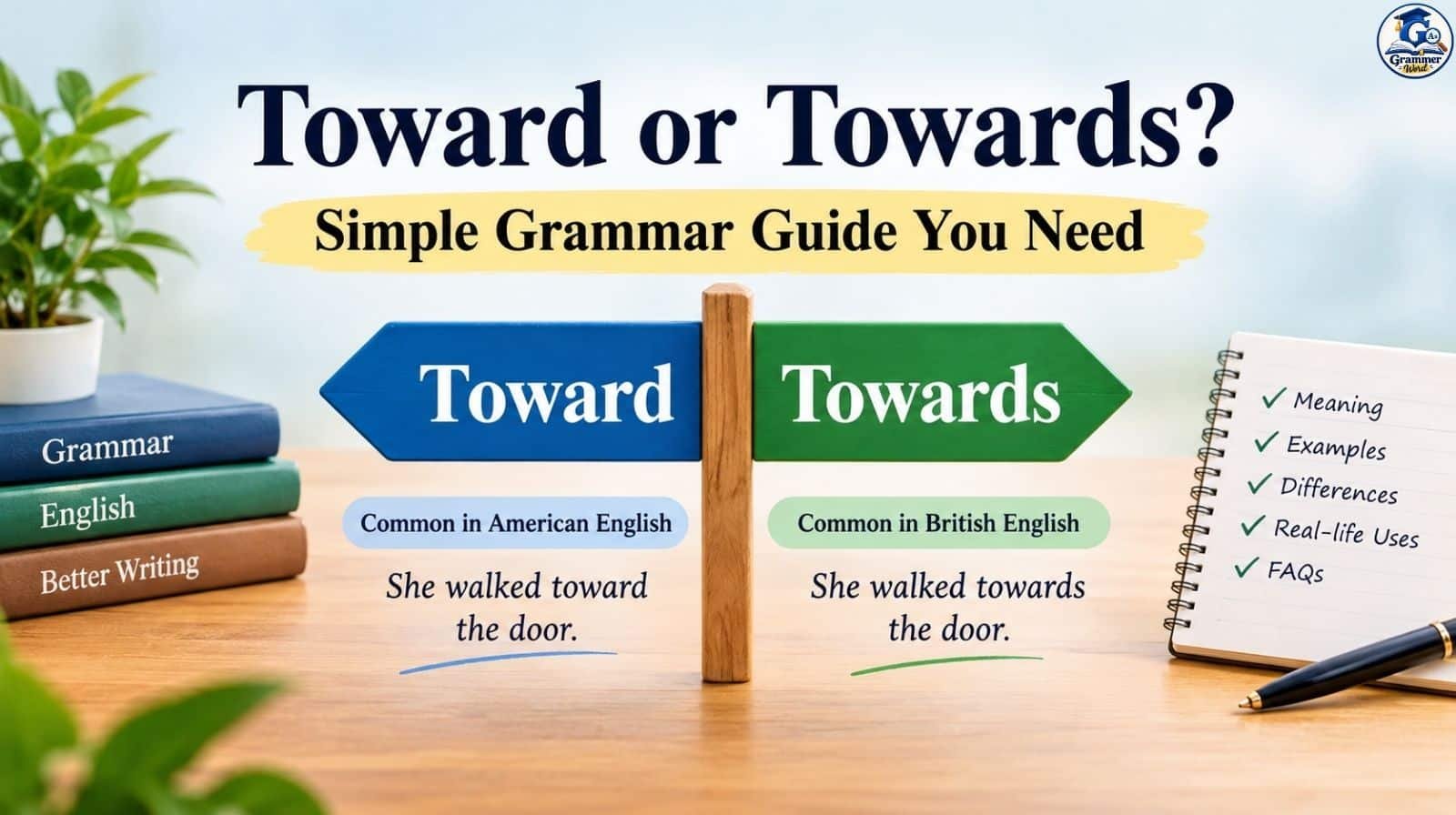
The main difference is regional preference: toward is more common in American English, while towards is more common in British English.
So, should you write “She walked toward the door” or “She walked towards the door”?
Both are correct.
In this guide, you will learn exactly when to use toward and towards, what they mean, how American and British English differ, and which form is best for your writing.
Read More: To Much or Too Much: Which One Is Correct?
What Is the Difference Between Toward and Towards?
The simplest answer is this:
Toward and towards have essentially the same meaning. The main difference is regional preference.
Toward is generally preferred in American English, while towards is generally preferred in British English. Cambridge identifies toward as mainly US and towards as mainly UK.
Toward in American English
American English commonly uses toward without the final -s.
Examples:
- She walked toward the station.
- We are working toward our goal.
- He turned toward the window.
- The company is moving toward a greener future.
- I looked toward the mountains.
Towards in British English
British English commonly uses towards with the final -s.
Examples:
- She walked towards the station.
- We are working towards our goal.
- He turned towards the window.
- The company is moving towards a greener future.
- I looked towards the mountains.
Notice something important: the meaning has not changed.
The choice is mainly about the variety of English you are using.
Read More: Gases or Gasses – Which Spelling Is Correct?
Is Toward or Towards More Correct?
Neither is universally “more correct.”
If you are writing in American English, toward will usually sound more natural.
If you are writing in British English, towards will usually sound more natural.
Cambridge’s grammar guidance explicitly states that both forms can be used.
How to Use Toward or Towards in a Sentence
Both forms work in several common situations. Understanding these uses makes the toward vs towards question much easier.
1. Showing Direction or Movement
The most common use is to show movement in the direction of someone or something.
American English:
The child ran toward his mother.
British English:
The child ran towards his mother.
More examples:
- The dog ran toward the gate.
- The dog ran towards the gate.
- We drove toward the city.
- We drove towards the city.
- She moved toward the exit.
- She moved towards the exit.
Both versions are grammatically acceptable.
2. Showing Attitude or Feelings
Toward and towards can also describe someone’s attitude or feelings in relation to another person or thing.
Examples:
- He has a positive attitude toward his coworkers.
- He has a positive attitude towards his coworkers.
- She showed kindness toward the children.
- She showed kindness towards the children.
- His feelings toward his family are strong.
- His feelings towards his family are strong.
Cambridge lists this as one of the established uses of the word.
Read More: Loosing or Losing: What’s The Correct Spelling And When To Use It?
3. Showing a Point in Time or Position
The words can also mean “near” or “close to” a particular time or place.
For example:
- We arrived toward the end of the afternoon.
- We arrived towards the end of the afternoon.
- The weather became colder toward winter.
- The weather became colder towards winter.
- Our seats were toward the back.
- Our seats were towards the back.
This use is especially common in phrases such as toward the end, towards the end, toward morning, and towards lunchtime.
4. Showing Progress Toward a Goal
Both forms can also describe progress toward achieving something.
Examples:
- We are working toward a solution.
- We are working towards a solution.
- She is working toward her degree.
- She is working towards her degree.
- The team is moving toward success.
- The team is moving towards success.
They can also be used when talking about contributions:
- I put $20 toward the cost.
- I put £20 towards the cost.
Cambridge includes this “purpose or contribution” meaning in its definitions of both forms.
Toward vs Towards: American English vs British English
The easiest way to remember the difference is to think about regional consistency.
| English variety | Preferred form | Example |
|---|---|---|
| American English | toward | She walked toward the door. |
| British English | towards | She walked towards the door. |
| Both varieties | Either can occur | Both forms are grammatical. |
Which One Should American Writers Use?
If your audience expects American English, toward is generally the better default.
For example:
The company is moving toward a new business model.
She looked toward the horizon.
We are working toward a solution.
Cambridge labels toward as mainly US.
Read More: Apart or A Part: Understanding The Difference
Which One Should British Writers Use?
If you are writing primarily in British English, towards is generally the natural choice.
For example:
The company is moving towards a new business model.
She looked towards the horizon.
We are working towards a solution.
Cambridge similarly labels towards as mainly UK.
What About Canadian, Australian, and Other English Varieties?
English outside the United States and United Kingdom does not always follow a perfectly simple rule.
That is why the safest approach for professional writing is to identify your intended variety of English and follow its normal conventions.
More importantly, do not switch randomly between the two forms within the same document unless there is a specific reason.
A Simple Rule for Choosing Toward or Towards
If you want an easy rule, use this:
American English → toward
British English → towards
That’s enough for most everyday writing.
A Quick Editing Trick
Before publishing an article, essay, or business document, ask:
“Which variety of English am I using?”
If the answer is American English, choose toward consistently.
If the answer is British English, choose towards consistently.
For example, if your article uses American spellings such as color, organize, center, and traveled, using toward will generally create a more consistent style.
Likewise, if your article uses British spellings such as colour, organise, centre, and travelled, towards may fit better.
Don’t Treat the Other Form as a Spelling Error
This is an important point for English learners.
Seeing towards in an American text does not automatically mean it is misspelled. Likewise, seeing toward in British English does not automatically make it incorrect.
The two forms are legitimate variants.
LanguageTool’s article on the pair, published in 2025 and revised in February 2026, likewise describes them as two spellings of the same preposition and recommends choosing consistently according to the variety of English being used.
Read More: Here Here or Hear Hear? The Correct Phrase Explained Simply
Toward or Towards: What Current Usage Data Shows
Usage data supports the idea that the difference is largely regional rather than grammatical.
A current 2026 English frequency index from PlainSpell, using a corpus vintage dated September 3, 2026, ranks towards at #936 and toward at #1,970 in its English word-frequency index.
These rankings are specific to that index and should not be treated as a universal measure of English usage, but they demonstrate that both forms remain common words in contemporary English.
More importantly, established corpus research has consistently found a strong regional split. Earlier corpus comparisons show toward strongly favored in American English and towards strongly favored in British English.
For example, one LOB/BROWN comparison recorded 318 instances of toward versus 14 of towards in the British sample, while the American sample recorded 64 toward versus 386 towards showing that corpus results can vary depending on the dataset and period, while still demonstrating the underlying regional contrast.
What This Data Means for Writers
The practical lesson is more useful than any single frequency number:
- Both forms are established English words.
- Neither is inherently grammatically wrong.
- Toward is strongly associated with American English.
- Towards is strongly associated with British English.
- Consistency matters more than trying to find one “universally correct” form.
Real-Life Example: Choosing the Right Form for Your Audience
Imagine that Maya is writing a website for an American technology company. Her article contains sentences such as:
“Our team is working toward a more sustainable future.”
“The industry is moving toward renewable energy.”
“We are taking steps toward improving customer service.”
All three sentences sound natural in American English.
Now imagine that Maya’s colleague, James, is preparing a similar article for a British audience. He might write:
“Our team is working towards a more sustainable future.”
“The industry is moving towards renewable energy.”
“We are taking steps towards improving customer service.”
James has not changed the meaning. He has simply chosen the form that better matches British English conventions.
Read More: Busses vs Buses: The Correct Spelling You Need To Know In 2026
Now suppose Maya mixes the styles:
“Our team is working toward a more sustainable future. The industry is moving towards renewable energy. We are taking steps toward improving customer service.”
There is no serious grammatical error here. A reader will understand every sentence. However, if the entire article is intended to follow American English, consistently using toward would produce a cleaner editorial style.
This is why the toward vs towards question is not really about finding a “correct” and “incorrect” word. It is about understanding English varieties and making deliberate choices.
For students, writers, bloggers, and businesses, that distinction is useful because consistent language makes writing look more polished and intentional.
Common Mistakes With Toward and Towards
Although choosing between the two forms is simple, writers sometimes make other mistakes around them.
Mistake 1: Thinking Towards Is Always Wrong
Some learners are taught that toward is the only correct spelling.
That is not true.
Towards is a standard English form, particularly common in British English. Cambridge explicitly recognizes both forms.
Mistake 2: Thinking Toward Is Only American and Therefore Wrong in British English
This is also too strict.
British English commonly prefers towards, but toward is not an impossible or meaningless form in British usage.
The difference is one of preference and frequency, not a simple grammatical ban.
Mistake 3: Switching Forms Without a Reason
Try to maintain consistency.
Instead of:
We are moving toward success and working towards a better future.
Choose one style when both sentences belong to the same piece of writing:
We are moving toward success and working toward a better future.
Or:
We are moving towards success and working towards a better future.
Read More: Choose or Chose: Everything You Need To Know
Mistake 4: Assuming the S Changes the Meaning
It does not.
In ordinary modern usage:
- toward = towards
- towards = toward
The difference is primarily regional preference.
Toward or Towards? Quick Reference Checklist
Use this checklist before submitting your writing:
- Writing for a US audience? → Prefer toward.
- Writing for a UK audience? → Prefer towards.
- Showing direction? → Either can work.
- Showing an attitude? → Either can work.
- Talking about time or position? → Either can work.
- Talking about progress toward a goal? → Either can work.
- Unsure whether one is grammatically correct? → Both are correct.
- Writing a long article? → Pick one regional style and use it consistently.
Mini Quiz: Toward or Towards
1. Quick Pick: Which One Is Correct?
Which sentence is correct?
A) She walked toward the door.
B) She walked towrd the door.
Answer: A) She walked toward the door.
2. Toward or Towards?
Which form is generally preferred in American English?
A) Toward
B) Towards
Answer: A) Toward
3. British English Check
Which form is generally preferred in British English?
A) Toward
B) Towards
Answer: B) Towards
4. True or False?
Both toward and towards are grammatically correct.
Answer: True
Read More: Lets or Let’s: Which One Is Correct And When To Use It?
5. Fill the Gap
“We are working ___ a solution.”
A) toward
B) towords
Answer: A) toward
6. Meaning Match
What does toward usually express in “He walked toward the park”?
A) Direction
B) Time
C) Ownership
Answer: A) Direction
7. Spot the Better US Style
Which sentence fits American English better?
A) We are moving toward success.
B) We are moving success.
Answer: A) We are moving toward success.
8. Can You Catch It?
Which sentence is correct?
A) She looked towards the mountains.
B) She looked towardss the mountains.
Answer: A) She looked towards the mountains.
9. Same Meaning?
Do toward and towards generally have the same meaning?
A) Yes
B) No
Answer: A) Yes
10. Choose the British Style
Which sounds more natural in British English?
A) They walked toward the station.
B) They walked towards the station.
Answer: B) They walked towards the station.
11. Grammar Speed Round
Which sentence is correct?
A) He turned toward me.
B) He turned toword me.
Answer: A) He turned toward me.
12. What About Goals?
“We are working ___ a better future.”
Which word fits?
A) toward
B) though
Answer: A) toward
13. Don’t Fall for the Trap!
Is towards automatically wrong in American English?
A) Yes
B) No
Answer: B) No it can still be used, although “toward” is generally preferred in American English.
Read More: Per Say or Per Se: Which One Is Correct?
14. Pick the Correct Pair
Which pair contains two correct forms?
A) Toward / Towards
B) Towrd / Towardz
Answer: A) Toward / Towards
15. Final Challenge!
What is the easiest rule to remember?
A) Toward = generally US; Towards = generally UK
B) Toward is always wrong in British English
C) Towards is always wrong in American English
Answer: A) Toward = generally US; Towards = generally UK
FAQs
Q1. Is “toward” or “towards” correct?
Both are correct. Toward is generally preferred in American English, while towards is generally preferred in British English.
Q2. Is “towards” British or American?
Towards is mainly associated with British English, although it can also appear in American English. Cambridge lists towards as mainly UK and toward as mainly US.
Q3. Is “toward” American English?
Yes. Toward is the usual preferred form in American English, although towards is also understood and used.
Q4. Does toward mean the same as towards?
Yes. In normal modern usage, toward and towards have the same basic meanings. Both can express direction, relation, position in time or space, and movement toward a goal.
Q5. Should I use toward or towards in academic writing?
Use the form that matches your chosen variety of English. For American academic writing, toward is generally the better choice. For British academic writing, towards is generally preferred.
Q6. Is “working toward” correct?
Yes. Working toward is completely correct, especially in American English.
For example:
We are working toward a better solution.
British English may use:
We are working towards a better solution.
Conclusion:
So, toward or towards which one should you use?
The answer is simple: both are correct.
The main difference is regional usage. Toward is generally preferred in American English, while towards is generally preferred in British English. Both can describe direction, attitude, position, time, contribution, or progress toward a goal.
The best approach is to choose the form that matches your audience and then use it consistently.
Writing for American readers? Choose “toward.” Writing for British readers? Choose “towards.”
Once you remember that simple rule, the toward or towards question becomes much easier.
Discover More Article
- Too or To: Complete Guide To Correct Usage
- Cancelation or Cancellation: Which Spelling Is Correct?
- Who’s or Whose? Simple Guide To The Difference (With Examples)
- Whether or Wether – Which One Is Correct?
Keep learning with more easy grammar lessons on Grammer Word.com

Hi, I’m Noor Fatima, the person behind this website. I created this site to make English grammar and confusing words easier to understand. I love breaking down tricky words, meanings, spellings, and grammar rules into simple explanations. My goal is to help you learn English naturally, avoid common mistakes, and feel more confident every time you write or speak.