If you are wondering whether to write “master’s degree” or “masters degree,” you are not alone. The missing apostrophe may look like a tiny punctuation issue, but it changes the grammatical form of the phrase.
The correct form in standard English is “master’s degree” with an apostrophe before the s. Major university style guides, including those from the University of Cambridge and several U.S. universities, recommend this form when referring generally to an academic degree.
In this guide, you will learn why “master’s degree” is correct, when to capitalize it, when “Master of Science” is different, and how to use the phrase correctly in sentences, resumes, applications, and academic writing.
Read More: Freshman or Freshmen: Which One Is Correct?
Master’s Degree or Masters Degree: Which Is Correct?

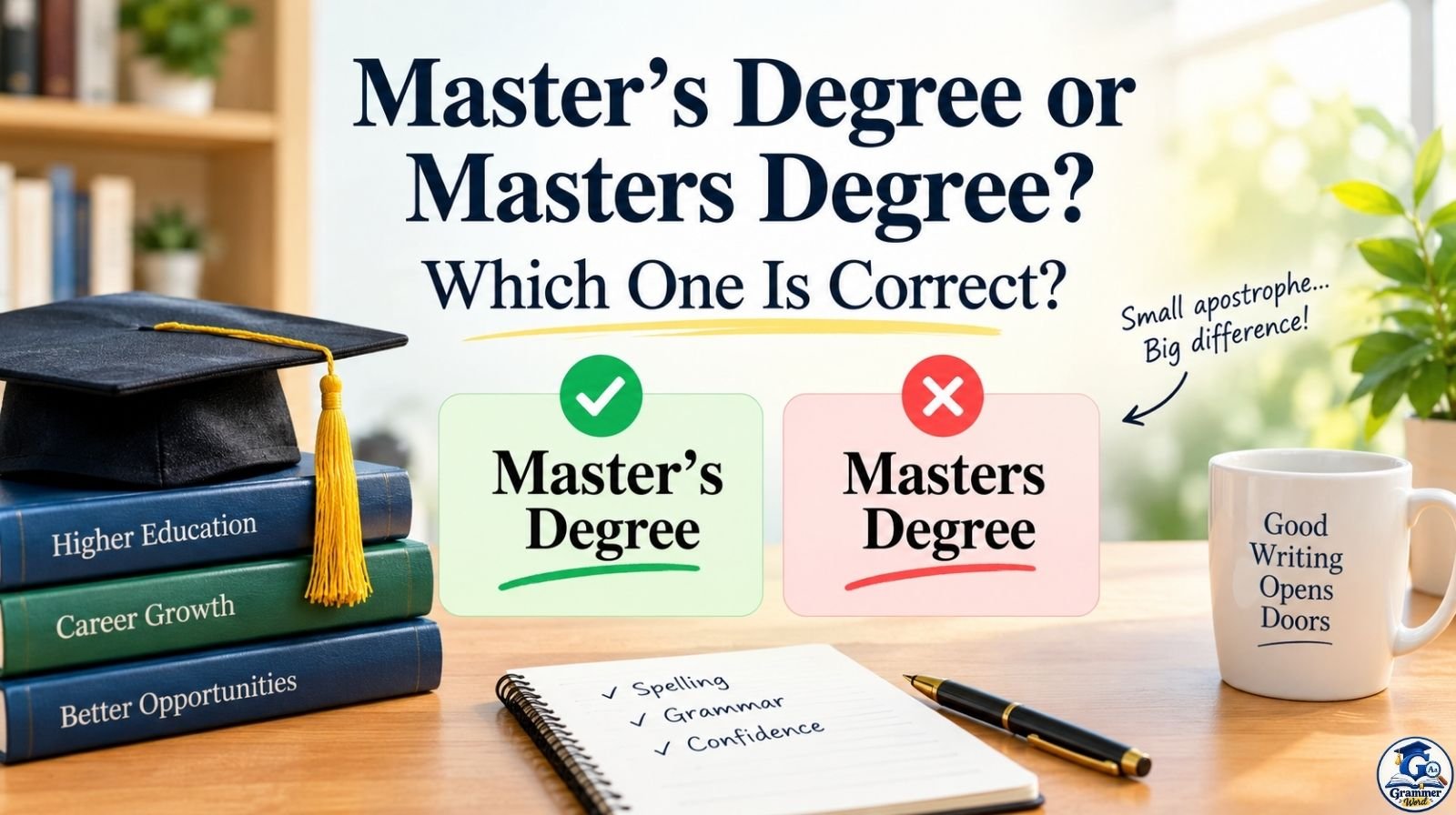
The correct form is master’s degree. The apostrophe belongs before the s:
- ✅ master’s degree
- ❌ masters degree
The reason is grammatical. Master’s is a possessive form of the singular noun master. In the phrase master’s degree, the word master’s modifies degree.
For example:
She earned a master’s degree in psychology.
The plural form masters means more than one master, so masters degree does not follow the standard possessive construction used for a general academic degree.
University style guides consistently support the apostrophe form. Cambridge, for example, specifically gives “a master’s degree” as its preferred singular form.
Why Is “Master’s Degree” Correct?
Understanding the apostrophe makes this spelling much easier to remember.
The Apostrophe Shows the Possessive Form
In English, an apostrophe followed by s is commonly used to create the possessive form of a singular noun.
Compare:
- student → student’s book
- teacher → teacher’s desk
- master → master’s degree
The phrase master’s degree can be understood historically as referring to a degree associated with or belonging to a master.
The same pattern appears in:
- bachelor’s degree
- master’s degree
However, there is an important distinction with formal degree names.
Read More: Fiancé or Fiancée: Understanding The Difference And Correct Usage
“Master’s Degree” vs. “Master of Science”
A general reference normally uses lowercase master’s degree:
Maria earned a master’s degree in biology.
But a formal degree title does not use the possessive construction:
Maria earned a Master of Science in biology.
So these forms serve different purposes:
| General reference | Formal degree name |
|---|---|
| master’s degree | Master of Science |
| master’s degree in history | Master of Arts in History |
| bachelor’s degree | Bachelor of Science |
| bachelor’s degree in English | Bachelor of Arts in English |
University style guides make the same distinction between general degree references and formal degree names.
Should “Master’s Degree” Be Capitalized?

Usually, no.
When you are talking about a master’s degree in general, use lowercase:
She is pursuing a master’s degree.
He already has a master’s degree in engineering.
A master’s degree can take several years to complete.
However, formal degree names are capitalized:
She earned a Master of Science in Chemistry.
He received a Master of Arts in English.
Read More: Your vs You’re: Simple Guide To The Most Confusing English Pair
When “Master’s Degree” Appears in a Title
In headlines and titles, capitalization may depend on the publication’s headline style.
For example:
Master’s Degree or Masters Degree: Which One Is Correct?
Here, Master’s is capitalized because it appears in the title, not because the general term requires capitalization.
The University of Bath similarly recommends lowercase master’s degree for a general reference and capitalization for a specific qualification.
A Simple Rule to Remember
Think of it this way:
General degree → lowercase + apostrophe
a master’s degree
Formal degree name → capitalize + no apostrophe
Master of Science
That simple distinction will prevent most mistakes.
Common Examples of “Master’s Degree”
Knowing the rule is useful, but seeing the phrase in context makes it easier to remember.
Correct Sentences
Here are several natural examples:
- She earned a master’s degree in business administration.
- I am considering pursuing a master’s degree next year.
- He completed his master’s degree while working full-time.
- A master’s degree may qualify you for more specialized positions.
- She has a master’s degree in computer science.
- They offer several master’s degree programs.
- He plans to apply for a master’s degree in education.
Incorrect Form
Avoid writing:
❌ She earned a masters degree in English.
Instead, write:
✅ She earned a master’s degree in English.
The same rule applies whether the phrase appears in an ordinary sentence, a resume, an article, or an academic document.
Read More: Awhile or A While: What’s The Difference?
Master’s Degree or Masters Degree on a Resume?

A resume is one of the places where this question matters most because educational qualifications are presented formally.
Use “Master’s Degree” in General Descriptions
For example:
Master’s Degree in Marketing
or:
Earned a master’s degree in marketing from XYZ University.
If you are listing the official name of the qualification, use the institution’s official wording:
Master of Business Administration (MBA)
Master of Science in Computer Science
The important distinction is between a general description and the official name of the degree.
What About “Master’s” Without “Degree”?
You can also use master’s alone when the context is clear:
She earned her master’s in economics.
The apostrophe remains because master’s is still the possessive form.
A Real-Life Example: Choosing the Correct Form in Academic Writing
Imagine a university student named Daniel who is preparing a graduate-school application. In his personal statement, he writes:
“I plan to pursue a masters degree in environmental science because I want to develop advanced research skills.”
The meaning is completely understandable, but the spelling is not the standard form for a general reference. Daniel should change the phrase to:
“I plan to pursue a master’s degree in environmental science because I want to develop advanced research skills.”
Later in the same application, suppose the university asks him to state the exact qualification he hopes to earn. If the program’s official title is Master of Science in Environmental Science, Daniel should use that formal name instead:
Read More: Labelled or Labeled: Which Spelling Is Correct?
“I am applying to the Master of Science in Environmental Science program.”
This illustrates an important point: master’s degree and Master of Science are not competing spellings of exactly the same grammatical construction. The first is a general description of an academic degree; the second is a formal degree title.
This distinction is especially useful for students writing resumes, personal statements, scholarship applications, university webpages, and professional biographies. Using the correct form makes the writing look polished without making the sentence unnecessarily complicated.
Master’s Degree Usage in 2025–2026

The term master’s degree remains highly relevant in modern education and employment discussions.
According to the U.S. Bureau of Labor Statistics’ 2025 Education Pays data, workers with a master’s degree had median usual weekly earnings of $1,876 and an unemployment rate of 2.6% among people age 25 and over.
The figures are descriptive statistics for U.S. workers and do not mean that earning a master’s degree guarantees a particular salary or employment outcome.
The U.S. Census Bureau, summarizing National Center for Education Statistics projections, reported that approximately 982,000 master’s degrees were projected to be awarded during the 2025–26 school year.
These figures help explain why terms such as master’s degree, graduate degree, and postgraduate degree continue to appear frequently in education and career content.
What the Data Tells Us
The data shows that master’s-level education represents a substantial part of the U.S. higher-education landscape.
However, statistics about earnings or unemployment should be interpreted carefully. Outcomes vary by occupation, industry, field of study, experience, location, and other factors.
Therefore, the statistics provide context for the popularity and relevance of master’s-level education, but they should not be treated as a promise of individual career results.
Master’s Degree vs. Masters Degree: Quick Comparison
| Form | Correct? | Explanation | Example |
|---|---|---|---|
| master’s degree | ✅ Yes | Standard general form | She earned a master’s degree. |
| masters degree | ❌ No | Missing the possessive apostrophe | Avoid this form. |
| master’s degree | ✅ Yes | Same correct form using a straight apostrophe | He has a master’s degree. |
| Master of Science | ✅ Yes | Formal degree name | She earned a Master of Science. |
| Master’s | ✅ Yes | Possessive form used by itself | He completed his master’s. |
| Masters | ⚠️ Context-dependent | Can refer to a plural or proper name in other contexts | The Masters tournament |
The table highlights why masters degree should not be used when you mean the general academic qualification.
Read More: Blond or Blonde: What’s The Difference And Which One Is Correct?
Easy Ways to Remember the Apostrophe

Think “Bachelor’s” and “Master’s”
One of the easiest memory tricks is to pair these two common academic terms:
- bachelor’s degree
- master’s degree
Both use an apostrophe before the s.
For example:
She earned a bachelor’s degree before pursuing a master’s degree.
University writing guides commonly recommend this construction for general references to both degrees.
Don’t Confuse “Masters” With “Master’s”
Masters without an apostrophe can be a legitimate word in other contexts.
For example:
The masters of several artistic traditions were discussed.
Here, masters is simply the plural of master.
Likewise, The Masters is the proper name of a major golf tournament.
But when you are talking about the academic qualification, write:
master’s degree
not:
masters degree
Read More: Onto or On To: What’s The Difference And Which One Is Correct?
Mini Quiz: Masters Degree or Master’s Degree

1. Quick Check: Which Is Correct?
A) Masters degree
B) Master’s degree
C) Masters’ degree
Answer: B) Master’s degree
2. Apostrophe Time!
Where does the apostrophe go in master’s?
A) Before the M
B) After the s
C) Before the s
D) No apostrophe
Answer: C) Before the s
3. Fill the Gap
She earned a ______ degree in psychology.
A) masters
B) master’s
C) masters’
Answer: B) master’s
4. Capital or Lowercase?
Which is normally correct in a regular sentence?
A) Master’s Degree
B) master’s degree
C) MASTER’S DEGREE
Answer: B) master’s degree
5. Formal Degree Name
Which one is a formal degree title?
A) master’s degree
B) Master of Science
C) masters degree
Answer: B) Master of Science
6. Spot the Mistake!
Which sentence is written correctly?
A) He has a masters degree.
B) He has a master’s degree.
C) He has a masters’ degree.
Answer: B) He has a master’s degree.
7. Resume Ready?
Which phrase is best for a general resume description?
A) Masters Degree in Marketing
B) Master’s Degree in Marketing
C) Master’s degree in marketing
Answer: C) Master’s degree in marketing
8. Master’s or Masters?
Which word can mean more than one master?
A) Master’s
B) Masters
C) Master
Answer: B) Masters
9. Complete the Sentence
She is working toward her ______.
A) master’s
B) masters
C) master
Answer: A) master’s
10. Which One Looks Right?
A) a master’s degree
B) a masters degree
C) a masters’ degree
Answer: A) a master’s degree
11. Degree Detective
Which sentence uses a formal degree name correctly?
A) She earned a master’s of science.
B) She earned a Master of Science.
C) She earned a Masters of Science.
Answer: B) She earned a Master of Science.
12. True or False?
“Master’s degree” is the standard form for a general reference to the academic degree.
Answer: True
13. True or False?
“Masters degree” is the standard spelling in formal English.
Answer: False
14. Bachelor’s Partner
Which term follows the same apostrophe pattern as master’s degree?
A) bachelor’s degree
B) bachelors degree
C) bachelor degree
Answer: A) bachelor’s degree
15. The Final Challenge!
Choose the correctly written sentence:
A) I want to pursue a masters degree.
B) I want to pursue a Master’s degree.
C) I want to pursue a master’s degree.
D) I want to pursue a masters’ degree.
Answer: C) I want to pursue a master’s degree.
Read More: ECT or ETC? What’s The Correct Abbreviation?
FAQs
Q1. Is “masters degree” grammatically correct?
No. When referring to the academic qualification in general English, the standard form is master’s degree, with an apostrophe before the s.
Q2. Is it “a master’s degree” or “a masters degree”?
The correct form is a master’s degree.
Example:
She has a master’s degree in education.
Q3. Does “master’s degree” need an apostrophe?
Yes. The standard general form is master’s degree, with an apostrophe before the s. University style guides such as Cambridge explicitly recommend this form.
Q4. Should master’s degree be capitalized?
Usually, no. Write master’s degree when referring to the qualification generally.
Capitalize a formal degree name such as Master of Arts or Master of Science.
Q5. Is “Master of Science” the same as “master’s degree”?
Master of Science (MS or MSc) is a specific type of master’s degree. Therefore, you can say:
She earned a master’s degree.
Or, more specifically:
She earned a Master of Science in Biology.
Q6. Can I write “master’s” without “degree”?
Yes. When the context is clear, master’s can stand alone:
He is working toward his master’s.
The apostrophe remains because the word is still possessive.
Final Answer:
The correct form is master’s degree with an apostrophe before the s.
Use:
- ✅ master’s degree
- ✅ a master’s degree
- ✅ master’s degree in English
- ✅ Master of Science for a formal degree title
Avoid:
- ❌ masters degree
The easiest rule is simple: when you mean the academic qualification generally, write “master’s degree.” Use capitalization without the apostrophe when writing a formal degree name such as Master of Arts or Master of Science.
If you are writing a resume, university application, academic article, or professional profile, getting this small detail right can make your writing clearer and more polished.
Remember: master’s degree = apostrophe + s.
Discover More Article
- Jist or Gist: Which Spelling Is Correct And How To Use It Properly?
- Led or Lead: What’s The Difference?
- Every Time or Everytime: Which One Is Correct?
- Each Other or Eachother? The Correct Spelling Explained Simply
Keep learning with more easy grammar lessons on Grammer Word.com

Hi, I’m Noor Fatima, the person behind this website. I created this site to make English grammar and confusing words easier to understand. I love breaking down tricky words, meanings, spellings, and grammar rules into simple explanations. My goal is to help you learn English naturally, avoid common mistakes, and feel more confident every time you write or speak.