Have you ever typed “loose or lose” and suddenly wondered which word belongs in your sentence? You are not alone. These two words look and sound similar, but they have completely different meanings and grammatical uses.
The simplest answer is this: lose is usually a verb meaning to misplace something, fail to keep something, or not win. Loose is usually an adjective meaning not tight, not firmly attached, or free from restraint. It can also function as a verb meaning to release or untie something.
Once you understand what each word means, the difference becomes much easier to remember.
This guide explains loose vs. lose, shows common examples, examines why people confuse them, and gives you a simple memory trick you can use whenever you’re unsure.
Loose or Lose: What Is the Difference?
The main difference between loose and lose is their meaning.
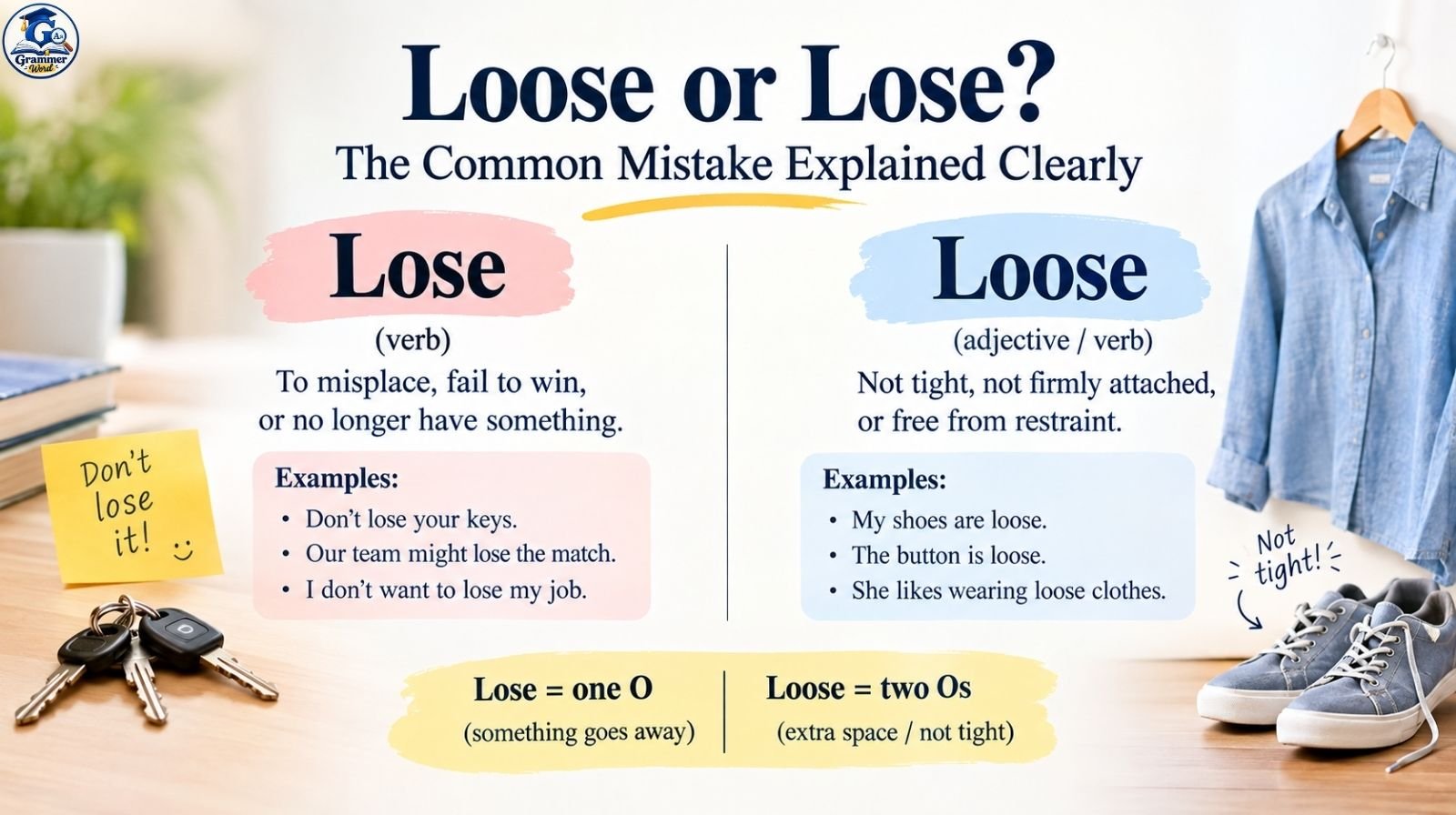
- Lose means to misplace, no longer have, fail to win, or be deprived of something.
- Loose generally means not tight, not firmly attached, or free.
What Does “Lose” Mean?
Lose is primarily a verb.
It can describe several situations:
- You cannot find something.
- You fail to win.
- You no longer have something.
- You fail to maintain something.
- You experience a reduction or deprivation.
For example:
I don’t want to lose my keys.
Here, lose means that you might no longer know where your keys are.
Other examples include:
- Don’t lose your phone.
- Our team might lose the match.
- She doesn’t want to lose her job.
- Try not to lose focus.
- He could lose his wallet.
What Does “Loose” Mean?
Loose is most commonly an adjective.
It describes something that is not tight, fixed, or securely attached.
For example:
My shoes are loose.
The shoes are not fitting tightly.
Other examples include:
- This shirt is too loose.
- The door handle is loose.
- The dog got loose from the yard.
- I prefer loose clothing.
- There is a loose screw on the chair.
Merriam-Webster defines loose in several related ways, including not being securely fastened, not being tight-fitting, and being free from restraint.
Loose vs. Lose: A Simple Comparison
The fastest way to understand these commonly confused words is to compare them directly.
| Word | Main function | Basic meaning | Example |
|---|---|---|---|
| Lose | Verb | Misplace, fail, or no longer have | Don’t lose your keys. |
| Loose | Adjective | Not tight or firmly attached | My shoes are loose. |
| Loose | Verb | Release or untie | Loose the rope. |
Remember: Lose = Something Goes Away
Think about lose as something disappearing, being taken away, or not being won.
- Lose your keys → You cannot find them.
- Lose the game → You did not win.
- Lose your job → You no longer have it.
- Lose weight → Your weight decreases.
Read More: Blond or Blonde: What’s The Difference And Which One Is Correct?
Remember: Loose = Not Tight
Think of loose whenever something is the opposite of tight.
- Loose shirt
- Loose belt
- Loose tooth
- Loose screw
- Loose rope
This distinction covers most everyday situations.
How to Remember Loose or Lose
If you frequently make this spelling mistake, use a simple memory trick.
Lose Has One “O”
Lose = one O
The word lose has only one o:
L-O-S-E
Associate the single o with something you lose and no longer have.
For example:
I don’t want to lose my money.
Loose Has Two “O”s
Loose = two Os
The two o letters in loose can remind you of something that has extra room.
The shirt is loose.
The shirt has extra space rather than fitting tightly.
A simple visual reminder is:
LOSE → one O → something goes away
LOOSE → two Os → extra space → not tight
It is not a grammatical rule, but it is an effective spelling memory aid.
Common Examples of Lose and Loose
Seeing the words in context makes the difference much clearer.
Examples With “Lose”
Here are natural examples of lose:
- Don’t lose your passport.
- I don’t want to lose this opportunity.
- Our team may lose the final.
- She doesn’t want to lose her confidence.
- Be careful not to lose your keys.
- He hopes to lose some weight.
- You could lose valuable time.
- They might lose the competition.
In each case, lose describes something that is no longer possessed, maintained, achieved, or won.
Examples With “Loose”
Now compare them with loose:
- My trousers are too loose.
- The button is loose.
- There is a loose wire behind the computer.
- She likes wearing loose clothes.
- The dog broke free and ran loose.
- The tooth feels loose.
- Check the loose screw before using the chair.
- The rope became loose.
Here, loose generally describes something that is not tight, secure, or restrained.
Read More: Onto or On To: What’s The Difference And Which One Is Correct?
Why Do People Confuse Loose and Lose?
The confusion is understandable because the two words are visually similar and are pronounced similarly.
They Look Almost Identical
Compare:
LOSE
LOOSE
The only major spelling difference is the additional O in loose.
That small difference can easily cause a typing or spelling mistake.
Their Pronunciations Are Different
Although they may sound similar to some learners, standard pronunciation distinguishes them:
- lose → /luːz/
- loose → /luːs/
The final sound is different:
lose ends with a z sound.
loose ends with an s sound.
This pronunciation difference can help English learners distinguish them when speaking.
“Loosing” Is Not the Same as “Losing”
Another common mistake is confusing:
losing
with
loosing
The normal present participle of lose is:
losing
For example:
I am losing my patience.
Loosing does exist, but it comes from the verb loose, meaning to release or let something go. It is much less common in everyday English. Merriam-Webster lists loosing as the present participle of loose.
Therefore:
❌ I am loosing my keys.
✅ I am losing my keys.
A Real-Life Example: The Email That Changed the Meaning
Imagine a manager sending an important email to an employee:
“We don’t want to loose this customer.”
At first glance, the intended meaning is understandable. The manager probably means:
“We don’t want to lose this customer.”
But the spelling error changes the professionalism of the message.
Now imagine a different sentence:
“The customer complained that the chair was lose.”
That should be:
“The customer complained that the chair was loose.”
In this situation, the chair is not securely or tightly assembled.
These mistakes may seem small, but they can affect how polished your writing appears. A job application, business email, website, school assignment, or professional report can lose credibility when basic word-choice errors appear repeatedly.
Read More: ECT or ETC? What’s The Correct Abbreviation?
The good news is that you do not need to memorize complicated grammar rules to avoid the mistake. Instead, stop for one second and ask what you mean.
If you mean misplace, fail, or no longer have, choose lose.
If you mean not tight, not secure, or free, choose loose.
For example, before sending an email saying, “Don’t loose your chance,” ask yourself: Am I describing something that is not tight? No. I mean that someone should not let an opportunity slip away. Therefore, the correct word is lose:
Don’t lose your chance.
That quick meaning check can prevent the mistake.
Loose or Lose in Everyday English
The words appear in many common expressions.
Common Expressions With Lose
You may frequently see:
- lose weight
- lose interest
- lose hope
- lose control
- lose money
- lose time
- lose patience
- lose confidence
- lose a game
- lose your way
Examples:
Don’t lose hope.
She doesn’t want to lose interest in the project.
We cannot afford to lose time.
Common Expressions With Loose
Common combinations include:
- loose clothing
- loose change
- loose connection
- loose screw
- loose tooth
- loose hair
- loose grip
- loose knot
- loose fitting
Examples:
He prefers loose clothing during summer.
The technician found a loose connection.
I have a loose tooth.
2025–2026 Perspective: Why Correct Word Choice Still Matters
There is no reliable universal statistic showing that a particular percentage of English writers confuse loose and lose, so it would be misleading to invent one.
However, current Google guidance continues to emphasize content that is useful, reliable, well-written, easy to read, and free from spelling and grammatical mistakes. Google’s Search Essentials similarly recommends using words that people actually use when searching and creating helpful, people-first content.
That matters for both readers and publishers.
A page explaining loose or lose should therefore do more than repeat dictionary definitions. It should answer the practical questions readers actually have:
- Which word is correct?
- Why are they different?
- How do I use each one?
- What mistakes should I avoid?
- How can I remember the difference?
The lesson is simple: accuracy and usefulness matter more than artificially repeating a keyword.
Google’s current guidance also explicitly says there is no preferred word count that automatically improves rankings. The goal should be satisfying the reader’s need rather than writing to an arbitrary length.
A Quick Step-by-Step Guide to Choosing the Right Word
When you are unsure about loose or lose, follow these three steps.
Step 1: Ask What You Mean
Are you talking about something disappearing, failing, or no longer being possessed?
Use lose.
I might lose my phone.
Step 2: Check Whether Something Is Not Tight
Are you describing something that is not tight, firmly attached, or restrained?
Use loose.
This belt is loose.
Step 3: Use the One-O/Two-O Trick
Still unsure?
LOSE = one O
LOOSE = two Os
Then test the sentence.
Don’t ___ your wallet.
“Not tight” does not make sense, so the answer is lose.
My shoes are too ___.
“Misplace” does not make sense, so the answer is loose.
This quick test works for most everyday examples.
Read More: Timeframe or Time Frame: Simple Grammar Explanation
Loose or Lose: Quick Reference Checklist
Before using either word, check this:
- Misplace something? → Lose
- Fail to win? → Lose
- No longer have something? → Lose
- Something isn’t tight? → Loose
- Something isn’t securely attached? → Loose
- Something is free or unrestrained? → Loose
- Talking about the act of releasing something? → Loose as a verb
One-Line Rule
Lose means you no longer have or win something; loose means something is not tight or securely attached.
Mini Quiz: Loose or Lose?
1. Quick Start: Which One Is Correct?
Don’t ______ your keys.
Answer: Lose You can lose something when you cannot find it.
2. Fit Check
This shirt is too ______ for me.
Answer: Loose Loose means not tight or fitting closely.
3. Game Time
Our team might ______ the match.
Answer: Lose You lose a match when you do not win.
4. Spot the Spelling
Which sentence is correct?
A. I don’t want to loose my phone.
B. I don’t want to lose my phone.
Answer: B. I don’t want to lose my phone.
5. Not Tight!
The screw is ______.
Answer: Loose A screw that is not firmly attached is loose.
6. One O or Two?
Which spelling means “misplace”?
A. Loose
B. Lose
Answer: B. Lose Lose means to misplace or no longer have something.
7. Don’t Let It Slip!
Never ______ hope.
Answer: Lose We say lose hope, not “loose hope.”
8. Clothing Clue
She prefers wearing ______ clothes.
Answer: Loose Loose clothes are not tight-fitting.
9. The Common Trap
Which sentence is correct?
A. He is losing his patience.
B. He is loosing his patience.
Answer: A. He is losing his patience. The correct form of lose is losing.
Read More: Freshman or Freshmen: Which One Is Correct?
10. Tooth Trouble
My tooth feels ______.
Answer: Loose A tooth that moves or is not firmly attached is loose.
11. Memory Trick
Which word has two O’s?
A. Lose
B. Loose
Answer: B. Loose Loose has two O’s; lose has one.
12. Wallet Check
Answer: Lose A wallet can be lost when you misplace it.
Be careful you might ______ your wallet.
13. Belt Problem
My belt is too ______.
Answer: Loose If a belt isn’t tight enough, it is loose.
14. Final Challenge
Which sentence uses the words correctly?
A. Don’t loose your chance.
B. My shoes are lose.
C. Don’t lose your chance.
D. I might loose the game.
Answer: C. Don’t lose your chance. Lose is correct because the sentence means you should not miss or fail to keep the opportunity.
15. Can You Nail the Difference?
Complete both sentences:
“My team could ______ the game, but my shoelace is ______.”
Answer: Lose, loose You can lose a game, while a shoelace can be loose when it isn’t tied tightly.
FAQs
Q1. Is it “loose” or “lose”?
A: Both words are correct, but they have different meanings. Lose is generally a verb meaning to misplace, fail, or no longer have something. Loose usually means not tight or not securely attached.
Q2. What is the difference between loose and lose?
A: Lose describes losing possession, failing to win, or no longer having something. Loose describes something that is not tight, fixed, or restrained.
I don’t want to lose my phone.
My phone case is loose.
Q3. Is “loose” a verb?
A: Yes. Although loose is commonly used as an adjective, it can also be a verb meaning to release, untie, or make something less tight.
Q4. Is “loosing” a correct word?
A: Yes, loosing is a real word, but it comes from the verb loose and is relatively uncommon. If you mean the present participle of lose, the correct spelling is losing.
She is losing her keys.
Not:
She is loosing her keys.
Q5. How can I remember lose vs. loose?
A: Use the simple memory trick:
Lose = one O
Loose = two Os
You can associate the extra O in loose with extra space or something that isn’t tight.
Q6. Which is correct: “I don’t want to loose you” or “I don’t want to lose you”?
A: The correct sentence is:
I don’t want to lose you.
Here, lose means to no longer have someone or to be separated from them. Loose would not fit the meaning.
Final Thoughts:
The difference between loose or lose is much simpler once you focus on meaning rather than spelling.
Use lose when something is misplaced, no longer possessed, or not won:
Don’t lose your keys.
Use loose when something is not tight, secure, or restrained:
This shirt is loose.
When you’re stuck, remember:
LOSE = one O → something goes away
LOOSE = two Os → extra room / not tight
This tiny memory trick can help you avoid one of the most common English spelling mistakes in emails, assignments, social posts, and everyday writing.
For more practical explanations of confusing English words, keep learning one pair at a time and always check the meaning before choosing the spelling.
Discover More Article
- Awhile or A While: What’s The Difference?
- Your vs You’re: Simple Guide To The Most Confusing English Pair
- Any Time or Anytime: Which One Is Correct?
Keep learning with more easy grammar lessons on Grammer Word.com

Hi, I’m Noor Fatima, the person behind this website. I created this site to make English grammar and confusing words easier to understand. I love breaking down tricky words, meanings, spellings, and grammar rules into simple explanations. My goal is to help you learn English naturally, avoid common mistakes, and feel more confident every time you write or speak.