Have you ever typed a sentence and suddenly wondered whether you should use too or to? You are not alone. These two words sound alike in everyday English, but they do completely different jobs in a sentence.
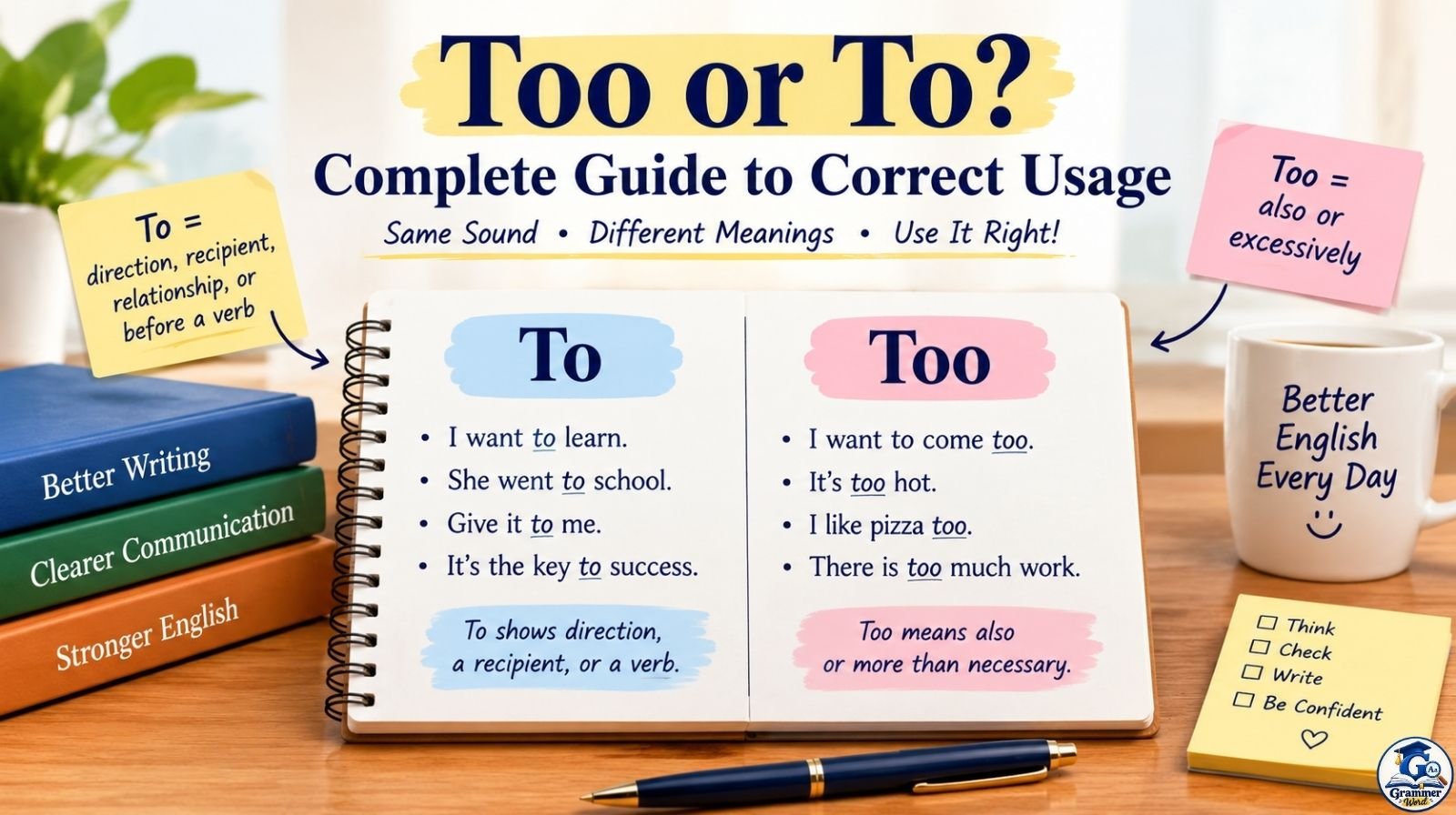
The good news is that the difference between too and to is much easier to understand once you focus on meaning instead of pronunciation. To is commonly used for direction, relationships, and before a verb. Too usually means “also” or “more than necessary.”
For example:
- I want to learn English.
- She is coming too.
- We walked to the store.
- This coffee is too hot.
This guide explains too or to in simple English, with clear rules, examples, common mistakes, memory tricks, and practical usage tips.
By the end, you should be able to choose the right word without second-guessing yourself.
Read More: Sponser vs Sponsor: Difference And Correct Usage
Too or To: What Is the Difference?
The simplest way to understand too or to is to look at what each word means.
To is generally used as a preposition or as part of an infinitive verb. It can show direction, destination, a recipient, or a connection between words.
Too is an adverb. It commonly means “also” or “more than is wanted, needed, or acceptable.” Cambridge Dictionary explains that too can express an excessive degree and can also mean also.
Quick Difference Between Too and To
| Word | Main function | Meaning | Example |
|---|---|---|---|
| to | Preposition | Direction, destination, recipient, relationship | Give it to Sarah. |
| to | Infinitive marker | Used before a base verb | I want to sleep. |
| too | Adverb | Also / as well | I want to come too. |
| too | Adverb | Excessively / more than necessary | It is too cold. |
There is also a third word worth remembering: two.
- To = direction or infinitive
- Too = also or excessive
- Two = the number 2
These words are homophones, meaning they can sound alike even though they have different spellings and meanings. The Language Portal of Canada also identifies two, too, and to as homophones with different meanings and grammatical functions.
Read More: Midday vs Mid Day: Which Spelling Is Correct In Modern English?
When to Use “To”
The word to has several important uses. It is one of the most common words in English, so learning its basic patterns is extremely useful.
To Shows Direction or Destination
Use to when someone or something moves toward a place.
Examples:
- We are going to school.
- She drove to the airport.
- They traveled to London.
- He walked to the kitchen.
- I went to the library after class.
Here, to connects the action with the destination.
A simple test is to ask:
“Where is someone or something going?”
If the answer involves a destination, to is often the correct choice.
For example:
Omar went to the market.
The market is the destination, so to is correct.
To Identifies a Recipient
To can also show who receives something.
Examples:
- Give the book to me.
- Send the email to your teacher.
- She gave the keys to her brother.
- I explained the problem to my friend.
- Please hand this letter to Maria.
In each sentence, to introduces the person receiving something or receiving an action.
Compare:
I gave the gift to Ali.
Here, Ali is the recipient.
To Comes Before a Verb
Another extremely common use of to is as an infinitive marker.
The basic pattern is:
to + base form of verb
Examples:
- to eat
- to sleep
- to study
- to read
- to write
- to learn
- to travel
- to improve
You can see this pattern in complete sentences:
- I want to learn English.
- She needs to study tonight.
- They decided to leave early.
- We hope to see you soon.
- He plans to start tomorrow.
This is one of the easiest ways to identify to.
If a base-form verb comes immediately after the word, there is a good chance you need to, not too.
To Can Express a Relationship or Connection
To also appears in expressions where it connects one thing with another.
Examples:
- The answer to the question
- The key to success
- The solution to the problem
- The introduction to the book
- The road to the village
For example:
What is the answer to this question?
You would not write “answer too this question.”
The meaning here is not “also” or “excessively,” so to is correct.
Read More: Girlie or Girly: Which Word Is Correct? Meaning, Usage, Differences, And Examples For 2026
When to Use “Too”
Now we come to too, the word with the extra o.
The easiest way to remember its main meanings is:
Too = also OR more than necessary
Cambridge Dictionary describes too as an adverb and gives both of these major uses.
Too Means “Also”
When too means also, it adds another person, thing, or idea.
Examples:
- I like pizza too.
- She wants to come too.
- He speaks Spanish too.
- We watched the movie too.
- I was surprised too.
In everyday English, too often appears at the end of a sentence.
For example:
“I love this song.”
“I love it too.”
The second speaker means:
“I also love this song.”
You can usually replace too with also to test this meaning.
I like coffee too.
becomes:
I also like coffee.
Because the meaning remains similar, too is correct.
Too Means “More Than Necessary”
The second major meaning of too is excessively or more than wanted, needed, or acceptable.
Examples:
- The tea is too hot.
- The bag is too heavy.
- The room is too small.
- He is driving too fast.
- The price is too high.
Consider:
The soup is too hot to eat.
This does not simply mean that the soup is very hot. It suggests that the temperature is higher than is suitable for eating.
That distinction matters.
Compare:
The soup is very hot.
This simply emphasizes the temperature.
The soup is too hot.
This suggests that the temperature is excessive for the situation.
Cambridge specifically distinguishes very from too because very increases emphasis while too can indicate that something has gone beyond the desired or necessary level.
Too Before Adjectives and Adverbs
When too means excessively, it commonly appears before an adjective or adverb.
Examples:
- too expensive
- too difficult
- too cold
- too loud
- too quickly
- too slowly
- too late
Sentence examples:
This exercise is too difficult.
The music is too loud.
You are walking too slowly.
We arrived too late.
A useful test is to see whether “excessively” or “more than necessary” makes sense.
The box is too heavy.
The box is heavier than is suitable for the task.
Therefore, too is correct.
Read More: Masonary vs Masonry: Which Spelling Is Correct And Why It Matters
Too or To: A Simple Comparison
Once you know the basic meanings, choosing between the two becomes much easier.
Compare the Meaning
| Sentence | Correct word | Why? |
|---|---|---|
| I want to go home. | to | It comes before a verb. |
| I want to go home too. | too | It means “also.” |
| She went to school. | to | It shows destination. |
| She was too tired. | too | It means excessively tired. |
| Give it to him. | to | It identifies the recipient. |
| Give me one too. | too | It means “also.” |
| It is too cold. | too | It means excessively cold. |
| I need to study. | to | It comes before the base verb. |
Notice something important: both words can appear in the same sentence.
For example:
It is too late to call him.
The first word means excessively or beyond the suitable time.
The second word introduces the verb call.
Another example:
I want to go too.
Here:
- to go = infinitive
- too = also
This is why understanding meaning and sentence structure is more useful than relying only on pronunciation.
The “Too or To” Memory Trick
A simple memory trick can help you remember the difference.
Think of the Extra O as “Extra”
The word too has an extra o.
Think:
Too = something extra
It can mean:
also → something extra is being added.
I want ice cream too.
Or:
excessively → there is more than necessary.
This ice cream is too cold.
By contrast, to has only one o and is commonly used for direction, relationships, or before a verb.
This is not a grammatical rule, but it is a practical memory device.
Try the “Also” Test
If you think the word means also, try replacing it with also.
I want to come too.
→ I also want to come.
The sentence works, so too is correct.
But:
I want to come.
→ I want also come.
That does not work.
Therefore, to is correct.
Read More: This Is She or This Is Her? The Correct Way To Answer The Phone
Try the “Excessively” Test
If the word means more than necessary, try replacing too with excessively.
The water is too cold.
→ The water is excessively cold.
The meaning works, so too is correct.
But:
I went to the store.
→ I went excessively the store.
That clearly does not work.
Therefore, to is correct.
Common “Too or To” Mistakes
Even though the rules are straightforward, several mistakes appear again and again in everyday writing.
“I Want Too Go” vs. “I Want to Go”
Correct:
I want to go.
Incorrect:
I want too go.
Why?
Because to is introducing the base verb go.
The sentence follows this pattern:
want + to + verb
Examples:
- want to eat
- want to sleep
- want to learn
- want to travel
“Too Much” vs. “To Much”
Correct:
There is too much sugar in this tea.
Incorrect:
There is to much sugar in this tea.
Here, too means more than necessary.
The same rule applies to:
- too much
- too many
- too little
- too few
Examples:
There are too many people here.
I have too much work today.
There is too little time.
Read More: Possum or Opossum: What’s The Correct Spelling And Usage?
“Me Too” vs. “Me To”
When you are agreeing with someone, the correct expression is usually “me too.”
Example:
“I love chocolate.”
“Me too!”
Here, too means also.
You would not normally write:
“Me to!”
Cambridge notes that me too is the normal informal short response.
“You Too” vs. “You To”
If someone says:
“Have a great day!”
A natural response is:
“You too!”
It means:
“I hope you have a great day also.”
So:
You too = correct when returning a wish or saying “also.”
Example:
“Good luck!”
“You too!”
However, to can still correctly appear before you when it serves another grammatical function.
For example:
I gave the book to you.
Here, to identifies the recipient.
Too + Adjective + To: A Common Grammar Pattern
One of the most useful structures involving both words is:
too + adjective + to + verb
Examples:
The coffee is too hot to drink.
The box is too heavy to lift.
The child is too young to drive.
The room is too dark to read.
This pattern can be confusing because too and to appear close together, but they perform completely different jobs.
Take this sentence:
The bag is too heavy to carry.
Too heavy means the bag has excessive weight.
To carry introduces the verb.
English grammar references describe this as the too + adjective/adverb + to-infinitive structure.
More Examples
It is too late to call.
She was too tired to study.
The water is too cold to swim in.
The movie was too long to finish.
This structure is especially useful in formal and academic writing because it communicates a relationship between degree and possibility.
Read More: Discrete vs Discreet: Which One Should You Use?
A Real-Life Example: Editing a Professional Email
Imagine that someone is writing an email to a teacher, manager, or colleague.
Their original sentence says:
“I am to tired to attend the meeting, but I want too join the next one.”
There are two mistakes.
The corrected version is:
“I am too tired to attend the meeting, but I want to join the next one.”
Why?
The first too means more than is manageable. The writer is saying that they are excessively tired.
The second to comes before the base verb join, so it forms the infinitive to join.
Now imagine a slightly different sentence:
“I want to attend the meeting too.”
This time, to is connected to the verb attend, while too means also.
This example shows why simply memorizing that “one has one O and one has two O’s” is not enough. You need to understand what the word is doing in the sentence.
What This Example Teaches
When proofreading your own writing, ask three questions:
- Does the word mean “also”?
Use too. - Does it mean “more than necessary”?
Use too. - Is it showing direction, a recipient, or introducing a verb?
Use to.
This quick process can catch most common mistakes.
2025–2026 Usage and Evidence Snapshot
Current English-learning and reference material published or updated during 2025–2026 continues to treat to, too, and two as a common source of confusion for learners.
For example, Collins published a dedicated guide on the distinction in May 2025, describing the three words as homophones that are often confused by both learners and native speakers.
Babbel likewise published a To vs. Too guide in May 2025 and emphasizes that the words sound the same but have different grammatical functions.
A current 2026 grammar reference similarly summarizes the distinction around two core meanings of too “also” and “excessively” and the main functions of to, including direction and the infinitive.
There is an important limitation here: authoritative language references do not publish a standardized annual 2025–2026 error-rate statistic specifically measuring how often writers confuse too and to. Therefore, it would be misleading to invent a percentage.
Read More: Laid Off or Layed Off: Which One Is Correct?
The available recent evidence instead comes from updated grammar resources, dictionaries, and learner-focused guides that continue to address the distinction directly.
From a practical standpoint, the current rule remains simple:
- To = direction, recipient, relationship, or infinitive
- Too = also or excessive
- Two = the number 2
A Step-by-Step Guide to Choosing Too or To
If you are unsure which word belongs in a sentence, use this checklist.
Step 1: Ask What the Word Means
Does it mean also?
Use too.
I want to come too.
Does it mean more than necessary?
Use too.
This bag is too heavy.
Step 2: Check Whether a Verb Follows
If the word comes before a base-form verb, to is often the correct choice.
I need to study.
She wants to leave.
They decided to wait.
Step 3: Look for Direction or a Recipient
If the word introduces a destination or recipient, use to.
We went to school.
Send it to me.
Give the letter to Sarah.
Step 4: Try “Also”
If also fits naturally, use too.
I like it too.
→ I also like it.
Step 5: Try “Excessively”
If excessively or more than necessary fits, use too.
The room is too cold.
→ The room is excessively cold.
If none of these meanings fits, to is often the word you need, but always consider the complete sentence.
Read More: Theater or Theatre: Which Spelling Is Correct?
Too vs. To vs. Two
Because two sounds like the other two words, it is worth including it in your proofreading check.
To
Used for direction, recipients, relationships, and infinitives.
I went to the store.
I need to study.
Too
Means also or excessively.
I want to go too.
It is too expensive.
Two
Refers to the number 2.
I have two brothers.
She bought two books.
A simple visual reminder is:
One O → to
Two Os → too
W → two
The spelling alone does not explain every grammatical use, but these visual associations can make proofreading easier.
Why “To” and “Too” Sound the Same
The confusion is largely caused by pronunciation.
In many varieties of English, to and too can sound identical or extremely similar, especially when spoken quickly.
That means you cannot always rely on your ears when deciding which spelling to use.
For example, if someone says:
“I want to go too.”
The two words may sound almost indistinguishable in normal conversation.
Writing is different. The spelling must communicate the intended meaning.
This is why context is more important than sound when choosing between too and to.
Final Too or To Checklist
Before publishing an email, essay, article, assignment, or social media post, quickly check every use of too and to.
- Does too mean also? Correct.
- Does too mean excessively? Correct.
- Does to show direction? Correct.
- Does to identify a recipient? Correct.
- Does to come before a base-form verb? Correct.
- Does two refer to the number 2? Use two.
The key is not to memorize dozens of isolated e
Read More: Gases or Gasses – Which Spelling Is Correct?
Quick & Catchy “Too or To” Mini Quiz
1. Pick the Right Word
I want ___ learn English.
A) Too
B) To
Answer: To “To” comes before the verb “learn.”
2. Spot the Meaning
“I want to come ___.”
A) To
B) Too
Answer: Too Here, “too” means “also.”
3. Which One Fits?
The coffee is ___ hot to drink.
A) To
B) Too
Answer: Too “Too” means more than necessary.
4. Destination Check
She went ___ school early.
A) Too
B) To
Answer: To “To” shows the destination.
5. Quick Grammar Test
Which sentence is correct?
A) I need too study.
B) I need to study.
Answer: B “To” is used before the base verb “study.”
6. “Also” Test
Which word can mean “also”?
A) To
B) Too
Answer: Too “Too” can mean “also” or “as well.”
7. Find the Correct Phrase
Which one is correct?
A) Too much
B) To much
Answer: A “Too much” means more than necessary.
8. Friendly Reply
Someone says, “Have a great day!”
What should you reply?
A) You to!
B) You too!
Answer: B “You too” means “you also.”
9. Number Alert
Which word means the number 2?
A) To
B) Too
C) Two
Answer: C Two is the number 2.
10. Complete the Sentence
It is ___ late to call her.
A) To
B) Too
Answer: Too “Too late” means later than is suitable.
11. Two Words, One Sentence
Choose the correct pair:
“It is ___ cold ___ swim.”
A) too, to
B) to, too
Answer: A too, to. “Too cold” shows excess, while “to swim” introduces the verb.
12. Give It a Try
Please give the book ___ me.
A) Too
B) To
Answer: To “To” identifies the person receiving the book.
13. Can You Catch the Mistake?
Which sentence is correct?
A) She wants too leave.
B) She wants to leave.
Answer: B “To” comes before the verb “leave.”
14. Meaning Match
“This bag is too heavy.”
What does “too” mean here?
A) Also
B) More than necessary
C) A destination
Answer: B More than necessary.
15. Final Challenge
Which sentence uses both words correctly?
A) I want too go to the party.
B) I want to go too the party.
C) I want to go to the party too.
D) I want two go to the party.
Answer: C “To go” is the infinitive, “to the party” shows destination, and “too” means “also.”
FAQs
Q1. Is It “Too” or “To” Late?
The correct phrase is:
too late
Here, too means excessively or later than is acceptable.
Example:
We arrived too late to see the beginning.
Q2. Is It “Me Too” or “Me To”?
The correct expression for agreement is:
Me too.
It means “me also.”
Example:
“I love reading.”
“Me too.”
Q3. Is It “You Too” or “You To”?
Use you too when you mean “you also.”
Example:
“Have a nice weekend!”
“You too!”
Use to when it performs another grammatical function:
I gave the present to you.
Q4. Is “Too Much” or “To Much” Correct?
The correct form is:
too much
because too means more than necessary.
Example:
There is too much noise here.
Q5. Can “Too” and “To” Appear in the Same Sentence?
Yes.
For example:
It is too cold to swim.
Or:
I want to come too.
Their meanings remain different even when they appear next to each other.
Q6. Is “Too” Always Negative?
No.
When too means also, it is neutral.
I am coming too.
When too means excessive, it often suggests a problem or undesirable degree.
The shoes are too expensive.
However, context matters. Expressions such as too kind can be positive or polite, depending on how they are used.
Q7. What Is the Easiest Way to Remember Too vs. To?
Remember:
Too = also or extra.
If you can replace the word with also, use too.
If it means more than necessary, use too.
For direction, a recipient, or before a base-form verb, use to.
Conclusion:
The difference between too or to becomes much easier once you stop relying on pronunciation and start looking at meaning.
Use to for direction, destinations, recipients, relationships, and infinitive verbs:
I want to learn.
Use too when you mean also:
I want to learn too.
Use too when something is more than necessary or acceptable:
The lesson is too difficult.
And remember two when you mean the number 2:
I have two questions.
When you’re unsure, use the also test or the excessively test. If neither applies, look at whether to is introducing a verb, showing direction, or identifying a recipient.
Once these patterns become familiar, choosing between too and to becomes almost automatic.
For more accurate writing, keep this simple rule in mind: to points, to verbs, while too adds or exceeds. Practice it in your everyday writing, and you’ll make far fewer mistakes.
Discover More Article
- Busses vs Buses: The Correct Spelling You Need To Know In 2026
- Led or Lead: What’s The Difference?
- Master’s Degree or Masters Degree: Which One Is Correct?
- Dieing or Dying: Which One Is Correct?
Keep learning with more easy grammar lessons on Grammer Word.com

Hi, I’m Noor Fatima, the person behind this website. I created this site to make English grammar and confusing words easier to understand. I love breaking down tricky words, meanings, spellings, and grammar rules into simple explanations. My goal is to help you learn English naturally, avoid common mistakes, and feel more confident every time you write or speak.