If you are trying to make your writing more powerful, you may have come across repetition vs parallelism and wondered whether they are basically the same thing. They are related, but they are not the same writing technique.
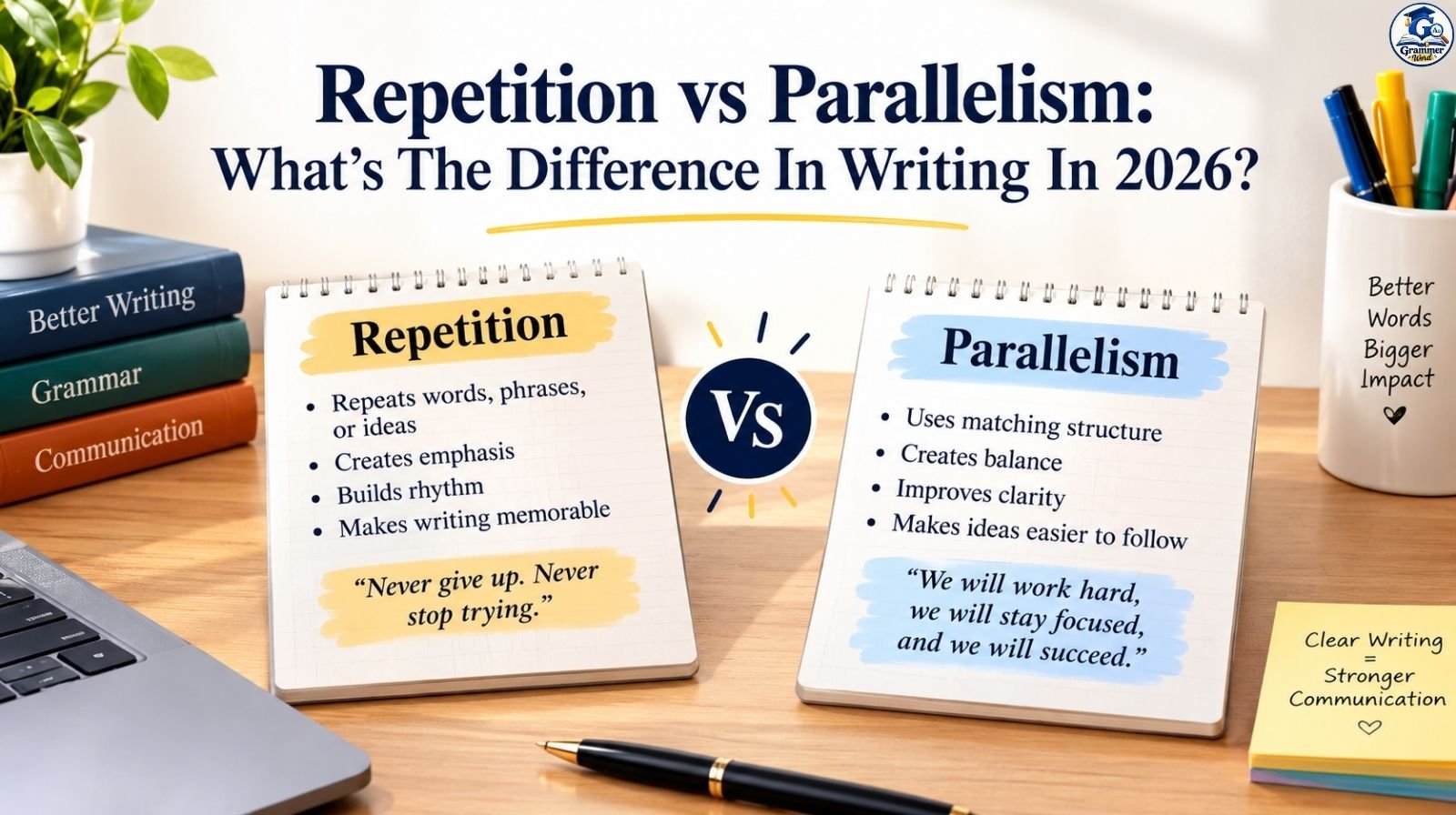
Repetition deliberately repeats a word, phrase, sound, or idea to create emphasis, rhythm, or memorability. Parallelism, on the other hand, uses matching grammatical or structural patterns to make related ideas balanced and clear.
For example:
“We will work hard, we will stay focused, and we will succeed.”
The repeated phrase “we will” is repetition, while the matching grammatical structure creates parallelism.
Understanding the difference helps you write stronger essays, speeches, articles, stories, presentations, and persuasive content. In this guide, you will learn what each technique means, how they differ, when to use them, and how they can work together.
Read More: Ageing or Aging: Which Spelling Is Correct? A Simple, Clear Guide
What Is Repetition in Writing?
Repetition is a writing technique in which a writer intentionally repeats a word, phrase, sentence pattern, sound, or idea.
The purpose is usually to make something more noticeable, memorable, emotional, rhythmic, or persuasive.
Repetition in Simple Terms
Think of repetition as saying something again because you want the reader or listener to notice it.
For example:
“Practice, practice, practice.”
The word practice is repeated for emphasis.
Another example is:
“Never give up. Never stop learning. Never stop trying.”
The repeated word “Never” creates emphasis and rhythm.
Repetition is common in speeches, advertisements, poetry, storytelling, persuasive writing, and other forms of communication.
Common Types of Repetition
Repetition can appear in several forms.
Simple repetition: Repeating the same word.
“Run, run, run!”
Phrase repetition: Repeating a phrase.
“We need better planning. We need better communication. We need better results.”
Anaphora: Repeating a word or phrase at the beginning of successive clauses.
“We will learn. We will improve. We will succeed.”
Epistrophe: Repeating a word or phrase at the end of successive clauses.
“They wanted justice, fought for justice, and demanded justice.”
These techniques can make writing more memorable and give it a stronger rhythm.
Read More: Lets or Let’s: Which One Is Correct And When To Use It?
What Is Parallelism in Writing?
Parallelism is a technique in which two or more related words, phrases, or clauses follow a similar grammatical or structural pattern.
In other words, parallelism makes related ideas look and sound balanced.
Parallelism in Simple Terms
Consider this sentence:
“She enjoys reading, writing, and painting.”
The three activities use the same -ing grammatical form:
- reading
- writing
- painting
That is parallelism.
Now compare it with:
“She enjoys reading, writing, and to paint.”
This is not properly parallel because reading and writing are gerunds, while to paint uses an infinitive.
A better version is:
“She enjoys reading, writing, and painting.”
Parallel Structure Examples
Here are a few simple examples.
Not parallel:
“The job requires creativity, working quickly, and attention to detail.”
Parallel:
“The job requires creativity, speed, and attention to detail.”
Or:
“The job requires being creative, working quickly, and paying attention to detail.”
In each improved version, the elements follow a consistent grammatical pattern.
Repetition vs Parallelism: The Main Difference
The simplest way to understand repetition vs parallelism is this:
Repetition repeats something; parallelism matches the structure of related ideas.
They can occur separately, or they can appear in the same sentence.
Quick Comparison Table
| Feature | Repetition | Parallelism |
|---|---|---|
| Main purpose | Emphasis, rhythm, memorability | Balance, clarity, structure |
| What repeats? | Words, phrases, sounds, or ideas | Grammatical or structural patterns |
| Requires identical words? | Often, but not always | No |
| Main focus | What is repeated | How ideas are structured |
| Common in | Speeches, poetry, advertising | Essays, lists, speeches, professional writing |
| Example | “Never give up. Never surrender.” | “She likes reading, writing, and painting.” |
| Can they work together? | Yes | Yes |
Repetition Focuses on Emphasis
Consider:
“This is our moment. This is our opportunity. This is our future.”
The phrase “This is” is repeated. The repetition gives the statement emotional force.
Parallelism Focuses on Balance
Now consider:
“She wanted to learn, to improve, and to succeed.”
The three infinitive phrases follow the same pattern:
- to learn
- to improve
- to succeed
That is parallelism.
Read More: Per Say or Per Se: Which One Is Correct?
Repetition and Parallelism Can Overlap
This is where the confusion often begins.
Consider:
“We will learn, we will practice, and we will improve.”
This sentence uses both techniques.
Repetition: “we will” appears repeatedly.
Parallelism: Each clause follows the same basic structure:
subject + modal verb + verb
So, repetition and parallelism are different concepts, but one sentence can use both at the same time.
Repetition vs Parallelism: Examples You Can Remember
The easiest way to distinguish these techniques is to compare examples side by side.
Example 1: Repetition
“I want answers. I want honesty. I want results.”
The phrase “I want” is repeated.
The repetition emphasizes the speaker’s demands.
Example 2: Parallelism
“She likes reading, writing, and drawing.”
Each item uses the same grammatical form.
That is parallelism.
Example 3: Both Together
“We will plan carefully, we will work patiently, and we will finish successfully.”
The repeated phrase “we will” creates repetition.
The matching clause structure creates parallelism.
Example 4: Parallelism Without Repeating the Same Words
“The company values creativity, efficiency, and reliability.”
There is no major repetition of the same word or phrase.
However, the three nouns have matching grammatical roles.
Therefore, the sentence demonstrates parallelism.
Example 5: Repetition Without Strong Parallel Structure
“Never again. Never forget.”
The word “Never” is repeated.
The expressions are short and emphatic, but the main stylistic feature is repetition rather than a carefully matched grammatical series.
Read More: To Much or Too Much: Which One Is Correct?
How to Use Repetition and Parallelism Effectively
Both techniques can improve writing, but they work best when used intentionally.
Use Repetition for Emphasis
Use repetition when you want an important idea to stick in the reader’s mind.
For example:
“Quality matters. Quality builds trust. Quality creates loyalty.”
The repetition of quality keeps the central idea visible.
This can work especially well in speeches and persuasive writing.
Use Parallelism for Clarity
Use parallelism when presenting a list or connecting related ideas.
For example:
“The course teaches students to research, to write, and to edit.”
The repeated “to + verb” structure makes the sentence easy to follow.
Use Both for Persuasive Writing
The combination can be particularly effective:
“We need to think clearly, we need to act quickly, and we need to communicate honestly.”
Here, “we need to” is repeated, while the clauses maintain a parallel structure.
The result is rhythmic, balanced, and persuasive.
A 2025–2026 Data Point: Why Structure Still Matters Online
Good writing is not only about sounding impressive. It also needs to be easy for people to process.
Research into online reading behavior has consistently shown that people often scan web content rather than read every word from beginning to end. This makes clear organization, concise wording, headings, lists, and recognizable sentence structures especially useful for online readers.
Recent web-writing research has also emphasized the importance of concise, scannable content because readers often consume only a portion of the written material on a typical webpage.
Read More: Ax vs Axe: The Simple Difference Most People Don’t Know
This does not mean every sentence should be short or that repetition should be added everywhere. Instead, it reinforces a useful principle: make important ideas easy to recognize and understand.
For SEO content, this supports a people-first approach. Search-friendly writing should ultimately be useful, understandable, and satisfying for real readers rather than being written simply to manipulate search rankings.
Case Study: How a Writer Can Use Both Techniques
Imagine a content writer preparing a short landing page for an online writing course.
The first draft says:
“Our course teaches grammar. It also teaches vocabulary. Students learn how to write better sentences. They can also learn how to edit their work.”
The information is correct, but the writing feels disconnected. The ideas do not have a strong rhythm or consistent structure.
The writer revises it:
“Learn grammar. Build vocabulary. Write clearer sentences. Edit with confidence.”
Now the copy is much more direct. The verbs learn, build, write, edit create a parallel pattern, while the short sentence structure makes each benefit stand out.
The writer could take the technique one step further:
“Learn grammar. Learn vocabulary. Learn structure. Learn to write with confidence.”
Here, “learn” is deliberately repeated. That repetition reinforces the central promise of the course.
A stronger combination might be:
“Learn grammar, build vocabulary, and write with confidence. Learn the skills that make every sentence clearer.”
The first sentence uses parallelism through matching verb structures. The second uses repetition of “learn” to reinforce the central message.
This example demonstrates an important lesson: repetition and parallelism are not competing techniques. A skilled writer can use both to improve rhythm, emphasis, clarity, and persuasion without making the text feel forced.
The goal is not to repeat words simply because repetition exists as a rhetorical device. The goal is to make the reader understand and remember the message more easily.
Common Mistakes With Repetition and Parallelism
Understanding the difference is useful, but knowing what to avoid is just as important.
Mistake 1: Repeating Words Too Much
Repetition can become annoying when it adds no meaning.
Weak:
“This product is useful because this product is affordable, and this product is reliable.”
Better:
“This product is useful because it is affordable and reliable.”
Intentional repetition should create an effect. Accidental repetition usually creates clutter.
Read More: There or Their: Clear Guide To Correct Usage
Mistake 2: Confusing Similar Words With Parallelism
Parallelism does not simply mean using similar vocabulary.
For example:
“She enjoys reading, books, and creative writing.”
The items are related, but their structures are not well matched.
A cleaner version is:
“She enjoys reading, writing, and creating stories.”
Now the three items use the -ing form.
Mistake 3: Breaking a Parallel Pattern
Consider:
“The manager asked employees to arrive early, to work carefully, and that they communicate clearly.”
The first two items use infinitives:
- to arrive
- to work
But the third uses a that-clause.
A better version is:
“The manager asked employees to arrive early, to work carefully, and to communicate clearly.”
Mistake 4: Using Repetition Without Purpose
Repeating a phrase does not automatically make writing powerful.
Before repeating something, ask:
What does this repetition accomplish?
If the answer is “nothing,” remove it.
A Simple Step-by-Step Guide to Choosing the Right Technique
When you are unsure whether to use repetition or parallelism, follow these steps.
Step 1: Identify Your Goal
Ask what you want the sentence to accomplish.
- Want emphasis? Consider repetition.
- Want balance and clarity? Consider parallelism.
- Want both? Combine them.
Step 2: Look at the Sentence Structure
If you are listing related ideas, check whether they have the same grammatical form.
For example:
“to read, to write, and to edit”
is parallel.
Read More: Greatful or Grateful: Which One Is Correct?
Step 3: Check for Unnecessary Repetition
Read the sentence aloud.
If the repeated word strengthens the message, keep it.
If it merely makes the sentence longer, remove it.
Step 4: Read the Sentence as a Whole
Ask:
- Does it sound natural?
- Is the main idea obvious?
- Does the rhythm help the meaning?
- Would a reader understand it quickly?
Step 5: Edit for Purpose
Good writing is not about using as many rhetorical devices as possible.
Use the technique that best serves the reader.
Repetition vs Parallelism: Which One Should You Use?
There is no universal winner because the two techniques solve different problems.
Choose repetition when you want to:
- emphasize an important idea
- create rhythm
- make a phrase memorable
- add emotion
- strengthen a persuasive message
Choose parallelism when you want to:
- organize related ideas
- create grammatical balance
- improve sentence clarity
- make a list easier to follow
- make writing sound polished
Use both when you want a sentence that is simultaneously memorable and structurally balanced.
For example:
“We will learn from our mistakes, we will improve our methods, and we will strengthen our results.”
The repeated opening provides emphasis, while the matching clauses provide parallelism.
Read More: Lay Down or Lie Down – What’s The Correct Usage?
Repetition vs Parallelism: Mini Quiz
1. What does repetition mainly do?
A. Creates emphasis
B. Changes spelling
C. Removes details
D. Makes sentences longer
Answer: A. Creates emphasis
2. What does parallelism mainly focus on?
A. Matching grammatical structure
B. Repeating one word many times
C. Adding difficult vocabulary
D. Making paragraphs longer
Answer: A. Matching grammatical structure
3. Which sentence uses repetition?
A. She enjoys reading and writing.
B. We need better planning and better communication.
C. He likes books and movies.
D. They arrived early.
Answer: B. We need better planning and better communication.
4. Which sentence shows parallelism?
A. She likes reading, writing, and painting.
B. She likes reading, books, and to paint.
C. She likes books and painting quickly.
D. She enjoys a book and to write.
Answer: A. She likes reading, writing, and painting.
5. Are repetition and parallelism exactly the same?
A. Yes
B. No
C. Only in essays
D. Only in poetry
Answer: B. No
6. Which phrase is repeated in this sentence?
“We will learn, we will practice, and we will improve.”
A. We will
B. Learn
C. Practice
D. Improve
Answer: A. We will
7. What does parallelism make writing feel?
A. Balanced and clear
B. Confusing and random
C. Longer and harder
D. Informal and careless
Answer: A. Balanced and clear
8. Which is an example of repetition?
A. “Practice, practice, practice.”
B. “Reading, writing, painting.”
C. “To learn, to grow, to improve.”
D. “Fast cars and big houses.”
Answer: A. “Practice, practice, practice.”
9. Can repetition and parallelism appear in the same sentence?
A. Yes
B. No
C. Only in poetry
D. Only in speeches
Answer: A. Yes
10. What is wrong with this sentence?
“She enjoys reading, writing, and to paint.”
A. The sentence is too short.
B. The items are not grammatically parallel.
C. It contains repetition.
D. It has too many verbs.
Answer: B. The items are not grammatically parallel.
11. Which technique is especially useful for emphasizing an important idea?
A. Repetition
B. Parallelism
C. Punctuation
D. Capitalization
Answer: A. Repetition
12. Which sentence uses both repetition and parallelism?
A. “We will learn, we will practice, and we will improve.”
B. “She reads books.”
C. “He likes music and movies.”
D. “The students arrived early.”
Answer: A. “We will learn, we will practice, and we will improve.”
13. What should you ask before using repetition?
A. Does it serve a purpose?
B. Can I make it longer?
C. Can I add more words?
D. Can I repeat every sentence?
Answer: A. Does it serve a purpose?
14. Which technique is useful for making a list grammatically balanced?
A. Repetition
B. Parallelism
C. Slang
D. Abbreviation
Answer: B. Parallelism
15. What is the easiest way to remember the difference?
A. Repetition repeats; parallelism matches structure.
B. Repetition is always wrong; parallelism is always right.
C. They are exactly the same.
D. Parallelism only belongs in poetry.
Answer: A. Repetition repeats; parallelism matches structure.
FAQs
Q1. Is repetition the same as parallelism?
No. Repetition involves deliberately repeating words, phrases, sounds, or ideas. Parallelism involves using similar grammatical or structural patterns for related ideas. They can occur together in the same sentence.
Q2. Is repetition a type of parallelism?
Not exactly. They are separate rhetorical or stylistic techniques. However, repetition can sometimes contribute to a parallel structure, particularly when the same opening phrase is repeated across similarly constructed clauses.
Q3. What is an example of repetition and parallelism together?
“We will study harder, we will practice more, and we will perform better.”
The repeated phrase “we will” is repetition, while the matching clause structure creates parallelism.
Q4. Why is parallelism important in writing?
Parallelism makes related ideas easier to compare and understand. It can also make sentences sound smoother and more balanced.
Q5. Why do writers use repetition?
Writers use repetition to emphasize important ideas, create rhythm, strengthen emotional impact, and make phrases easier to remember.
Q6. Can repetition make writing bad?
Yes. Intentional repetition can be powerful, but unnecessary repetition can make writing wordy, boring, or awkward. The key is to repeat something only when the repetition serves a clear purpose.
Q7. Which technique is better for essays?
It depends on the purpose. Parallelism is especially useful for organizing comparisons, lists, and arguments. Repetition can be useful when emphasizing a thesis, key point, or persuasive message. Strong essays may use both.
Final Verdict:
The difference between repetition vs parallelism becomes simple once you know what each technique is designed to do.
Repetition repeats words, phrases, sounds, or ideas to create emphasis, rhythm, or memorability. Parallelism uses matching grammatical or structural patterns to create balance and clarity.
The two techniques can work independently, but they can also work together:
“We will learn, we will practice, and we will improve.”
The repeated “we will” creates emphasis, while the consistent sentence structure creates parallelism.
The best approach is to use each technique deliberately. Before repeating a word or matching a grammatical structure, ask what effect it creates for your reader.
If you want your writing to be clearer, more persuasive, and easier to remember, mastering repetition and parallelism is a simple but powerful step.
Discover More Article
- Whether or Wether – Which One Is Correct?
- Toward or Towards Explained: Simple Grammar Guide You Need
- Bougie or Boujee: What’s The Correct Spelling And Meaning?
- Miss or Ms: What’s The Difference And When To Use Each?
Keep learning with more easy grammar lessons on Grammer Word.com

Hi, I’m Noor Fatima, the person behind this website. I created this site to make English grammar and confusing words easier to understand. I love breaking down tricky words, meanings, spellings, and grammar rules into simple explanations. My goal is to help you learn English naturally, avoid common mistakes, and feel more confident every time you write or speak.