Choosing between Miss or Ms can feel surprisingly confusing. You may know that both are titles used before a woman’s name, but you may not know whether marriage, age, or personal preference determines which one is correct.
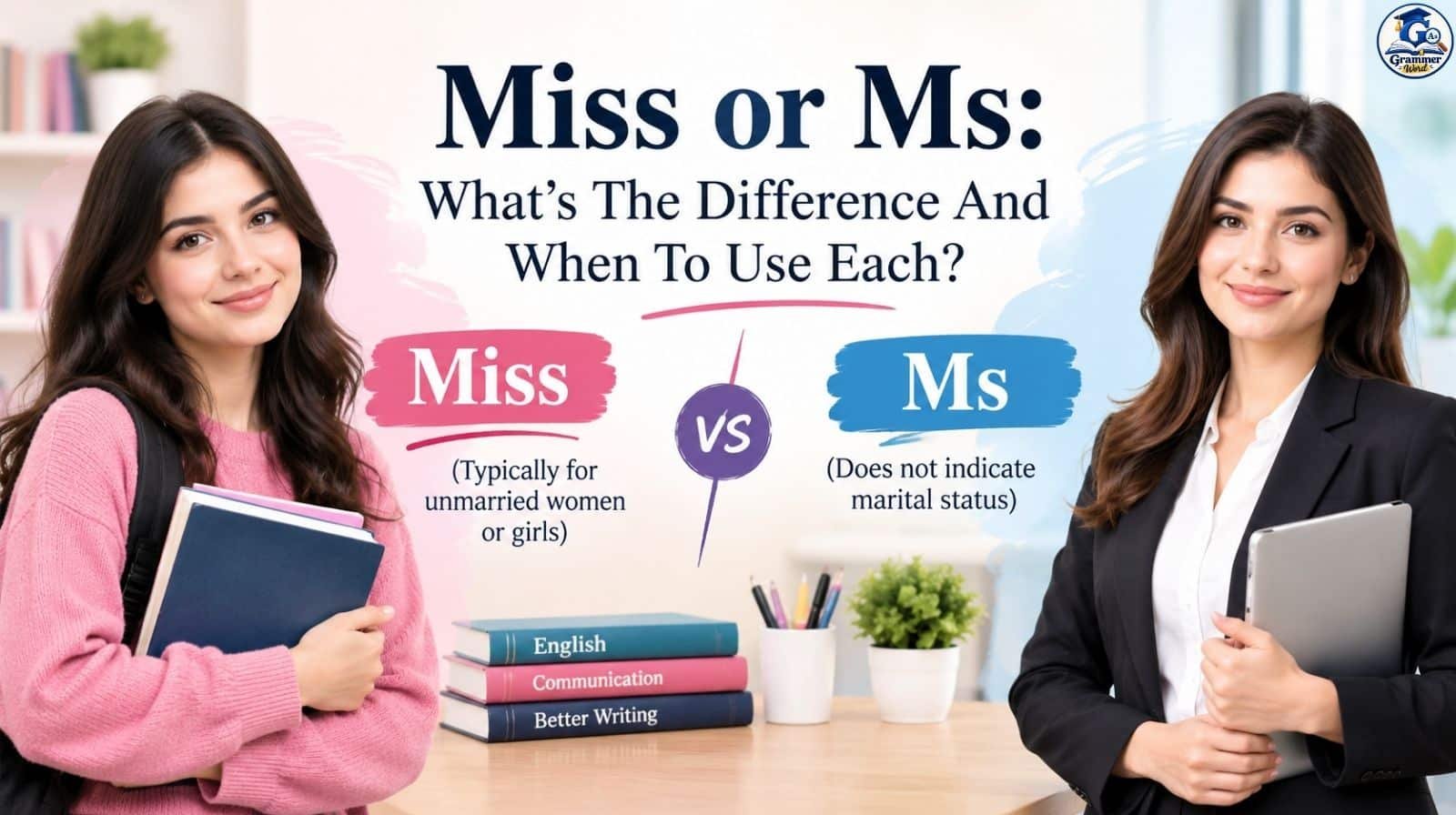
The short answer is simple: Miss traditionally identifies an unmarried woman or girl, while Ms does not reveal or depend on marital status.
Cambridge Dictionary defines Miss as a title used before the name of a single woman, while Ms is used without indicating whether a woman is married.
That difference matters in emails, letters, school communication, applications, invitations, and professional settings.
So, Miss or Ms which should you choose? This guide explains the difference, shows real examples, covers modern usage, and gives you an easy way to make the right choice without overthinking it.
Miss or Ms: What Is the Main Difference?
The biggest difference between Miss and Ms is the information each title traditionally communicates.
Miss is generally associated with a woman or girl who is unmarried. Ms, pronounced /mɪz/, is a neutral title that does not indicate whether the woman is married or unmarried.
What Does Miss Mean?
Miss traditionally refers to an unmarried woman or girl.
For example:
- Miss Sarah Johnson
- Miss Emily Brown
- Miss Carter
You may also hear Miss used simply to address a young woman or girl, especially in some varieties of English.
For example:
“Excuse me, Miss. You dropped your notebook.”
Cambridge Dictionary notes that Miss can also be used as a form of address for a girl or young woman, particularly in American English or in older British usage.
However, context matters. In modern professional communication, using Miss solely because you assume a woman is unmarried may not always be the best choice.
What Does Ms Mean?
Ms is a title for a woman that does not specify her marital status.
For example:
- Ms Sarah Johnson
- Ms Emily Brown
- Ms Carter
This makes Ms especially useful when you do not know someone’s marital status or when marital status is irrelevant.
Cambridge Dictionary specifically describes Ms as a title used before a woman’s family or full name when the writer or speaker does not want to indicate whether she is married.
In professional communication, that neutral quality makes Ms a practical default when you don’t know the person’s preferred title.
Miss vs Ms at a Glance
| Title | Traditional meaning | Indicates marital status? | Common modern use |
|---|---|---|---|
| Miss | Unmarried woman or girl | Yes | Personal, traditional, or when preferred |
| Ms | Woman without specifying marital status | No | Professional, formal, and general use |
The important point is that Ms is not another word for married. It is specifically useful because it avoids making marital status part of the address.
When Should You Use Miss?
Knowing the definition of Miss is only half the answer. The next question is when it actually makes sense to use it.
Use Miss When the Woman Prefers It
The safest rule is always to respect the person’s stated preference.
If someone introduces herself as Miss Taylor, uses that title in her professional profile, or specifically asks you to address her as Miss, there is little reason to replace it with Ms.
For example:
Dear Miss Taylor,
If Miss Taylor has told you that this is her preferred form of address, following her preference is appropriate.
Use Miss for Traditional or Personal Contexts
Miss can still appear naturally in certain contexts.
For example:
- A teacher may be called Miss by students in some regions.
- A young woman may prefer Miss.
- A beauty-pageant title may use Miss, such as Miss World or Miss India.
- A person may use Miss as part of a traditional or cultural form of address.
The title can therefore be perfectly correct when the context supports it.
Miss Can Be Less Appropriate When You Are Guessing
Suppose you are writing a formal email to someone you have never met.
You know her name is Jessica Morgan, but you don’t know her marital status or preferred title.
Writing:
Dear Miss Morgan,
may imply that you have determined she is unmarried.
That may be an unnecessary assumption.
In this situation, Ms Morgan is generally a safer choice if no other professional title is known.
When Should You Use Ms?
For many modern situations, Ms is the easiest title to use when you do not know a woman’s preference.
Use Ms When Marital Status Is Unknown
Imagine you’re sending a job-related email to Alexandra Brown.
You don’t know whether Alexandra is married, unmarried, divorced, or widowed. More importantly, you don’t need to know.
You could write:
Dear Ms Brown,
This avoids making her marital status part of the conversation.
Purdue OWL’s guidance for business letters similarly recommends following a woman’s preference and says that Ms is appropriate when you are unsure of her preference.
Use Ms in Professional Communication
Ms is particularly practical in:
- Business emails
- Cover letters
- Formal letters
- Customer communication
- School administration
- Workplace documents
- Professional introductions
- Applications and forms
For example:
Dear Ms Patel,
We are pleased to invite you to the interview on Monday.
Here, the person’s marital status has nothing to do with the purpose of the message.
Ms Does Not Mean “Married”
This is one of the most common misunderstandings.
Ms does not mean married.
Instead:
- Miss traditionally indicates an unmarried woman.
- Mrs traditionally indicates a married woman.
- Ms does not indicate marital status.
Cambridge’s guidance also notes that some married women use Ms, while others may use Mrs, depending on their personal preference.
Therefore, seeing Ms before someone’s name does not tell you whether she is married.
Miss or Ms in Emails, Letters, and Everyday Writing
The choice becomes much easier when you consider the situation rather than trying to memorize one universal rule.
Formal Email Example
Suppose you’re contacting a manager named Maria Wilson for the first time.
If you don’t know her preferred title, you could write:
Dear Ms Wilson,
This is generally more neutral than guessing that she prefers Miss or Mrs.
However, if Maria’s official correspondence or email signature uses another title, follow that preference.
Job Application Example
Imagine you’re applying for a position and addressing the hiring manager.
If the manager is Emma Davis and you don’t know her preference:
Dear Ms Davis,
is a reasonable formal choice.
Even better, if the organization provides a professional title such as Dr Davis, use the professional title instead:
Dear Dr Davis,
A professional or academic title generally takes priority over a courtesy title such as Miss or Ms.
School Example
School settings can be different.
A student might naturally say:
“Excuse me, Miss.”
In some countries and school systems, this is a common way for students to address a female teacher. Cambridge Dictionary specifically notes this use in British English.
That doesn’t mean every female teacher should be addressed as Miss in every English-speaking environment. Local custom and the teacher’s preference matter.
Miss or Ms: A Simple Decision Guide
If you’re stuck between Miss or Ms, use this quick guide.
Step 1: Check for a Preferred Title
If the woman has already told you how she prefers to be addressed, use that title.
For example:
- Email signature says Ms Johnson → use Ms Johnson.
- She introduces herself as Miss Johnson → use Miss Johnson.
- She uses Dr Johnson → use Dr Johnson.
Step 2: Use a Professional Title When Available
If the person has a professional title, it may be more appropriate than Miss or Ms.
Examples include:
- Dr
- Professor
- Certain military or professional titles
For example:
Dear Dr Wilson,
is more specific than:
Dear Ms Wilson,
when Dr Wilson uses the professional title.
Step 3: If You Don’t Know, Choose Ms
If you know only the woman’s name and have no information about her preferred title, Ms is generally the safest neutral option.
Purdue OWL recommends using Ms when you are uncertain about a woman’s preference in a business-letter context.
Quick Checklist
Before addressing someone, ask:
| Question | Best approach |
|---|---|
| Does she have a professional title? | Use it |
| Has she stated her preferred title? | Follow it |
| Do you know she prefers Miss? | Use Miss |
| You don’t know her preference? | Ms is a neutral choice |
| Is marital status irrelevant? | Ms avoids bringing it into the address |
| Is it an informal situation? | Follow local custom and context |
This approach is more reliable than trying to guess someone’s personal circumstances from their age or name.
Why Ms Has Become an Important Modern Choice
The popularity of Ms is closely connected to the idea that a woman’s marital status does not need to be part of ordinary identification.
A Title Can Be Neutral
Consider two professional introductions:
Miss Sarah Adams
and:
Ms Sarah Adams
The first traditionally communicates something about Sarah’s marital status. The second does not.
In many professional situations, that distinction is unnecessary.
For example, if Sarah is applying for a job, managing a project, teaching a class, or sending an invoice, her marital status usually has no relevance to the task.
That’s why Ms works well as a neutral form of address.
Younger Women May Prefer Ms
Cambridge’s English Grammar Today notes that the use of Miss is becoming less common among younger women, while Ms does not indicate whether someone is married.
This doesn’t mean Miss is incorrect or that everyone should replace it with Ms.
It simply shows how English usage changes over time.
Language isn’t frozen. Titles evolve as social and professional conventions change.
Ms Can Prevent Unnecessary Assumptions
Using Ms can also prevent a simple communication mistake.
Imagine you’re sending an invitation to:
Ms Lauren Green
You don’t know anything about her personal life, and the invitation doesn’t require that information.
Using Ms keeps the focus where it belongs: on the person and the purpose of the communication.
2025–2026 Data: What Demographic Statistics Tell Us
There isn’t a reliable national statistic showing exactly what percentage of women choose Miss versus Ms. Government demographic surveys generally measure characteristics such as age, sex, and marital status rather than personal title preferences.
That distinction is important: marital-status statistics should not be treated as statistics about title usage.
Recent U.S. Census Data
The U.S. Census Bureau’s 2024 American Community Survey table on sex and marital status reports about 139.7 million females aged 15 and over in the table’s population universe. Of those, approximately 44.2 million were never married, while approximately 67.0 million were currently married.
The Census Bureau also released its 2025 population estimates by age and sex in April 2026, providing updated demographic estimates through July 1, 2025.
These figures demonstrate why marital status is a large demographic category, but they do not tell us which title each woman prefers.
Why This Matters for Miss vs Ms
The practical lesson is simple:
You should not use demographic assumptions as a substitute for someone’s stated preference.
A woman who is unmarried may prefer Ms.
A married woman may prefer Ms.
Another woman may prefer Miss.
Therefore, marital status alone cannot tell you which title a particular person wants you to use.
Case Study: Choosing the Right Title in a Professional Email
Consider an example involving Nadia Khan, a fictional employee receiving a formal email from a new business contact.
The sender knows Nadia’s full name but has never met her. He searches the company’s website and finds:
Nadia Khan Marketing Director
However, the website does not provide a courtesy title.
The sender initially considers writing:
Dear Miss Khan,
He then realizes that he doesn’t know Nadia’s marital status or preferred title.
Instead, he chooses:
Dear Ms Khan,
That choice avoids an unnecessary assumption.
Later, Nadia replies using the signature:
Nadia Khan
Marketing Director
In future correspondence, the sender could simply address her as Nadia, if the professional relationship becomes less formal and that style is appropriate.
Now imagine a different situation. Nadia’s official email signature says:
Miss Nadia Khan
In that case, using Miss Khan would be reasonable because Nadia has clearly demonstrated her preference.
This example shows an important principle: the best title isn’t always the one you can infer from someone’s age or marital status. It’s the one that fits the context and respects the person’s preference.
In formal communication, when no preference is known, Ms provides a practical neutral option. This is consistent with Purdue OWL’s business-letter guidance.
Common Mistakes People Make With Miss and Ms
Even people who speak English fluently can mix up these titles.
Mistake 1: Thinking Ms Means Married
It doesn’t.
Ms deliberately avoids indicating marital status.
If you need a title that doesn’t reveal whether a woman is married, Ms is the appropriate neutral choice.
Mistake 2: Assuming Every Unmarried Woman Wants Miss
Being unmarried doesn’t automatically mean someone prefers Miss.
A person can be unmarried and still prefer Ms.
The traditional definition and personal preference are not always the same thing.
Mistake 3: Assuming Ms Is More Respectful Than Miss
Neither title is automatically more respectful.
The appropriate choice depends on:
- Personal preference
- Context
- Local convention
- Formality
- Whether another professional title applies
Mistake 4: Ignoring a Person’s Stated Preference
If someone tells you:
“Please call me Ms Brown.”
there is no reason to guess.
Use Ms Brown.
Respecting someone’s preferred form of address is usually more important than applying a rigid rule.
Mistake 5: Using a Courtesy Title When You Don’t Need One
In some writing styles, especially journalism, courtesy titles may be omitted after a person’s first reference. Purdue OWL’s summary of AP style, for example, notes that writers generally don’t use courtesy titles such as Miss or Ms unless they are part of a direct quotation or needed to distinguish people.
So the right answer can depend on what you’re writing, not just who you’re writing about.
Miss vs Ms Examples You Can Copy
Seeing the titles in context makes the difference easier to remember.
Formal Letter
Neutral:
Dear Ms Johnson,
Thank you for contacting our office.
If she prefers Miss:
Dear Miss Johnson,
Thank you for contacting our office.
Professional Introduction
I’d like to introduce Ms Taylor, our new project manager.
Or, if that is her preference:
I’d like to introduce Miss Taylor, our new project manager.
General Address
Excuse me, Miss. You left your phone on the table.
Here, Miss is functioning as a form of address rather than necessarily being part of the person’s formal written title.
When a Professional Title Exists
Instead of:
Dear Ms Ahmed,
you might write:
Dear Dr Ahmed,
if Ahmed uses the title Dr.
This is why checking the person’s official information can be more useful than guessing.
Mini Quiz: Miss or Ms
1. Quick Pick: What Does “Ms” Tell You?
Question: Does “Ms” reveal whether a woman is married?
Answer: No. Ms is a neutral title that does not indicate marital status.
2. Miss or Ms?
Question: Which title traditionally refers to an unmarried woman?
Answer: Miss.
3. The Professional Choice
Question: You don’t know a woman’s preferred title. Which is usually the safer neutral choice?
Answer: Ms.
4. Tiny Pronunciation Test
Question: Is “Ms” commonly pronounced like “miss”?
Answer: No. It is commonly pronounced “miz.”
5. Spot the Smart Choice
Question: You’re writing a formal email to Sarah Brown, but you don’t know her marital status. What could you use?
Answer: Ms Brown.
6. True or False?
Question: “Ms” means that a woman is married.
Answer: False. Ms does not indicate marital status.
7. Preference Wins!
Question: If a woman specifically asks you to call her “Miss Taylor,” should you respect that preference?
Answer: Yes.
8. Which One Is Neutral?
Question: Which title avoids mentioning marital status: Miss or Ms?
Answer: Ms.
9. Email Challenge
Question: Which sounds more neutral when you don’t know someone’s preference: “Dear Miss Khan” or “Dear Ms Khan”?
Answer: Dear Ms Khan.
10. Professional Title Bonus
Question: If someone uses “Dr” professionally, should you normally use Dr instead of guessing between Miss or Ms?
Answer: Yes.
11. Miss in Everyday Speech
Question: Can “Miss” be used when directly addressing a young woman or girl?
Answer: Yes.
12. Marriage Doesn’t Decide Everything
Question: Can a married woman choose to use “Ms”?
Answer: Yes. Ms can be used regardless of marital status.
13. Fill the Gap
Question: “Dear ___ Johnson” You don’t know her marital status or preferred title. Which fits best?
Answer: Ms.
14. One-Word Memory Trick
Question: Which title should you remember as the neutral option?
Answer: Ms.
15. Final Boss: Miss or Ms?
Question: What is the simplest rule when you’re unsure which title a woman prefers?
Answer: Use Ms as a neutral choice, unless you know she prefers another title.
FAQs
Q1. Is Ms for married or unmarried women?
Both. Ms does not specify whether a woman is married or unmarried. It is a neutral title.
Q2. Is Miss only for unmarried women?
Traditionally, yes. Miss is generally used for a girl or unmarried woman. However, actual usage can also depend on personal preference and context.
Q3. Which is more professional, Miss or Ms?
Neither is automatically more professional. However, Ms is often a practical professional choice when you don’t know a woman’s preferred title or marital status, particularly in formal correspondence. Purdue OWL recommends Ms when you’re unsure of a woman’s preference.
Q4. Should I use Ms if I don’t know whether a woman is married?
Yes. Ms is generally the safest neutral choice when you don’t know her preference and marital status is irrelevant.
Q5. Is Ms pronounced “miss”?
No. Ms is commonly pronounced “miz” /mɪz/, while Miss is pronounced /mɪs/.
Q6. Can a married woman use Ms?
Yes. A married woman can use Ms, and some women prefer it. Cambridge explicitly notes that married women may choose Ms rather than Mrs.
Q6. What should I use if the woman has a doctorate?
If she uses Dr as her preferred professional title, use Dr rather than guessing between Miss, Ms, or Mrs.
Final Verdict:
So, Miss or Ms which should you use?
Use Miss when you know the woman prefers it, when the traditional unmarried meaning is relevant, or when the context naturally calls for it.
Use Ms when you want a neutral title that doesn’t reveal marital status, especially when you’re addressing someone professionally and don’t know her preference.
The easiest rule to remember is:
If you don’t know her preferred title, Ms is usually the safer neutral choice.
However, the best practice is always to follow the person’s stated preference. A title is a small part of a name, but using it correctly shows attention, respect, and good communication.
Whether you’re writing a formal email, filling out an application, addressing a letter, or learning English, understanding Miss or Ms helps you communicate more confidently.
When in doubt, don’t guess about someone’s personal life choose the neutral option or check how they prefer to be addressed.
Discover More Article
- Whether or Wether – Which One Is Correct?
- Bougie or Boujee: What’s The Correct Spelling And Meaning?
- Toward or Towards Explained: Simple Grammar Guide You Need
- Cancelation or Cancellation: Which Spelling Is Correct?
Keep learning with more easy grammar lessons on Grammer Word.com

Hi, I’m Noor Fatima, the person behind this website. I created this site to make English grammar and confusing words easier to understand. I love breaking down tricky words, meanings, spellings, and grammar rules into simple explanations. My goal is to help you learn English naturally, avoid common mistakes, and feel more confident every time you write or speak.