Have you ever wondered whether something was solicited or unsolicited? The two words look similar, but they describe very different situations.
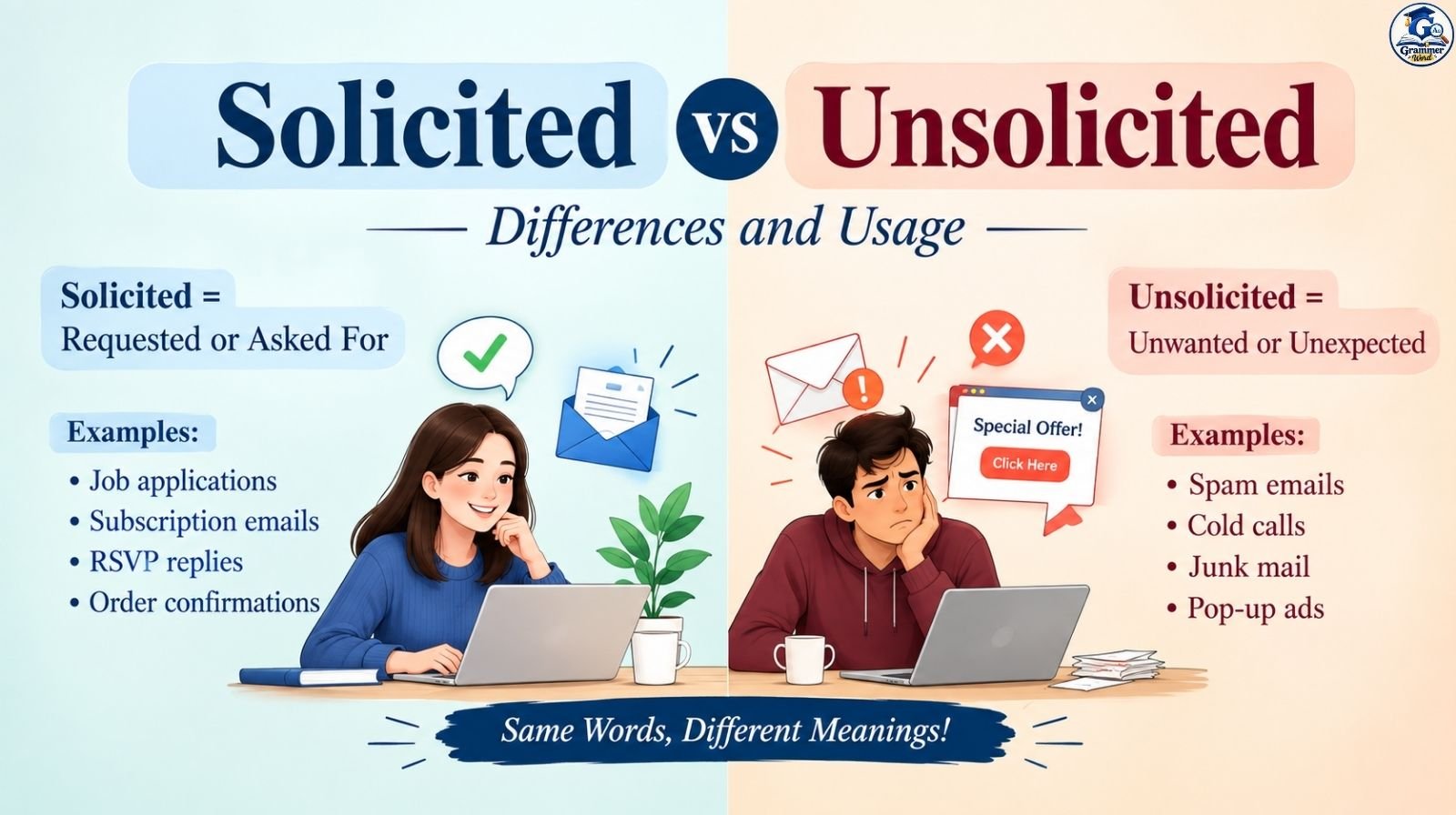
In simple terms, solicited usually means something was requested, invited, or asked for, while unsolicited means it was offered, sent, or given without being requested.
Understanding the difference is especially useful in professional communication, emails, job applications, advice, feedback, marketing, and everyday conversations.
In this guide, you’ll learn the meaning of solicited vs unsolicited, how to use each word correctly, and how to avoid common mistakes.
Read More: Each Other or Eachother? The Correct Spelling Explained Simply
Solicited vs Unsolicited: What Do They Mean?
The easiest way to understand these words is to focus on whether something was requested.
What Does “Solicited” Mean?
Solicited means something was requested, invited, or deliberately sought.
For example:
- The company requested solicited feedback from its customers.
- She submitted a solicited application for the position.
- The editor accepted solicited articles from experienced writers.
If someone asks you for your opinion and you provide it, your opinion is solicited.
Simple definition:
Solicited = requested or asked for.
What Does “Unsolicited” Mean?
Unsolicited means something was given, sent, offered, or provided without being requested.
For example:
- I received an unsolicited email from a company I had never contacted.
- He gave me unsolicited advice about my career.
- The author received an unsolicited manuscript from a new writer.
Simple definition:
Unsolicited = not requested or not asked for.
Solicited vs Unsolicited at a Glance
| Word | Meaning | Example |
|---|---|---|
| Solicited | Requested or invited | She gave solicited feedback. |
| Unsolicited | Not requested | He offered unsolicited advice. |
A quick memory trick is:
Solicited = someone asked for it.
Unsolicited = nobody asked for it.
Read More: Every Time or Everytime: Which One Is Correct?
Solicited vs Unsolicited: Key Differences
The main difference between solicited and unsolicited is whether there was a request beforehand.
1. Solicited Means Requested
When something is solicited, the recipient generally wanted or invited it.
For example:
The manager asked employees to submit feedback about the new policy.
The feedback is solicited because the manager specifically requested it.
Other examples include:
- solicited applications
- solicited opinions
- solicited feedback
- solicited donations
- solicited proposals
- solicited advice
2. Unsolicited Means Unrequested
When something is unsolicited, the person receives it without having asked for it.
For example:
My coworker gave me unsolicited advice about how I should manage my time.
The advice is unsolicited because the speaker did not request it.
You may encounter unsolicited:
- emails
- advice
- messages
- offers
- applications
- criticism
- proposals
- comments
3. Context Can Change the Tone
Although unsolicited simply means “not requested,” it can sometimes carry a negative or critical tone.
Compare these:
The consultant provided solicited feedback.
This sounds neutral and professional.
The consultant provided unsolicited feedback.
This may suggest that the feedback was unnecessary or unwelcome.
Therefore, understanding the literal meaning isn’t always enough. You should also consider the context and tone.
How to Use Solicited and Unsolicited Correctly
Knowing the definitions is easy. Using these words naturally is where many writers hesitate.
When to Use “Solicited”
Use solicited when a person, organization, or situation specifically requests something.
For example:
- The company solicited feedback from its employees.
- The magazine accepts solicited submissions.
- The researcher collected solicited responses from participants.
- We received several solicited proposals.
Notice that the common idea in each sentence is a request or invitation.
When to Use “Unsolicited”
Use unsolicited when something arrives or is offered without being requested.
For example:
- She received an unsolicited job offer.
- I don’t appreciate unsolicited criticism.
- The customer complained about receiving unsolicited messages.
- He sent an unsolicited proposal to the publisher.
The prefix un- is useful here because it often indicates the opposite or absence of something.
Solicited → requested
Unsolicited → not requested
Read More: Jist or Gist: Which Spelling Is Correct And How To Use It Properly?
Solicited and Unsolicited Advice
One of the most common uses is solicited advice versus unsolicited advice.
Solicited advice:
I asked my brother for advice about buying a car.
His advice was solicited.
Unsolicited advice:
My neighbor started telling me how to repair my car even though I never asked.
His advice was unsolicited.
This distinction is particularly useful because unsolicited advice can sometimes be perceived as intrusive, even when the person giving it has good intentions.
Solicited vs Unsolicited in Emails and Communication
Email is one area where the distinction becomes especially important.
Solicited Emails
A solicited email is generally one the recipient expected or requested.
Examples include:
- a newsletter someone signed up for
- a response to an inquiry
- a confirmation email
- a requested business proposal
- a reply to a job application
For example:
I received a solicited email containing the information I requested.
The recipient had already asked for the information.
Unsolicited Emails
An unsolicited email arrives without the recipient requesting it.
Examples might include:
- unexpected promotional messages
- sales pitches
- unwanted offers
- messages from unfamiliar senders
However, unsolicited does not automatically mean illegal or malicious. Whether an email is legally permitted can depend on the circumstances and applicable laws.
In modern digital communication, the distinction matters because people receive enormous volumes of email. Statista estimates that around 376 billion emails were sent and received globally each day in 2025, with that figure projected to reach about 424 billion per day in 2026.
Kaspersky also reported that 44.99% of global email traffic was spam in 2025, while more than 144 million malicious or potentially unwanted email attachments were detected during the year.
These figures demonstrate why distinguishing expected communication from unwanted communication remains highly relevant.
Read More: Flyer or Flier: Which One Is Correct? A Clear Guide For Writers
Why Solicited Communication Is Often More Welcome
When people request information, they already have a reason to receive it. Therefore, the communication is more likely to feel relevant.
For example:
Solicited:
You asked us for a price quote, so here is the information.
Unsolicited:
We noticed your business online and thought you might want our services.
The second message may still be useful, but the recipient did not ask for it.
Solicited vs Unsolicited: Real-Life Case Study
Consider a small business owner named Sarah who wants to improve her company’s website.
Sarah posts on LinkedIn asking experienced marketers for feedback. Several marketing professionals respond with suggestions about her homepage, navigation, and content strategy.
Because Sarah specifically requested their opinions, their feedback is solicited.
A week later, another marketer contacts Sarah without being asked. The marketer says her website needs major improvements and offers to redesign it for a fee.
Sarah never requested an audit or contacted the marketer. That feedback and sales offer are therefore unsolicited.
Now imagine that Sarah later contacts the same marketer and asks for a formal proposal. The situation changes. Once Sarah requests the proposal, the marketer’s response becomes solicited.
This example shows an important point: the same type of information can be solicited or unsolicited depending on the circumstances.
A business proposal is not inherently solicited or unsolicited. Its status depends on whether someone requested it.
The distinction also applies outside business. If a friend asks, “What do you think about my new haircut?” your answer is solicited. If you suddenly criticize someone’s haircut without being asked, your comment is unsolicited.
So, instead of memorizing complicated rules, ask one simple question:
“Did the person request it?”
If the answer is yes, solicited is usually the right word. If the answer is no, unsolicited is usually appropriate.
Common Examples of Solicited and Unsolicited
Seeing the words in realistic sentences can make the difference easier to remember.
Solicited Examples
- The company requested solicited feedback from its customers.
- The editor asked for solicited submissions from professional writers.
- She gave me the solicited information immediately.
- The committee reviewed several solicited proposals.
- His advice was solicited by the new employee.
Unsolicited Examples
- I received an unsolicited message from a salesperson.
- She offered unsolicited advice about my relationship.
- The writer sent an unsolicited manuscript to the publisher.
- We received an unsolicited business proposal.
- He made an unsolicited comment about her appearance.
A Simple Usage Test
When you’re unsure which word to use, complete this question:
Was it requested?
- Yes → Solicited
- No → Unsolicited
This simple test works in most everyday situations.
2025–2026 Data: Why the Difference Still Matters
The distinction between solicited and unsolicited communication is particularly relevant in the digital age.
Email Remains a Major Communication Channel
According to HubSpot’s 2026 marketing statistics, about 75% of marketers planned to maintain or increase their email marketing investment in 2026. HubSpot also reports that the number of global email users reached 4.6 billion in 2025.
At the same time, unsolicited and potentially harmful email remains a significant issue. Kaspersky reported that almost 45% of global email traffic was spam in 2025.
These numbers don’t mean that every unsolicited message is spam. Rather, they show why recipients increasingly need to distinguish between communication they requested and communication they did not.
What the Data Means for Writers and Marketers
For anyone creating email campaigns or professional communications, relevance matters.
A message that someone requested is naturally more aligned with their expectations. An unexpected message needs a clear reason to exist and should provide genuine value rather than simply adding noise.
This also aligns with Google’s broader guidance for online content: Google recommends creating helpful, reliable, people-first content rather than content designed primarily to manipulate search rankings.
The broader lesson is simple: respect the reader’s intent.
Solicited vs Unsolicited: Quick Comparison Checklist
Use this checklist whenever you’re unsure which word fits.
| Question | If Yes | If No |
|---|---|---|
| Did the person ask for it? | Solicited | Unsolicited |
| Was it specifically requested? | Solicited | Unsolicited |
| Was it invited? | Solicited | Unsolicited |
| Did it arrive unexpectedly? | Usually unsolicited | |
| Was feedback requested? | Solicited feedback | Unsolicited feedback |
| Was advice requested? | Solicited advice | Unsolicited advice |
| Was a proposal requested? | Solicited proposal | Unsolicited proposal |
The Fastest Way to Remember
Think of the words this way:
Solicited = “I asked for it.”
Unsolicited = “I didn’t ask for it.”
That’s the core distinction.
Mini Quiz: Solicited vs Unsolicited
1. What does “solicited” mean?
A) Requested
B) Unexpected
C) Unwanted
D) Secret
Answer: A) Requested
2. What does “unsolicited” mean?
A) Carefully planned
B) Not requested
C) Officially approved
D) Personally invited
Answer: B) Not requested
3. You ask your friend for advice. What kind of advice is it?
A) Unsolicited advice
B) Solicited advice
C) Random advice
D) Unwanted advice
Answer: B) Solicited advice
4. Someone gives you advice even though you never asked. What is it?
A) Solicited advice
B) Requested advice
C) Unsolicited advice
D) Formal advice
Answer: C) Unsolicited advice
5. Which word is the opposite of “solicited”?
A) Requested
B) Invited
C) Unsolicited
D) Accepted
Answer: C) Unsolicited
6. You request feedback from your manager. The feedback is:
A) Unsolicited
B) Solicited
C) Accidental
D) Unwanted
Answer: B) Solicited
7. Which sentence uses “unsolicited” correctly?
A) I asked for her opinion, so it was unsolicited.
B) He gave me unsolicited advice without being asked.
C) She requested an unsolicited report.
D) We invited unsolicited feedback from the team.
Answer: B) He gave me unsolicited advice without being asked.
8. Which sentence uses “solicited” correctly?
A) She asked for feedback, so her feedback was solicited.
B) He never asked for advice, so it was solicited.
C) The unexpected email was solicited.
D) Nobody requested the offer, so it was solicited.
Answer: A) She asked for feedback, so her feedback was solicited.
9. Complete the sentence: “The company asked customers for feedback, so the feedback was ____.”
A) unsolicited
B) solicited
C) accidental
D) unexpected
Answer: B) solicited
10. Complete the sentence: “I received an ____ email from a company I had never contacted.”
A) solicited
B) requested
C) unsolicited
D) invited
Answer: C) unsolicited
11. Is unsolicited always the same as unwanted?
A) Yes, always
B) No, not necessarily
C) Only in emails
D) Only at work
Answer: B) No, not necessarily
12. Which phrase is correct?
A) Solicited advice
B) Solicited unasked advice
C) Unsolicited requested advice
D) Requested unsolicited advice
Answer: A) Solicited advice
13. A publisher asks a writer to send an article. The article is:
A) Unsolicited
B) Solicited
C) Unexpected
D) Random
Answer: B) Solicited
14. Which is the easiest way to remember the difference?
A) Solicited = expensive
B) Unsolicited = professional
C) Solicited = requested; unsolicited = not requested
D) Both words mean exactly the same thing
Answer: C) Solicited = requested; unsolicited = not requested
15. Quick challenge: Someone sends you a business proposal after you specifically asked them for one. Is it solicited or unsolicited?
A) Unsolicited
B) Solicited
C) Neither
D) Both
Answer: B) Solicited
FAQs
Q1. Is solicited the opposite of unsolicited?
Yes. In most contexts, unsolicited is the direct opposite of solicited. Solicited means requested or invited, while unsolicited means not requested or invited.
Q2. What is an example of something solicited?
If you ask your manager for feedback on your work and your manager provides it, the feedback is solicited feedback because you requested it.
Q3. What is an example of something unsolicited?
If someone gives you career advice even though you never asked for it, that is unsolicited advice.
Q4. Is unsolicited always negative?
No. Unsolicited simply means something was not requested. It can be useful, harmless, or unwelcome depending on the situation. For example, an unsolicited gift may be appreciated even though it was not requested.
Q5. Is unsolicited the same as unwanted?
Not necessarily. Something can be unsolicited without being unwanted. For example, an unexpected compliment is unsolicited, but you may still appreciate it.
Q6. Is solicited advice better than unsolicited advice?
Not necessarily. Solicited advice is simply advice that was requested. Its quality still depends on whether the advice is accurate, relevant, and useful.
Q7. How do you remember solicited vs unsolicited?
Remember one simple rule: solicited means requested; unsolicited means not requested. If you asked for something, it is solicited. If you didn’t ask for it, it is generally unsolicited.
Conclusion:
The difference between solicited vs unsolicited is straightforward once you focus on whether something was requested.
Solicited means requested, invited, or asked for. Unsolicited means not requested or offered without being asked.
For example, feedback you specifically request is solicited feedback, while advice someone gives you without being asked is unsolicited advice.
The words can describe emails, applications, proposals, opinions, feedback, advice, offers, and many other forms of communication. When you’re unsure, ask yourself one question: “Did someone request it?”
If yes, use solicited. If no, unsolicited is usually the better choice.
For more clear English usage guides, keep exploring related word differences and practical examples so you can write with greater confidence.
Discover More Article
- Bougie or Boujee: What’s The Correct Spelling And Meaning?
- Miss or Ms: What’s The Difference And When To Use Each?
- Repetition vs Parallelism: What’s The Difference In Writing In 2026?
- Complement vs Compliment: Stop Confusing These Words Today
Keep learning with more easy grammar lessons on Grammer Word.com

Hi, I’m Noor Fatima, the person behind this website. I created this site to make English grammar and confusing words easier to understand. I love breaking down tricky words, meanings, spellings, and grammar rules into simple explanations. My goal is to help you learn English naturally, avoid common mistakes, and feel more confident every time you write or speak.