If you have ever wondered whether dysregulated or disregulated is the correct spelling, you are not alone. The two forms look and sound remarkably similar, especially when you hear the word in conversations about emotions, behavior, psychology, or the nervous system.
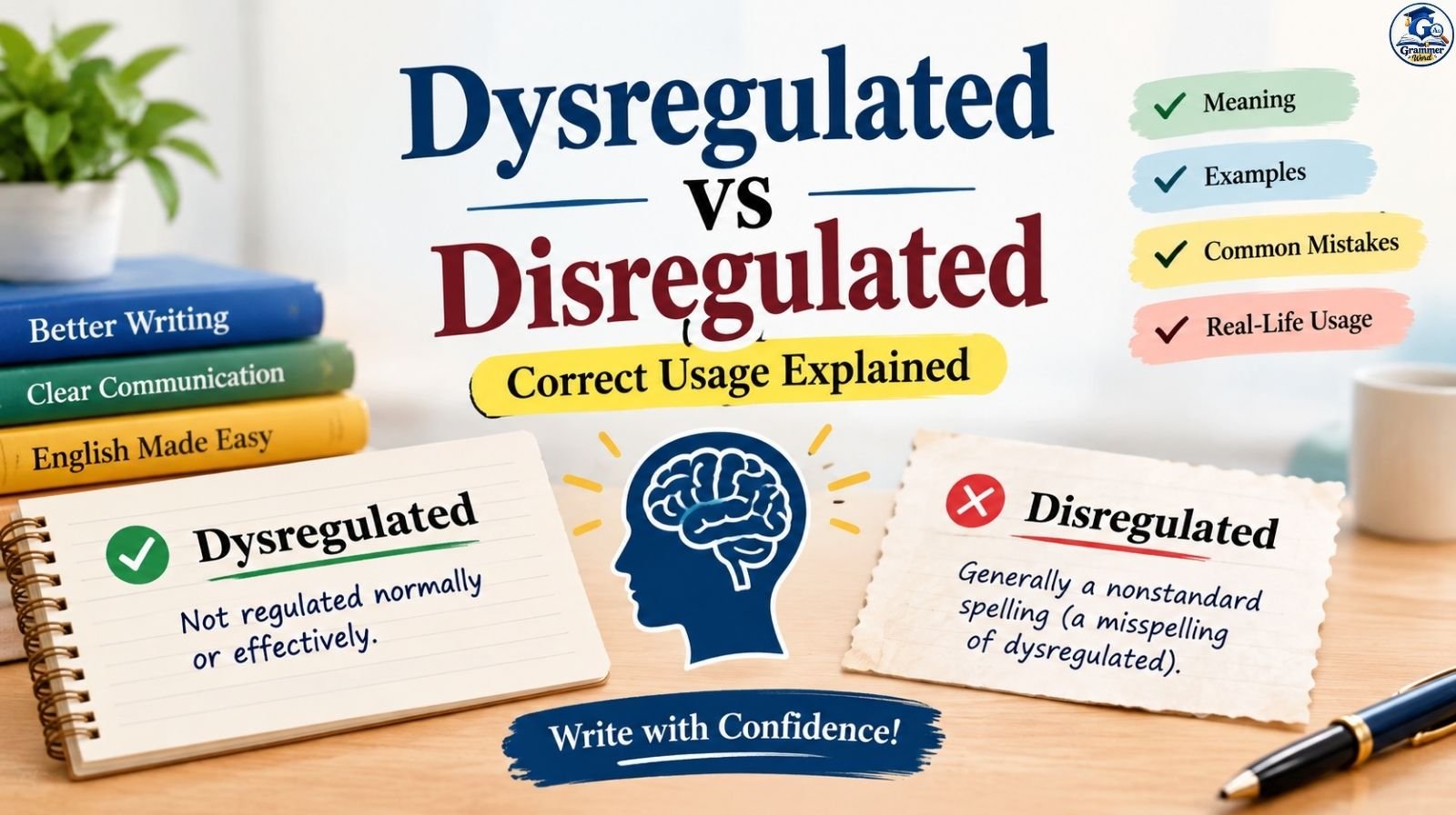
The correct standard form is dysregulated. It describes something that is not being regulated normally or effectively. Disregulated is generally considered a nonstandard spelling and is often used when someone accidentally substitutes dis- for dys-.
In this guide, you will learn the difference between dysregulated vs disregulated, what dysregulated means, why the confusion happens, how to use it correctly, and how it appears in modern psychological and medical writing.
Read More: Further or Farther: Simple Rules And When To Use Each
Dysregulated vs Disregulated: Which One Is Correct?
The short answer is simple: dysregulated is the standard and preferred word.
| Word | Correct in standard English? | Meaning |
|---|---|---|
| Dysregulated | ✅ Yes | Not regulated normally or effectively |
| Disregulated | ❌ Generally nonstandard | Usually a misspelling of dysregulated |
| Deregulated | ✅ Yes | Freed from rules, controls, or government regulation |
Cambridge Dictionary recognizes dysregulated as a specialized adjective used in medical and psychological contexts. It can describe a body process that is not controlled normally or a person whose emotions are difficult to control.
What Does Dysregulated Mean?
Dysregulated means that a system, process, behavior, or emotional response is not functioning within its normal or effective range of regulation.
For example:
- The child became dysregulated after the stressful event.
- Chronic stress can contribute to dysregulated emotional responses.
- The disease caused dysregulated glucose metabolism.
- Her sleep schedule became dysregulated after several weeks of night shifts.
The word can therefore be used beyond emotions. It may describe biological processes, behavior, physiological systems, and other forms of regulation.
Is Disregulated a Correct Word?
In standard contemporary English, disregulated is generally not the form you should use when you mean that something is poorly or abnormally regulated.
The form appears occasionally online, but dictionary references commonly treat disregulated as a misspelling of dysregulated.
So, if you are writing an essay, article, report, professional document, or educational resource, choose dysregulated.
Read More: Lay Down or Lie Down – What’s The Correct Usage?
Why Is Dysregulated the Correct Spelling?
The easiest way to understand the spelling is to look at the prefix.
Dysregulated vs Disregulated: Understanding the Prefix
Dysregulated can be understood as:
dys- + regulated
The prefix dys- is used in English to indicate something abnormal, impaired, difficult, or faulty. It appears in other familiar words such as:
- dysfunction
- dyslexia
- dysphoria
- dysregulation
- dysregulated
Therefore, dysregulated communicates the idea that regulation is present but is not functioning properly.
For example:
His emotional responses became dysregulated during periods of extreme stress.
The sentence does not mean that regulation has simply disappeared. Instead, it suggests that the normal process of managing or controlling the response is impaired or disrupted.
Why People Write Disregulated
The confusion is understandable because dis- is an extremely common English prefix.
We see it in words such as:
- disagree
- disconnect
- disapprove
- disorganized
- dishonest
- disappear
Because disregulated looks like it follows the same pattern, writers may instinctively choose it.
However, the established term used in psychology and medicine is dysregulated.
A simple memory trick is:
Dysregulated = regulation that is abnormal or impaired.
Think of dys- as appearing in dysfunction. Both words describe something that is not working normally.
How to Use Dysregulated Correctly
Dysregulated is most useful when you are describing something whose normal regulation has become impaired, disrupted, excessive, or ineffective.
Dysregulated in Emotional Contexts
One of the most common modern uses is emotional dysregulation.
A person may experience emotions that are unusually intense, difficult to manage, prolonged, or poorly matched to the situation.
Examples include:
- He felt emotionally dysregulated after the argument.
- The child became dysregulated when the routine suddenly changed.
- Emotional dysregulation can affect behavior and decision-making.
- She needed time to become calm after feeling overwhelmed.
Importantly, calling someone dysregulated does not automatically mean that they have a mental health diagnosis. The word describes a pattern or state; context matters.
Read More: Carmel or Caramel: Which One Is Correct?
Dysregulated in Medical or Biological Contexts
The term is also used in scientific and medical writing.
For example:
- The researchers examined dysregulated immune responses.
- The condition is associated with dysregulated hormone activity.
- Dysregulated glucose metabolism can occur in some diseases.
- The study investigated dysregulated cellular signaling.
Cambridge specifically gives medical examples involving dysregulated glucose metabolism and cell-to-cell signaling.
Dysregulated in Everyday Writing
The word has also moved beyond strictly technical contexts.
Someone might casually say:
I’m completely dysregulated after that stressful meeting.
In informal writing, this can mean that the person feels overwhelmed, emotionally unsettled, overstimulated, or unable to regain their usual balance.
However, casual use should not be confused with a clinical diagnosis.
Dysregulated vs Disregulated Examples
Seeing the two forms side by side makes the difference easier to remember.
Correct Examples With Dysregulated
Example 1:
The loud environment left the child feeling dysregulated.
Example 2:
Her emotions became dysregulated after several stressful days.
Example 3:
Researchers observed dysregulated activity in the affected cells.
Example 4:
Poor sleep may affect how a person manages stress and emotional responses.
Example 5:
The patient showed signs of a dysregulated physiological process.
Incorrect or Nonstandard Examples With Disregulated
These sentences should normally be changed:
❌ The child became disregulated after the stressful event.
✅ The child became dysregulated after the stressful event.
❌ The study examined disregulated emotional responses.
✅ The study examined dysregulated emotional responses.
❌ Her nervous system seemed disregulated.
✅ Her nervous system seemed dysregulated.
The key correction is straightforward: replace disregulated with dysregulated when you mean impaired orbnormal regulation.
Read More: Ageing or Aging: Which Spelling Is Correct? A Simple, Clear Guide
A Real-Life Example of Dysregulated Usage
Consider a student preparing for an important examination.
For several nights, the student sleeps poorly, skips meals, drinks excessive amounts of caffeine, and spends hours worrying about the exam. On the morning of the test, a small problem such as losing a pen triggers an unusually strong emotional reaction.
The student becomes frustrated, finds it difficult to concentrate, and feels overwhelmed by a situation that would normally be manageable.
A friend might casually describe the student as dysregulated.
That does not necessarily mean the student has a disorder. Instead, the word can describe a temporary state in which emotional or physiological regulation is not working as effectively as usual.
This example also illustrates why context matters. The same word may be used differently in casual conversation and professional research. In everyday language, dysregulated may describe feeling overwhelmed or unable to settle.
In academic or clinical research, however, researchers may define and measure emotional dysregulation much more precisely.
A 2025 systematic review in the Journal of Child Psychology and Psychiatry examined the processes associated with emotion dysregulation in young people.
The researchers reviewed different cognitive, emotional, behavioral, neural, and social processes rather than treating dysregulation as a single simple mechanism.
This is an important distinction: dysregulated is a descriptive term, and its exact meaning depends on what is being regulated and the context in which the word is used.
What Recent Research Says About Dysregulation
The growing use of dysregulated is not simply an internet spelling trend. The underlying concept of regulation and dysregulation continues to receive substantial attention in psychological research.
2025 Research Data
A 2025 systematic review published in the Journal of Child Psychology and Psychiatry examined research on processes involved in emotional dysregulation among young people.
The review considered evidence from multiple areas, including stimulus processing, response selection and control, emotion generation, and regulatory processes.
Another systematic review published online in July 2025 synthesized 38 studies examining emotion-regulation profiles.
It identified several recurring profiles, with adaptive/selective, moderate/high, and dysregulated profiles appearing most frequently across the included research.
These findings demonstrate that dysregulation is an active research concept in 2025–2026, particularly in psychology and behavioral science.
However, the research also shows that dysregulation is complex and should not be reduced to simply being “out of control.”
Read More: Greatful or Grateful: Which One Is Correct?
What This Means for Everyday Writers
If you encounter the word in a psychology article, healthcare resource, school document, or research paper, dysregulated is the established spelling to recognize.
Therefore, when writing about emotional regulation, behavior, physiology, or biological systems, use dysregulated, not disregulated.
Dysregulated vs Disregulated vs Deregulated
One additional word causes confusion: deregulated.
Although dysregulated and deregulated look similar, they have different meanings.
Dysregulated
Dysregulated means regulation is impaired, abnormal, or not functioning effectively.
The patient’s blood glucose regulation was dysregulated.
Deregulated
Deregulated usually means that rules, controls, or restrictions have been removed or reduced.
The government deregulated the industry.
These meanings are not interchangeable.
Quick Comparison
| Term | Main meaning | Example |
|---|---|---|
| Dysregulated | Regulation is impaired or abnormal | His emotions became dysregulated. |
| Disregulated | Generally nonstandard spelling | Avoid in formal writing |
| Deregulated | Rules or controls have been removed | The market was deregulated. |
A useful rule is:
If something is not regulating properly → dysregulated.
If an authority removes regulations → deregulated.
How to Remember the Correct Word
If you regularly confuse these terms, use this simple three-step check.
Step 1: Ask What You Mean
Are you describing a system that is functioning abnormally?
If yes, you probably need dysregulated.
Step 2: Look for the “Dys-” Pattern
Remember related words such as:
- dysfunction
- dysregulation
- dysregulated
The dys- prefix helps signal abnormal or impaired functioning.
Read More: Ax vs Axe: The Simple Difference Most People Don’t Know
Step 3: Don’t Confuse It With Deregulated
If you are talking about removing government rules, industry controls, or restrictions, use deregulated instead.
For example:
- His emotions were dysregulated. ✅
- The industry was deregulated. ✅
- His emotions were disregulated. ❌ Generally nonstandard
Mini Quiz: Dysregulated vs Disregulated
1. Quick Check: Which spelling is correct?
A) Disregulated
B) Dysregulated
C) Dysregulatted
Answer: B) Dysregulated
2. What does “dysregulated” generally mean?
A) Properly controlled
B) Abnormally or poorly regulated
C) Completely removed
Answer: B) Abnormally or poorly regulated
3. Which sentence uses the correct word?
A) She became disregulated after the stressful event.
B) She became dysregulated after the stressful event.
C) She became deregulated after the stressful event.
Answer: B) She became dysregulated after the stressful event.
4. True or False: “Disregulated” is the preferred standard spelling.
Answer: False
5. Fill in the blank: “His emotions became _____ during the stressful situation.”
A) dysregulated
B) disregulated
C) deregulated
Answer: A) dysregulated
6. Which prefix appears in “dysregulated”?
A) dis-
B) dys-
C) de-
Answer: B) dys-
7. What is emotional dysregulation mainly about?
A) Difficulty regulating emotional responses
B) Removing government rules
C) Learning new vocabulary
Answer: A) Difficulty regulating emotional responses
8. Which word is associated with abnormal or impaired functioning?
A) Dysregulated
B) Deregulated
C) Organized
Answer: A) Dysregulated
9. True or False: “Dysregulated” can describe biological processes as well as emotions.
Answer: True
10. Which sentence is correct?
A) The study examined dysregulated cellular activity.
B) The study examined disregulated cellular activity.
C) The study examined dis-regulated cellular activity.
Answer: A) The study examined dysregulated cellular activity.
11. What does “deregulated” usually mean?
A) Regulation has become abnormal
B) Rules or controls have been removed or reduced
C) Someone is emotionally overwhelmed
Answer: B) Rules or controls have been removed or reduced
12. Which word should you use in formal writing?
A) Disregulated
B) Dysregulated
C) Disregulatted
Answer: B) Dysregulated
13. Spot the mistake: “The child became disregulated after the routine changed.”
A) Child
B) Became
C) Disregulated
Answer: C) Disregulated use “dysregulated.”
14. Which is the easiest memory trick?
A) Dysregulated is related to dysfunction.
B) Disregulated is always correct.
C) Deregulated means emotional distress.
Answer: A) Dysregulated is related to dysfunction.
15. Final Challenge: Which sentence is completely correct?
A) His emotions were dysregulated.
B) His emotions were disregulated.
C) His emotions were deregulated because of stress.
Answer: A) His emotions were dysregulated.
Read More: There or Their: Clear Guide To Correct Usage
FAQs
Q1. Is dysregulated the correct spelling?
Yes. Dysregulated is the standard spelling and is recognized in established dictionary usage, including medical and psychological contexts.
Q2. Is disregulated a real word?
Disregulated appears occasionally in English-language content, but it is generally treated as a nonstandard form or misspelling of dysregulated. For formal and professional writing, use dysregulated.
Q3. What does dysregulated mean in simple terms?
It means that something is not being regulated or controlled normally or effectively. It can describe emotions, behavior, biological processes, and other systems.
Q4. Is emotional dysregulation a diagnosis?
Not by itself. Emotional dysregulation is a descriptive or research concept involving difficulties with emotional regulation. It can occur in connection with different conditions or situations, but the term alone does not establish a diagnosis.
Q5. What is the difference between dysregulated and deregulated?
Dysregulated means regulation is impaired or abnormal. Deregulated means rules, controls, or regulations have been removed or reduced.
Q6. Why do people say disregulated instead of dysregulated?
The mistake is likely encouraged by the familiar dis- prefix found in many English words. Because disregulated looks and sounds plausible, it can be easy to write accidentally. The established term in psychology and medicine is dysregulated.
Q7. What is an easy way to remember dysregulated?
Think of dysfunction. Both dysfunction and dysregulated use dys- to indicate something abnormal or impaired.
Conclusion:
When choosing between dysregulated vs disregulated, the answer is clear: use dysregulated.
Dysregulated is the established form used to describe something that is not regulating normally or effectively.
It can refer to emotions, behavior, physiological processes, biological systems, and other forms of regulation. Disregulated, by contrast, is generally considered nonstandard and should be avoided in formal writing.
Just remember:
Dysregulated = regulation is impaired or abnormal.
Deregulated = regulations or controls have been removed.
Disregulated = generally avoid this spelling.
If you are writing an academic paper, professional report, health article, or everyday message, choosing dysregulated will keep your wording accurate and consistent with established usage.
For more clear word comparisons and practical English usage guides, keep exploring related spelling and grammar questions so you can write with greater confidence
Discover More Article
- Too or To: Complete Guide To Correct Usage
- Cancelation or Cancellation: Which Spelling Is Correct?
- Complement vs Compliment: Stop Confusing These Words Today
- Solicited vs Unsolicited: Differences And Usage
Keep learning with more easy grammar lessons on Grammer Word.com

Hi, I’m Noor Fatima, the person behind this website. I created this site to make English grammar and confusing words easier to understand. I love breaking down tricky words, meanings, spellings, and grammar rules into simple explanations. My goal is to help you learn English naturally, avoid common mistakes, and feel more confident every time you write or speak.