Have you ever seen both aluminum and aluminium and wondered which spelling is correct? You’re not alone. These two words often confuse students, writers, and English learners because they refer to the same chemical element but look slightly different.
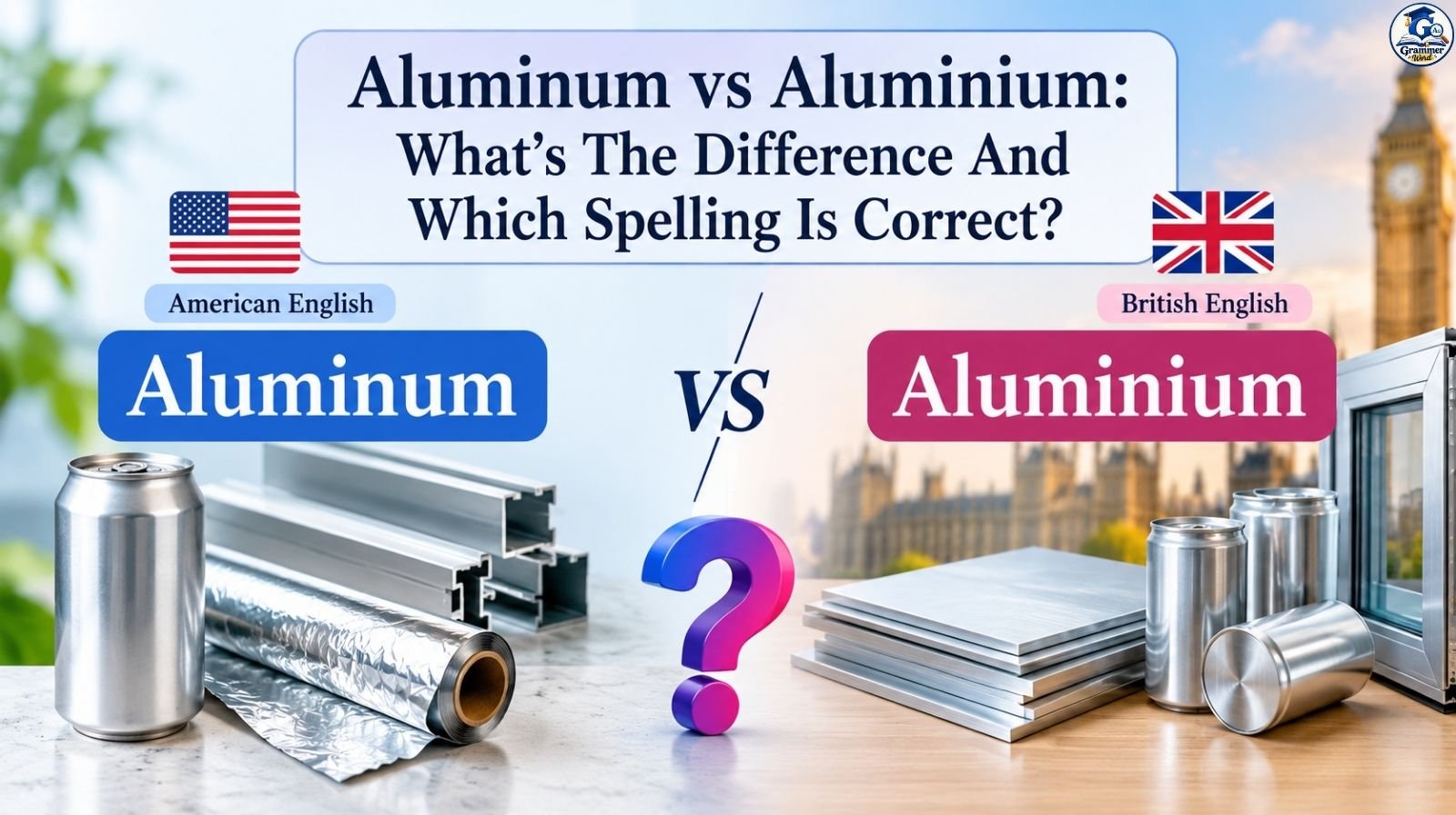
The difference between aluminum vs aluminium is mainly regional spelling. Aluminum is the standard spelling in American English, while aluminium is the standard spelling in British English and many other varieties of English.
Both words describe the same lightweight, silvery metal used in products such as cans, aircraft, kitchen foil, and construction materials.
Therefore, neither spelling is universally wrong; the best choice depends on your audience and the style of English you’re using.
In this guide, you’ll learn the meaning of each word, why the spellings differ, how to use them in sentences, and which version to choose for your writing.
Read More: Bougie or Boujee: What’s The Correct Spelling And Meaning?
What Is the Difference Between Aluminum and Aluminium?
The main difference between aluminum and aluminium is how the word is spelled in different English-speaking regions. Both names refer to the chemical element with the symbol Al and atomic number 13.
Aluminum: The American English Spelling
Aluminum is the preferred spelling in the United States. American dictionaries, educational materials, and publications generally use this version.
Examples:
- The airplane is made partly from aluminum.
- Please wrap the leftovers in aluminum foil.
- The company manufactures aluminum window frames.
If you’re writing for an American audience, use aluminum to maintain consistency with American English conventions.
Aluminium: The British English Spelling
Aluminium is the standard spelling in British English. It is also commonly used in countries such as Australia and New Zealand.
Examples:
- The kitchen window has an aluminium frame.
- Aluminium is widely used in modern construction.
- The factory produces aluminium sheets for packaging.
If your readers primarily use British English, aluminium is usually the better choice.
Are Both Spellings Correct?
Yes. Both are accepted spellings of the same metal’s name.
| Feature | Aluminum | Aluminium |
|---|---|---|
| Meaning | Same chemical element | Same chemical element |
| American English | Standard | Less common |
| British English | Less common | Standard |
| Chemical symbol | Al | Al |
| Atomic number | 13 | 13 |
| Pronunciation | Usually uh-LOO-muh-num | Usually al-yoo-MIN-ee-um |
The key rule is simple: choose the spelling that matches your audience, and use it consistently throughout your article or document.
Read More: Miss or Ms: What’s The Difference And When To Use Each?
Why Do Aluminum and Aluminium Have Different Spellings?
The spelling difference developed through the history of chemistry and the evolution of English. It is a useful example of how American and British English can use different forms of the same word.
The Historical Origin of the Two Spellings
The metal’s name is connected to alum, a substance known long before aluminum was isolated as a metal. British chemist Humphry Davy initially used the name aluminum.
The form aluminium subsequently gained acceptance, following a naming pattern used for many chemical elements. In 1925, the American Chemical Society adopted aluminum as its standard spelling.
Over time, the two spellings became established in different English-speaking regions.
Why American and British English Differ
American and British English have several familiar spelling differences. For example:
- Color / Colour: American / British
- Center / Centre: American / British
- Organize / Organise: Both forms are used, with preferences varying by style
- Aluminum / Aluminium: American / British
These differences do not necessarily indicate that one form is incorrect. Instead, they reflect different language conventions.
Which Spelling Should You Use in 2026?
The same regional rule applies in 2026 as in previous years. There is no need to change your spelling simply because one version looks more scientific or formal.
Use aluminum for American audiences and aluminium for British audiences. For international content, choose a spelling that matches your publication’s established style guide and apply it consistently.
Read More: Repetition vs Parallelism: What’s The Difference In Writing In 2026?
How to Use Aluminum and Aluminium in Sentences
Understanding the regional difference is easier when you see both spellings in context.
Examples Using Aluminum
Use these examples when writing in American English:
- The manufacturer uses aluminum to produce lightweight bicycle frames.
- We bought aluminum foil for wrapping food.
- The building features aluminum doors and windows.
- Aluminum is widely used in the aerospace industry.
- The recycling center accepts aluminum cans.
Examples Using Aluminium
These examples follow British English conventions:
- The manufacturer uses aluminium to produce lightweight bicycle frames.
- We bought aluminium foil for wrapping food.
- The building features aluminium doors and windows.
- Aluminium is widely used in the aerospace industry.
- The recycling centre accepts aluminium cans.
Notice that the meaning remains the same. In the final example, center also changes to centre to match British spelling.
Common Mistakes to Avoid
The most common mistake is assuming that aluminum and aluminium describe different materials.
They do not. Both names refer to the same chemical element. Another mistake is mixing spelling conventions unnecessarily within one article.
For example, a document that uses aluminium, colour, and centre generally follows British English. If the intended audience is American, aluminum, color, and center would usually be more appropriate.
Consistency makes writing easier to read and more professional.
Read More: Solicited vs Unsolicited: Differences And Usage
Aluminum vs Aluminium: A Practical Comparison Guide
When deciding which spelling to use, consider your readers, the purpose of the document, and any style requirements.
Quick Comparison Table
| Situation | Recommended spelling |
|---|---|
| Article for a US audience | Aluminum |
| Article for a UK audience | Aluminium |
| Australian publication | Aluminium |
| American school assignment | Aluminum |
| British school assignment | Aluminium |
| Scientific writing | Follow the journal’s terminology and style |
| International website | Choose one regional style and remain consistent |
A Simple Step-by-Step Guide
Step 1: Identify your audience.
Determine whether your readers primarily use American or British English.
Step 2: Check the style guide.
Follow your teacher’s instructions, publisher’s guidelines, or workplace writing standards.
Step 3: Stay consistent.
Use the same spelling throughout the article, including headings, captions, and examples.
Which Version Is Better for SEO?
Neither spelling is automatically better for SEO. The best choice depends on the search terms your intended audience uses and the language conventions of your website.
For example, a website targeting readers in the United States may naturally use aluminum foil, while a British website may use aluminium foil.
Use the wording that best fits your audience, write genuinely helpful content, and avoid repeating either keyword unnaturally.
A well-written article can serve readers effectively with either spelling.
Read More: Dysregulated vs Disregulated: Correct Usage Explained
Real-Life Example: Choosing the Right Spelling for a Website
Imagine a company that manufactures window frames and sells its products in both the United States and the United Kingdom. Its marketing team needs to publish product descriptions, installation guides, and blog articles for customers in both countries.
Initially, the company uses aluminium across its entire website. This spelling is appropriate for its British customers, who commonly see terms such as aluminium windows and aluminium doors. However, the American marketing team notices that its local product descriptions usually use aluminum windows and aluminum doors.
The company decides to adapt its content for each audience. Its American pages use aluminum, color, and center, while its British pages use aluminium, colour, and centre. The technical specifications remain the same because both spellings refer to the same metal.
The team also avoids creating unnecessary duplicate pages simply to target spelling variations. Instead, it focuses on clear product information, useful installation advice, and terminology familiar to local customers.
This example illustrates an important writing principle: regional spelling should support the reader’s experience rather than distract from the message. Whether you’re writing a school assignment, a technical manual, or an SEO blog post, selecting the appropriate spelling and maintaining consistency helps your content look professional.
Aluminum vs Aluminium: Facts and Statistics for 2025–2026
Although the spelling difference is linguistic, the metal itself remains important across manufacturing, transportation, packaging, and construction.
Read More: CatchUp vs Catch Up: Differences, Meaning, And Correct Usage
Key Facts About the Metal
| Fact | Information |
|---|---|
| Chemical symbol | Al |
| Atomic number | 13 |
| Appearance | Silvery-white |
| Density | Approximately 2.70 g/cm³ |
| State at room temperature | Solid |
| Common uses | Cans, foil, aircraft parts, and window frames |
What Recent Production Data Tells Us
The spelling difference has not changed, but the metal’s industrial importance is reflected in recent production figures.
- 2025: Global primary aluminium production reached approximately 73.78 million metric tonnes, according to figures attributed to the International Aluminium Institute and reported in January 2026.
- 2026: Recent industry reporting and energy-sector analysis continue to examine aluminium production, energy demand, and emissions.
These figures describe the industry, not the frequency of the two spellings. There is no reason to infer that one spelling is more correct because more metal is produced in a particular country.
For readers, students, and writers, the useful takeaway remains the same: the spelling depends on regional English conventions, while the chemical identity stays unchanged.
Read More: Leafs vs Leaves: Which Is Correct And How To Use Them?
Frequently Asked Questions
1. Is aluminum or aluminium correct?
Both are correct. Aluminum is standard in American English, while aluminium is standard in British English and many other varieties of English.
2. Why do Americans spell it aluminum?
The spelling aluminum was used early in the naming history of the metal and was later adopted as the standard form by the American Chemical Society in 1925.
3. Is aluminium British English?
Yes. Aluminium is the standard British English spelling and is also widely used in Australian and New Zealand English.
4. Do aluminum and aluminium mean different things?
No. Both words refer to the same chemical element, with the symbol Al and atomic number 13.
5. Which spelling should I use in an academic paper?
Follow your institution’s or publisher’s style guide. Use aluminum if the required convention is American English and aluminium if it is British English, unless the publication specifies otherwise.
6. Which spelling should I use for SEO?
Choose the spelling that fits your target audience and the language conventions of your website. Use relevant search terms naturally, provide helpful information, and avoid keyword stuffing.
7. How do you remember the difference between aluminum and aluminium?
Use this simple memory tip: American English uses aluminum; British English uses aluminium. Remember the extra i in the British form, and keep your spelling consistent.
Conclusion:
The difference between aluminum vs aluminium is a matter of regional spelling, not meaning or chemical composition. Both words identify the same lightweight, silvery metal used in everyday products and industrial applications.
Remember these simple rules:
- Choose aluminum when writing for an American audience.
- Choose aluminium when writing for a British, Australian, or New Zealand audience.
- Follow your required style guide for academic, technical, and professional documents.
- Maintain consistent spelling throughout your content.
Neither spelling is universally wrong, so you don’t need to worry about choosing between them without considering your readers.
Ready to improve your English spelling? Use the examples and comparison table in this guide whenever you need to decide between aluminum and aluminium, and share this article with someone who has wondered about the difference.
Keep learning with more easy grammar lessons on Grammer Word

Hi, I’m Noor Fatima, the person behind this website. I created this site to make English grammar and confusing words easier to understand. I love breaking down tricky words, meanings, spellings, and grammar rules into simple explanations. My goal is to help you learn English naturally, avoid common mistakes, and feel more confident every time you write or speak.