Have you ever wondered whether to write leafs or leaves? Although both spellings are correct in certain contexts, they are not interchangeable in everyday English. Choosing the right word depends on what you mean and how you use it in a sentence.
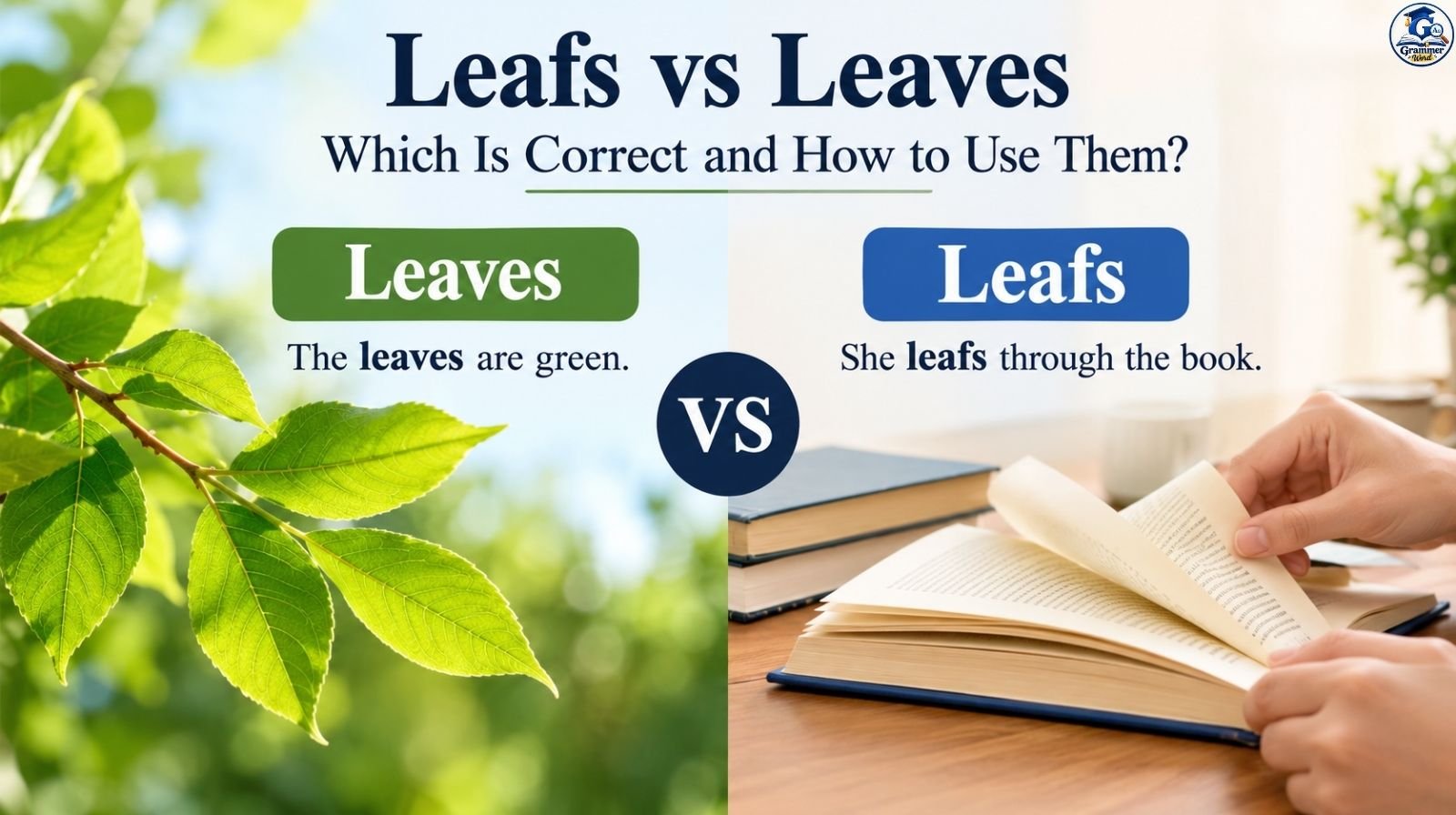
Leaves is the standard plural of leaf when referring to the parts of a plant. Leafs is mainly used as a verb form meaning that someone leafs through pages, or as part of a proper name, such as the Toronto Maple Leafs hockey team.
In this guide, you will learn the difference between leafs and leaves, understand their grammatical rules, and explore simple examples that will help you use both words confidently.
Read More: Provider vs Providor: Which Word Is Correct?
What Is the Difference Between Leafs and Leaves?
The main difference between leafs and leaves is their grammatical function and context. Both are legitimate English words, but they serve different purposes.
What Does Leaves Mean?
Leaves is the usual plural noun of leaf. It refers to more than one leaf growing on a tree, plant, or flower.
Examples:
- The tree loses its leaves during autumn.
- Green leaves help plants capture sunlight.
- I collected colorful leaves from the garden.
- The plant has several new leaves.
The word leaves can also be a verb form of leave, meaning to go away or depart.
Examples:
- She leaves for work at eight every morning.
- He leaves his books on the desk.
Therefore, the correct meaning depends on the sentence.
What Does Leafs Mean?
Leafs is commonly used as the third-person singular form of the verb leaf, meaning to turn pages or browse through a book or document.
Examples:
- She leafs through the magazine while waiting.
- He leafs through his old photographs.
- The student leafs through the textbook to find the answer.
Leafs also appears in proper names. A well-known example is the Toronto Maple Leafs, a professional ice hockey team.
However, when talking about several leaves on a tree, leaves is the standard spelling.
Read More: Coozie vs Koozie: Which One Is Correct And How Do You Use It?
Why Does Leaf Become Leaves?
English has several irregular plural nouns. Instead of simply adding -s or -es, some words change their endings when they become plural.
The Rule Behind the Spelling Change
Many nouns ending in -f or -fe change that ending to -ves in the plural form.
For example:
| Singular | Plural |
|---|---|
| Leaf | Leaves |
| Wolf | Wolves |
| Knife | Knives |
| Wife | Wives |
| Life | Lives |
| Shelf | Shelves |
This pattern explains why we normally write leaves instead of leafs when discussing plants.
However, English spelling has exceptions. Some nouns ending in -f retain the -f and simply add -s.
Examples include:
- Roof → roofs
- Chief → chiefs
- Belief → beliefs
Therefore, it is best to learn the plural form of each noun rather than assume every word follows the same rule.
Read More: Suing vs Sueing: Which Spelling Is Correct?
Is Leafs Ever Grammatically Correct?
Yes. Leafs is grammatically correct when used as a verb or as part of a proper name.
For example:
- She leafs through the newspaper every morning.
- The Toronto Maple Leafs won the game.
In the first sentence, leafs describes an action. In the second, it is part of a team’s official name.
Leafs vs Leaves: Examples and Usage

Understanding how each word works in real sentences makes the difference easier to remember.
Examples of Leaves in Sentences
Use leaves when the plural noun refers to plant foliage.
- The leaves on the maple tree turned red.
- Dry leaves covered the garden path.
- The gardener removed the damaged leaves.
- Fresh leaves appeared after the rain.
- Birds sometimes build nests among thick leaves.
You can also use leaves as a verb form of leave.
- My brother leaves home early.
- The bus leaves at noon.
- She leaves a note beside the door.
Examples of Leafs in Sentences
Use leafs when describing someone browsing through pages.
- He leafs through the dictionary to find a word.
- She leafs through her travel journal.
- The librarian leafs through the old manuscript carefully.
It is also correct in the official name Toronto Maple Leafs.
Quick tip: If you are talking about plant parts, choose leaves. If you mean browsing through pages, leafs may be the correct verb.
Read More: Fluorescent vs Flourescent: Difference And Usage
A Simple Comparison Guide for Leafs vs Leaves

The following table summarizes the main differences so you can choose the correct word quickly.
| Feature | Leafs | Leaves |
|---|---|---|
| Plural of the plant noun leaf | No, not in standard usage | Yes |
| Verb meaning to browse through pages | Yes | No |
| Verb form of leave | No | Yes |
| Used in the team name Toronto Maple Leafs | Yes | No |
| Example | She leafs through a book. | The leaves are green. |
How to Choose the Correct Word
Follow these simple steps:
- Are you talking about plant parts? Use leaves: “The leaves are falling.”
- Are you describing someone turning pages? Use leafs: “He leafs through the book.”
- Are you talking about someone departing? Use leaves: “She leaves at six.”
- Are you writing a team’s official name? Preserve the spelling Toronto Maple Leafs.
These checks cover the most common situations in which the two spellings cause confusion.
Read More: Dilemma vs Dilema: Which One Is Correct?
A Real-Life Example: Choosing Between Leafs and Leaves
Imagine that Emma is writing a short report about a school garden. She wants to describe how the garden changes during autumn, but she is unsure whether to write leafs or leaves.
Her first sentence reads, “The trees lose their colorful leafs in October.” Although readers may understand her meaning, the plural noun is incorrect in standard English. She should write, “The trees lose their colorful leaves in October.”
Later, Emma describes her science teacher looking for information in a gardening book. She writes, “The teacher leafs through the book to find information about autumn plants.” This time, leafs is correct because it describes the action of turning pages.
Finally, Emma writes about a local ice hockey team in a separate paragraph. If she mentions the Toronto Maple Leafs, she must preserve the team’s official name rather than change it to “Toronto Maple Leaves.”
This example demonstrates why context matters more than simply memorizing the spellings. Emma needs leaves for the plural noun, leafs for the browsing action, and Maple Leafs for the team’s name.
The practical lesson is straightforward: identify the meaning of the word before deciding how to spell it. Doing so helps you avoid common grammar mistakes in school assignments, articles, emails, and everyday writing.
Read More: Wholey vs Wholly: Difference, Meaning, And Correct Usage
Common Mistakes and Helpful Grammar Tips
Even experienced English writers sometimes confuse these words because their spelling patterns look similar.
Mistake 1: Using Leafs as a Plant Noun
Incorrect: The garden is full of green leafs.
Correct: The garden is full of green leaves.
Remember that leaves is the standard plural of leaf when referring to foliage.
Mistake 2: Confusing Leaves With Leafs as a Verb
Incorrect: She leaves through the pages of the book.
Correct: She leafs through the pages of the book.
The verb leaf through means to browse or turn pages. In contrast, leaves is a form of the verb leave, meaning to depart or go away.
Mistake 3: Changing an Official Name
Incorrect: The Toronto Maple Leaves are playing tonight.
Correct: The Toronto Maple Leafs are playing tonight.
Proper names should retain their official spelling, even when that spelling differs from the usual plural form of a common noun.
A Simple Memory Trick
Think of the word leaves as the word you normally see growing on trees. Remember leafs through a book as an action involving pages.
This small distinction can make the correct spelling much easier to recall.
Read More: Bony vs Boney: Difference, Meaning, And Usage
FAQs
Q1. Is leafs or leaves correct?
Both are correct in specific contexts. Leaves is the standard plural noun for plant foliage, while leafs is a verb meaning to browse through pages or part of a proper name.
Q2. Why is the plural of leaf leaves instead of leafs?
The word follows a common English spelling pattern in which some nouns ending in -f change to -ves in the plural. Therefore, leaf becomes leaves.
Q3. Can I use leafs when talking about trees?
In standard English, use leaves when referring to multiple plant leaves. Writing leafs for this meaning is generally considered a spelling mistake.
Q4. What does leafs through a book mean?
It means to turn or browse through the pages of a book, often quickly or without reading every word.
Example: “He leafs through the magazine while waiting for his appointment.”
Q5. Why is the hockey team called the Toronto Maple Leafs?
The Toronto Maple Leafs is the team’s official proper name. Proper names do not always follow the ordinary plural spelling rules used for common nouns.
Q6. Is leaves also a verb?
Yes. Leaves can be the third-person singular form of leave.
Example: “She leaves the office at five o’clock.”
Q7. What is the easiest way to remember leafs vs leaves?
Use leaves for plant parts and for the verb meaning to depart. Use leafs when someone browses through pages or when reproducing a proper name such as the Toronto Maple Leafs.
Conclusion:
The difference between leafs and leaves becomes simple once you understand their meanings. Leaves is the correct plural of leaf when referring to plants, while leafs is used as a verb meaning to browse through pages and in certain proper names.
For example, write “The leaves are falling from the trees,” but “She leafs through a magazine.” If you mention the hockey team, keep its official name, the Toronto Maple Leafs.
The next time you are unsure which spelling to use, check the context before writing. Apply these simple rules to make your English clearer, more accurate, and more confident.
Ready to improve your English? Keep practicing with real sentences, learn common irregular plurals, and review your writing to catch small spelling mistakes before they become habits.
Keep learning with more easy grammar lessons on Grammer Word

Hi, I’m Noor Fatima, the person behind this website. I created this site to make English grammar and confusing words easier to understand. I love breaking down tricky words, meanings, spellings, and grammar rules into simple explanations. My goal is to help you learn English naturally, avoid common mistakes, and feel more confident every time you write or speak.