Have you ever wondered whether to write bony or boney? These two spellings can be confusing because they look almost identical and have the same pronunciation.
Whether you are writing an essay, an article, or an everyday message, choosing the right word can make your writing clearer.
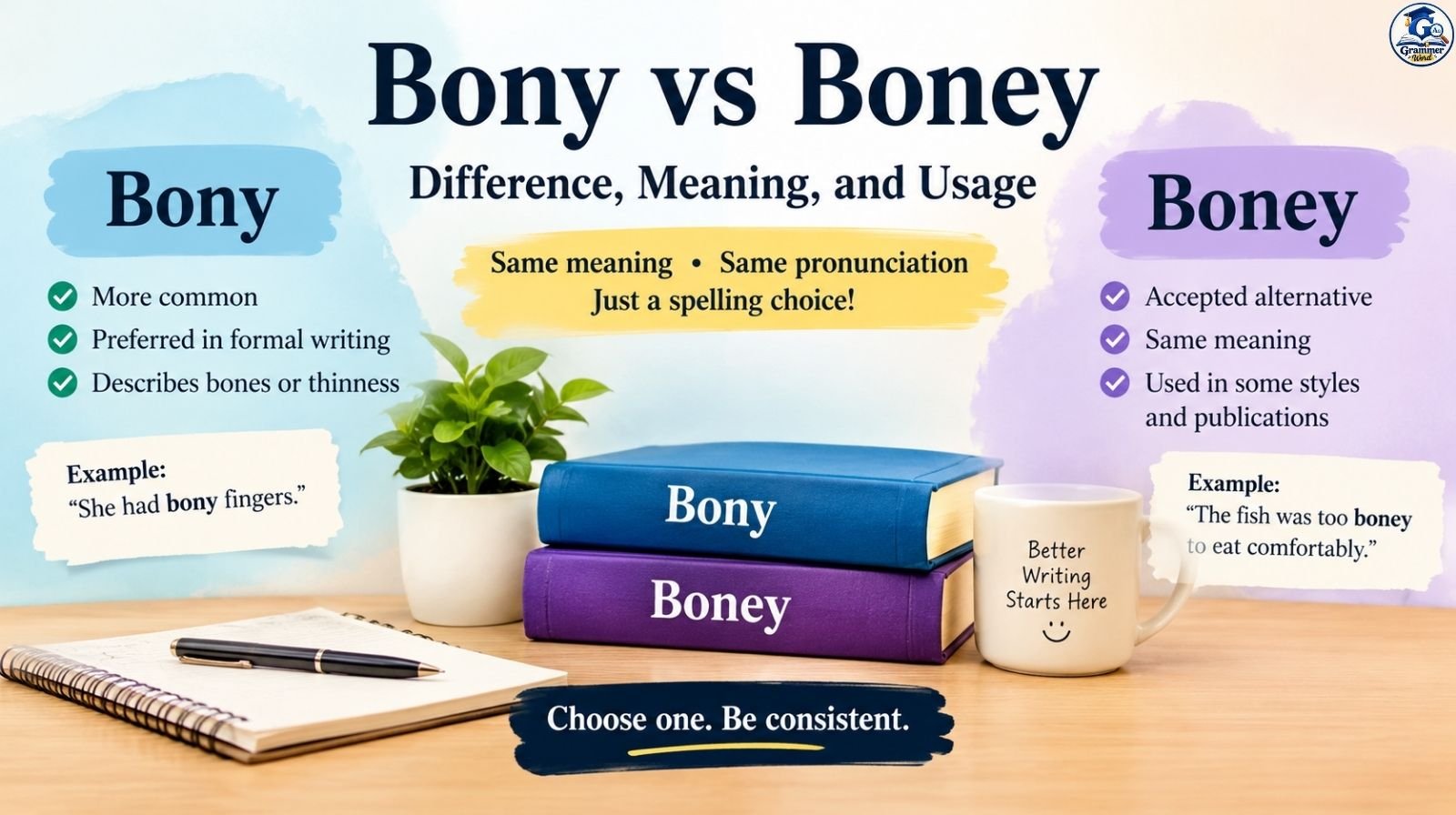
The good news is that both bony and boney are accepted English spellings. Bony is the more common and conventional spelling, while boney is an accepted variant.
Both words can describe someone who is very thin, something related to bones, or something that contains many bones.
In this guide, you will learn the meanings of bony and boney, understand their differences, explore practical examples, and discover which spelling is best for your writing.
What Does Bony Mean?

Meaning of Bony
Bony is an adjective that describes something related to bones or something so thin that the bones are noticeable. It can also describe fish or other foods containing many bones.
The word is commonly used in everyday English, descriptive writing, and discussions about anatomy.
Examples:
- She had long, bony fingers.
- The doctor examined the bony structure of the patient’s wrist.
- We ordered a fish dish, but it was surprisingly bony.
- His bony shoulders were visible beneath his shirt.
In these examples, bony describes a physical feature, a bone structure, or the presence of bones.
How to Use Bony in a Sentence
Use bony when describing a person’s appearance, a body part, or an object containing bones.
Consider these examples:
- Appearance: The old man’s bony hands rested on the table.
- Anatomy: The skull forms a protective bony structure around the brain.
- Food: This fish is delicious, although it is quite bony.
- Animal description: The horse had a narrow face and bony legs.
The meaning depends on the context. When describing a person, the word can suggest thinness or prominent bones. When describing anatomy, it refers to bones or a bone-like structure.
Is Bony a Common English Word?
Yes. Bony is the conventional spelling you should generally use in schoolwork, professional writing, and online articles.
For example:
“She rested her bony elbows on the desk.”
This sentence sounds natural and follows standard spelling conventions. Although boney is also accepted, bony is the safer default when you are unsure which spelling to choose.
What Does Boney Mean?

Meaning of Boney
Boney is an accepted alternative spelling of bony. It has the same pronunciation and generally carries the same meanings.
Examples:
- The old dog had a boney face.
- The cattle looked boney after the long winter.
- The fish had a boney structure that made eating it difficult.
These sentences use boney in the same way that bony could be used.
Is Boney Incorrect?
No. Calling boney incorrect in every situation would be misleading. It is a recognized spelling variant.
However, the fact that both spellings are accepted does not mean they are equally common in every publication or style guide. Many editors and writers prefer bony because it is the conventional spelling.
For example:
- Preferred in most general writing: The child had bony knees.
- Also acceptable: The child had boney knees.
Both sentences communicate essentially the same idea.
When Should You Use Boney?
You can use boney when it matches the spelling used by a publication, a particular writing style, or an established piece of text.
For example, if you are quoting a source that uses boney, preserve its original spelling in the quotation.
Otherwise, choose bony for consistency, especially when writing formal assignments, educational content, or professional articles.
Bony vs Boney: What Is the Difference?
Main Differences Between Bony and Boney
The central difference is spelling preference rather than meaning. Both words are pronounced the same way and can describe thinness or something associated with bones.
| Feature | Bony | Boney |
|---|---|---|
| Correct spelling | Yes | Yes |
| Meaning | Related to bones or very thin | Same general meaning |
| Pronunciation | BOH-nee | BOH-nee |
| Word type | Adjective | Adjective |
| General usage | More common and preferred | Accepted variant |
| Formal writing | Recommended default | Acceptable when appropriate |
Which Spelling Should You Choose?
If you are unsure, choose bony. It is the more conventional option and works well in most writing situations.
For example:
- Write “bony fingers” rather than “boney fingers” when following standard editorial preferences.
- Write “bony structure” in a general anatomy explanation.
- Use “boney” if a source, quotation, or house style specifically calls for it.
The goal is not to treat the alternative as wrong but to maintain consistency throughout your writing.
Easy Trick to Remember the Difference
Remember this simple rule:
Bony = the preferred spelling. Boney = an accepted alternative.
You do not need to memorize two separate definitions because the words generally mean the same thing.
If you are editing a document, search for both spellings and choose one form consistently unless you are reproducing a source’s original wording.
Real-Life Examples of Bony vs Boney

Everyday Examples
Here are several examples showing how both spellings work in natural sentences.
| Sentence Using Bony | Alternative Using Boney |
|---|---|
| She has bony hands. | She has boney hands. |
| His bony knees hurt after the hike. | His boney knees hurt after the hike. |
| The fish was too bony to eat comfortably. | The fish was too boney to eat comfortably. |
| The doctor examined the bony area. | The doctor examined the boney area. |
| The dog had a bony face. | The dog had a boney face. |
The sentences in each row express essentially the same idea. The difference is the spelling choice, not a change in the word’s basic meaning.
A Practical Writing Case Study
Imagine a student named Sarah preparing an English assignment about human anatomy. She writes the following sentence in her first draft:
“The doctor studied the boney structure of the patient’s wrist.”
Sarah is unsure whether boney is a spelling mistake. After checking the spelling, she discovers that boney is recognized as a variant of bony. Therefore, she does not need to change the sentence simply because the spelling is unfamiliar.
However, Sarah wants her assignment to follow conventional academic spelling. She decides to revise it to:
“The doctor studied the bony structure of the patient’s wrist.”
She then reviews the rest of her assignment and notices that she has used both spellings. To make the document consistent, she changes the remaining instances of boney to bony, except where the original spelling appears in a direct quotation.
This example illustrates an important writing principle: recognizing an acceptable variant is different from deciding which form best suits a particular document.
Sarah’s choice is practical because it follows a consistent spelling preference without incorrectly labeling boney as universally wrong.
The same approach works for students, bloggers, editors, and professional writers. When two spellings are accepted, consider your audience, follow your preferred writing style, and use one form consistently.
Common Mistakes to Avoid
Watch out for these common errors:
- Assuming boney is always wrong: It is an accepted spelling variant.
- Using both spellings randomly: Choose a consistent form.
- Confusing spelling with meaning: The two forms generally mean the same thing.
- Ignoring context: A bony hand, a bony fish, and a bony structure use the adjective in different but related ways.
- Using the word insensitively: Describing someone as bony may sound unkind depending on the context. Choose descriptive language thoughtfully.
Bony vs Boney: Usage Trends and Dictionary Evidence in 2025–2026

What Does the Available Evidence Tell Us?
There is no verified statistic presented here that measures the exact percentage of English writers using bony compared with boney in 2025–2026. It would be misleading to invent a percentage or claim that one spelling has increased by a particular amount.
However, established spelling conventions provide a useful basis for explaining their status.
- Spelling recognition: Both forms are accepted, with boney serving as a variant of bony.
- Standard spelling guidance: Bony is the practical default for general English writing.
- Editorial consistency: Writers can improve clarity by selecting one spelling and using it consistently.
Why Does This Matter for Writers?
Spelling decisions affect readability, editing, and consistency. Although the difference between bony and boney is small, readers may question an unfamiliar spelling if they have not encountered it before.
For educational websites, blogs, and grammar guides, using bony as the primary form helps establish a clear editorial standard. You can still explain that boney is accepted so readers understand why they may see both spellings elsewhere.
The best approach is to rely on established spelling conventions, avoid unsupported usage statistics, and prioritize clarity over unnecessary spelling rules.
Bony vs Boney: Mini Quiz Questions
Test your English spelling skills with these 15 quick and easy questions about Bony vs Boney. Check each answer right after the question and see how well you know the difference!
1. Which Is the More Common Spelling?
A. Boney B. Bony C. Bonee D. Bonie
Answer: B. Bony It is the more common and conventional spelling.
2. Is “Boney” an Accepted Spelling?
A. Yes B. No
Answer: A. Yes Boney is an accepted alternative spelling of bony.
3. Fill in the Blank
“She had long, _____ fingers.”
A. Bonee B. Boney C. Bony D. Bonie
Answer: C. Bony Bony is the preferred spelling in general writing.
4. What Part of Speech Is “Bony”?
A. Verb B. Adjective C. Adverb D. Pronoun
Answer: B. Adjective It describes a person, body part, or object.
5. True or False: Bony and Boney Have the Same Pronunciation.
Answer: True Both are pronounced BOH-nee.
6. Which Word Can Describe a Fish With Many Bones?
A. Bony B. Quickly C. Bright D. Smooth
Answer: A. Bony For example, “This fish is very bony.”
7. Choose the Best Spelling for Formal Writing.
A. Boney B. Bonie C. Bony D. Bonee
Answer: C. Bony It is the conventional choice for most formal writing.
8. True or False: “Boney” Is Always a Spelling Mistake.
Answer: False Boney is an accepted spelling variant.
9. Fill in the Blank
“The old man’s _____ hands rested on the table.”
A. Bony B. Bonie C. Bonee D. Bonny
Answer: A. Bony It describes hands with prominent bones.
10. What Is the Main Difference Between Bony and Boney?
A. Their pronunciation B. Their basic meaning C. Their spelling preference D. Their part of speech
Answer: C. Their spelling preference The words generally share the same meaning and pronunciation.
11. Which Sentence Uses “Bony” Correctly?
A. She bony quickly to school. B. He had bony knees. C. They bony every day. D. Bony is runningly.
Answer: B. He had bony knees. Bony correctly describes the person’s knees.
12. What Does “Bony Structure” Refer To?
A. A structure related to bones B. A colorful structure C. A soft fabric D. A musical instrument
Answer: A. A structure related to bones The adjective describes a bone-related structure.
13. Which Spelling Should You Use Consistently in an Article?
A. Change spellings randomly B. Use only misspelled forms C. Choose one preferred spelling D. Avoid adjectives completely
Answer: C. Choose one preferred spelling Consistency makes writing clearer and more professional.
14. Fill in the Blank
“The horse had a narrow face and _____ legs.”
A. Boney B. Bony C. Bonee D. Bonie
Answer: B. Bony It is the conventional spelling for describing the horse’s legs.
15. What Is the Easiest Rule to Remember?
A. Both words have completely different meanings. B. Boney is always incorrect. C. Bony is preferred; boney is an accepted alternative. D. Neither word is an adjective.
Answer: C. Bony is preferred; boney is an accepted alternative. This simple rule helps you choose the right spelling for most writing situations.
FAQs
Q1. Is Bony or Boney Correct?
Both are accepted. Bony is the more conventional spelling, while boney is an accepted alternative.
Q2. What Does Bony Mean?
Bony describes something related to bones, something with prominent bones, or something containing many bones, such as certain fish.
Q3. Does Boney Mean the Same as Bony?
Yes. In ordinary English usage, boney generally has the same meaning as bony.
Q4. Is Boney a Spelling Mistake?
Not necessarily. It is a recognized spelling variant. However, bony is usually the better default for formal and general writing.
Q5. Which Spelling Is Better for Academic Writing?
Use bony unless your institution, publisher, or required style guide specifies otherwise.
Q6. How Do You Pronounce Bony and Boney?
Both are pronounced the same way: BOH-nee.
Q7. Can I Use Bony to Describe Fish?
Yes. Bony can describe fish that contain many bones, as in “This fish is very bony.”
Conclusion:
The difference between bony vs boney is mainly a matter of spelling preference. Both forms are accepted, share the same pronunciation, and generally have the same meaning.
However, bony is the more conventional spelling and is the best choice for most everyday, academic, and professional writing.
Remember these three points:
- Choose bony as your default spelling.
- Recognize boney as an acceptable alternative.
- Keep your spelling consistent throughout your writing.
Now that you understand the difference, you can use either form with confidence and make better spelling decisions.
Discover More Article
- Elude vs Allude: Which One Is Correct And How Do You Use Them?
- Whoa vs Woah: Which One Is Correct? Meaning, Usage, And Examples
- CatchUp vs Catch Up: Differences, Meaning, And Correct Usage
- Wholey vs Wholly: Difference, Meaning, And Correct Usage
Keep learning with more easy grammar lessons on Grammer Word.com

Hi, I’m Noor Fatima, the person behind this website. I created this site to make English grammar and confusing words easier to understand. I love breaking down tricky words, meanings, spellings, and grammar rules into simple explanations. My goal is to help you learn English naturally, avoid common mistakes, and feel more confident every time you write or speak.