Have you ever wondered whether the correct spelling is suing or sueing? These two spellings look similar, so it is easy to see why people get confused. However, only one is correct in standard English.
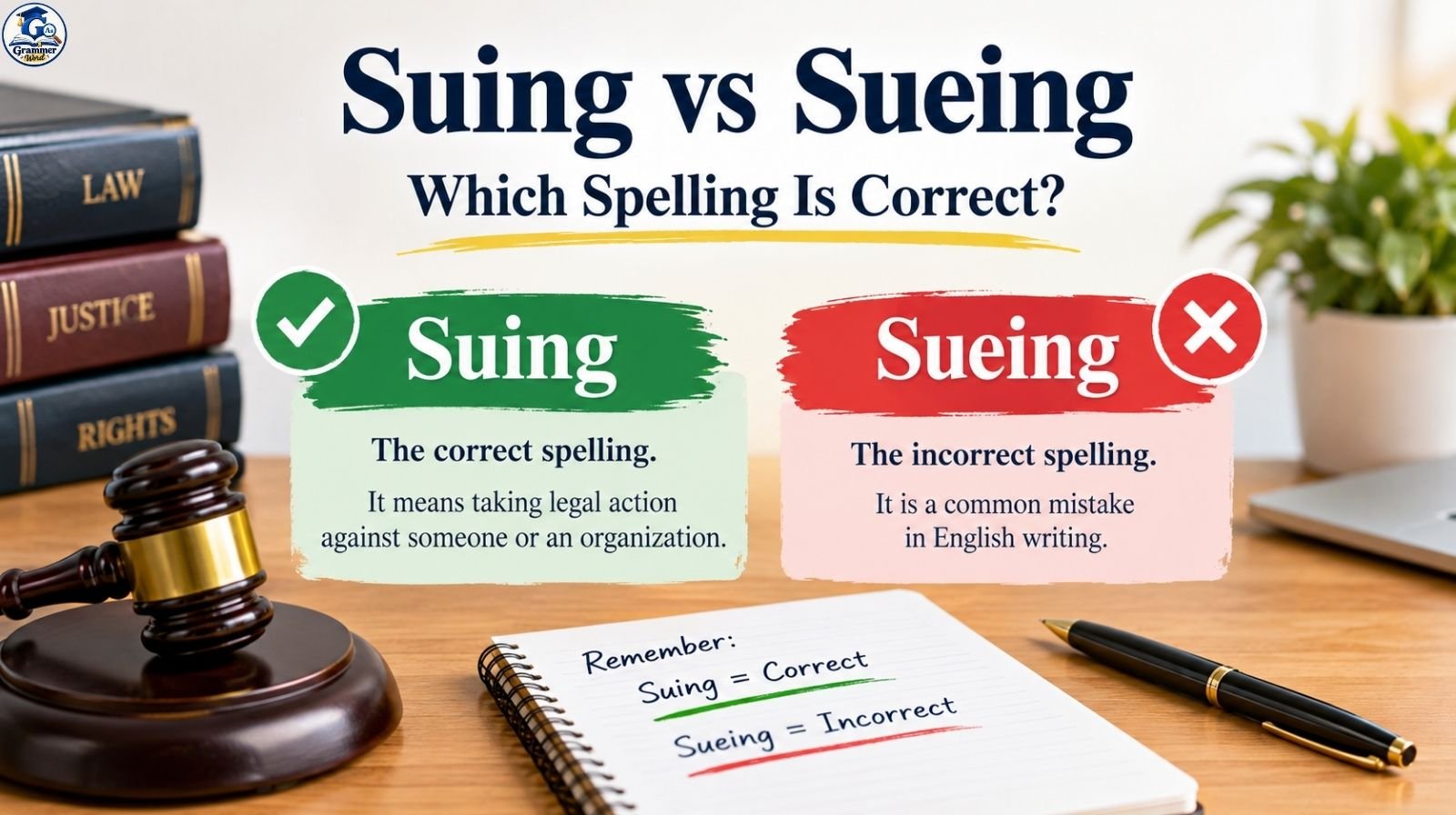
The correct spelling is suing. It is the present participle of the verb sue, which means to take legal action against someone or an organization. When adding -ing to sue, you drop the final e to form suing, not sueing.
In this guide, you will learn why suing is correct, understand the spelling rule, explore practical examples, and discover how to avoid this common English spelling mistake.
Read More: Provider vs Providor: Which Word Is Correct?
What Is the Difference Between Suing and Sueing?
The main difference is that suing is the correct spelling, while sueing is a misspelling in standard modern English.
Both forms may appear in online searches or informal writing, but only suing should be used in professional documents, school assignments, and legal contexts.
Suing: The Correct Spelling
Suing is the present participle and gerund form of the verb sue. It refers to taking legal action against a person, business, or organization.
Examples:
- She is suing her former employer for unpaid wages.
- The company is suing a competitor over a contract dispute.
- Suing someone can involve considerable time and expense.
- They are considering suing the landlord over property damage.
In each sentence, suing describes legal action or the act of taking someone to court.
Sueing: The Incorrect Spelling
Sueing is a common spelling mistake. It usually occurs because writers assume that the final e in sue must remain when adding -ing.
Incorrect: She is sueing the company for damages.
Correct: She is suing the company for damages.
The important point is simple: although the base verb is spelled sue, its standard -ing form is suing.
Read More: Dilemma vs Dilema: Which One Is Correct?
Why Is Suing Correct and Sueing Incorrect?
The spelling follows a common English rule for verbs ending in a silent e. In most cases, when you add -ing to a verb ending in a silent e, you remove the final e first.
The Drop-the-Final-E Rule
The general pattern is:
Verb ending in silent e + ing = remove e + ing
Here are some common examples:
| Base verb | Correct -ing form | Incorrect form |
|---|---|---|
| Sue | Suing | Sueing |
| Make | Making | Makeing |
| Write | Writing | Writeing |
| Hope | Hoping | Hopeing |
| Bake | Baking | Bakeing |
| Dance | Dancing | Danceing |
This spelling rule makes words easier to recognize and helps maintain standard English spelling conventions.
Are There Exceptions to the Rule?
Yes. English spelling has exceptions, so the rule does not apply identically to every verb.
For example, verbs ending in -ee generally retain both letters when adding -ing:
- See → seeing
- Agree → agreeing
- Free → freeing
The verb dye also retains its e in dyeing to distinguish it from dying, the -ing form of die.
However, none of these exceptions changes the standard spelling of sue: its correct -ing form is suing.
Read More: Mentioned vs Mentionned: Difference, Meaning, And Usage
How to Use Suing Correctly in a Sentence
Understanding the meaning of suing makes it easier to use the word naturally. It generally appears when discussing lawsuits, disputes, legal rights, or possible court action.
Examples in Everyday English
Here are several examples showing how suing works in different contexts:
- The customer is suing the manufacturer over a defective product.
- He threatened to sue, but he has not started suing anyone.
- The family is suing the hospital over alleged negligence.
- They discussed suing the contractor after the repairs failed.
- The business is suing its former partner over a financial disagreement.
- She is thinking about suing for damages.
- Suing a company does not guarantee that you will win the case.
Notice that suing can follow auxiliary verbs such as is, are, and was. It can also function as a noun-like gerund, as in “Suing can be expensive.”
Examples in Formal and Professional Writing
In legal and professional writing, correct spelling matters because it improves clarity and credibility.
Incorrect: The employee is sueing the employer for wrongful termination.
Correct: The employee is suing the employer for wrongful termination.
Incorrect: Sueing a business may require legal advice.
Correct: Suing a business may require legal advice.
Always use suing in reports, emails, academic assignments, and other formal documents.
Read More: Occurring vs Occuring: Which One Is Correct?
Suing vs Sueing: A Real-Life Example
A Workplace Dispute
Imagine an employee named Daniel who believes his former employer failed to pay him the wages he was owed. After discussing the situation with a qualified legal professional, Daniel decides to explore his legal options.
While writing an email to a friend, he types, “I am thinking about sueing my former employer.” Although the meaning is understandable, the spelling is incorrect.
A grammar checker or careful proofreader would identify sueing as a spelling error. Daniel revises the sentence to read, “I am thinking about suing my former employer.”
The corrected version follows the standard rule for verbs ending in a silent e. It also makes the email look more polished and professional.
Later, Daniel prepares a formal summary of the dispute. He writes, “The employee is considering suing the company over unpaid wages.” This sentence uses the correct spelling in a more formal context.
This example illustrates why a small spelling detail matters. Whether you are writing a personal message, a workplace email, or a formal account of a legal dispute, using suing helps your writing meet standard English conventions.
Of course, correct spelling does not determine the outcome of a legal matter, but it does help communicate your meaning clearly.
Read More: Coozie vs Koozie: Which One Is Correct And How Do You Use It?
Suing vs Sueing: Quick Comparison and Spelling Statistics
A Simple Comparison Table
Use this table whenever you need to decide between the two spellings.
| Feature | Suing | Sueing |
|---|---|---|
| Standard spelling | Correct | Incorrect |
| Base verb | Sue | Sue |
| Meaning | Taking legal action | Intended to mean the same thing |
| Grammar | Gerund or present participle | Nonstandard misspelling |
| Suitable for formal writing | Yes | No |
| Example | She is suing the company. | She is sueing the company. |
Quick answer: If you are unsure which spelling to use, choose suing every time.
What Do Recent Spelling Statistics Tell Us?
There is no verified, authoritative 2025–2026 statistic available here that establishes the exact percentage of English writers who misspell suing as sueing.
It would be misleading to invent a figure or claim that a particular percentage of searches use the incorrect form.
However, the spelling question illustrates a broader challenge in English: writers must remember when to remove a silent final e before adding a suffix.
For reliable spelling guidance, consult established dictionaries and reputable language references. Search frequency alone does not determine whether a spelling is correct, because search engines also receive misspellings and informal queries.
Read More: CatchUp vs Catch Up: Differences, Meaning, And Correct Usage
Frequently Asked Questions
1. Is it suing or sueing?
Suing is correct. Sueing is a misspelling in standard English.
Example: The customer is suing the company for damages.
2. Why does sue become suing?
The verb sue ends in a silent e. When adding -ing, you normally drop that final e, producing suing.
3. What does suing mean?
Suing means taking legal action against someone or an organization, usually by bringing a claim in court.
Example: The tenant is suing the landlord over a contractual dispute.
4. Is suing a real word?
Yes. Suing is the standard present participle and gerund form of sue.
Example: Suing may involve legal costs and time.
5. Is sueing ever correct?
No. In standard modern English, sueing is considered a misspelling of suing. Use suing in formal and informal writing.
6. What is the past tense of sue?
The past tense is sued.
Examples:
- She sued the company last year.
- They have sued the contractor over the dispute.
7. Where can I check the correct spelling of suing?
You can check a reputable dictionary, such as Merriam-Webster or Cambridge Dictionary, or consult a reliable English grammar reference for suffix and spelling rules.
Conclusion:
The answer is straightforward: suing is correct, and sueing is incorrect in standard English.
The reason is the drop-the-final-e spelling rule. When you add -ing to sue, you remove the final e to form suing. This is the same pattern found in words such as making, writing, and hoping.
Remember these three points:
- Use suing when referring to taking legal action.
- Avoid sueing in professional, academic, and everyday writing.
- Apply the silent-e rule to help spell similar words correctly.
Now that you know the difference between suing vs sueing, you can write with greater confidence. Save this spelling rule for future reference, and share it with anyone who wants to improve their English spelling.
Keep learning with more easy grammar lessons on Grammer Word

Hi, I’m Noor Fatima, the person behind this website. I created this site to make English grammar and confusing words easier to understand. I love breaking down tricky words, meanings, spellings, and grammar rules into simple explanations. My goal is to help you learn English naturally, avoid common mistakes, and feel more confident every time you write or speak.