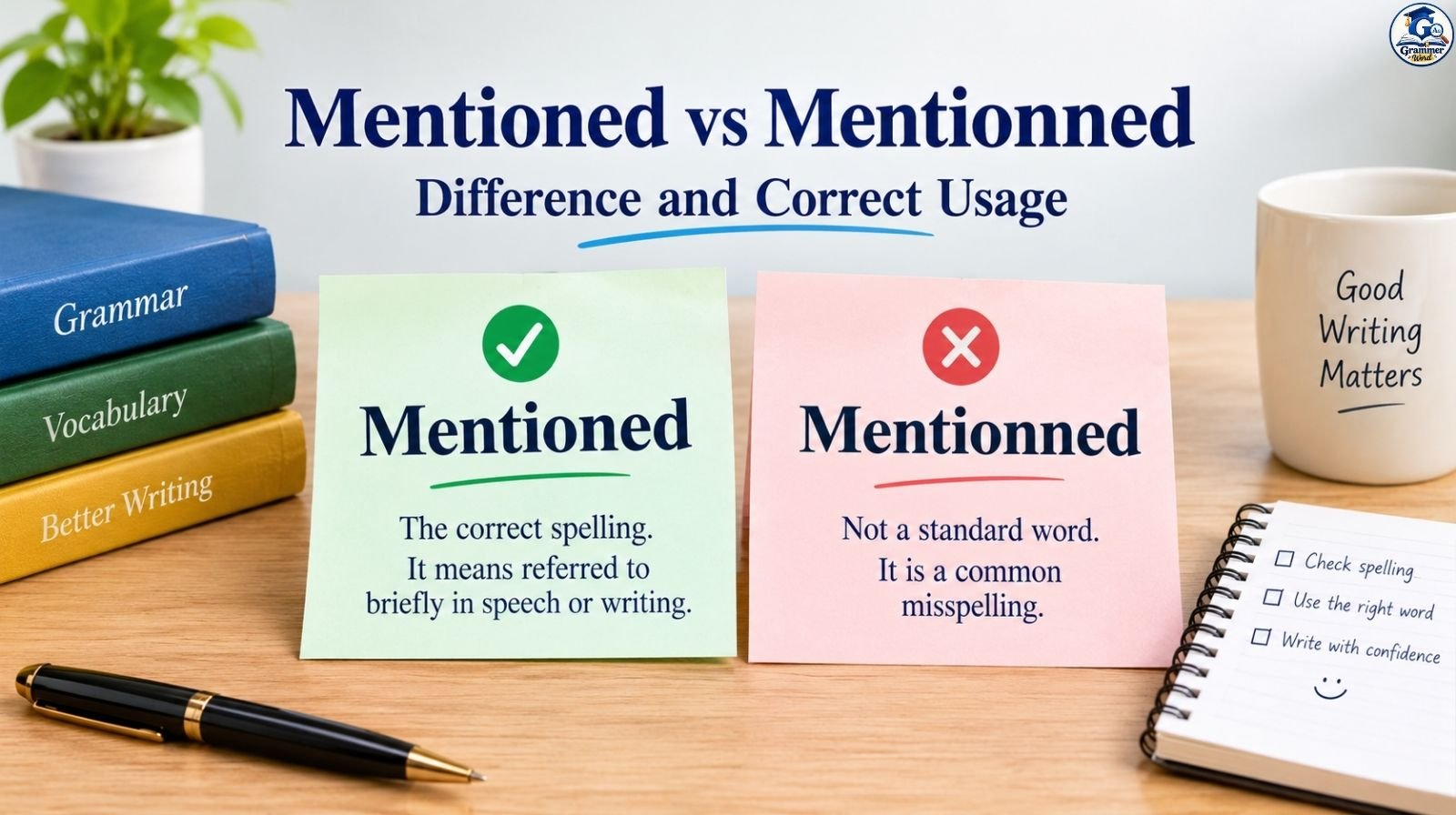
Have you ever wondered whether to write mentioned or mentionned? These two spellings look similar, so it is easy to assume that both are correct. However, only one is the standard spelling in English.
Mentioned is the correct spelling, while mentionned is a misspelling. The word mentioned is the past tense and past participle of the verb mention, which means to refer to someone or something briefly in speech or writing.
In this guide, you will learn the difference between mentioned vs mentionned, understand the spelling rule behind the correct form, and explore practical examples that will help you avoid this common writing mistake.
Read More: Dysregulated vs Disregulated: Correct Usage Explained
What Is the Difference Between Mentioned vs Mentionned?
The difference between mentioned and mentionned is spelling. Mentioned is the accepted English spelling; mentionned is incorrect in standard English.
The verb mention becomes mentioned when used in the simple past tense or as a past participle. You do not double the final letter n when adding -ed.
Mentioned: Meaning and Definition
Mentioned means referred to something or someone briefly, either in conversation or in writing.
Examples:
- She mentioned your name during the meeting.
- I mentioned the problem in my email.
- The teacher mentioned an important rule.
- He has mentioned this issue several times.
In each example, the word describes something that was brought up or referred to.
Mentionned: Is It a Correct Word?
Mentionned is not the standard English spelling. It is usually a typing error or a misunderstanding of English spelling rules.
Incorrect: She mentionned the new project yesterday.
Correct: She mentioned the new project yesterday.
Remember that when adding -ed to mention, the final n stays single.
Read More: Occurring vs Occuring: Which One Is Correct?
Why Is Mentioned the Correct Spelling?
English spelling rules explain why mentioned contains only one n at the end of the base word.
The Base Verb Is Mention
The original verb is mention. To form its simple past tense, add -ed:
Mention + ed = Mentioned
The spelling remains straightforward because the word already ends in two different consonants, o and n, preceded by a vowel-consonant sequence that does not require doubling the final consonant.
For example:
- Mention → Mentioned
- Listen → Listened
- Open → Opened
- Happen → Happened
These verbs do not double their final consonants when forming the past tense.
Why Not Mentionned?
Some writers mistakenly double the final n, perhaps because English has words that double their final consonants before adding a suffix.
For example:
- Plan → Planned
- Stop → Stopped
- Beg → Begged
However, consonant doubling follows specific spelling patterns. It does not apply to every verb ending in a consonant. The word mention becomes mentioned, not mentionned.
Read More: Bony vs Boney: Difference, Meaning, And Usage
Mentioned vs Mentionned: Examples in Everyday English
The easiest way to remember the correct spelling is to see how mentioned works in different contexts.
Examples in Sentences
| Incorrect | Correct |
|---|---|
| She mentionned the meeting. | She mentioned the meeting. |
| I mentionned your suggestion. | I mentioned your suggestion. |
| They mentionned the deadline. | They mentioned the deadline. |
| He has mentionned the issue. | He has mentioned the issue. |
| The article mentionned three studies. | The article mentioned three studies. |
Examples in Professional and Academic Writing
The correct spelling is equally important in formal and informal writing.
Professional email: “As mentioned in my previous email, the deadline is Friday.”
Academic writing: “The researcher mentioned several limitations in the study.”
Everyday conversation: “She mentioned that she would arrive late.”
Blog writing: “The guide mentioned three useful ways to improve your vocabulary.”
In all these situations, mentioned is the appropriate spelling.
Case Study: A Simple Spelling Mistake in a Professional Email
Imagine a job applicant named Sarah who is preparing an email to follow up with a hiring manager after an interview.
She writes:
“Thank you for your time yesterday. As we mentionned during the interview, I am particularly interested in the marketing position.”
The message is polite, clear, and professional, but it contains a spelling error. Although the reader will probably understand the intended meaning, the incorrect spelling may make the email appear less carefully proofread.
Sarah reviews the email before sending it and checks the verb mention. She realizes that the correct past-tense form is mentioned, so she changes the sentence to:
“Thank you for your time yesterday. As we mentioned during the interview, I am particularly interested in the marketing position.”
The revised version communicates the same message without the spelling mistake.
This example illustrates an important lesson: small spelling errors can distract readers, particularly in job applications, business correspondence, academic assignments, and published articles.
Sarah does not need complicated grammar knowledge to fix the problem. She only needs to remember the base verb and its correct past-tense form.
A quick proofreading check can help writers catch errors like mentionned before they reach their intended audience.
Read More: Wholey vs Wholly: Difference, Meaning, And Correct Usage
Mentioned vs Mentionned: Spelling Rules and Quick Comparison
Use this comparison table whenever you are unsure which spelling to choose.
A Simple Comparison Table
| Feature | Mentioned | Mentionned |
|---|---|---|
| Correct English spelling | Yes | No |
| Standard dictionary form | Yes | No |
| Meaning | Referred to briefly | Intended to mean the same thing |
| Grammar role | Past tense or past participle | Misspelling |
| Appropriate for formal writing | Yes | No |
| Example | I mentioned the topic. | I mentionned the topic. |
How to Remember the Correct Spelling
Follow these simple steps:
- Identify the base verb: mention.
- Add the regular past-tense ending: -ed.
- Write the result as mentioned.
- Check that you have not added an extra n.
Memory tip: Mention has one final n. Add -ed without doubling it: mentioned.
Read More: Whoa vs Woah: Which One Is Correct? Meaning, Usage, And Examples
What Do Dictionaries and Recent Data Tell Us?

Spelling questions are best answered using established dictionaries and reliable language references rather than assumptions based on how a word looks.
Checking Trusted Language Resources
For the spelling of mentioned, consult these authoritative references:
- Cambridge Dictionary: Mention explains the meaning and grammatical use of mention.
- Merriam-Webster: Mention provides the definition and verb forms.
- Google Search Central offers guidance on creating helpful, reliable, people-first online content.
These resources help distinguish established English spelling from common typing mistakes.
Is There Statistical Data for Mentioned vs Mentionned in 2025–2026?
There is no verified 2025–2026 statistic available here that establishes the exact number of people who write mentioned versus mentionned.
Therefore, assigning a percentage or claiming that a particular number of writers make this mistake would be misleading.
For this spelling question, the most useful evidence is the established dictionary spelling and the verb’s grammatical form.
Writers can verify the correct form directly through reputable dictionaries instead of relying on unsupported search-volume figures or invented statistics.
Read More: CatchUp vs Catch Up: Differences, Meaning, And Correct Usage
Frequently Asked Questions
Q1. Is Mentioned or Mentionned Correct?
Mentioned is correct in standard English. Mentionned is a misspelling and should be avoided in formal and informal writing.
Q2. What Does Mentioned Mean?
Mentioned means referred to someone or something briefly in speech or writing.
Example: “She mentioned the new schedule during the meeting.”
Q3. Why Is Mentionned Incorrect?
The base verb is mention, and its regular past-tense form is mentioned. The final n is not doubled when adding -ed.
Q4. Is Mentioned the Past Tense of Mention?
Yes. Mentioned is both the simple past tense and the past participle of mention.
Examples:
- Simple past: “He mentioned the deadline.”
- Present perfect: “He has mentioned the deadline.”
Q5. Can I Use Mentionned in Formal Writing?
No. Use mentioned in emails, essays, reports, articles, and professional documents. The spelling mentionned is not standard English.
Q6. How Can I Avoid Spelling Mentioned Incorrectly?
Remember the formula mention + ed = mentioned. You can also use a spellchecker or consult a trusted dictionary when proofreading your work.
Conclusion:
When comparing mentioned vs mentionned, the answer is simple: mentioned is the correct English spelling, and mentionned is incorrect.
The word mentioned is the past tense and past participle of mention, meaning to refer to something or someone briefly. You form it by adding -ed to the base verb without doubling the final n.
Whether you are writing an email, completing an assignment, preparing a report, or publishing a blog post, using the correct spelling helps make your writing clearer and more professional.
Ready to improve your English? Save this spelling rule, check your writing before publishing, and explore more grammar and word-difference guides to build your confidence one word at a time.
Keep learning with more easy grammar lessons on Grammer Word

Hi, I’m Noor Fatima, the person behind this website. I created this site to make English grammar and confusing words easier to understand. I love breaking down tricky words, meanings, spellings, and grammar rules into simple explanations. My goal is to help you learn English naturally, avoid common mistakes, and feel more confident every time you write or speak.