Have you ever wondered whether a period belongs inside or outside quotation marks? You are not alone. Many students, bloggers, writers, and professionals find this punctuation rule confusing, especially when switching between American and British English.
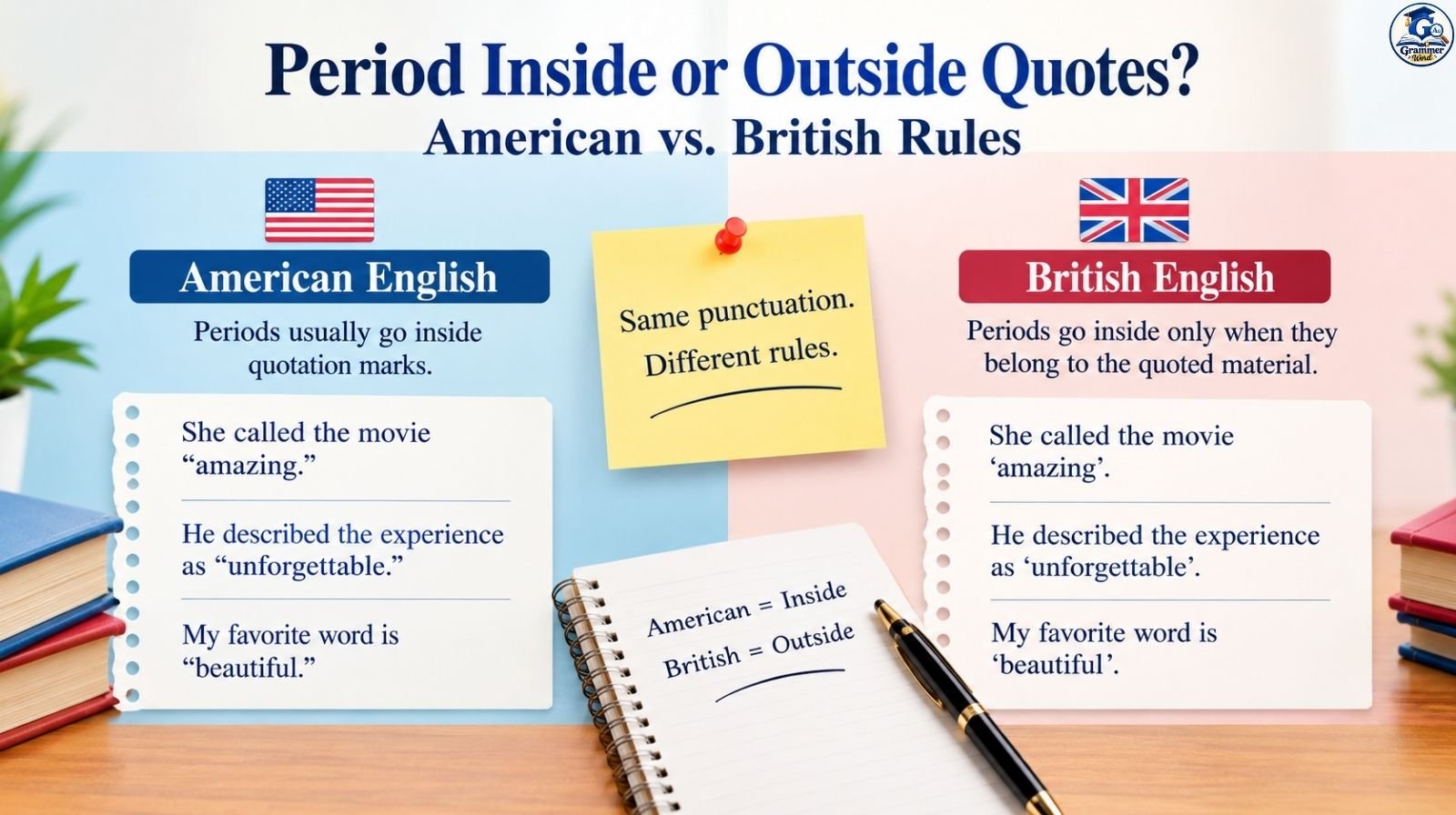
The answer depends largely on which English style you follow. In American English, periods usually go inside quotation marks, even when the punctuation is not part of the original quoted material.
In British English, periods (often called full stops) generally go inside only when they belong to the quoted text.
Understanding when to put a period inside or outside quotes helps you write clearly, proofread confidently, and maintain consistency throughout your work. In this guide, you will learn the differences, explore real examples, and discover a simple way to remember the rules.
Read More: Occurring vs Occuring: Which One Is Correct?
American vs. British Rules: Where Does the Period Go?
The easiest way to understand this punctuation rule is to remember that American and British English traditionally follow different conventions.
The American English Rule: Put the Period Inside
In American English, periods and commas generally go inside the closing quotation marks. This convention applies even when the period is not part of the original quoted words.
For example:
- Correct: She called the movie “amazing.”
- Correct: He described the experience as “unforgettable.”
- Correct: My favorite word is “beautiful.”
Notice that the period comes before the final quotation mark in every example.
This convention is widely used in American books, newspapers, academic writing, and online publications. Purdue University’s Online Writing Lab also explains that American English generally places periods and commas inside closing quotation marks.
The British English Rule: Follow the Meaning
British English traditionally uses a more logical approach. A period or full stop goes inside the quotation marks when it belongs to the quoted material. If it belongs to the surrounding sentence instead, it generally goes outside.
For example:
- British style: She called the movie ‘amazing’.
- British style: He described the experience as ‘unforgettable’.
- British style: My favorite word is ‘beautiful’.
In these examples, the period completes the surrounding sentence rather than forming part of the quoted word.
However, if the quoted material is a complete sentence with its own period, the punctuation stays inside:
– British style: She said, ‘The movie was amazing.’
The key is to identify which punctuation belongs to the quotation and which belongs to the sentence around it.
Read More: Mentioned vs Mentionned: Difference, Meaning, And Usage
American vs. British Punctuation at a Glance
| Situation | American English | British English |
|---|---|---|
| Quoted word at the end of a sentence | She said it was “perfect.” | She said it was ‘perfect’. |
| Quoted phrase at the end | He called it “a great idea.” | He called it ‘a great idea’. |
| Complete quoted sentence | She said, “I am ready.” | She said, ‘I am ready.’ |
| Period belonging to the quoted material | Inside | Inside |
| Period belonging only to the surrounding sentence | Usually inside | Usually outside |
These are traditional patterns, not universal rules followed by every publisher. Some British publications use American-style punctuation, and individual style guides may have their own requirements.
Why Do American and British English Use Different Rules?
The difference is not simply a matter of right versus wrong. Both approaches are established conventions, and each has its own logic.
The Historical American Convention
American publishing developed a convention in which periods and commas are placed inside closing quotation marks. This approach became standard in many American editorial styles.
For example:
- American: The sign said “Keep Out.”
- American: She described the plan as “unrealistic.”
Even if the quoted words originally appeared without a period, American style generally puts the period inside the quotation marks.
This is why American punctuation can sometimes look unusual to writers who prefer punctuation to reflect the exact wording of the original quotation.
Read More: Dilemma vs Dilema: Which One Is Correct?
The Logical British Convention
Traditional British punctuation focuses more directly on the relationship between the quoted words and the surrounding sentence.
Consider this example:
– British: The word ‘excellent’ describes her performance.
The quotation marks identify the word being discussed, while the period completes the full sentence.
This approach can be particularly helpful when discussing individual words, technical terms, labels, or short phrases.
However, British punctuation is not entirely uniform. Publishers may use different conventions depending on the type of writing and their preferred style guide.
Which Rule Should You Follow?
Choose the convention that matches your audience and publication.
- Writing for an American audience? Use American punctuation conventions.
- Writing for a British audience? Follow the British publication’s style guide.
- Writing for an international website? Choose one consistent style and apply it throughout the article.
- Writing for a university or professional organization? Follow its required editorial or citation style.
Consistency matters more than mixing conventions from different systems.
When Does a Period Go Inside or Outside Quotes?
Understanding the general rule is useful, but real sentences can create more complicated situations. These examples show how punctuation works in different contexts.
When Quoting a Single Word
When a quoted word appears at the end of a sentence, the punctuation depends on the style you are using.
American English:
- The teacher called the answer “correct.”
- I consider that approach “effective.”
British English:
- The teacher called the answer ‘correct’.
- I consider that approach ‘effective’.
The words themselves do not change. Only the placement of the final period differs.
When Quoting a Complete Sentence
If you reproduce a complete sentence, its punctuation normally remains inside the quotation marks in both systems.
Examples:
- American: She said, “I will call you tomorrow.”
- British: She said, ‘I will call you tomorrow.’
The period belongs to the quoted sentence, so it remains inside the closing quotation mark.
Be careful not to confuse a complete quotation with a short quoted phrase embedded in your own sentence.
Read More: Aluminum vs Aluminium: What’s The Difference And Which Spelling Is Correct?
When Quoting a Phrase Within a Longer Sentence
Suppose you want to describe someone’s choice of words.
American English:
– The reviewer called the ending “surprisingly emotional.”
British English:
– The reviewer called the ending ‘surprisingly emotional’.
The quoted phrase does not form an independent sentence. The period completes the larger sentence, so the two traditions place it differently.
This is one of the most common situations in which writers notice the difference between American and British punctuation.
Special Cases: Questions, Exclamations, and Technical Text
Periods are not the only punctuation marks that can appear beside quotation marks. Question marks, exclamation marks, and punctuation in technical instructions require additional care.
Question Marks and Exclamation Marks
For question marks and exclamation marks, both American and British English generally consider whether the punctuation belongs to the quotation or to the surrounding sentence.
For example, when the quoted words themselves form a question:
- American: She asked, “Are you ready?”
- British: She asked, ‘Are you ready?’
The question mark stays inside because it belongs to the quoted question.
When the entire sentence is a question but the quotation is not, the question mark generally goes outside:
- American: Did she really call it “a disaster”?
- British: Did she really call it ‘a disaster’?
The same principle applies to exclamation marks:
- Quoted exclamation: He shouted, “Watch out!”
- Question about a quoted phrase: Did he really say it was “wonderful”?
Read More: Leafs vs Leaves: Which Is Correct And How To Use Them?
Periods With Quoted Words in Technical Instructions
Technical writing creates an important exception to the usual American convention.
Imagine that a user must type a command or enter an exact status into a software application. Moving the period inside the quotation marks could make the required text ambiguous.
For example:
Enter the status “Complete”.
Here, the period is outside the quotation marks so readers can clearly distinguish the exact status from the sentence-ending punctuation.
In American editorial style, this is a practical exception when placing punctuation inside the quotation marks could change the meaning or cause someone to copy the wrong text.
Titles and Quoted Text
Titles, labels, and quoted material may also need special attention.
For instance, if you are reproducing an exact title, preserve its original wording and punctuation as required by the relevant style guide. Do not automatically move punctuation that is part of the official title.
When accuracy matters, distinguish between punctuation that belongs to the original text and punctuation added to complete your sentence.
A Real-Life Example: Editing a Blog for Two Audiences
Imagine that a content writer is preparing an article about a new mobile application. The article will appear on two versions of the same website: one for American readers and another for British readers.
The original draft includes the sentence: The reviewer called the application “easy to use”.
The writer notices that the sentence ends with a period outside the quotation marks. Is it correct?
For the American version, the writer changes the sentence to: The reviewer called the application “easy to use.” This follows the standard American convention of placing the period inside the closing quotation mark.
For the British version, the writer keeps the period outside: The reviewer called the application ‘easy to use’. This follows the traditional British logical approach because the quoted phrase does not include the sentence-ending period.
The writer then encounters another sentence: The reviewer wrote, “The application is easy to use.” In this case, the period stays inside the quotation marks in both versions because it belongs to the complete quoted sentence.
Finally, the writer checks a technical instruction that tells users to enter the exact word “Complete” into a search field. The writer keeps the period outside the quotation marks in that instruction to avoid suggesting that users should type the period as part of the word.
Read More: Fluorescent vs Flourescent: Difference And Usage
By reviewing each sentence according to its purpose, the writer produces two consistent versions without changing the meaning of the article. The lesson is simple: understand the audience, distinguish quoted text from surrounding text, and check for exceptions when exact wording matters.
This example illustrates how a small punctuation decision can improve readability, reduce confusion, and make content more suitable for its intended audience.
What the 2025–2026 Evidence Tells Us About Quotation Punctuation
There is no reliable, widely established 2025–2026 statistic specifically measuring how often writers put periods inside versus outside quotation marks. Inventing a percentage or claiming that one convention is universally preferred would therefore be misleading.
However, current editorial guidance provides a useful evidence-based picture of the rule.
What Established Style Guides Say
Three important observations help explain the current situation:
- American punctuation has a clear default. Purdue OWL explains that periods and commas generally go inside closing quotation marks in standard American English.
- British punctuation recognizes a logical alternative. The University of Edinburgh’s editorial style guide describes how a full stop can fall outside quotation marks when the quoted words are not a complete sentence.
- Modern editorial guidance acknowledges exceptions. The Chicago Manual of Style’s 18th edition, published in 2024, explains both the traditional American convention and the British approach to punctuation.
These sources establish that the difference is a matter of editorial convention rather than a simple distinction between correct and incorrect English.
Read More: Suing vs Sueing: Which Spelling Is Correct?
Three Practical Facts to Remember
- Two major conventions: American-style punctuation generally places periods inside quotation marks; traditional British-style punctuation considers whether the period belongs to the quoted material.
- One important distinction: A complete quoted sentence normally retains its own ending punctuation inside the quotation marks.
- One consistency rule: A document should follow the style required by its publisher, institution, or intended audience.
These are descriptive facts about editorial practice, not statistical measurements of how frequently each style is used in 2025 or 2026.
For further guidance, consult these credible references:
- Purdue Online Writing Lab: How to Use Quotation Marks
- The Chicago Manual of Style: Periods Inside or Outside Quotation Marks
- University of Edinburgh: Editorial Style Guide for Quotations
Read More: Coozie vs Koozie: Which One Is Correct And How Do You Use It?
Frequently Asked Questions
Q1. Does the period go inside or outside quotation marks in American English?
In standard American English, periods generally go inside the closing quotation marks, even when they are not part of the original quoted text.
Example: She called the result “excellent.”
Q2. Does British English put periods outside quotation marks?
Often, yes. Traditional British English places the period outside when it belongs to the surrounding sentence rather than the quoted material.
Example: She described the result as ‘excellent’.
However, a period that belongs to a complete quoted sentence stays inside the quotation marks.
Q3. Is it ever correct to put a period outside quotation marks in American English?
Yes. Exceptions can occur when punctuation outside the quotation marks is needed to preserve the exact text, especially in technical instructions, code, labels, and other situations where the punctuation could be mistaken for part of the quoted material.
Q4. What happens when a quotation contains a complete sentence?
The period normally stays inside the quotation marks in both American and British English.
Example: He said, “I have finished the work.”
Q5. Do periods and commas follow the same rules?
In traditional American English, periods and commas generally go inside quotation marks. Traditional British English more often places them according to whether they belong to the quoted material. The exact conventions can vary by style guide.
Q6. Which punctuation style should I use for my blog?
Choose the style that matches your primary audience. Use American conventions for an American-focused publication and the relevant British convention for a British-focused publication. If your website has an editorial style guide, follow it consistently.
Conclusion:
Knowing whether a period belongs inside or outside quotes becomes much easier once you understand the difference between American and British English.
Remember the essential rule: American English generally places periods inside quotation marks, while traditional British English places them according to whether they belong to the quoted material.
For example, American English uses “a great idea.” while traditional British English may use ‘a great idea’. When the quotation is a complete sentence, however, the period normally stays inside the quotation marks in both styles.
The best approach is to identify your audience, follow the appropriate style guide, and remain consistent throughout your writing. Pay particular attention to technical instructions and exact quotations, where punctuation can affect meaning.
Ready to improve your writing? Apply these rules the next time you edit an article, write an email, or proofread a document. With practice, choosing the correct punctuation will become a natural part of your writing process.
Keep learning with more easy grammar lessons on Grammer Word

Hi, I’m Noor Fatima, the person behind this website. I created this site to make English grammar and confusing words easier to understand. I love breaking down tricky words, meanings, spellings, and grammar rules into simple explanations. My goal is to help you learn English naturally, avoid common mistakes, and feel more confident every time you write or speak.