Have you ever wondered whether to write afterward or afterwards? You may have seen both spellings in books, emails, blog posts, and everyday conversations. The confusing part is that both words look correct, and many writers are unsure which one to choose.
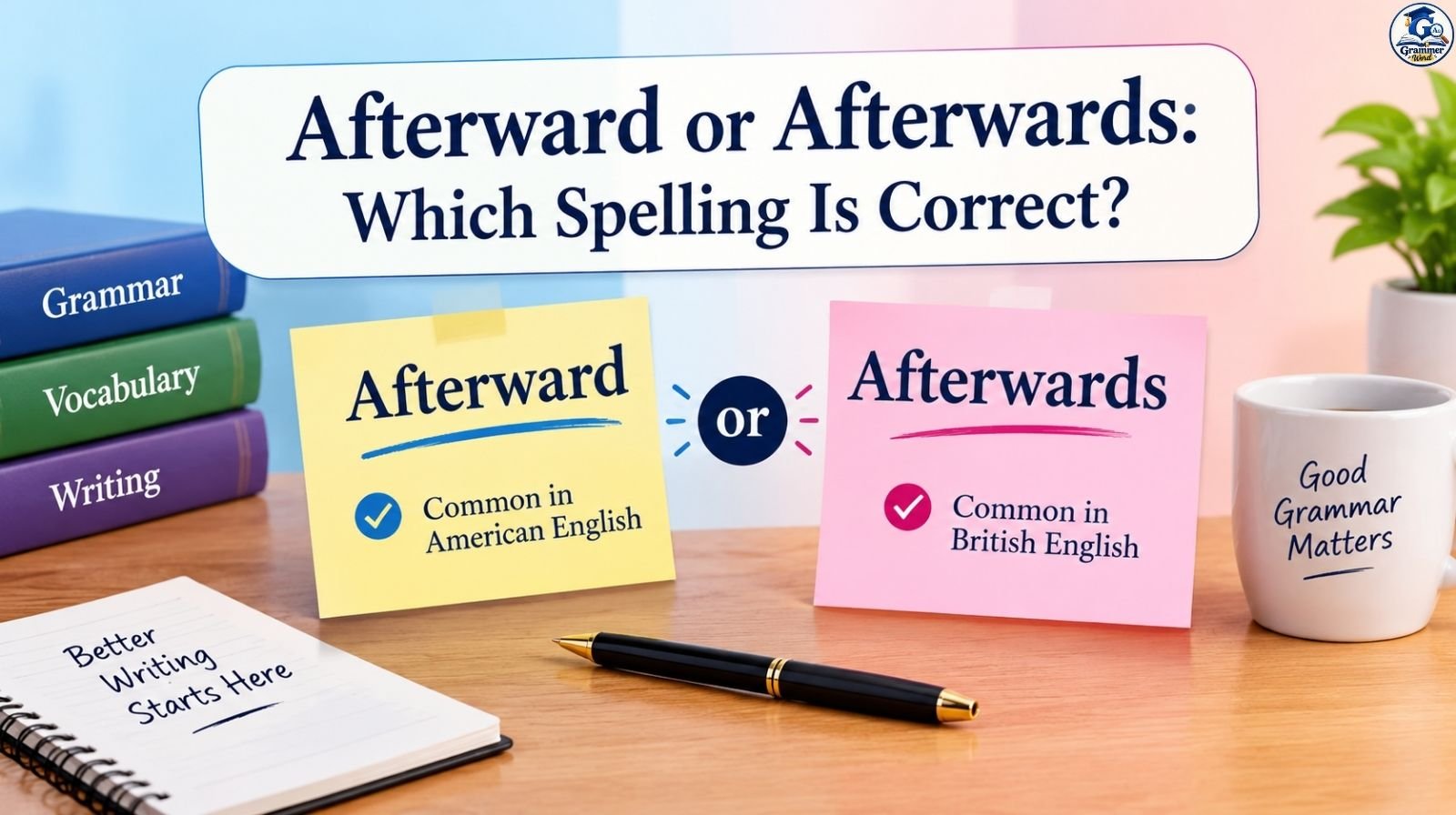
The good news is that both afterward and afterwards are correct English words. They have the same meaning, but their popularity differs by region. American English generally favors afterward, while British English commonly uses afterwards.
In this guide, you’ll learn what each word means, how to use it correctly, the difference between American and British usage, and practical examples to help you choose the right form for your writing.
Read More: Sponser vs Sponsor: Difference And Correct Usage
What Do Afterward and Afterwards Mean?
Both afterward and afterwards are adverbs that mean at a later time or after something has happened. They describe an action or event that takes place after another event.
For example:
- We finished our homework and went outside afterward.
- We finished our homework and went outside afterwards.
Both sentences are grammatically correct. The only difference is the spelling preference, not the meaning.
What Does Afterward Mean?
Afterward means at a later time or following an event. It is especially common in American English and appears in formal writing, casual conversations, academic papers, and business communication.
Examples:
- She called me afterward to explain what happened.
- We attended the meeting and discussed the results afterward.
- He realized his mistake shortly afterward.
- The students went to the library afterward.
In each example, afterward indicates that one action happened after another.
What Does Afterwards Mean?
Afterwards has exactly the same meaning as afterward. It is particularly common in British English and is widely used in everyday speech and writing.
Examples:
- We went shopping and had lunch afterwards.
- She apologized afterwards for her rude comment.
- They finished the project and celebrated afterwards.
- Afterwards, everyone returned to their seats.
The additional s does not change the meaning or make the word plural. It is simply an alternative form of the same adverb.
Read More: Period Inside or Outside Quotes? American vs. British Rules
Afterward vs. Afterwards: What Is the Difference?
The main difference between afterward and afterwards is regional usage. Neither spelling is universally more correct than the other.
American English vs. British English
American and British English sometimes prefer different versions of words that share the same meaning. This pair follows a similar pattern.
| Feature | Afterward | Afterwards |
|---|---|---|
| Meaning | At a later time | At a later time |
| Part of speech | Adverb | Adverb |
| American English | Generally preferred | Also acceptable |
| British English | Correct but less typical | Generally preferred |
| Formal writing | Correct | Correct |
| Grammatical status | Standard English | Standard English |
For American readers, afterward is generally the natural choice.
Example: We finished dinner and watched a movie afterward.
For British readers, afterwards is often more natural.
Example: We finished dinner and watched a movie afterwards.
Both sentences communicate the same information. Choose the version that best matches your intended audience.
Read More: Elude vs Allude: Which One Is Correct And How Do You Use Them?
Does the Extra S Change the Meaning?
No. Adding an s does not change the meaning of afterward.
Compare these examples:
- I spoke to my teacher afterward.
- I spoke to my teacher afterwards.
Both sentences mean that the conversation took place later.
The same type of variation appears in other English words, including toward and towards, as well as forward and forwards. Regional preferences may differ, but the alternative forms can have the same basic meaning.
Which Form Is Better for Formal Writing?
Neither form is inherently more formal. Both are suitable for professional emails, academic writing, essays, articles, and reports.
However, consistency matters. If you are writing for an American publication, afterward is generally the safer choice. If your audience is primarily British, afterwards is often the more natural option.
For example:
- American-style report: The committee reviewed the proposal and responded afterward.
- British-style report: The committee reviewed the proposal and responded afterwards.
Always follow your organization’s preferred style guide when one is specified.
When Should You Use Afterward or Afterwards?
Choosing between these words becomes easy when you consider your audience and the type of English you are using.
Use Afterward in American English
Choose afterward when writing primarily for an American audience.
You can use it in:
- School assignments and college essays.
- Professional emails and business reports.
- American English blog posts.
- News articles and general publications.
- Everyday conversations and personal writing.
Examples:
- I’ll call you afterward.
- The presentation ended, and everyone went home afterward.
- She felt relieved shortly afterward.
- We can discuss the details afterward.
These examples sound natural in American English.
Read More: Enrol vs Enroll: Which One Is Correct And How To Use Them?
Use Afterwards in British English
Choose afterwards when writing primarily for a British audience or following British English conventions.
Examples:
- I’ll call you afterwards.
- The presentation ended, and everyone went home afterwards.
- She felt relieved shortly afterwards.
- We can discuss the details afterwards.
The word is also widely understood internationally. If your readers are familiar with British English, it is a perfectly suitable choice.
A Simple Checklist for Choosing the Correct Word
Use this quick guide whenever you are unsure.
- Writing for a US audience? Prefer afterward.
- Writing for a UK audience? Prefer afterwards.
- Following a specific editorial style guide? Use its preferred form.
- Writing for a mixed international audience? Either form is acceptable; stay consistent.
- Referring to the final section of a book? Use afterword, not afterward or afterwards.
This checklist helps you make the right choice without overthinking a small spelling difference.
Real-Life Example: Choosing the Right Word in a Blog Post
Imagine a writer preparing an article about effective study habits for an international education website. The article explains how students can organize their schedules, complete assignments, and review their lessons.
The writer initially drafts this sentence:
“Students should review their notes after class and discuss difficult topics with classmates afterward.”
The sentence is correct. However, before publishing the article, the editor checks the website’s style guide and discovers that the publication primarily follows British English conventions.
The editor suggests changing the sentence to:
“Students should review their notes after class and discuss difficult topics with classmates afterwards.”
The change is small, but it makes the writing more consistent with the publication’s preferred English variety.
Now imagine the same article is being prepared for a website aimed specifically at American college students. In that case, keeping afterward would be a sensible choice.
This example illustrates an important principle: the best spelling depends on your audience and editorial style, not on one form being grammatically correct and the other being wrong.
Writers should focus on clarity, consistency, and the expectations of their readers. They do not need to change every instance of afterward to afterwards or vice versa. Instead, they should establish a consistent style and apply it throughout the article.
Read More: Solicited vs Unsolicited: Differences And Usage
Afterward or Afterwards: Usage Evidence and Language Trends
English spelling preferences are influenced by regional conventions, dictionaries, publishing standards, and everyday usage. The distinction between afterward and afterwards is a useful example of this variation.
What Do Dictionaries Say?
Major English dictionaries recognize both forms. Afterward is commonly associated with American English, while afterwards is especially common in British English. Both words express the same idea of something happening later.
This supports the main conclusion: both spellings are legitimate, and the primary distinction is regional preference rather than grammatical correctness.
Are There Official Statistics for 2025–2026?
There is no verified statistic presented here that establishes an exact percentage of writers using afterward compared with afterwards during 2025–2026.
It would be misleading to invent a percentage or claim that one form has definitively overtaken the other without reliable language data.
A proper frequency comparison would require a defined collection of texts, such as American and British newspaper archives, books, or a balanced English-language corpus. Researchers would then compare the occurrences of each word while accounting for differences in region and genre.
For practical writing, these general usage patterns provide a reliable starting point:
- American English: Afterward is generally preferred.
- British English: Afterwards is generally preferred.
- Both varieties: Both forms are understood, and neither is inherently incorrect.
This evidence-based approach is more useful than relying on unsupported claims about spelling trends.
Read More: Complement vs Compliment: Stop Confusing These Words Today
Common Mistakes to Avoid
Even though afterward and afterwards are straightforward words, writers sometimes confuse them with other expressions or assume that one spelling is incorrect.
Mistake 1: Thinking Afterwards Is Always Wrong
Incorrect assumption: “Afterwards is not a real English word.”
Correct understanding: Afterwards is a standard English adverb, especially common in British English.
Example: We visited the museum and went for lunch afterwards.
Mistake 2: Believing Afterward Is Only Used in America
Incorrect assumption: “British writers must never use afterward.”
Correct understanding: Afterward is valid English, although afterwards is generally more characteristic of British usage.
Example: We finished the meeting and returned to work afterward.
Mistake 3: Confusing Afterward With Afterword
These words have different meanings.
- Afterward: An adverb meaning later or after an event.
- Afterword: A concluding section in a book, usually written by the author or another contributor.
Examples:
- We discussed the results afterward.
- The author included an afterword at the end of the book.
Remembering this distinction helps prevent a different kind of spelling mistake.
Mistake 4: Using Both Forms Inconsistently
Switching between afterward and afterwards is not automatically a grammatical error. Nevertheless, using one form consistently usually makes an article look more polished.
For example, if you are writing an American English article, you can use afterward throughout. For a British English article, afterwards is usually the more natural default.
Read More: Repetition vs Parallelism: What’s The Difference In Writing In 2026?
Frequently Asked Questions
Q1. Is afterward or afterwards correct?
Both are correct. Afterward is generally preferred in American English, while afterwards is especially common in British English. Both mean “at a later time.”
Q2. Is afterwards American or British English?
Afterwards is most strongly associated with British English, but it is also used and understood in American English.
Q3. Is afterward one word or two?
Afterward is one word. It is an adverb meaning later or following an event. The alternative spelling, afterwards, is also written as one word.
Q4. Can I use afterward and afterwards interchangeably?
Yes. In most contexts, the two words are interchangeable because they have the same meaning. Your choice should depend on regional preference, audience, and any applicable style guide.
Q5. Which is better for formal writing?
Neither is inherently more formal. Both are appropriate for formal writing. Use afterward for a primarily American audience and afterwards for a primarily British audience, unless your style guide specifies otherwise.
Q6. What is the difference between afterward and afterword?
Afterward means at a later time, while afterword is a section at the end of a book. For example, “We spoke afterward” refers to a later conversation, whereas “I read the afterword” refers to a book’s concluding section.
Conclusion
So, afterward or afterwards which spelling is correct? Both are correct, and both mean “at a later time.” The main difference is regional preference: American English generally favors afterward, while British English commonly uses afterwards.
If you are writing for an American audience, choose afterward. If you are writing for a British audience, afterwards is often the more natural option. For international writing, either form works as long as you remain consistent.
Remember that good writing is not just about choosing the right spelling. It is also about understanding your audience, communicating clearly, and following appropriate writing conventions.
Ready to improve your English? Use the examples and checklist in this guide to choose the right word confidently in your next email, essay, or blog post.
Keep learning with more easy grammar lessons on Grammer Word

Hi, I’m Noor Fatima, the person behind this website. I created this site to make English grammar and confusing words easier to understand. I love breaking down tricky words, meanings, spellings, and grammar rules into simple explanations. My goal is to help you learn English naturally, avoid common mistakes, and feel more confident every time you write or speak.