Have you ever wondered whether you should write elude or allude? These two words sound very similar, but they have completely different meanings and uses.
Understanding the difference between elude vs allude can help you avoid common spelling and vocabulary mistakes in academic writing, professional communication, and everyday English.
The good news is simple: both “elude” and “allude” are correct words. The important question is what you mean.
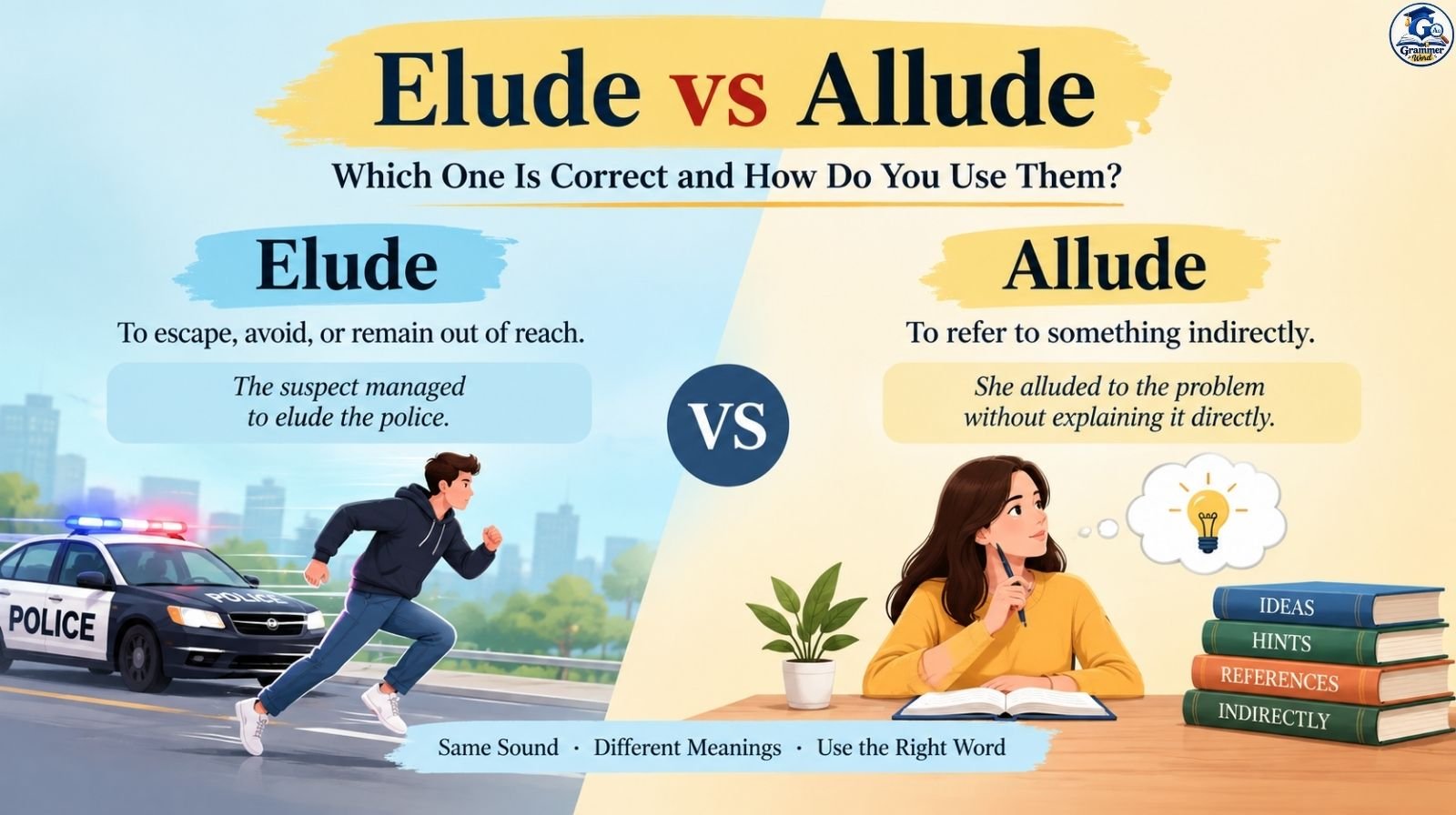
Elude generally means to escape, avoid, or remain difficult to achieve, understand, or remember. Allude, normally used with to, means to refer to someone or something indirectly rather than mentioning it directly.
In this guide, you will learn the meanings, differences, examples, usage rules, memory tricks, and common mistakes that make these words easy to confuse.
Read More: Flyer or Flier: Which One Is Correct? A Clear Guide For Writers
Elude vs Allude: What Is the Difference?
The easiest way to understand elude vs allude is to focus on their core meanings.
Elude means to escape from something, avoid being caught, or remain beyond someone’s ability to achieve, understand, or remember.
Allude means to mention or refer to something indirectly.
What Does Elude Mean?
Elude is a verb. It can describe escaping from a person or situation, but it can also describe something that remains difficult to achieve, understand, or remember.
For example:
- The suspect managed to elude the police.
- The answer continued to elude me.
- Success has eluded him for years.
- Her name eluded my memory.
So, if something is getting away from you literally or figuratively elude is usually the right word.
What Does Allude Mean?
Allude is also a verb, but its meaning is different. It means to refer to something indirectly instead of stating it openly.
It is commonly followed by to:
- She alluded to an earlier disagreement.
- The speaker alluded to the company’s financial problems.
- He alluded to his childhood without giving details.
- The article alludes to several historical events.
A useful pattern to remember is:
Allude to = refer to indirectly
Cambridge Dictionary defines allude to as mentioning someone or something without talking about it directly.
Elude vs Allude: How to Use Each Word Correctly
Although these words look and sound similar, their grammatical jobs are easy to separate once you understand the idea behind each one.
Use Elude for Escape, Failure, or Difficulty
Use elude when someone or something escapes, cannot be caught, cannot be achieved, or cannot be remembered or understood.
Consider these examples:
- The criminal eluded investigators.
- The solution eluded the researchers.
- The perfect opportunity eluded her.
- His name eludes me at the moment.
Notice that the object is something that remains out of reach.
Use Allude to Refer Indirectly
Use allude when someone makes an indirect reference.
For example:
- The manager alluded to possible changes.
- She alluded to her previous experience.
- The politician alluded to the controversy.
- His speech alluded to several important historical events.
The speaker does not explain the subject directly. Instead, they give a hint or indirect reference.
Read More: Jist or Gist: Which Spelling Is Correct And How To Use It Properly?
The Quickest Way to Tell Them Apart
Ask yourself one question:
Am I talking about escaping or something being out of reach?
If yes, choose elude.
Am I talking about referring to something indirectly?
If yes, choose allude.
| Word | Core Meaning | Common Pattern | Example |
|---|---|---|---|
| Elude | Escape, avoid, or remain out of reach | elude someone/something | The suspect eluded the police. |
| Allude | Refer to something indirectly | allude to something | She alluded to the problem. |
Common Examples of Elude and Allude
Seeing the words in realistic sentences makes the difference much easier to remember.
Examples of Elude
Here are several common uses of elude:
- The runner eluded his pursuers.
The runner escaped from the people chasing him. - The answer eluded me.
I could not remember or figure out the answer. - Success continued to elude the team.
The team could not achieve success. - The animal eluded capture.
The animal avoided being captured. - A clear explanation eluded the researchers.
The researchers could not find or develop a clear explanation.
Cambridge gives similar uses of elude, including escaping capture, failing to achieve something, and being unable to remember information.
Examples of Allude
Now compare those sentences with allude:
- She alluded to the disagreement.
She referred to the disagreement without discussing it directly. - The author alludes to Greek mythology.
The author makes an indirect reference to Greek mythology. - He alluded to his plans during the interview.
He hinted at his plans without explaining them fully. - The speaker alluded to a recent controversy.
The speaker referred indirectly to the controversy. - The novel alludes to several famous historical events.
The novel contains indirect references to those events.
The key idea is reference, not escape.
Read More: Led or Lead: What’s The Difference?
A Simple Memory Trick for Elude vs Allude

If you frequently mix up these words, a small memory trick can make them much easier.
Remember “Elude = Escape”
Think:
E = Escape → Elude
If someone escapes from the police, they elude the police.
If an answer is difficult to remember, it eludes you.
If success cannot be achieved, success eludes you.
Remember “Allude = Allude To”
Think:
Allude → Allude to → Mention indirectly
Whenever you see allude, remember that it is very commonly followed by to.
For example:
She alluded to the problem.
This simple association can help prevent the two words from becoming mixed up.
Elude vs Allude in Real-Life Writing
The difference becomes especially important in professional, academic, and journalistic writing because choosing the wrong word can change the meaning of a sentence.
A Real-Life Example
Imagine a journalist is writing about a politician who discussed a controversial event without naming it directly.
The journalist might write:
“During the interview, the politician alluded to the controversy but did not discuss it directly.”
Here, alluded to is correct because the politician made an indirect reference.
Now imagine the politician was trying to avoid reporters after the interview:
“The politician eluded reporters outside the building.”
In this sentence, eluded is correct because the politician avoided or escaped the reporters.
The same subject can therefore be connected with both words, but the meaning changes completely.
Why This Difference Matters
Using elude instead of allude can make a sentence sound as though someone escaped when you actually mean they made an indirect reference.
For example:
Incorrect for an indirect reference:
The speaker eluded to the issue.
Correct:
The speaker alluded to the issue.
Likewise:
Incorrect:
The suspect alluded the police.
Correct:
The suspect eluded the police.
These examples show why context matters more than pronunciation.
Read More: Every Time or Everytime: Which One Is Correct?
Elude vs Allude: Common Mistakes to Avoid
Many errors happen because the two words have similar sounds. However, their meanings and sentence patterns are different.
Mistake 1: Writing “Allude” When You Mean Escape
Incorrect:
The thief alluded the police.
Correct:
The thief eluded the police.
The thief escaped or avoided capture, so eluded is the correct choice.
Mistake 2: Writing “Elude To”
Incorrect:
She eluded to the problem.
Correct:
She alluded to the problem.
Allude to is the standard expression when you mean “refer indirectly.”
Mistake 3: Assuming Allude Means “Mention Clearly”
Alluding to something does not usually mean explaining it directly.
Compare:
She mentioned the problem.
This suggests a direct reference.
She alluded to the problem.
This suggests an indirect reference.
Therefore, allude is closer to hint at or refer indirectly to than simply mention.
Mistake 4: Confusing “Elusive” With “Allusive”
The related adjectives can also cause confusion.
Elusive means difficult to find, achieve, understand, or remember.
Example:
The solution remained elusive.
Allusive means containing or making indirect references.
Example:
The poem has an allusive style.
These words follow the meanings of their respective verbs.
Data & Usage Insights for 2025–2026
The distinction between words such as elude and allude remains useful as people increasingly search for precise language explanations online.
Google reported in December 2025 that searches beginning with “How do I…” reached an all-time high, increasing 25% year over year, while searches phrased as “Tell me about…” increased 70%. This reflects a broader shift toward conversational, explanatory searches rather than short keyword-only queries.
Google also reported in 2025 that people using AI Mode were asking substantially longer questions roughly two to three times the length of traditional searches in early testing. By October 2025, Google said AI Mode queries were nearly three times longer than traditional Search queries.
For English-learning content, this matters because users are increasingly asking detailed questions such as:
- “What is the difference between elude and allude?”
- “Which word should I use in this sentence?”
- “Does allude always take ‘to’?”
- “How can I remember elude vs allude?”
Clear, direct explanations are therefore valuable for modern search behavior.
Google’s current guidance also emphasizes people-first content that gives readers a satisfying, useful answer rather than content created primarily to manipulate search rankings.
Read More: Each Other or Eachother? The Correct Spelling Explained Simply
Mini Quiz: Elude vs Allude
1. Quick Start: Which Word Means “Escape”?
A) Allude
B) Elude
C) Mention
D) Explain
Answer: B) Elude
2. Pick the Right Word
“She ___ to the problem without explaining it directly.”
A) eluded
B) escaped
C) alluded
D) avoided
Answer: C) alluded
3. What Does “Allude” Mean?
A) To escape
B) To forget
C) To refer to something indirectly
D) To achieve something
Answer: C) To refer to something indirectly
4. Fill in the Blank
“The suspect managed to ___ the police.”
A) allude
B) elude
C) mention
D) refer
Answer: B) elude
5. Spot the Correct Phrase
Which sentence is correct?
A) She eluded to the issue.
B) She alluded to the issue.
C) She alluded the issue.
D) She elude to the issue.
Answer: B) She alluded to the issue.
6. Memory Check
Which word can describe something that remains difficult to achieve?
A) Allude
B) Elude
C) Mention
D) Refer
Answer: B) Elude
7. Complete the Sentence
“His name ___ my memory.”
A) alluded
B) escaped to
C) eluded
D) referred
Answer: C) eluded
8. Which One Uses “Allude” Correctly?
A) The runner alluded the police.
B) The speaker alluded to the controversy.
C) The answer alluded me.
D) The thief alluded capture.
Answer: B) The speaker alluded to the controversy.
9. Elude or Allude?
“The author ___ to Greek mythology in the novel.”
A) eluded
B) alluded
C) escaped
D) avoided
Answer: B) alluded
10. What Does “Elude” Suggest?
A) An indirect reference
B) An escape or something out of reach
C) A direct explanation
D) A formal announcement
Answer: B) An escape or something out of reach
11. Choose the Natural Sentence
A) Success alluded him.
B) Success alluded to him.
C) Success eluded him.
D) Success elude to him.
Answer: C) Success eluded him.
12. True or False?
“Allude” is commonly followed by “to” when making an indirect reference.
A) True
B) False
Answer: A) True
13. Which Word Fits Best?
“She ___ to her childhood but gave no details.”
A) eluded
B) alluded
C) escaped
D) avoided
Answer: B) alluded
14. The Final Challenge!
“The answer continued to ___ me.”
A) allude
B) allude to
C) elude
D) refer
Answer: C) elude
15. Can You Nail the Difference?
Which statement is correct?
A) Elude means to refer indirectly.
B) Allude means to escape.
C) Elude means to escape or remain out of reach.
D) Allude and elude always mean the same thing.
Answer: C) Elude means to escape or remain out of reach.
FAQs
1. Is “elude” or “allude” correct?
Both are correct words, but they have different meanings. Elude means to escape, avoid, or remain out of reach. Allude means to refer to something indirectly.
2. What is the easiest way to remember elude vs allude?
Remember:
Elude = Escape
Allude = Allude to something indirectly
This simple distinction covers most everyday uses.
3. Do you say “allude to” or “allude”?
When referring to a person, subject, idea, or event indirectly, allude to is the standard construction.
Example:
The speaker alluded to the recent changes.
4. Does elude mean avoid?
Yes. Elude can mean to avoid or escape someone or something, especially by being difficult to catch. It can also mean that something is difficult to achieve, understand, or remember.
5. Can something “elude” your memory?
Yes. This is a common use of elude.
Example:
Her name eluded my memory.
It means that you could not remember her name.
6. What is the difference between allude and imply?
They are related but not identical. Allude means to refer to indirectly, usually through a verbal or written reference. Imply means to communicate an idea without stating it directly.
For example:
The article alluded to the scandal.
The article indirectly referred to it.
His comments implied that something had gone wrong.
His comments suggested that idea without directly stating it.
Conclusion:
The difference between elude vs allude is easier than it first appears.
Use elude when something escapes, avoids capture, remains difficult to achieve, or cannot be remembered or understood.
Use allude to when someone refers to a person, idea, event, or subject indirectly.
The easiest memory trick is:
Elude = Escape
Allude = Allude to = Refer indirectly
So, if a suspect escapes the police, the suspect eludes them. If a speaker indirectly mentions a controversial issue, the speaker alludes to it.
Keep this distinction in mind, and you will be much less likely to confuse these two similar-looking words in your writing.
For more clear English word comparisons, keep exploring practical usage guides that explain not just which word is correct, but why and when to use it.
Discover More Artilce
- Repetition vs Parallelism: What’s The Difference In Writing In 2026?
- Dysregulated vs Disregulated: Correct Usage Explained
- Solicited vs Unsolicited: Differences And Usage
- Enrol vs Enroll: Which One Is Correct And How To Use Them?
Keep learning with more easy grammar lessons on Grammer Word.com

Hi, I’m Noor Fatima, the person behind this website. I created this site to make English grammar and confusing words easier to understand. I love breaking down tricky words, meanings, spellings, and grammar rules into simple explanations. My goal is to help you learn English naturally, avoid common mistakes, and feel more confident every time you write or speak.