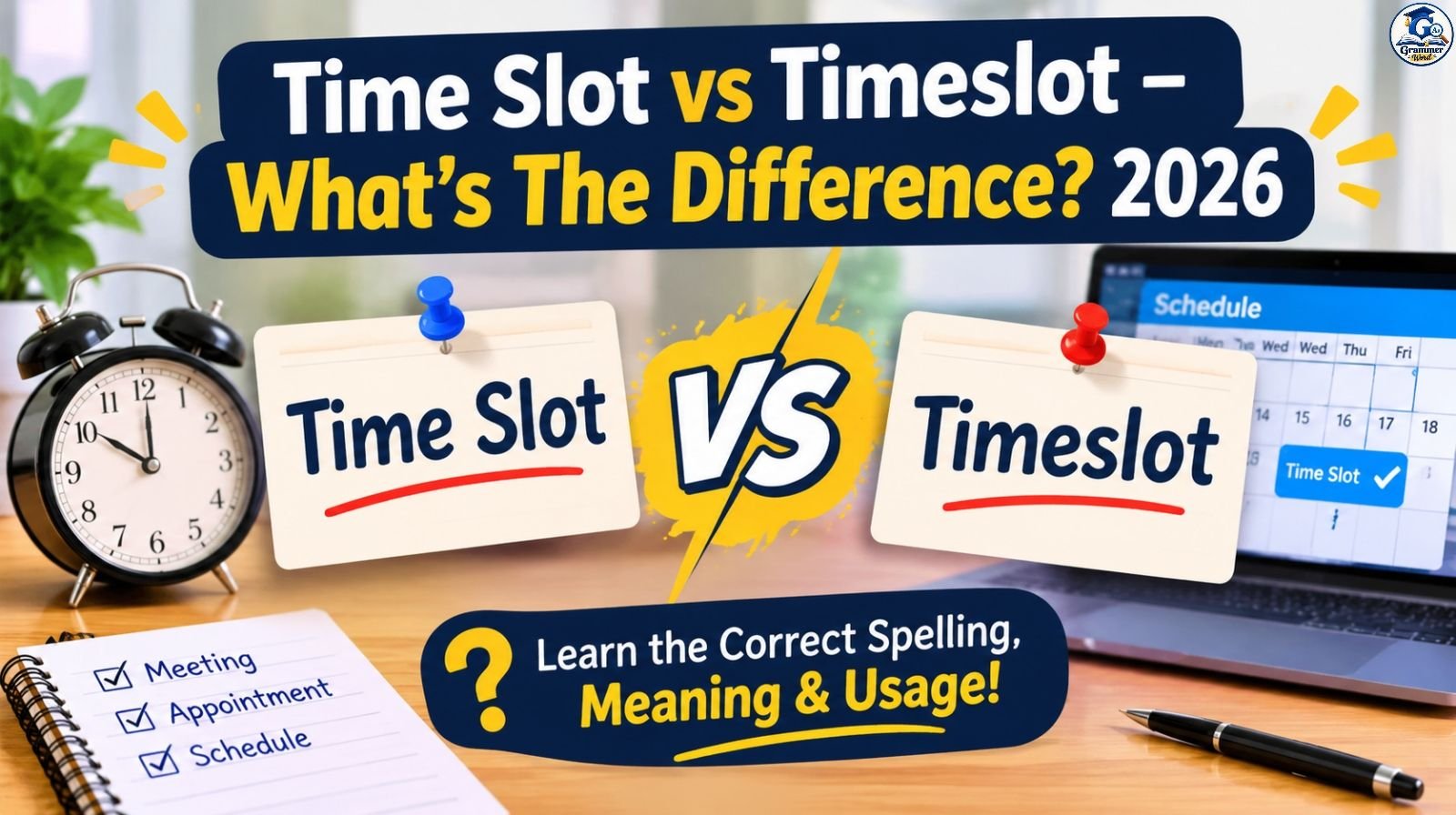
When scheduling a meeting, booking an appointment, or organizing your daily routine, you may come across two spellings:
time slot and timeslot. At first glance, they look almost identical, and many people use them interchangeably. However, is one spelling more correct than the other?
The difference may seem small, but choosing the right form can make your writing look more professional, especially in business emails, workplace communication, appointment confirmations, and formal documents.
In this guide, we’ll explain time slot vs timeslot, explore their meanings, discuss which spelling is preferred in modern English, and provide practical examples to help you use them confidently in everyday communication.
Read More: He Is Risen or He Has Risen – Which Is Correct? 2026
What Is the Difference Between Time Slot and Timeslot?
The main difference between time slot and timeslot is their spelling and conventional usage.
Time slot, written as two separate words, is the standard and widely preferred spelling in general English. It refers to a specific period of time reserved or allocated for an activity, appointment, meeting, or event.
Timeslot, written as one word, is also used, particularly in scheduling software, technical contexts, and informal digital communication. However, it is less conventional in general prose.
Here is a quick comparison:
| Time Slot | Timeslot |
|---|---|
| Two-word spelling | One-word spelling |
| Standard form in general writing | Less conventional alternative |
| Common in professional communication | Common in some digital and technical contexts |
| Preferred in formal emails and documents | May appear in software interfaces |
| Example: I booked a time slot. | Example: Select your timeslot. |
The simple answer: If you’re unsure which spelling to choose, use time slot. It is the safer and more widely accepted choice in standard English.
What Does Time Slot Mean?
Time slot is a noun that describes a particular period during which someone has scheduled or reserved an activity.
It usually refers to a limited amount of time assigned to a specific purpose. This could be a doctor’s appointment, a business meeting, a television program, an online class, or a job interview.
For example:
- I reserved a time slot for my dentist appointment.
- The manager gave me a 30-minute time slot for the interview.
- We need to choose a suitable time slot for tomorrow’s meeting.
- The television channel has a new program in its evening time slot.
In each example, the phrase describes a specific period allocated to an activity.
Read More: Mathew or Matthew: Which Spelling Is Correct?
Examples of Time Slot in Everyday Situations
Here are some realistic situations that demonstrate how to use time slot naturally.
1. Booking a Doctor’s Appointment
Imagine Sarah wants to visit her doctor but has a busy schedule. She calls the clinic to reserve an appointment.
Example:
“Hello, I’d like to book a time slot with Dr. James for Friday morning. Do you have anything available around 10:00 AM?”
Here, time slot refers to a specific appointment period reserved for Sarah.
2. Scheduling a Business Meeting
Suppose Daniel works in an office and needs to arrange a meeting with his team.
Example:
“Hi, everyone,
We need to schedule a meeting to discuss the upcoming project. Please let me know which time slot works best for you.
Best regards,
Daniel”
This example shows how naturally time slot fits into professional communication.
3. Booking an Online Class
A student wants to register for an online English lesson.
Example:
“I selected the 4:00 PM time slot for my English class because it fits my daily schedule.”
The phrase identifies the specific period reserved for the lesson.
4. Scheduling a Job Interview
A company offers several interview times to a candidate.
Example:
“Dear Emily,
Thank you for applying for the position. We currently have three available time slots for interviews:
- 9:00 AM
- 11:00 AM
- 2:00 PM
Please let us know which time slot is most convenient for you.
Kind regards,
Michael”
Here, time slot clearly communicates the available interview periods.
Read More: What Kind of vs What Kinds of: Which One Is Correct?
What Does Timeslot Mean?
Timeslot is a closed compound form of the words time and slot. It carries essentially the same meaning as time slot.
It describes a particular period reserved or allocated for an activity.
Although you may encounter this spelling in scheduling applications, booking platforms, and technical systems, it is not the preferred form in most standard English writing.
For example:
- Select your preferred timeslot.
- The system automatically assigns a timeslot to each customer.
- Your requested timeslot is no longer available.
These sentences communicate the intended meaning clearly. However, in general writing, using time slot would be a better choice.
Examples of Timeslot in Different Situations
Although time slot is generally preferable, understanding how timeslot appears in everyday contexts can help you recognize it.
1. Online Appointment System
Imagine a customer is booking an appointment through a website.
Example:
“Please choose an available timeslot from the calendar before completing your booking.”
This sentence uses the closed spelling in a digital booking context.
2. Workplace Scheduling Software
A company uses scheduling software to organize employee shifts.
Example:
“Each employee must select a timeslot before submitting their weekly availability.”
Here, timeslot refers to a specific period assigned to an employee.
3. Television Broadcasting
A television station organizes its programs according to a broadcasting schedule.
Example:
“The network has assigned the new drama series a prime-time timeslot.”
In broadcasting, timeslot is sometimes used as a compound spelling.
4. Online Consultation
A customer wants to arrange a virtual consultation.
Read More: Afterward or Afterwards: Which Spelling Is Correct?
Example:
“Your preferred timeslot has been saved successfully. You will receive a confirmation email shortly.”
This is an example of the kind of wording someone might encounter in an automated booking system.
Time Slot vs Timeslot: Which Spelling Is Correct?

If you’re wondering which spelling is correct, time slot is the recommended choice for standard English writing.
The two-word form is well established in dictionaries and everyday communication. It is appropriate for professional emails, academic writing, business documents, articles, and general conversation.
The one-word spelling, timeslot, is also encountered, but its use is less consistent.
Consider these examples:
PREFERRED
- I would like to reserve a time slot for tomorrow.
- Please choose an available time slot.
- The meeting time slot has been confirmed.
LESS PREFERRED IN GENERAL PROSE
- I would like to reserve a timeslot for tomorrow.
- Please choose an available timeslot.
- The meeting timeslot has been confirmed.
The meanings are essentially identical, but the first group follows the more conventional spelling.
Writing tip: When writing for a professional audience, consistency and standard spelling matter. Choosing time slot helps keep your writing clear and familiar to readers.
Read More: Period Inside or Outside Quotes? American vs. British Rules
When Should You Use Time Slot?
You should generally use time slot whenever you’re referring to a specific period reserved for an activity.
Here are some common situations where this spelling is appropriate.
1. In Professional Emails
When communicating with colleagues, clients, or managers, the two-word spelling is a reliable choice.
Example:
Subject: Request for a Meeting Time Slot
Dear Robert,
I hope you’re doing well. I would like to arrange a meeting to discuss the new marketing strategy. Could you please share an available time slot for Thursday? Thank you for your assistance.
Best regards,
Sophia
In this email, time slot sounds natural and professional.
2. In Appointment Scheduling
Whether you’re booking a medical appointment, salon visit, or consultation, use time slot in your writing.
Example:
“I would prefer the 2:30 PM time slot for my appointment. Please confirm whether it is available.”
3. In Academic Writing
Students and researchers may use the phrase when discussing schedules, examinations, and educational activities.
Example:
“Each student was assigned a specific time slot for the oral examination.”
4. In Workplace Communication
Employees often use the phrase when coordinating meetings, interviews, and work schedules.
Example:
“Please reserve a suitable time slot for the project presentation next week.”
Common Mistakes to Avoid When Using Time Slot and Timeslot
Even though these spellings are easy to understand, writers sometimes make mistakes when using them.
Here are some common issues to avoid.
1. Treating Both Spellings as Equally Preferred
Both forms can communicate the same meaning, but that doesn’t mean they are equally conventional.
Better: Use time slot in standard writing.
2. Writing Time-Slot Without a Reason
Some people write the expression with a hyphen:
- Time-slot
- Time slot
- Timeslot
In ordinary prose, time slot is the preferred form. Avoid unnecessary hyphenation.
Read More: Aluminum vs Aluminium: What’s The Difference And Which Spelling Is Correct?
3. Using the Wrong Article
Remember that time slot is a countable noun. When referring to one specific period, you generally need an appropriate article or determiner.
Incorrect: “I need book time slot.”
Correct: “I need to book a time slot.”
Incorrect: “She selected available time slot.”
Correct: “She selected an available time slot.”
4. Confusing a Time Slot With a Duration
A time slot and a duration are related, but they are not exactly the same.
A time slot is a scheduled period, while a duration describes how long something lasts.
For example:
- “My time slot is 10:00 AM to 10:30 AM.”
- “The duration of my appointment is 30 minutes.”
The first sentence identifies the allocated period, while the second describes its length.
Time Slot vs Timeslot: More Example Sentences

The following examples will help you understand how the phrase works in different situations.
Examples Using Time Slot
- I booked a time slot for my annual medical checkup.
- Please select your preferred time slot before Friday.
- The manager reserved a time slot for the team discussion.
- We couldn’t find an available time slot in the afternoon.
- My interview time slot is scheduled for 11:30 AM.
- The teacher assigned each student a separate time slot.
- Can you change my appointment time slot to Monday?
- The company offers flexible time slots for consultations.
- I prefer an early morning time slot because I work in the afternoon.
- The available time slots are listed on the booking page.
Read More: Leafs vs Leaves: Which Is Correct And How To Use Them?
Examples Using Timeslot
- Please select your preferred timeslot from the online calendar.
- The booking system automatically assigned a timeslot.
- My requested timeslot was unavailable.
- The application allows users to change their timeslot.
- Each employee received a different timeslot for training.
- The television network changed the show’s timeslot.
- Your selected timeslot has been saved.
- The software displays every available timeslot.
- Customers can choose a convenient timeslot online.
- The system will notify you if your timeslot changes.
Notice that both spellings communicate the same general idea. However, the two-word form remains the more conventional option for everyday English.
Is Time Slot One Word or Two Words?
Time slot is traditionally written as two words.
It consists of two separate words:
- Time: A period during which something happens.
- Slot: An allocated or designated position or period.
When combined, they describe a specific period reserved for an activity.
For example:
“Please book a time slot for your consultation.”
Although some writers and software platforms use timeslot as one word, the two-word spelling is the safer choice in standard English.
Is Time Slot Hyphenated?
No. In ordinary English writing, time slot is generally written without a hyphen.
The standard spelling is:
- Correct: Time slot
- Less conventional: Time-slot
- Less conventional: Timeslot
For example:
Correct: “I have reserved a time slot for the meeting.”
Less conventional: “I have reserved a time-slot for the meeting.”
There is no need to insert a hyphen between time and slot in ordinary usage.
Read More: Fluorescent vs Flourescent: Difference And Usage
Frequently Asked Questions
1. Is It Time Slot or Timeslot?
Time slot is the preferred spelling in standard English. Timeslot is also used, particularly in technical and digital scheduling contexts, but it is less conventional in general writing.
2. Is Time Slot One Word or Two?
The standard spelling is two words: time slot. It consists of the noun time and the noun slot.
3. Is Timeslot Grammatically Incorrect?
Not necessarily. Timeslot is an established alternative spelling in some contexts. However, time slot is more widely preferred in standard prose.
4. What Is the Plural of Time Slot?
The plural form is time slots.
Example: “There are five available time slots for tomorrow’s appointments.”
5. Can I Use Time Slot in a Formal Email?
Yes! Time slot is perfectly appropriate for formal emails, business communication, appointment requests, and professional scheduling.
Example:
“Dear Mr. Wilson,
Could you please let me know which time slot would be most convenient for our meeting?
Best regards,
Olivia”
6. Is Time Slot the Same as Appointment Time?
Not exactly. An appointment time usually refers to the specific time an appointment is scheduled to begin, while a time slot refers to the allocated period during which the appointment takes place.
For example, a 10:00 AM appointment may occupy a 30-minute time slot.
7. Should I Use Time Slot or Timeslot in an SEO Article?
For an SEO article written in standard English, time slot is generally the better choice. It reads naturally and follows conventional spelling.
Final Thoughts
When comparing time slot vs timeslot, the main difference comes down to spelling conventions rather than meaning.
Time slot, written as two separate words, is the standard and preferred form in general English. It works naturally in professional emails, business documents, appointment requests, academic writing, and everyday conversations.
Timeslot, written as one word, is also used, particularly in digital scheduling and technical contexts, but it is less conventional in general prose.
If you want your writing to sound clear, natural, and professional, remember this simple rule: Choose “time slot” whenever you’re unsure.
Whether you’re booking a doctor’s appointment, arranging a business meeting, or selecting an online consultation, the two-word spelling is a reliable choice in modern English.
Keep learning with more easy grammar lessons on Grammer Word

Hi, I’m Noor Fatima, the person behind this website. I created this site to make English grammar and confusing words easier to understand. I love breaking down tricky words, meanings, spellings, and grammar rules into simple explanations. My goal is to help you learn English naturally, avoid common mistakes, and feel more confident every time you write or speak.