When the holiday season arrives, people often send warm wishes to friends, family members, coworkers, clients, and customers.
You might write a greeting card, send a quick text message, or prepare a professional holiday email. But one small grammar question can cause confusion: Should you write “Happy Holiday” or “Happy Holidays”?
Both expressions may look correct at first glance, but they are not used in exactly the same way. One is generally more common as a seasonal greeting, while the other can be appropriate when referring to a particular holiday or occasion.
The good news is that understanding the difference is relatively simple. Once you know how singular and plural nouns work in greetings, you can confidently choose the right expression for almost any situation.
In this article, we will explain Happy Holiday vs. Happy Holidays, explore their meanings, discuss when to use each expression, and provide practical examples from emails, text messages, greeting cards, workplace conversations, and everyday situations.
Let’s get started!
Read More: Time Slot vs Timeslot – What’s The Difference? 2026
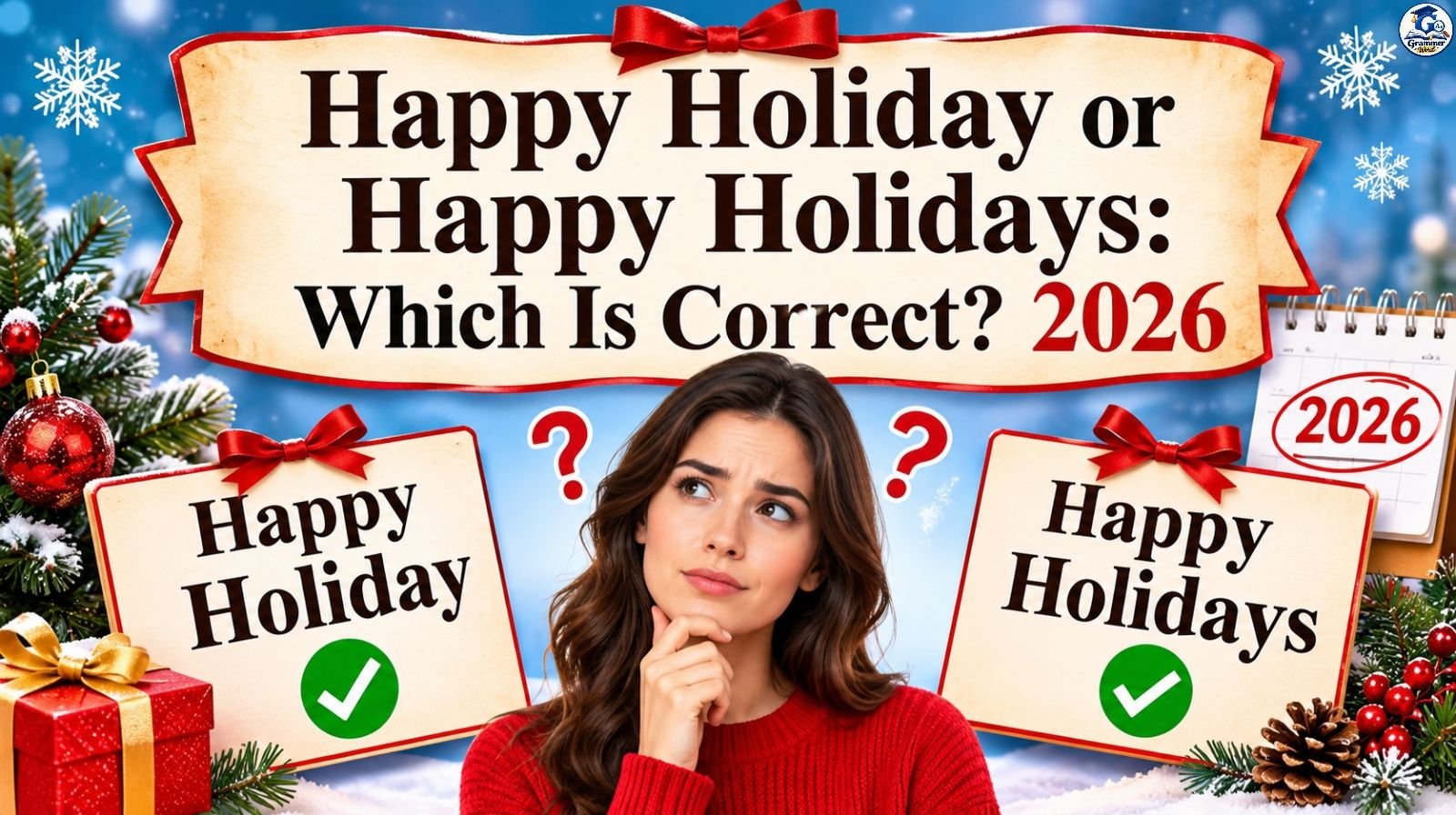
Happy Holiday or Happy Holidays: Which Is Correct?

The expression “Happy Holidays” is generally the more common and widely accepted greeting, especially during the end-of-year holiday season.
It is used to wish someone happiness during a period that may include several celebrations, such as Christmas, Hanukkah, New Year’s, and other seasonal occasions.
On the other hand, “Happy Holiday” is grammatically possible but less common as a general seasonal greeting. It can be used when referring to one particular holiday or wishing someone an enjoyable holiday experience.
Here is a simple comparison:
| Expression | Meaning | Common Usage |
|---|---|---|
| Happy Holiday | A wish for happiness during one holiday or vacation | Specific holiday or individual occasion |
| Happy Holidays | A wish for happiness during multiple holidays or the holiday season | General seasonal greeting |
For example:
- Happy Holidays! I hope you enjoy this wonderful season with your family.
- Have a happy holiday! Enjoy your vacation in Italy.
In the first example, the speaker is referring to the broader holiday season. In the second, the speaker is wishing someone an enjoyable individual holiday or vacation.
The important takeaway: If you are sending a general greeting during the December holiday season, “Happy Holidays” is usually the safest and most natural choice.
What Does Happy Holiday Mean?
“Happy Holiday” is a singular expression used to wish someone happiness, enjoyment, or a pleasant experience during one particular holiday.
The word holiday is a singular countable noun. It refers to an individual day of celebration, a special occasion, or a period when someone takes time away from work or everyday responsibilities.
When you use the singular form, you are generally focusing on one holiday or one period of rest.
For example:
- Have a happy holiday with your family!
- I hope you have a happy holiday in London.
- Wishing you a happy holiday filled with beautiful memories.
Although the expression is understandable, native English speakers often prefer “Have a happy holiday” rather than simply saying “Happy Holiday” as a general seasonal greeting.
Read More: He Is Risen or He Has Risen – Which Is Correct? 2026
When Is Happy Holiday Appropriate?
There are several situations where using the singular form makes sense.
1. When Someone Is Going on Vacation
If a friend or colleague is taking a vacation, you can wish them a happy holiday.
Example:
Your coworker, Daniel, tells you that he is taking a week off to visit his parents.
You can respond:
“That sounds wonderful, Daniel! Have a happy holiday and enjoy your time with your family.”
Here, the singular form works because you are referring to one specific vacation.
2. When Referring to One Particular Holiday
Sometimes, you may want to wish someone happiness during one specific celebration.
For example:
“Have a happy holiday! I hope your Christmas celebration is full of love and happiness.”
In this situation, the singular expression can work because the context identifies the particular occasion.
However, if you are addressing someone during the general holiday season, “Happy Holidays” will usually sound more natural.
3. When Sending a Personal Message
Imagine your friend, Sarah, is preparing to travel during a public holiday.
You could send her this message:
“Hi Sarah,
I hope you have a happy holiday! Enjoy your trip, take plenty of pictures, and make some wonderful memories.
Best wishes!”
This is a friendly and natural way to use the singular expression.
Happy Holiday in Email Examples
The singular expression can also appear in emails, especially when someone is taking time away from work.
Here are some practical examples.
Example 1: Email to a Coworker
Subject: Enjoy Your Time Off!
Hi Michael,
I heard that you are taking a few days off next week. I hope you have a happy holiday and get plenty of time to relax. Enjoy your break!
Best regards,
James
Example 2: Email to a Friend
Subject: Have a Wonderful Trip!
Hi Emma,
I just wanted to wish you a happy holiday before you leave for your vacation. Have a fantastic time, enjoy the beautiful scenery, and make unforgettable memories. Take care!
Best regards,
Olivia
Example 3: Email to an Employee
Subject: Enjoy Your Holiday Break
Dear David,
Thank you for your hard work and dedication throughout the year. As you prepare to take some time off, I hope you have a happy holiday and enjoy a relaxing break with your loved ones.
Best wishes,
Robert
These examples demonstrate that the singular expression can work naturally when the message focuses on an individual’s holiday or vacation.
Read More: Appal vs. Appall: What’s The Difference? (2026)
What Does Happy Holidays Mean?
“Happy Holidays” is a widely recognized greeting used to wish people happiness, peace, and enjoyment during the holiday season.
The word holidays is the plural form of holiday. It refers to more than one holiday or, in common seasonal usage, the broader period when several celebrations take place.
In many English-speaking countries, especially the United States and Canada, the phrase is frequently used during November, December, and early January.
This period may include celebrations such as:
- Christmas
- Hanukkah
- Kwanzaa
- New Year’s Day
- Other cultural and religious celebrations
The expression is particularly useful because it does not assume that everyone celebrates the same holiday.
For example:
“Happy Holidays! Wishing you and your family a season filled with joy, peace, and happiness.”
This greeting is suitable for friends, colleagues, customers, business partners, and people whose individual holiday traditions you may not know.
Why Is Happy Holidays More Common?
There are several reasons why “Happy Holidays” is more common as a general seasonal greeting.
1. It Includes Multiple Celebrations
The holiday season is not limited to one celebration. Different people observe different religious, cultural, and personal occasions.
Using the plural form allows you to offer a warm greeting without focusing on just one event.
2. It Is More Inclusive
Not everyone celebrates Christmas, and not everyone observes the same religious or cultural traditions.
“Happy Holidays” provides a friendly alternative that acknowledges the broader season.
3. It Works in Professional Communication
Businesses, schools, organizations, and workplaces often use this expression when sending seasonal greetings.
For example:
“Happy Holidays to our valued customers! Thank you for your continued support throughout the year.”
This message works well because it is warm, professional, and appropriate for a diverse audience.
4. It Is a Familiar Seasonal Greeting
Many English speakers are accustomed to hearing and reading “Happy Holidays” in advertisements, greeting cards, workplace messages, and everyday conversations.
As a result, it sounds natural when used as a general end-of-year greeting.
Happy Holidays in Email Examples
Here are some realistic examples showing how you can use “Happy Holidays” in different types of emails.
Example 1: Professional Email to a Client
Subject: Season’s Greetings!
Dear Mr. Anderson,
As the year comes to an end, we would like to thank you for your continued trust and support. We wish you and your family Happy Holidays and a wonderful New Year filled with success, good health, and happiness. We look forward to working with you again.
Best regards,
Daniel Wilson
Example 2: Email to Your Team
Subject: Happy Holidays, Everyone!
Hi Team,
Before we wrap up for the year, I want to thank everyone for their dedication, teamwork, and hard work. It has been a pleasure working with you all. Wishing you Happy Holidays! I hope you enjoy some quality time with your families and return feeling refreshed.
Best regards,
Jessica
Example 3: Email to a Friend
Subject: Sending Holiday Wishes!
Hi Sophia,
I hope you are doing well! I just wanted to send you warm wishes and say Happy Holidays. May this season bring you plenty of laughter, beautiful memories, and special moments with the people you love. Enjoy every moment!
Take care,
Emily
Example 4: Business Holiday Announcement
Subject: Holiday Greetings from Our Team
Dear Customers,
Thank you for being part of our journey this year. Your support means a great deal to us. From everyone at our company, we wish you Happy Holidays and a wonderful New Year! May the coming year bring you happiness, success, and new opportunities.
Warm regards,
The Customer Support Team
These examples show why the plural expression is especially useful in general holiday communication.
Read More: Some of Whom or Some of Who — Which One Is Correct? (2026)
Happy Holiday vs. Happy Holidays: Understanding the Grammar

To understand the difference between these expressions, it helps to look at a basic English grammar rule: singular and plural nouns.
In English, nouns can refer to one person, place, thing, or occasion, or to more than one.
The word holiday is singular, while holidays is plural.
For example:
- One holiday
- Two holidays
- A special holiday
- Several holidays
The difference between the two expressions comes from the number of holidays being referenced.
Understanding the Singular Form
The singular form, holiday, refers to one specific occasion or period of rest.
For example:
“I am looking forward to my summer holiday.”
In this sentence, the speaker is referring to one vacation period.
Similarly:
“Have a happy holiday!”
This sentence expresses a wish for someone to enjoy a particular holiday or vacation.
Understanding the Plural Form
The plural form, holidays, refers to multiple holidays or the general holiday season.
For example:
“Happy Holidays to everyone!”
The speaker is offering a seasonal greeting to a group of people.
Another example:
“We enjoy spending the holidays together.”
Here, the plural form refers to the holiday period, rather than one specific celebration.
Is Happy Holiday Grammatically Incorrect?
No. “Happy Holiday” is not grammatically incorrect.
However, grammar and natural usage are not always the same thing.
A phrase can be grammatically possible but less common in everyday communication.
For example, “Happy Holiday” can work in a sentence such as:
“I hope you have a happy holiday in Spain.”
However, when sending a general greeting during the December holiday season, most English speakers would naturally choose:
“Happy Holidays!”
Therefore, the difference is not simply about correct and incorrect grammar. It is also about context, meaning, and common English usage.
When Should You Use Happy Holiday?
Although “Happy Holidays” is the more familiar seasonal greeting, there are situations where the singular form is perfectly suitable.
Let’s explore some everyday examples.
1. When Someone Is Taking a Vacation
If your friend, colleague, or family member is going away for a few days or weeks, you can use “happy holiday” to wish them an enjoyable break.
Example:
Your colleague, Mark, tells you that he is visiting Australia for two weeks.
You say:
“That sounds amazing, Mark! Have a happy holiday and enjoy your trip.”
Here, the expression refers to one vacation.
2. When Talking About a Specific Holiday
You can use the singular form when discussing one particular holiday.
Example:
“Have a happy holiday with your children this weekend.”
The message focuses on one holiday occasion.
Read More: Ingrained or Engrained: Which Is Correct In 2026?
3. When Writing a Personal Greeting
Imagine your friend, Olivia, is celebrating a special holiday with her family.
You can write:
“Dear Olivia,
Wishing you a happy holiday filled with love, laughter, and wonderful memories. I hope you enjoy every moment with your family.
Warm wishes,
Sophie”
The singular form is understandable because the message focuses on one particular occasion.
4. When Wishing Someone a Pleasant Break
Sometimes, people use the word holiday to describe a break from work, school, or everyday responsibilities.
For example:
“Have a happy holiday! You deserve some time to relax after such a busy month.”
This is a natural way to wish someone an enjoyable break.
When Should You Use Happy Holidays?
The plural expression is suitable for many situations, especially when you are offering a general greeting.
Here are some common examples.
1. During the December Holiday Season
This is perhaps the most familiar use of “Happy Holidays.”
Example:
“Happy Holidays! May your days be filled with happiness, peace, and beautiful memories.”
This greeting is suitable for almost any general seasonal message.
2. When Sending Business Greetings
Companies frequently send holiday wishes to customers, employees, suppliers, and business partners.
Example:
“Happy Holidays from everyone at Bright Solutions! Thank you for making this year so special.”
It sounds friendly while maintaining a professional tone.
3. When Sending Greeting Cards
Holiday cards often include the plural expression because they are intended to offer general seasonal wishes.
Example:
“Happy Holidays! Wishing you a season full of joy and a New Year filled with exciting opportunities.”
This works well for family members, friends, and professional contacts.
4. When You Do Not Know Someone’s Holiday Traditions
If you are unsure which holidays someone celebrates, “Happy Holidays” is a thoughtful choice.
For example:
“Happy Holidays, everyone! I hope you enjoy this special time of year.”
It allows you to share good wishes without making assumptions about someone’s traditions.
Read More: Aether vs Ether: What’s The Real Difference? (2026)
Happy Holiday or Happy Holidays in Different Situations
Choosing the right expression becomes easier when you consider the situation.
Let’s compare how each phrase works in common everyday settings.
In a Workplace
Imagine your manager, Daniel, is preparing to send a message to the entire department before the office closes for the year.
Which expression should he choose?
Better choice: Happy Holidays
Example:
“Happy Holidays, everyone! Thank you for your hard work this year. I hope you enjoy a relaxing break with your families and friends.”
Why?
Because the message is intended for a group of people and refers to the broader holiday season.
However, if Daniel is speaking directly to one employee who is taking a vacation, he could say:
“Have a happy holiday, Sarah! Enjoy your time off.”
In a Personal Text Message
Suppose your friend, Emma, is celebrating the holiday season.
You can send:
“Happy Holidays, Emma! Hope you have a wonderful time with your family.”
This is natural and friendly.
However, if Emma is leaving for a vacation, you might write:
“Have a happy holiday, Emma! Enjoy your trip and stay safe.”
Both expressions work because they communicate different ideas.
In a Greeting Card
If you are preparing cards for several friends and relatives, the plural form is generally the better option.
Example:
“Happy Holidays! May your home be filled with warmth, your heart with happiness, and your year with beautiful memories.”
For a card specifically celebrating one holiday, you may also use a greeting that names that occasion.
In a Business Advertisement
A company preparing a seasonal promotional campaign might write:
“Happy Holidays! Celebrate the season with special offers and exciting surprises.”
This expression is suitable because the advertisement is aimed at a broad audience.
In a School or University Message
A teacher might send a message to students before the winter break.
Example:
“Happy Holidays, everyone! Enjoy your time away from school, stay safe, and come back ready for a wonderful new semester.”
The plural expression works naturally because the greeting is directed toward a group.
Common Mistakes to Avoid When Using Happy Holiday and Happy Holidays
Even though these expressions are simple, people sometimes use them in ways that sound unnatural.
Understanding a few common mistakes can help you write better English.
Mistake 1: Using Happy Holiday for Every Seasonal Greeting
Some people write:
“Happy Holiday to everyone!”
Although the meaning is understandable, “Happy Holidays to everyone!” is generally more natural as a broad seasonal greeting.
The plural form better reflects the multiple celebrations associated with the season.
Read More: Reschedule To or Reschedule For: Which One Is Correct? (2026)
Mistake 2: Assuming Happy Holiday Is Always Wrong
Another common misunderstanding is believing that the singular expression is grammatically incorrect.
That is not true.
For example:
“Have a happy holiday in Paris!”
This is a perfectly understandable sentence because it refers to one vacation.
Remember that context determines which expression is appropriate.
Mistake 3: Confusing Holiday With Holidays
The singular and plural forms have different meanings.
Consider these sentences:
- “I am planning a holiday.”
- “We are celebrating several holidays this month.”
The first sentence refers to one vacation or holiday period. The second refers to multiple occasions.
Using the wrong form can make your message less precise.
Mistake 4: Forgetting the Apostrophe
The word holidays does not need an apostrophe when used as a regular plural noun.
Correct:
“Happy Holidays!”
Incorrect:
“Happy Holiday’s!”
An apostrophe is generally used to show possession or contraction, not to create an ordinary plural.
Mistake 5: Using an Unnecessarily Complicated Greeting
Some writers believe that a longer greeting always sounds more professional.
However, simple expressions often communicate warmth more effectively.
For example:
“Happy Holidays! Wishing you a wonderful season.”
This is clear, friendly, and appropriate for most situations.
You do not need complicated wording to make your message meaningful.
Other Holiday Greetings You Can Use
Although “Happy Holidays” is a popular seasonal greeting, it is not your only option.
Depending on the situation, you can choose another expression that better communicates your message.
Here are some alternatives.
1. Season’s Greetings
“Season’s Greetings” is a traditional expression used in cards, letters, and professional messages.
Example:
“Season’s Greetings! Wishing you and your family peace, happiness, and success.”
It is especially suitable for business communication.
2. Merry Christmas
“Merry Christmas” is a specific greeting used by people celebrating Christmas.
Example:
“Merry Christmas, Olivia! I hope your day is filled with love and happiness.”
Unlike “Happy Holidays,” this greeting directly refers to Christmas.
3. Happy New Year
This greeting is used to wish someone happiness and success as a new calendar year begins.
Example:
“Happy New Year, Michael! May the coming year bring you new opportunities and wonderful experiences.”
It is particularly common around December 31 and January 1.
4. Have a Wonderful Holiday Season
This expression is a slightly longer alternative to “Happy Holidays.”
Example:
“Have a wonderful holiday season! I hope you enjoy every moment with your loved ones.”
It works well in both personal and professional messages.
Read More: Giving or Given: Which Is Correct? 2026 Grammar Guide
5. Enjoy Your Holiday Break
This greeting is particularly useful when someone is taking time off from work or school.
Example:
“Enjoy your holiday break, Sarah! I hope you get plenty of rest and relaxation.”
It is more specific than a general seasonal greeting.
Frequently Asked Questions
1. Is Happy Holiday or Happy Holidays Correct?
Both expressions can be correct, depending on the context. Happy Holidays is the more common general seasonal greeting, while Happy Holiday can refer to one particular holiday or vacation.
2. Should I Say Happy Holiday or Happy Holidays?
If you are sending a general greeting during the holiday season, choose Happy Holidays. If you are wishing someone an enjoyable individual vacation, “Have a happy holiday” is appropriate.
3. Is Happy Holidays Grammatically Correct?
Yes. Happy Holidays is grammatically correct. The word “holidays” is the plural form of “holiday” and is commonly used to refer to the broader holiday season.
4. Is Happy Holiday Grammatically Incorrect?
No. Happy Holiday is not grammatically incorrect. However, it is less common as a general seasonal greeting. It sounds more natural when referring to one specific holiday or vacation.
5. Why Do People Say Happy Holidays Instead of Happy Holiday?
People commonly say Happy Holidays because the phrase refers to a season that includes several celebrations. It is also a convenient greeting when addressing people who may celebrate different holidays.
6. Can I Write Happy Holidays in a Professional Email?
Absolutely! Happy Holidays is appropriate for professional emails, business greetings, customer messages, and workplace announcements.
For example:
“Happy Holidays! Thank you for your continued partnership. We look forward to working with you in the coming year.”
7. Is Happy Holidays More Polite Than Happy Holiday?
Neither expression is inherently more polite. Both can communicate good wishes. However, Happy Holidays is generally more suitable for broad seasonal greetings, especially when you do not know which celebration someone observes.
8. Can I Say Happy Holiday to One Person?
Yes. You can say “Have a happy holiday” to one person, particularly when they are going on vacation or celebrating a specific occasion.
9. Is Happy Holidays Singular or Plural?
Holidays is plural. It is the plural form of the singular noun “holiday.” In the greeting, it commonly refers to the broader holiday season.
10. Can Businesses Use Happy Holidays?
Yes. Businesses frequently use Happy Holidays in customer emails, advertisements, greeting cards, social media posts, and company announcements because it is suitable for a broad audience.
11. Should Happy Holidays Be Capitalized?
When used as a standalone greeting or at the beginning of a sentence, capitalize both words:
Happy Holidays!
When used in the middle of a sentence, ordinary sentence capitalization applies unless a particular style guide or design choice requires otherwise.
For example:
“We wish everyone happy holidays this year.”
Final Thoughts:
The answer depends on what you want to communicate.
“Happy Holidays” is the more common and natural choice when wishing someone well during the general holiday season. It is widely used in personal messages, professional emails, greeting cards, advertisements, and workplace announcements.
“Happy Holiday” is also grammatically possible, particularly when referring to one specific holiday or an individual’s vacation. For example, “Have a happy holiday!” is a perfectly understandable way to wish someone an enjoyable break.
The easiest way to remember the difference is:
- Happy Holiday: A wish connected to one particular holiday or vacation.
- Happy Holidays: A general greeting for the holiday season or multiple celebrations.
Ultimately, both expressions have their place in English. Just pay attention to the context, choose the wording that communicates your meaning clearly, and you will be able to use these greetings confidently.
When in doubt, choose “Happy Holidays” for a general seasonal greeting!
Keep learning with more easy grammar lessons on Grammer Word

Hi, I’m Noor Fatima, the person behind this website. I created this site to make English grammar and confusing words easier to understand. I love breaking down tricky words, meanings, spellings, and grammar rules into simple explanations. My goal is to help you learn English naturally, avoid common mistakes, and feel more confident every time you write or speak.