Have you ever wondered whether to use giving or given in a sentence? You are not alone. These two words come from the same verb, give, but they serve different grammatical purposes.
Choosing the wrong form can make a sentence sound awkward or grammatically incorrect.
The good news is that understanding the difference between giving and given is easier than you might think. Once you learn how each word works, you can use both confidently in everyday conversations, school assignments, emails, and professional writing.
In this guide, you will discover the meanings of giving and given, their grammar rules, practical examples, common mistakes, and simple tips to help you choose the correct word in 2026.
Read More: Afterward or Afterwards: Which Spelling Is Correct?
What Is the Difference Between Giving and Given?

Both giving and given are correct English words. However, they are different forms of the verb give and cannot always replace each other.
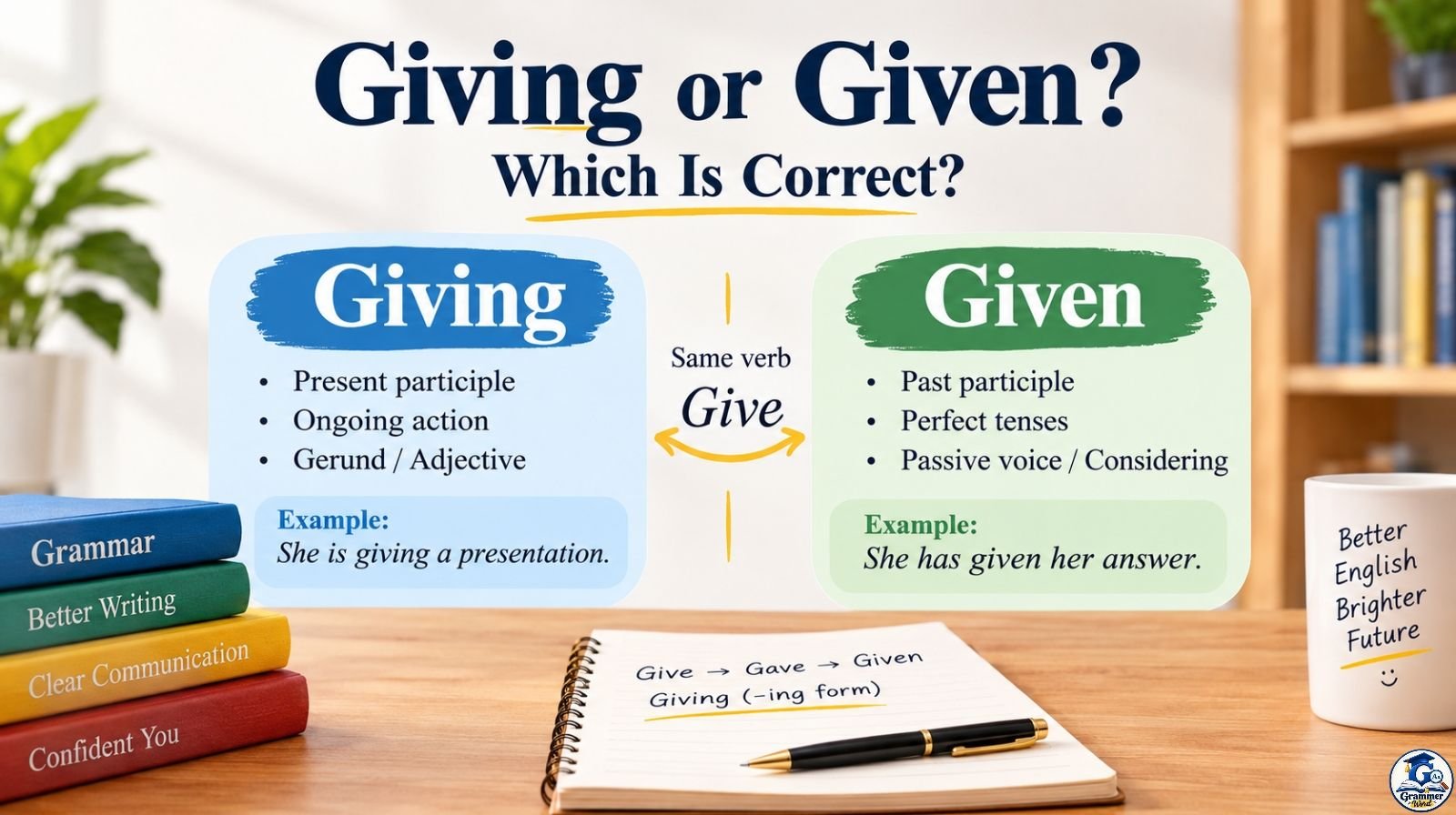
Giving is the -ing form of the verb. It commonly describes an ongoing action or the activity of providing something. Given is the past participle, used in perfect tenses, passive constructions, and expressions meaning “considering.”
Compare these examples:
- Giving: Sarah is giving her friend a present.
- Given: Sarah has given her friend a present.
In the first sentence, Sarah is performing the action. In the second, the sentence uses the present perfect tense to describe an action that has been completed.
Read More: What Kind of vs What Kinds of: Which One Is Correct?
Giving vs. Given: Quick Comparison
| Feature | Giving | Given |
|---|---|---|
| Verb form | Present participle; also used as a gerund | Past participle |
| Main use | Ongoing action or activity | Perfect tenses and passive voice |
| Common structure | Is giving, was giving | Has given, had given, was given |
| Example | He is giving advice. | He has given advice. |
| Additional meaning | Generosity, as in “a giving person” | Considering, as in “Given the circumstances” |
The Correct Forms of the Verb Give
To understand giving or given, it helps to learn all the principal forms of the verb give.
- Give: I give my brother a book.
- Gives: She gives useful advice.
- Gave: He gave me a gift yesterday.
- Giving: They are giving away old clothes.
- Given: I have given you my answer.
Remember that gave is the simple past tense, while given is the past participle. This distinction is especially important when using helping verbs such as has, have, and had.
When Should You Use Giving?
Use giving when you want to describe an action in progress, an activity, or someone’s generous nature. The correct meaning depends on how the word functions in the sentence.
1. Giving for an Ongoing Action
Giving frequently appears in continuous verb tenses. These structures describe an action happening now or one that was in progress at a particular time in the past.
Examples:
- She is giving a presentation to her classmates.
- My father is giving me some helpful advice.
- They are giving free meals to families in need.
- The teacher was giving instructions when the bell rang.
- We were giving our best during the competition.
In these sentences, giving emphasizes the action rather than simply stating that something has already been provided.
2. Giving as a Noun-Like Word
Giving can also function as a gerund. A gerund is an -ing form of a verb that performs the role of a noun.
Examples:
- Giving is an important part of friendship.
- I enjoy giving gifts to my family.
- Giving to charity can help people in need.
- She believes that giving is better than receiving.
In the sentence “I enjoy giving gifts,” the word giving identifies an activity. It does not mean that the action must be happening at the exact moment of speaking.
Read More: Mathew or Matthew: Which Spelling Is Correct?
3. Giving as an Adjective
Giving can also describe someone who is generous, kind, or willing to help others.
Examples:
- She is a giving person who always supports her friends.
- His giving nature makes him popular in the community.
- They have a generous, giving attitude toward others.
Here, giving describes a quality rather than a specific action in progress.
When Should You Use Given?
Use given when the sentence requires the past participle of give, when something is provided to someone, or when you want to express the meaning “considering.”
1. Given With Has, Have, and Had
The past participle given is used with helping verbs to form perfect tenses.
Examples:
- I have given you enough time to finish.
- She has given me excellent advice.
- They have given their permission.
- He had given the documents to his manager before the meeting.
- By next week, we will have given everyone the necessary information.
Notice the correct structure:
- Correct: She has given me a book.
- Incorrect: She has giving me a book.
- Incorrect: She has gave me a book.
The reason is simple: has, have, and had require the past participle in these perfect-tense constructions.
2. Given in Passive Sentences
Given is also used in passive constructions. In these sentences, the focus is on the person or thing receiving something rather than the person performing the action.
Examples:
- He was given a second chance.
- The students were given extra time.
- She was given an award for her hard work.
- The instructions have been given to all employees.
- Every applicant is given an opportunity to explain their experience.
For example, “The teacher gave the student a book” focuses on what the teacher did. “The student was given a book” emphasizes what the student received.
Both sentences are correct, but their emphasis differs.
Read More: Refer or Reffer: The Correct Spelling Revealed (2026)
3. Given Meaning “Considering”
Given can also introduce a fact or circumstance that helps explain a decision or conclusion.
Examples:
- Given the weather, we decided to stay home.
- Given her experience, she is a strong candidate for the position.
- Given the circumstances, your decision was reasonable.
- Given that the deadline is tomorrow, we should begin immediately.
In these examples, given does not mean that someone is physically handing something to another person. It means “considering” or “taking into account.”
This is a common use in formal writing, business communication, and everyday English.
Giving or Given: Common Grammar Mistakes to Avoid

Even experienced English learners can confuse these words when writing quickly. The easiest solution is to check the verb structure and the meaning of the entire sentence.
Mistake 1: Using Giving After Has
Incorrect: She has giving me a wonderful opportunity.
Correct: She has given me a wonderful opportunity.
Why? The present perfect tense requires has + past participle, so given is correct.
Mistake 2: Using Given for an Ongoing Action
Incorrect: He is given me a ride to work.
Correct: He is giving me a ride to work.
Why? The present continuous tense uses is + verb-ing.
Mistake 3: Confusing Gave With Given
Incorrect: I have gave him my phone number.
Correct: I have given him my phone number.
Remember the verb forms: give, gave, given. The simple past form is gave, but the past participle is given.
Mistake 4: Using Giving Instead of Given in a Passive Sentence
Incorrect: The students were giving extra time by the teacher.
Correct: The students were given extra time by the teacher.
Why? The students receive the extra time, so the passive construction requires were given.
Read More: Reinforce or Reenforce: Which Spelling Is Actually Correct?
A Real-Life Example: Giving or Given in the Workplace
Imagine that a team leader is preparing a progress report for a company manager. The report explains the team’s activities, completed tasks, and upcoming deadlines. Because the report needs to sound professional, choosing the correct verb forms matters.
The team leader writes:
“Our supervisor has giving us new instructions for the project.”
Although the meaning is understandable, the sentence is grammatically incorrect. The word has requires the past participle given in this construction. The corrected sentence is:
“Our supervisor has given us new instructions for the project.”
Now imagine that the supervisor is explaining the instructions during a meeting. The team leader writes:
“Our supervisor is giving us new instructions during today’s meeting.”
This sentence is correct because the action is happening now.
The report might also include the following statement:
“Given the limited budget, the team is focusing on the most important tasks first.”
Here, given means “considering.” It introduces a circumstance that explains the team’s decision.
Finally, the team leader writes:
“Additional time was given to employees who needed help completing their assignments.”
This is another correct use of given, because the sentence uses the passive voice.
These examples demonstrate why context is essential. A workplace report may need giving to describe an ongoing activity, given to describe something provided, and given to introduce a relevant circumstance.
Learning to recognize these patterns makes professional emails, reports, and other documents clearer and more accurate.
Read More: Soo vs. So: What’s The Difference? (2026 Guide)
Giving or Given: A Simple Guide for 2026

If you still hesitate between giving and given, use this quick checklist before finishing your sentence.
Step-by-Step Guide
Step 1: Is the action in progress?
Use giving after the appropriate form of be in a continuous tense.
Example: She is giving a speech.
Step 2: Does the sentence use a perfect tense?
Use given after has, have, or had in perfect-tense constructions.
Example: She has given her answer.
Step 3: Is the sentence passive?
Use given when the sentence describes someone receiving something.
Example: She was given an award.
Step 4: Does it mean “considering”?
Use given to introduce a fact or circumstance.
Example: Given the circumstances, we agreed.
Data and Grammar Evidence for 2025–2026
For an accurate understanding of giving versus given, established grammar rules are more useful than unsupported statistics.
The standard forms of the verb give are give, gave, and given, while giving is its -ing form. Continuous verb constructions use be + verb-ing, while perfect constructions use have + past participle.
These established grammar rules remain applicable in 2026.
There is no reliable, widely recognized 2025–2026 statistic specifically measuring how often English learners confuse the words giving and given.
Therefore, assigning a percentage to this particular mistake would be misleading. Instead, the grammatical patterns and examples in this guide provide a reliable basis for choosing the correct form.
Read More: Propose vs Purpose: Which Is Correct? (2026)
Frequently Asked Questions
Q1. Is Giving or Given Correct?
Both words are correct, but they serve different grammatical purposes. Use giving for ongoing actions and activities, and given for perfect tenses, passive constructions, and expressions meaning “considering.”
Examples: “She is giving advice” and “She has given advice.”
Q2. Is It Giving Me or Given Me?
It depends on the sentence.
- Correct: He is giving me a book.
- Correct: He has given me a book.
Use giving with the appropriate continuous-tense structure and given with the appropriate perfect-tense structure.
Q3. Is Given the Past Tense of Give?
No. Gave is the simple past tense, while given is the past participle.
Examples:
- Present: I give her a gift.
- Past: I gave her a gift.
- Present perfect: I have given her a gift.
Q4. Can Given Be Used Without Has, Have, or Had?
Yes. Given can appear in passive sentences, as in “She was given a prize,” and in expressions such as “Given the circumstances, we left early.”
Therefore, it does not always need has, have, or had.
Q5. Why Is “I Have Given” Correct but “I Have Giving” Incorrect?
The present perfect tense follows the structure have/has + past participle. Because given is the past participle of give, “I have given” is correct.
The word giving is the -ing form and does not fit that perfect-tense construction.
Q6. What Does “Given” Mean in a Sentence?
Given can describe something provided to a person, form part of a perfect or passive verb construction, or mean “considering.”
For example, “She was given a certificate” describes something received, while “Given the weather, we stayed inside” means “Considering the weather, we stayed inside.”
Conclusion:
When deciding between giving or given, remember that both are correct English words, but they cannot be used interchangeably.
Use giving to describe an ongoing action, an activity, or a generous quality. Use given as the past participle in perfect tenses and passive constructions, or to mean “considering” in expressions such as “Given the circumstances.”
The verb forms are simple to remember: give, gave, given, with giving as the -ing form. Check the structure of your sentence, identify what you want to express, and choose the form that fits.
Keep learning with more easy grammar lessons on Grammer Word

Hi, I’m Noor Fatima, the person behind this website. I created this site to make English grammar and confusing words easier to understand. I love breaking down tricky words, meanings, spellings, and grammar rules into simple explanations. My goal is to help you learn English naturally, avoid common mistakes, and feel more confident every time you write or speak.