Have you ever wondered whether to write fluorescent or flourescent? These spellings look similar, and the word can be surprisingly difficult to spell correctly.
Whether you are writing about bright colors, office lighting, highlighter pens, or scientific materials, choosing the right spelling matters.
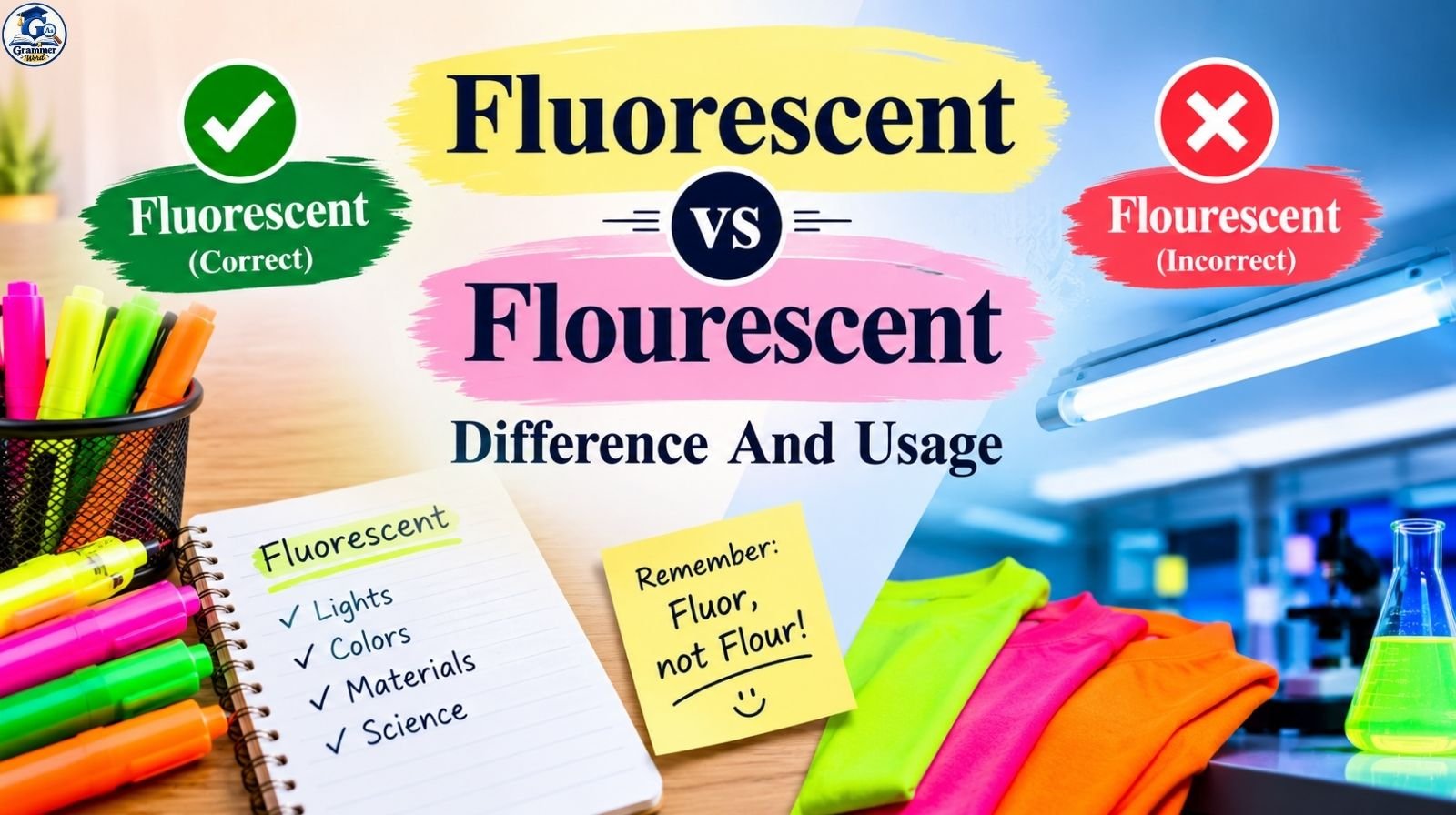
The correct spelling is fluorescent, while flourescent is a common misspelling. The correct word describes something that produces light through fluorescence or has an unusually bright, vivid appearance.
In this guide, you will learn the difference between fluorescent and flourescent, how to use the correct word in sentences, and a few simple tricks to remember its spelling.
Read More: Dysregulated vs Disregulated: Correct Usage Explained
Fluorescent vs Flourescent: Which Spelling Is Correct?
The main difference between these two spellings is that fluorescent is correct, whereas flourescent is incorrect in standard English.
They are not alternative spellings, and you should use fluorescent in academic, professional, and everyday writing.
What Does Fluorescent Mean?
Fluorescent is an adjective that describes a substance that emits light through fluorescence or a color that appears especially bright and vivid.
For example:
- The office uses fluorescent lighting.
- She bought a fluorescent yellow jacket.
- The scientist examined the sample under a fluorescent microscope.
The word appears in contexts involving lighting, clothing, art, laboratory work, and safety equipment.
Why Is Flourescent Incorrect?
The spelling flourescent rearranges the letters in the middle of the word. Although people may type it because they remember the sound incorrectly, it is not the standard spelling.
Incorrect: The classroom has flourescent lights.
Correct: The classroom has fluorescent lights.
Remember that the correct spelling contains fluor at the beginning, not flour.
Read More: Enrol vs Enroll: Which One Is Correct And How To Use Them?
Quick Comparison Table
| Feature | Fluorescent | Flourescent |
|---|---|---|
| Spelling status | Correct | Misspelling |
| Standard dictionary entry | Yes | No, not as the standard form |
| Meaning | Producing fluorescence or appearing vividly bright | No separate standard meaning |
| Formal writing | Use it | Avoid it |
| Example | Fluorescent green paint | Incorrect spelling |
Meaning and Common Uses of Fluorescent

The word fluorescent is used in several situations. Understanding its meaning makes it easier to recognize when the word belongs in a sentence.
Fluorescent Lights and Lamps
Fluorescent lighting refers to lighting that uses fluorescence to produce visible light. Fluorescent lamps have traditionally been common in offices, classrooms, shops, and other indoor spaces.
Examples:
- The old office was illuminated by fluorescent lights.
- We replaced the flickering fluorescent lamp.
- The laboratory has bright fluorescent lighting.
These examples describe a type of lighting rather than simply a bright color.
Fluorescent Colors and Clothing
The word also describes extremely vivid colors, such as neon-like yellow, green, pink, and orange.
Examples:
- He wore a fluorescent orange vest while cycling.
- The artist used fluorescent pink in the painting.
- I highlighted the important paragraph with a fluorescent yellow marker.
These colors are especially noticeable, which makes them useful for safety clothing, signs, and highlighting important information.
Fluorescent Materials in Science
In science, fluorescent materials absorb energy and emit light. They are used in laboratory tests, microscopy, research, and other applications.
Examples:
- Researchers used a fluorescent dye to identify the sample.
- The scientist observed fluorescent material under ultraviolet light.
- A fluorescent marker helped the team track the substance.
In each case, fluorescent is the correct spelling.
Read More: Whoa vs Woah: Which One Is Correct? Meaning, Usage, And Examples
How to Remember the Correct Spelling
Many spelling mistakes happen because people remember how a word sounds rather than how its letters are arranged. Fortunately, a simple memory technique can help you avoid writing flourescent.
Break the Word Into Smaller Parts
Try remembering the word in two parts:
FLUOR + ESCENT = FLUORESCENT
Focus on the opening letters: F-L-U-O-R.
When you remember this sequence, you are less likely to switch the letters and write flourescent.
Use a Simple Memory Sentence
Try this reminder:
“Fluorescent starts with FLUOR, not FLOUR.”
The word flour refers to the powder used in baking, while fluor helps you remember the beginning of fluorescent. Although the words look similar, they have different meanings.
Check the Spelling Before Publishing
If you are writing an article, assignment, email, or report, use this quick checklist:
- Does the word begin with fluor?
- Have I written fluorescent rather than flourescent?
- Does the word describe lighting, a bright color, or a fluorescent material?
- Have I checked the spelling if I am unsure?
A quick review can prevent a small spelling error from appearing repeatedly in published content.
Read More: CatchUp vs Catch Up: Differences, Meaning, And Correct Usage
Real-Life Example: Using Fluorescent Correctly

Imagine a student named Sarah preparing a science project about light and color. She wants to explain how fluorescent materials are used in everyday life, so she writes the following sentence in her first draft:
“Our school uses flourescent lights, and I marked the important parts of my project with a flourescent yellow highlighter.”
The sentence communicates her meaning, but the spelling is incorrect in both places. Before submitting the project, Sarah checks the spelling and discovers that the correct word is fluorescent.
She revises the sentence:
“Our school uses fluorescent lights, and I marked the important parts of my project with a fluorescent yellow highlighter.”
Now the spelling is correct, and the sentence clearly describes two different uses of the same word: lighting and a bright color.
Sarah also adds another example to her project: “Scientists sometimes use fluorescent dyes to make particular materials easier to identify during laboratory experiments.”
This example helps her understand that the word is not limited to household lights or stationery. It can also describe materials used in scientific research.
The lesson is straightforward: when a word has an unusual letter sequence, checking its spelling is often more reliable than relying on pronunciation alone.
Sarah’s example demonstrates how one small correction can improve the accuracy and professionalism of a piece of writing.
Read More: Wholey vs Wholly: Difference, Meaning, And Correct Usage
Fluorescent vs Flourescent: Spelling Evidence and Usage

What Do Established English Dictionaries Tell Us?
The standard spelling is fluorescent. It is used to describe fluorescent lamps, vivid colors, and materials that exhibit fluorescence. The alternative spelling flourescent is not accepted as the standard form.
It is important to distinguish established spelling evidence from search statistics. Without verified data, it would be misleading to claim a specific percentage of people who misspell this word or to invent search-volume figures for 2025–2026.
The practical conclusion is clear: use fluorescent in formal writing, educational assignments, website content, and professional documents.
Read More: Bony vs Boney: Difference, Meaning, And Usage
What This Means for Writers
For students, bloggers, and professional writers, the key points are simple:
- Correct form: Fluorescent.
- Incorrect form: Flourescent.
- Recommended action: Use fluorescent in titles, articles, assignments, and product descriptions.
- Best verification method: Check a trusted dictionary whenever you are uncertain.
A Simple Editorial Example
Suppose a website publishes an article titled “How to Choose Fluorescent Colors for Posters.” The title uses the correct spelling and clearly communicates the topic.
If the same title instead reads “How to Choose Flourescent Colors for Posters,” the spelling error may distract readers and make the content appear less carefully edited.
Correct spelling alone does not guarantee higher search rankings. Nevertheless, accurate, helpful writing supports a better reading experience and contributes to the overall quality of published content.
Read More: Suing vs Sueing: Which Spelling Is Correct?
Frequently Asked Questions
Q1. Is Fluorescent or Flourescent Correct?
Fluorescent is correct. Flourescent is a misspelling and should generally be avoided in standard English writing.
Q2. Why Is Fluorescent So Difficult to Spell?
The word contains an unusual sequence of vowels and consonants. People may rearrange the letters because they remember the pronunciation but not the exact spelling.
Q3. What Does Fluorescent Mean?
Fluorescent describes a substance that emits light through fluorescence or a color that appears especially bright and vivid.
Q4. Is Flourescent Ever an Acceptable Alternative Spelling?
No. In standard English, fluorescent is the accepted spelling. Do not treat flourescent as a regional or alternative spelling.
Q5. How Do You Spell Fluorescent Lights?
The correct phrase is fluorescent lights. For example: “The fluorescent lights illuminated the classroom.”
Q6. What Is an Easy Way to Remember Fluorescent?
Remember the opening sequence FLUOR. Think of the reminder “fluor, not flour” to help you avoid rearranging the letters.
Q7. What Is the Difference Between Fluorescent and Neon?
Fluorescent refers to a light-producing property or a particularly vivid color. Neon can refer to the chemical element neon or, in everyday usage, bright colors and illuminated signs. The terms are related in some contexts but are not interchangeable in every situation.
Conclusion:
When comparing fluorescent vs flourescent, the answer is simple: fluorescent is the correct spelling, and flourescent is a misspelling.
Use fluorescent when writing about fluorescent lights, vivid colors, safety clothing, laboratory dyes, or other materials that exhibit fluorescence. To remember the correct form, focus on the opening letters FLUOR and avoid confusing them with flour.
Correct spelling makes your writing clearer and more professional. Before publishing your next article, assignment, or report, take a moment to check this word.
Ready to improve your spelling? Save the “fluor, not flour” reminder and use fluorescent confidently whenever you need it.
Keep learning with more easy grammar lessons on Grammer Word

Hi, I’m Noor Fatima, the person behind this website. I created this site to make English grammar and confusing words easier to understand. I love breaking down tricky words, meanings, spellings, and grammar rules into simple explanations. My goal is to help you learn English naturally, avoid common mistakes, and feel more confident every time you write or speak.