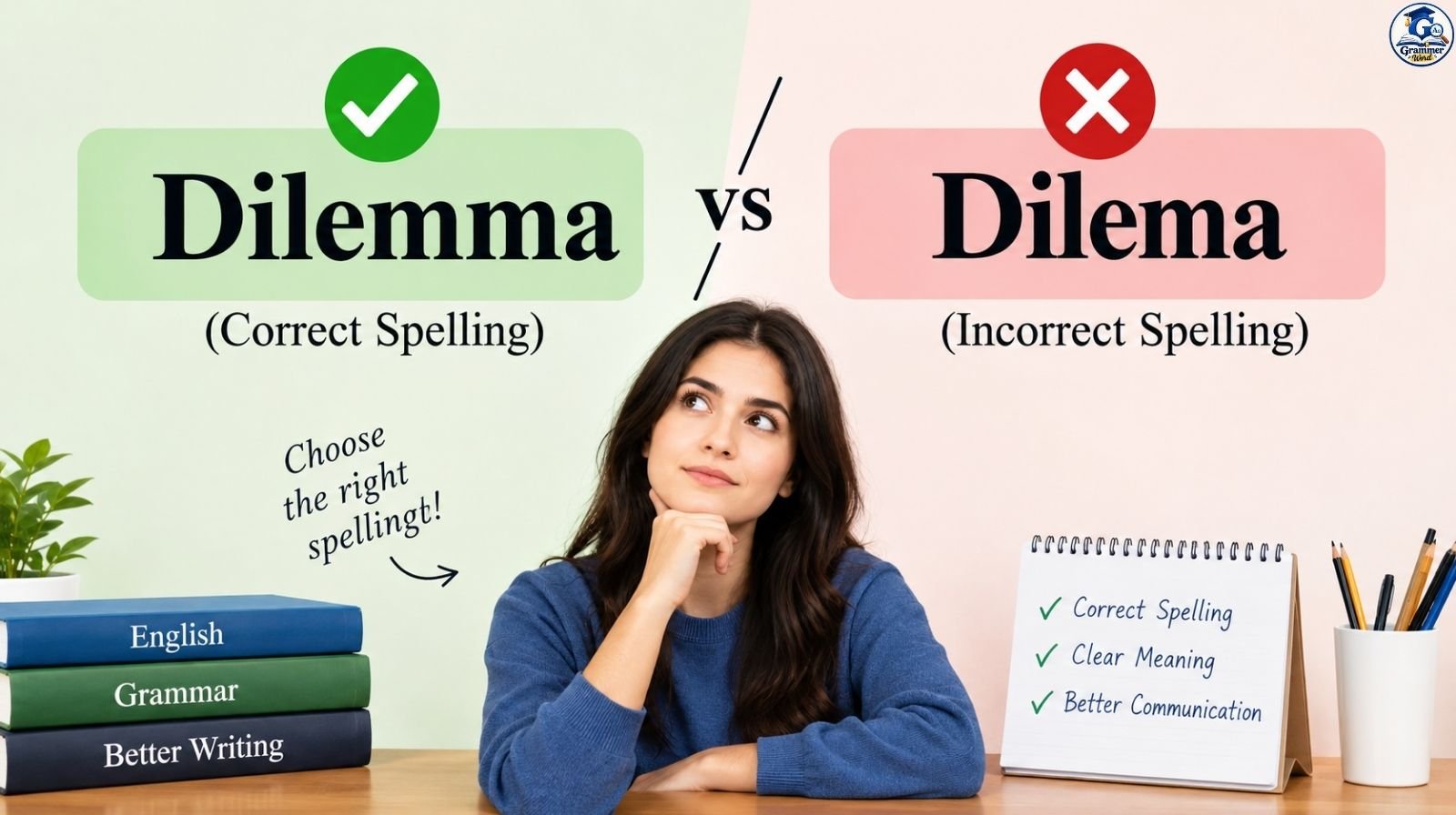
Have you ever written dilema and wondered whether it was correct? You are not alone. Many English learners and writers confuse dilemma vs dilema because the two spellings look almost identical. However, only one is correct in standard English.
The correct spelling is dilemma, with two m’s. Dilema is a misspelling and is not an accepted alternative spelling of the English word.
A dilemma is a difficult situation in which someone must make a choice between two or more options. In this guide, you will learn the correct spelling, its meaning, how to use it in sentences, and easy ways to remember it.
Read More: Here Here or Hear Hear? The Correct Phrase Explained Simply
What Is the Difference Between Dilemma and Dilema?
The difference between dilemma and dilema is simple: dilemma is correct, while dilema is incorrect in standard English.
The correct word contains two consecutive m’s. Although the incorrect version may appear in casual messages, online posts, or unedited writing, it should not be used in formal or professional communication.
Dilemma: The Correct Spelling
Dilemma is a noun that describes a difficult choice or situation, particularly one in which the available options create problems or have undesirable consequences.
Examples:
- Choosing between two excellent job offers can be a dilemma.
- She faced a dilemma when she had to choose between studying abroad and staying close to her family.
- The manager was in a dilemma about whether to hire another employee or reduce expenses.
The word is used in everyday conversations, academic writing, business communication, and discussions about ethical decisions.
Dilema: The Incorrect Spelling
Dilema is a common spelling mistake. It leaves out one of the two m’s in the correct word.
Examples:
- Incorrect: I have a serious dilema.
- Correct: I have a serious dilemma.
- Incorrect: He faced a dilema at work.
- Correct: He faced a dilemma at work.
Remember that the correct English spelling is always dilemma, whether you are writing for school, work, or personal communication.
Dilemma vs Dilema at a Glance
| Feature | Dilemma | Dilema |
|---|---|---|
| Spelling status | Correct | Incorrect |
| Meaning | A difficult choice or situation | Misspelling of the correct word |
| Part of speech | Noun | Not a standard English spelling |
| Double m | Yes | No |
| Suitable for formal writing | Yes | No |
Read More: Mentioned vs Mentionned: Difference, Meaning, And Usage
What Does Dilemma Mean in English?
The word dilemma refers to a situation in which a person must choose between competing possibilities. Often, neither option is completely satisfactory, making the decision challenging.
Simple Meaning of Dilemma
In simple English, a dilemma means being stuck between difficult choices and not knowing which one to select.
For example, imagine that you have an important examination tomorrow, but your best friend is getting married today. You want to attend the wedding, but you also need to prepare for the examination.
You might say:
“I am in a dilemma because I want to attend the wedding, but I need to study for my exam.”
Here, the word describes the conflict between two competing priorities.
Common Types of Dilemmas
The word appears in several situations:
- Personal dilemma: Deciding whether to move to another city or stay near family.
- Moral dilemma: Choosing between two actions when each raises ethical concerns.
- Financial dilemma: Deciding whether to save money or pay for an urgent expense.
- Professional dilemma: Choosing between a higher-paying job and a position with a better work-life balance.
- Academic dilemma: Deciding which subject or university to choose.
These examples show why dilemma is a useful word for explaining challenging decisions.
Synonyms of Dilemma
Depending on the context, you can use words such as predicament, quandary, problem, or difficult choice.
For example:
- “She faced a dilemma about accepting the offer.”
- “She faced a quandary about accepting the offer.”
Both sentences describe uncertainty about a decision, although the words can carry slightly different nuances.
Read More: Each Other or Eachother? The Correct Spelling Explained Simply
How to Use Dilemma Correctly in Sentences
Learning the correct spelling is only the first step. You should also understand how to use dilemma naturally in your writing.
Everyday Examples of Dilemma
Here are some simple examples you can use as a guide.
- I am facing a dilemma about which phone to buy.
- She had a dilemma about whether to travel or stay home.
- Choosing between friendship and honesty can create a dilemma.
- He found himself in a difficult dilemma after receiving two job offers.
- The family faced a financial dilemma when unexpected expenses arose.
- Students sometimes face a dilemma when selecting their university major.
Each sentence uses the correct spelling and describes a challenging choice or situation.
Dilemma in Professional and Academic Writing
In professional communication, dilemma can describe decisions involving competing responsibilities, limited resources, or ethical concerns.
Examples:
- The company faced a dilemma over whether to increase prices or reduce operating costs.
- The research team encountered an ethical dilemma during the study.
- The student wrote an essay about the moral dilemma presented in the novel.
Using the correct spelling helps maintain clarity and professionalism in reports, assignments, emails, and articles.
Singular and Plural Forms
The singular form is dilemma, while the plural form is dilemmas.
| Form | Example |
|---|---|
| Singular | She faced a dilemma. |
| Plural | They faced several dilemmas. |
Do not write dilemas when you mean more than one dilemma. The correct plural retains both m’s and adds -s.
Read More: Every Time or Everytime: Which One Is Correct?
Why Do People Confuse Dilemma and Dilema?
Although dilemma contains two m’s, people sometimes leave one out when typing quickly or writing from memory. Understanding why this happens can help you avoid the mistake.
Similar-Looking Spellings
English contains many words in which a single letter changes the spelling. Because dilemma and dilema look so similar, the incorrect version may seem reasonable at first glance.
However, familiar-looking spelling does not always mean a word is correct. Checking a reliable dictionary is a simple way to confirm uncertain spellings.
Pronunciation Does Not Always Reveal Spelling
When speaking, you cannot see the letters in a word. As a result, a person may pronounce dilemma correctly but write it with only one m.
This is particularly common among people learning English as an additional language.
For example:
- Spoken word: dilemma
- Incorrect written form: dilema
- Correct written form: dilemma
The solution is to learn the written form alongside the meaning and pronunciation.
An Easy Trick to Remember the Correct Spelling
Use this simple memory trick: A dilemma has double m’s.
Think of the two m’s as representing the two choices that often create a dilemma. This is a memory aid rather than the word’s historical origin, but it can help you remember the spelling.
You can also remember the word in three parts:
DI + LEM + MA = DILEMMA
When you write the word, check that the middle contains mm, not just one m.
Read More: Jist or Gist: Which Spelling Is Correct And How To Use It Properly?
Real-Life Example: Avoiding the Dilema Spelling Mistake
Consider a university student named Sarah who is preparing an important scholarship application. She wants to explain a difficult decision she made during her final year of school.
Sarah writes the following sentence in her first draft:
“One of the biggest dilemas in my life was deciding whether to continue my studies in my hometown or move to another city.”
Her story is meaningful, and the sentence clearly communicates her experience. However, the word dilemas is spelled incorrectly.
During proofreading, Sarah checks the word in a dictionary and discovers that the correct singular form is dilemma and the correct plural form is dilemmas.
She revises her sentence:
“One of the biggest dilemmas in my life was deciding whether to continue my studies in my hometown or move to another city.”
The corrected sentence communicates the same idea but follows standard English spelling.
Before submitting the application, Sarah also checks other words, reviews her punctuation, and reads the entire document aloud. This process helps her identify additional mistakes and makes her application more polished.
The important lesson is that even a small spelling error can distract readers from an otherwise strong piece of writing. Sarah does not need complicated vocabulary to communicate effectively.
She simply needs accurate spelling, clear sentences, and careful proofreading.
This example illustrates a practical writing habit: when a word looks unfamiliar or questionable, verify it rather than relying entirely on memory.
The same approach works for school assignments, job applications, professional emails, and online articles.
Read More: Flyer or Flier: Which One Is Correct? A Clear Guide For Writers
Dilemma vs Dilema: Spelling Facts and 2025–2026 Data
When comparing spellings, it is important to separate verified dictionary information from search statistics or assumptions about how often people make mistakes.
What Reliable Language Guidance Confirms
Standard English dictionaries recognize dilemma as the correct spelling of the noun describing a difficult choice or situation. Its plural form is dilemmas.
This means that writers should use dilemma in school assignments, business documents, articles, and everyday communication.
What the 2025–2026 Data Can Tell Us
There is no verified statistic presented here showing exactly how many people misspell dilemma as dilema in 2025 or 2026. Therefore, giving a precise percentage or claiming that the mistake has increased would be misleading.
Search interest and spelling-error frequency are also different measurements. A person searching for dilema may simply be checking the spelling rather than consistently using the incorrect form.
For writers and editors, the practical conclusions are straightforward:
- Use dilemma in standard English writing.
- Use dilemmas for the plural.
- Check uncertain spellings with a reputable dictionary.
- Avoid unsupported statistics about spelling mistakes.
Reliable language guidance is more useful than an impressive-looking statistic that cannot be verified.
Read More: CatchUp vs Catch Up: Differences, Meaning, And Correct Usage
Frequently Asked Questions
Q1. Is Dilemma or Dilema Correct?
Dilemma is correct. Dilema is a misspelling in standard English. Always use two m’s when writing this word.
Q2. What Does Dilemma Mean?
A dilemma is a difficult situation in which someone must choose between two or more competing options. For example, deciding between two job offers can create a dilemma.
Q3. Is Dilema Ever Correct in English?
No. When you intend to use the English word for a difficult choice, the standard spelling is dilemma. Do not use dilema as an alternative spelling.
Q4. What Is the Plural of Dilemma?
The plural is dilemmas. For example: “The manager faced several dilemmas while planning the project.”
Q5. Is Dilemma Spelled the Same in American and British English?
Yes. Both American and British English use dilemma. There is no standard US-versus-UK spelling difference for this word.
Q6. How Can I Remember How to Spell Dilemma?
Remember the phrase “double m in dilemma.” The two m’s can serve as a reminder that the correct spelling contains two consecutive m’s.
Conclusion:
The answer is simple: dilemma is the correct spelling, and dilema is incorrect in standard English.
A dilemma describes a difficult choice or situation, and the word is commonly used in personal conversations, academic assignments, professional writing, and discussions about ethical decisions.
Its plural form is dilemmas, and the spelling remains the same in American and British English.
To avoid mistakes, remember the double m’s, check unfamiliar words in a reliable dictionary, and proofread your writing before publishing or submitting it.
Now that you understand the difference between dilemma vs dilema, you can use the correct spelling with confidence.
If this guide helped you, share it with another English learner or explore more spelling and grammar guides to strengthen your writing skills.
Keep learning with more easy grammar lessons on Grammer Word

Hi, I’m Noor Fatima, the person behind this website. I created this site to make English grammar and confusing words easier to understand. I love breaking down tricky words, meanings, spellings, and grammar rules into simple explanations. My goal is to help you learn English naturally, avoid common mistakes, and feel more confident every time you write or speak.